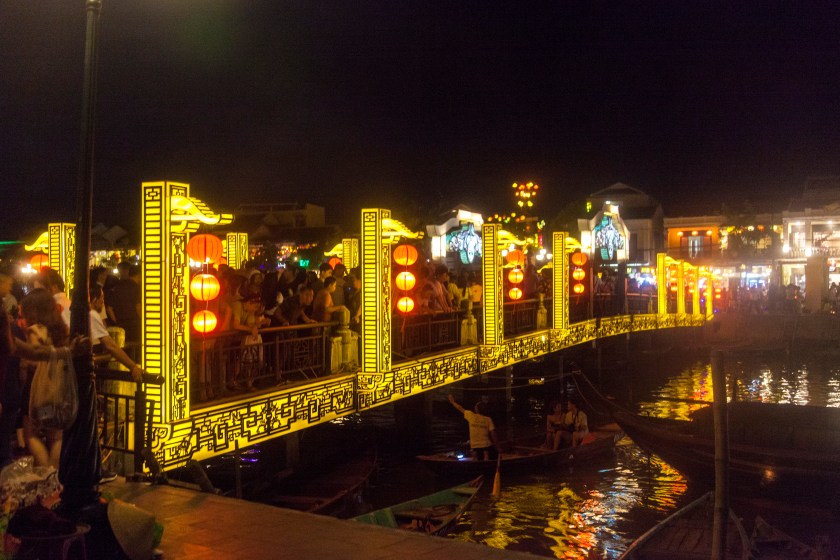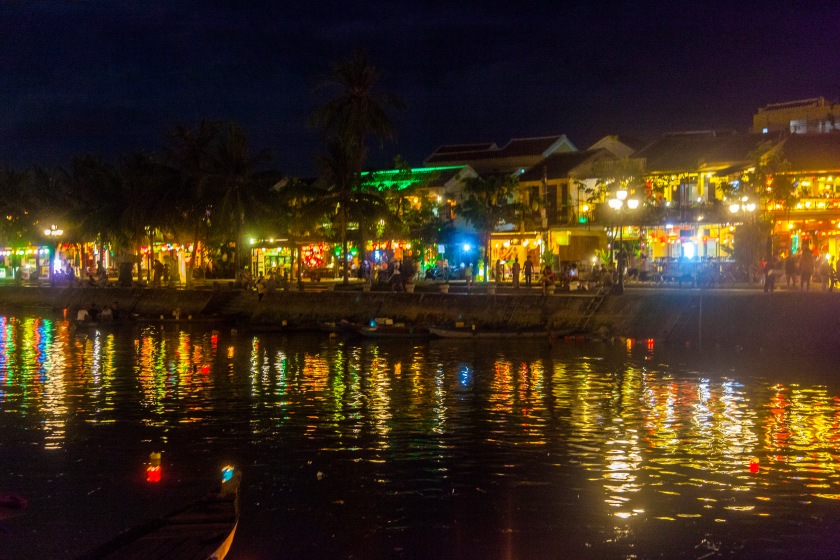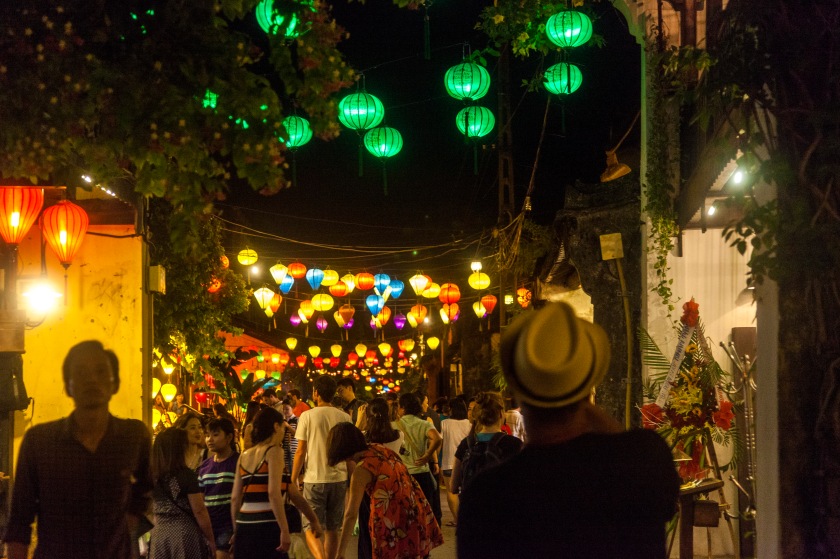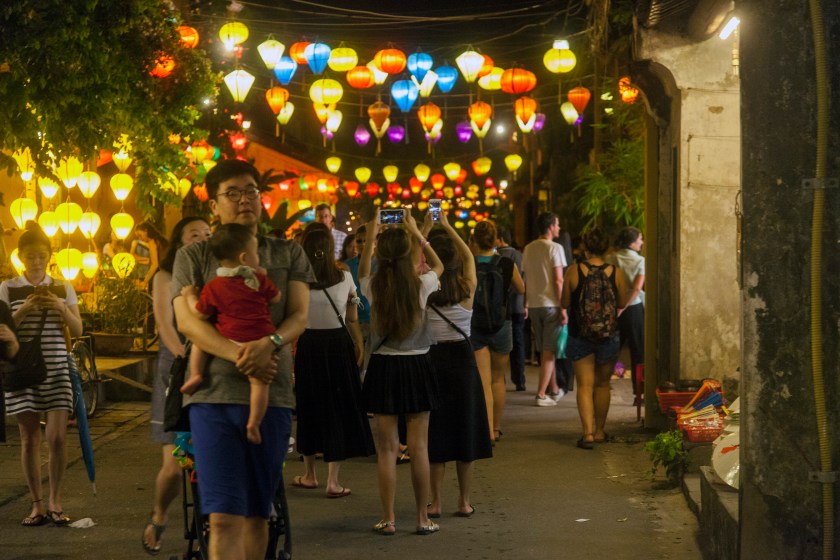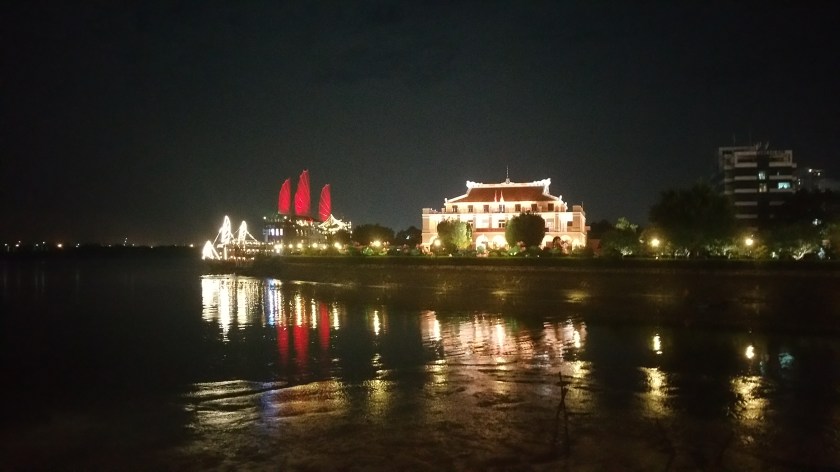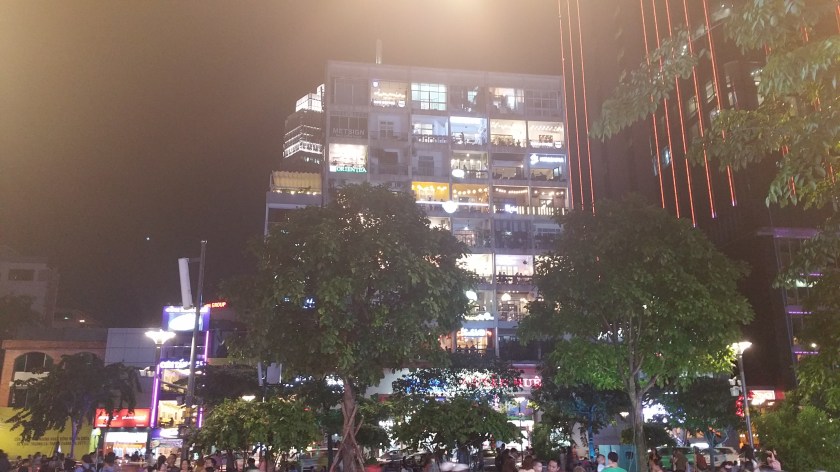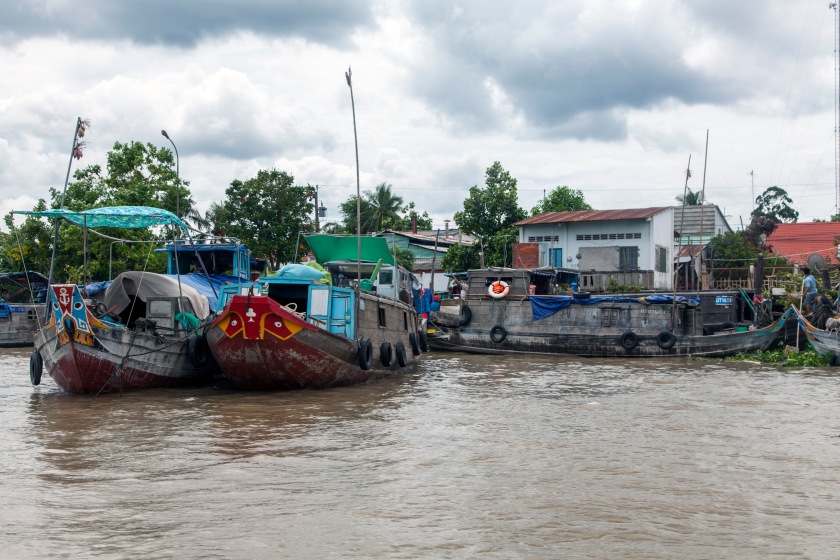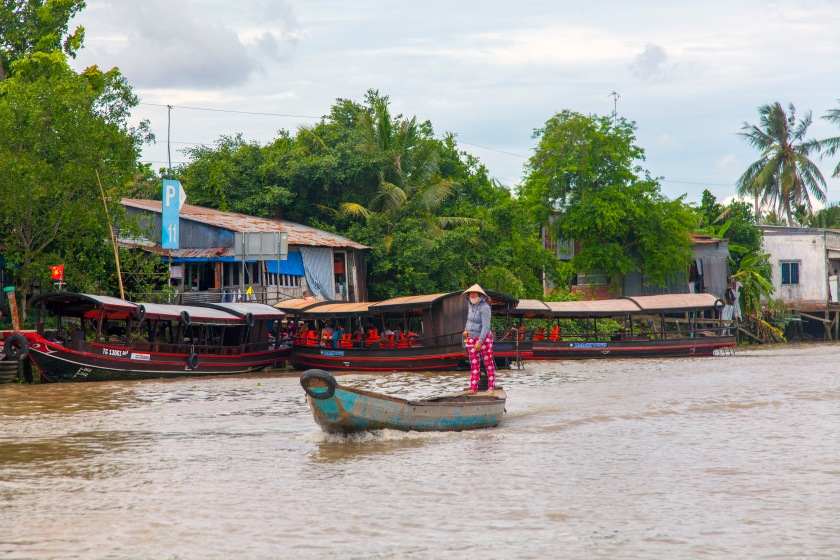
Posted in Asia, Danang, English, Hoi An, Hue, Vietnam

Vietnam – Day 5

РУССКОЯЗЫЧНАЯ ВЕРСИЯ ПО ЭТОЙ ССЫЛКЕ. CLICK HERE FOR RUSSIAN VERSION.

9 June 2017

The day has been very intense, but, to be honest, with the occasional feeling that everyone wants money from you. In Ho Chi Minh City this feeling wasn’t there and we even got the impression that Vietnam is a country not yet spoiled by tourism, because this industry is still developing here. But the further you move to more tourist places, the more this impression is dissipated.

I’ll come back to that, but first things first. In the morning, we checked out of our hotel in Hue and headed to see the imperial tombs nearby.

20170609_062925

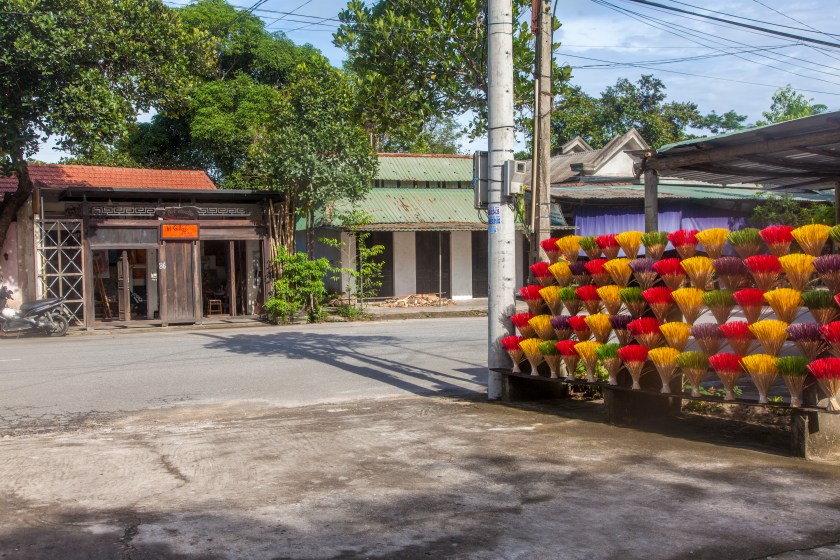
Today we have a new guide, a young man named Nam, who seems very diligent. Right on the outskirts of the city, we saw a lot of aromatic sticks for temples being sold along the roadside, and he asked the driver to stop the car so that we could see how they are made. Of course, the seller immediately started actively persuading us to buy regular souvenirs…

IMG_2486

IMG_2488

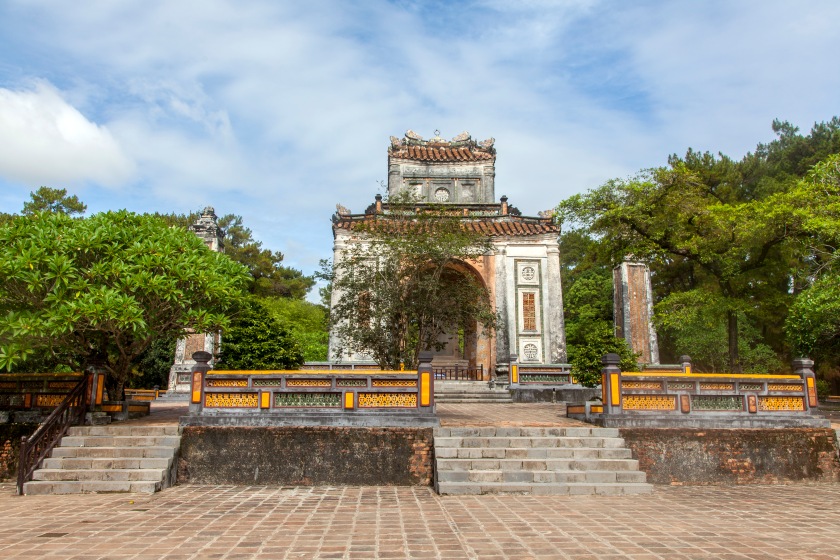
As I said, according to the programme, we had mausoleum visits planned, and the first one was the mausoleum of Tu Duc, who was the fourth emperor of the Nguyen dynasty and the last emperor of independent Vietnam – his successors ruled the French colony already. The presence of the ruling dynasty was perfectly acceptable for the French, since it facilitated the governing of people, so they didn’t get rid of it.

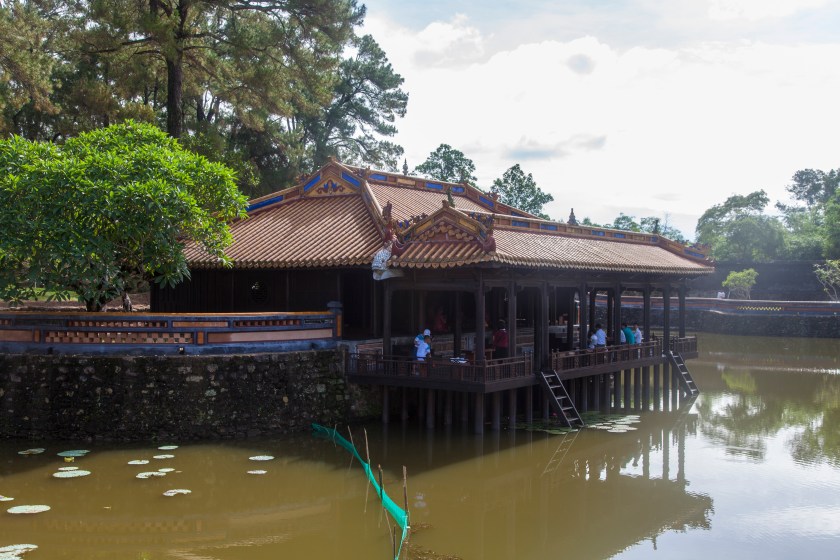
The mausoleum was built when Tu Duc was still alive and is not just a tomb, but in fact a whole complex that functioned as the Emperor’s summer cottage until his death, and later became home to his numerous wives and concubines.

IMG_2493

By the way, despite the fact that Tu Duc had a hundred or two wives and concubines, he did’t leave any offsprings, so his nephew inherited the throne after him.

IMG_2499

Interestingly, no one knows where exactly Tu Duc is buried in the mausoleum – it would seem logical that if there is a tomb, then that’s where he should be buried, but Nam explained to us that the emperor was clever and, considering the amount of treasures to be buried with him, he ordered to dig numerous tunnels under the territory of the mausoleum and bury him in one of them, so that no one knew where exactly. Nowadays, although with modern technologies determining the exact location wouldn’t be much of a problem, the government specifically decided not to do so.

IMG_2508

Our itinerary assumed that next we would go see the tomb of his grandfather – the very Minh Mang that I already mentioned in connection with traditional medicine. But Nam pointed out that even though the standard programme includes this mausoleum because of its convenient location, it is too similar to the first one, and, perhaps, we would find it more interesting if we went to see something different. So, he suggested another mausoleum instead, located slightly further – that of Khai Ding, the 12th and the penultimate emperor of the Nguyen dynasty, who ruled in the early 20th century. We agreed.

IMG_2510

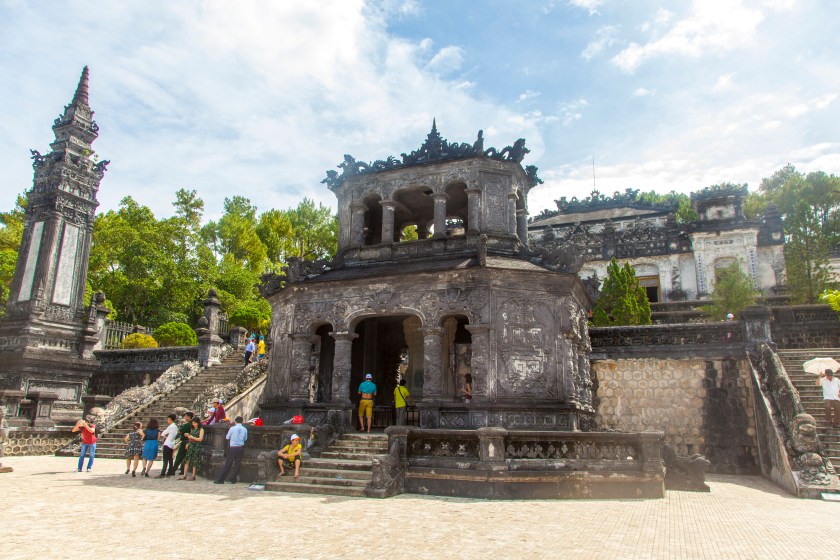
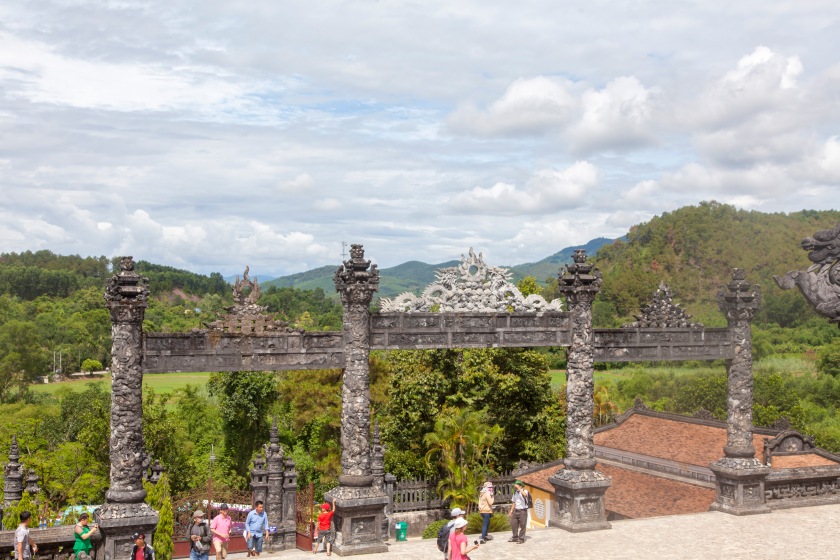
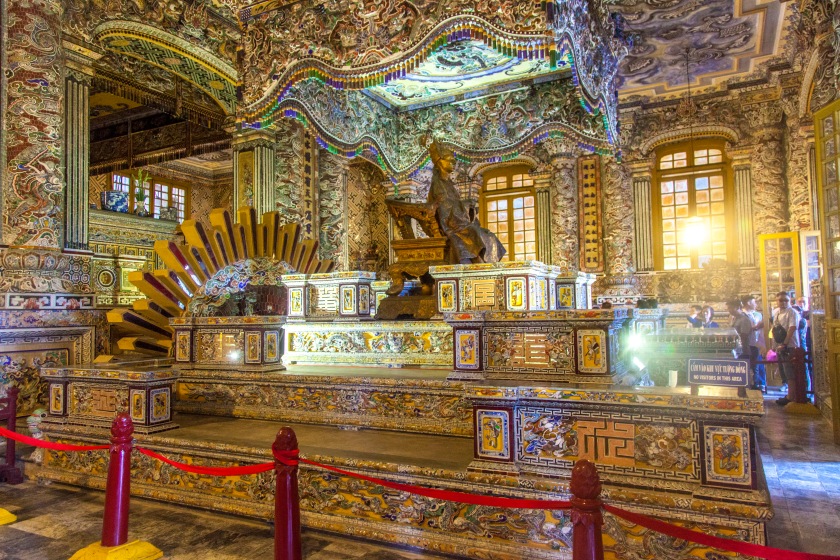
This mausoleum was indeed completely different – the architecture contained mixed elements of both traditional Oriental and European styles. The territory was quite small in comparison with the previous complex, which had pavilions, gardens and a lake, but the mausoleum took 11 years to build, whereas the previous one took only three.

IMG_2524

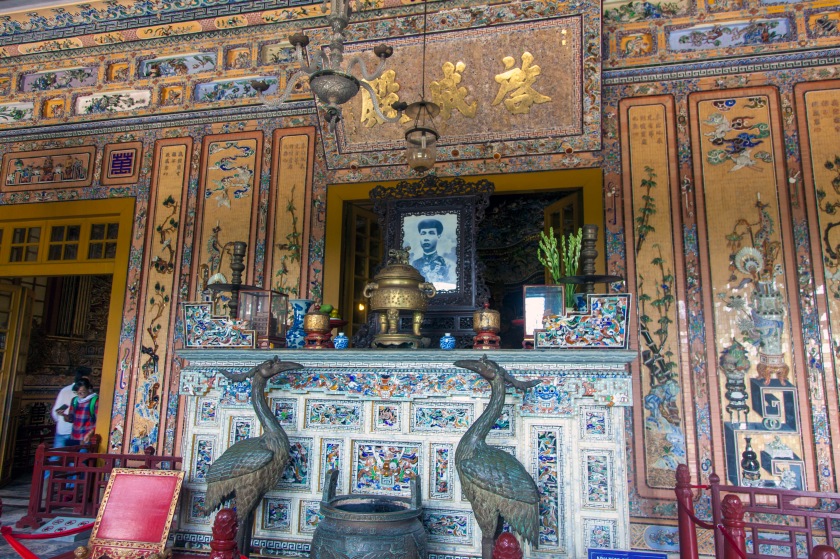
This is not surprising at all, because the tomb itself is truly luxurious: the walls are decorated with various types of ceramics – local Vietnamese, Chinese and Japanese – and the ceilings are painted with 99 dragons, in such way that you can’t track the beginning and end of each.

IMG_2517

IMG_2518

So, the buildings are impressive, I could totally have walked around here for a long time if it hadn’t been for the unbearable heat, which made me want to get back into the car as quickly as possible.

It’s time to say goodbye to Hue and move on, heading to to Hoi An, where we should spend the night. But on the way to Hoi An there is still much to see!

The road started climbing up the mountains, and the places around were becoming more and more picturesque. We stopped every now and then to take pictures, then had a short comfort stop in some roadside cafe, which was part of a family business for production of oysters and pearls – right here, across the road, there was a large shallow lake where the molluscs were bred.

IMG_2532

IMG_2531

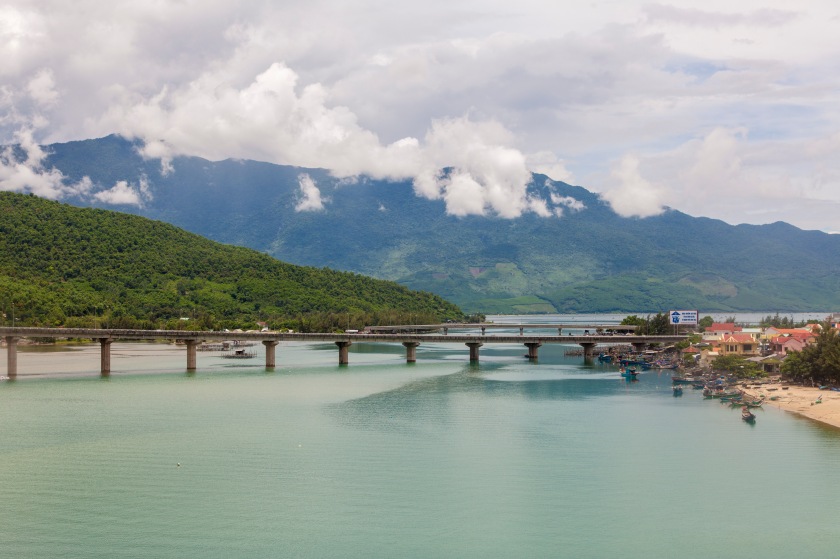
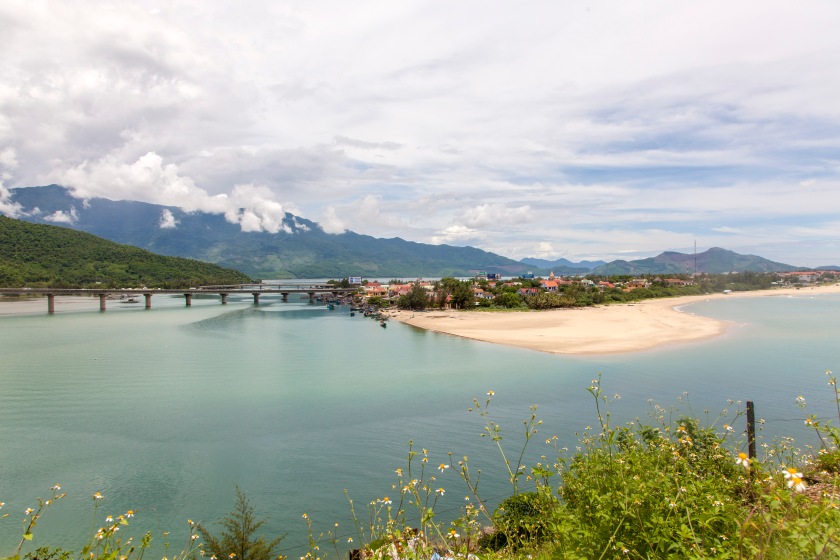
There is actually a tunnel through the mountain, but we drove over the Hai Van Pass instead to enjoy the picturesque views of the green slopes and the sea.
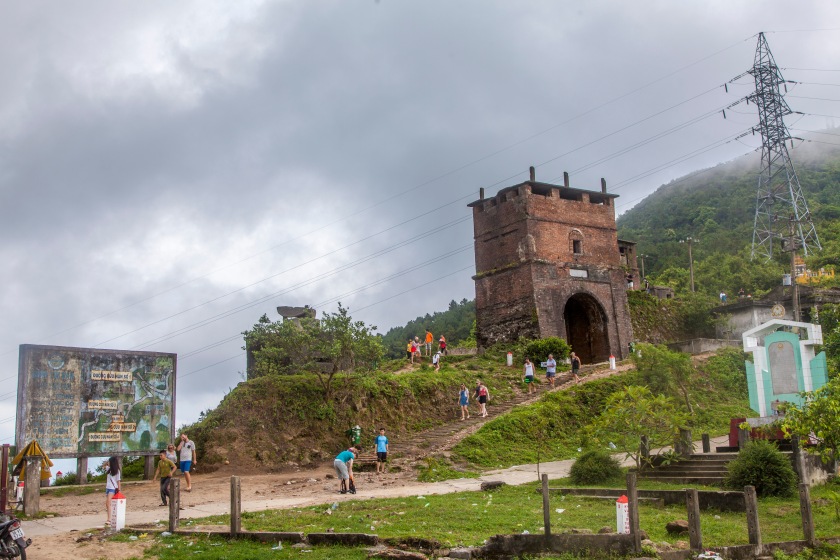
At the summit of the pass we made a photo-stop yet again, as there are some ruins that used to be a French fortress, and later an American bunker.

IMG_2538

The road from Hue to Danang, where we are going, takes two hours. We don’t stop in Danang itself, but Nam told us that the city is quite new, industrial, and has a large seaport – back in the days, the port was located in Hoi An, where we are heading eventually, but the French transferred it right here.

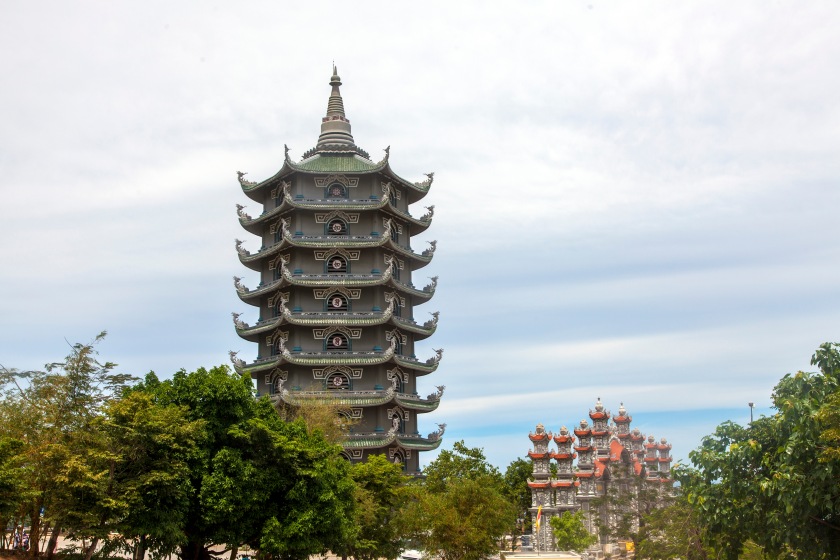
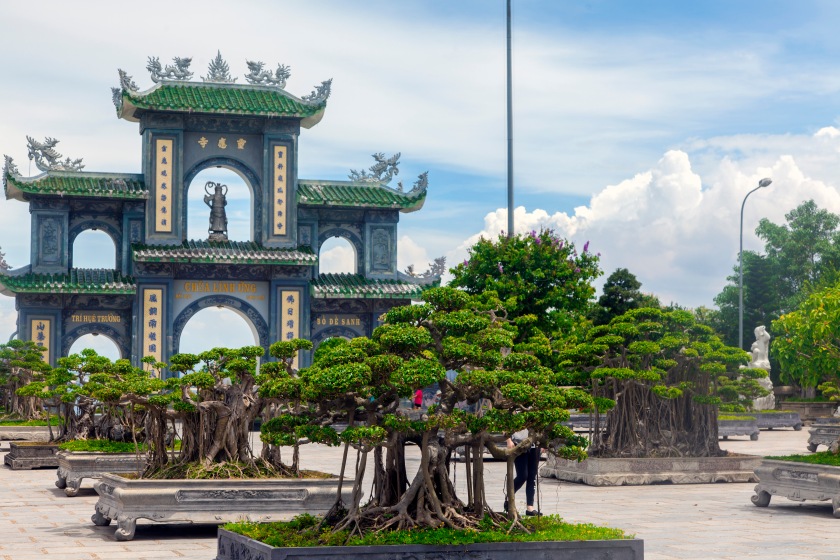
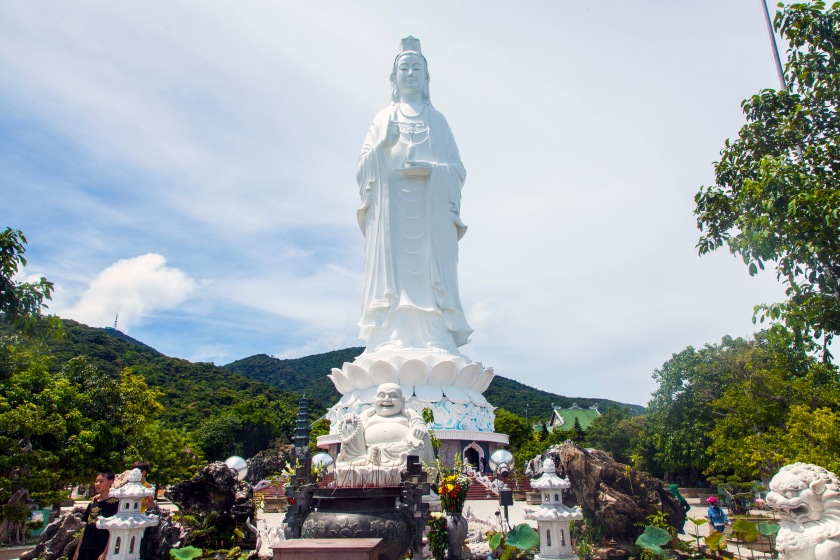
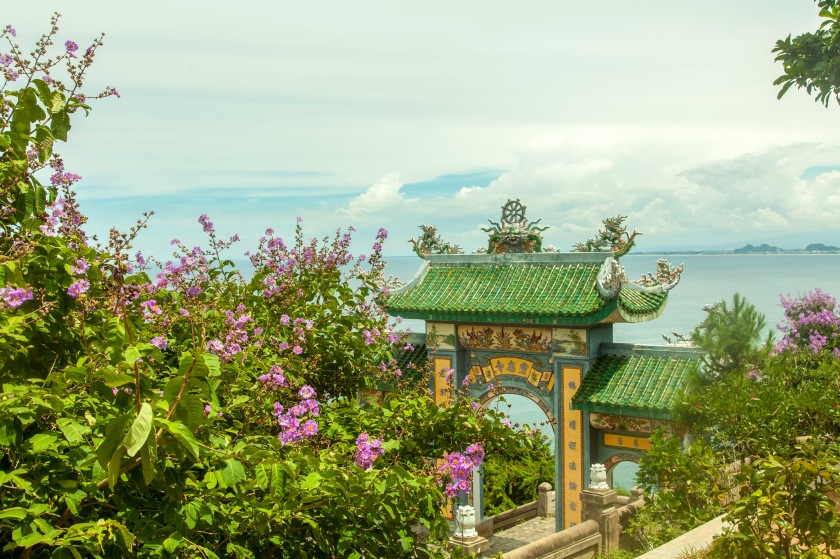
Actually, back when we were booking our tour, we made a special request to visit Danang, as we wanted to see the statue of Lady Buddha. That is why we were taken to the Son Tra mountain, also known as the Monkey Mountain, where this statue is located. Besides the statue, there is a whole complex with carved gates and the Linh Ung pagoda.

IMG_2552

IMG_2558

The pagoda is quite new, built in 2010, and the statue is even newer. I must say, Lady Buddha is very impressive, and no wonder: it is 70 metres high, made of a single piece of marble and can be seen from a long distance, almost 35km. It’s facing the bay, since it is supposed to protect sailors – it resonates with the Chinese goddess Tin Hau, perhaps the idea is even inspired by her. I was generally surprised by the idea of a female Buddha, but Nam explained that even though Buddha is a man in Indian Buddhism, in the Chinese version of Buddhism, under the influence of which this temple complex was built, there is also a female Buddha for balance (like yin and yang).

Apart from Lady Buddha, there is also a small Laughing Buddha statue nearby, which is said to bring good luck if you rub his belly. We stand in front of him to take a picture of Lady Buddha, and suddenly we hear loud sounds from the pond, resembling a dog barking, which turn out to be toads croaking!

IMG_2572

IMG_2574

Nam suggested that we have lunch in Danang on our way to the statue, but we were anxious that it might rain like it did yesterday in the pagoda of the Heavenly Lady and ruin the sightseeing experience that we’d been looking forward to from the very beginning, so we preferred to see Lady Buddha first, while the weather was still good (albeit very hot) and have lunch later when we get to Hoi An.

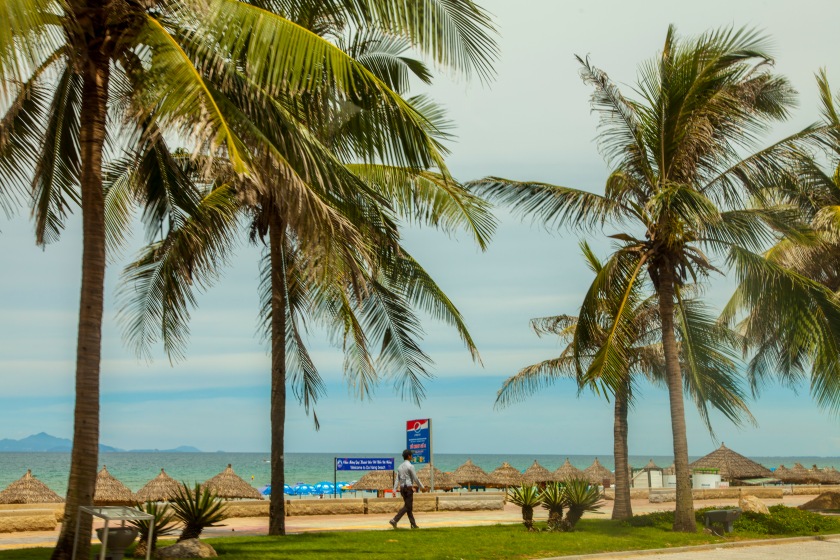
Along the coastline all the way from Danang to Hoi An we saw a huge number of hotels and fancy five-star beach resorts, but even more than the already existing ones were still under construction – clearly, tourism is developing extensively in this region and in the future Danang intends to compete with the resorts of Thailand, Indonesia and Malaysia.

IMG_2579

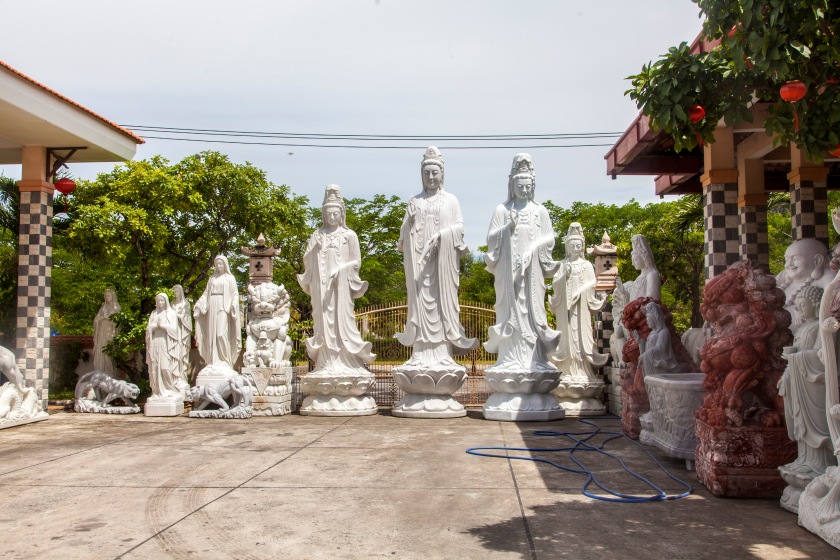
On the way, we made another stop, although our stomachs were already dreaming about food, at a marble factory, which there are quite a few of in Vietnam, and they showed us how marble statues were made. Looking at the statues themselves was actually more interesting than observing the production process: there were smaller replicas of the Lady Buddha statue, other Buddha statues, various animals and mythical creatures, Jesus Christ and the Virgin Mary (10% of the Vietnamese population are Catholics). At the factory we were also very actively solicited to buy souvenirs, but we didn’t like the little figurines that much and the big statues would obviously be quite problematic to buy.

IMG_2581

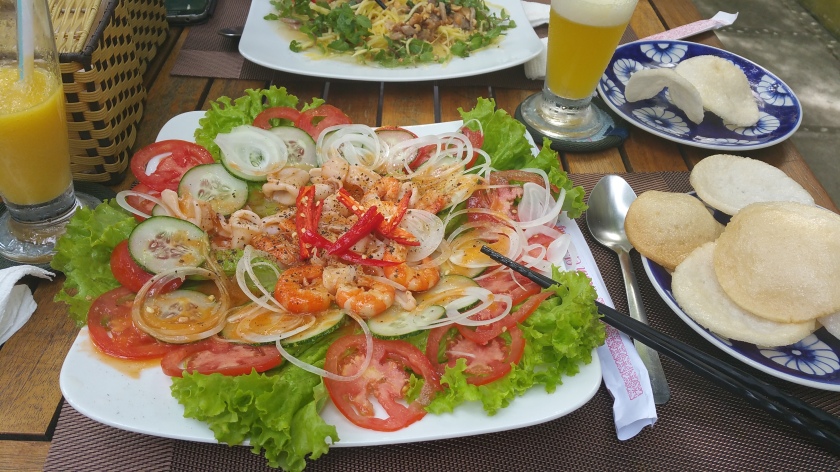
Thank goodness, there were now only a few kilometres separating us from our desired lunch, and finally we stopped at some roadside restaurant. First, for some reason, we had pretty low expectations of the restaurant – probably, because it was located right next to the noisy highway and, since the owner was apparently working in the kitchen by himself, the service wasn’t too prompt – but then we were served delicious salads and grilled fish, and also treated with orange slices and chewing gum when we asked for the bill, so our opinion of the restaurant made a complete U-turn.

20170609_144137

What Nam told us about Hoi An was that it is an old trading city, where the big seaport was located between the 16th and the 18th. Trade with China, Japan and European countries was conducted through the port, which is why there were many Chinese and Japanese living here.

IMG_2602

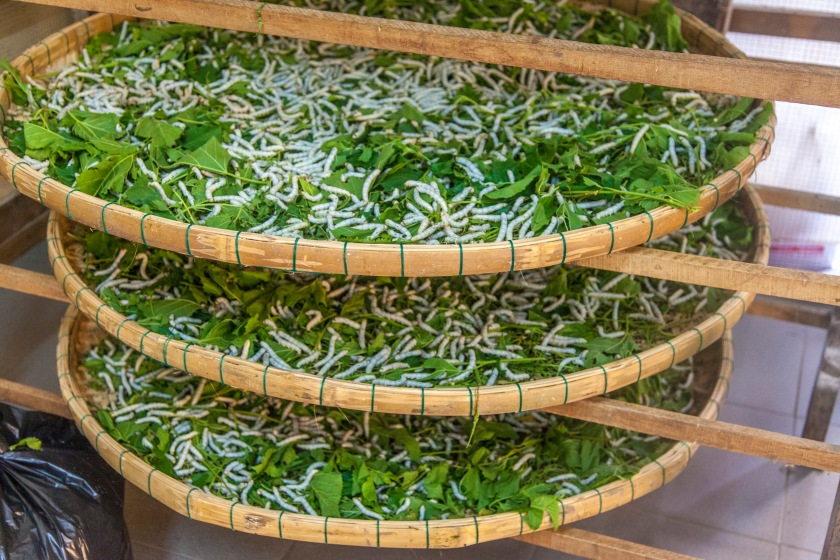
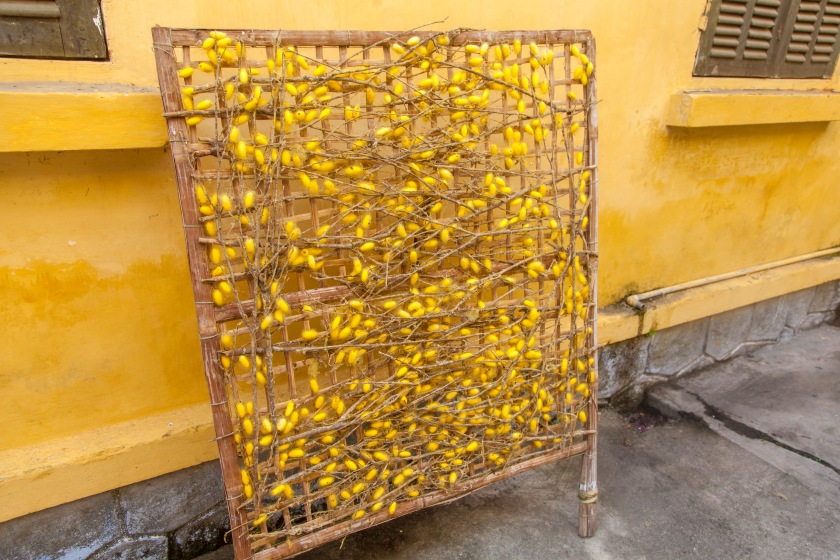
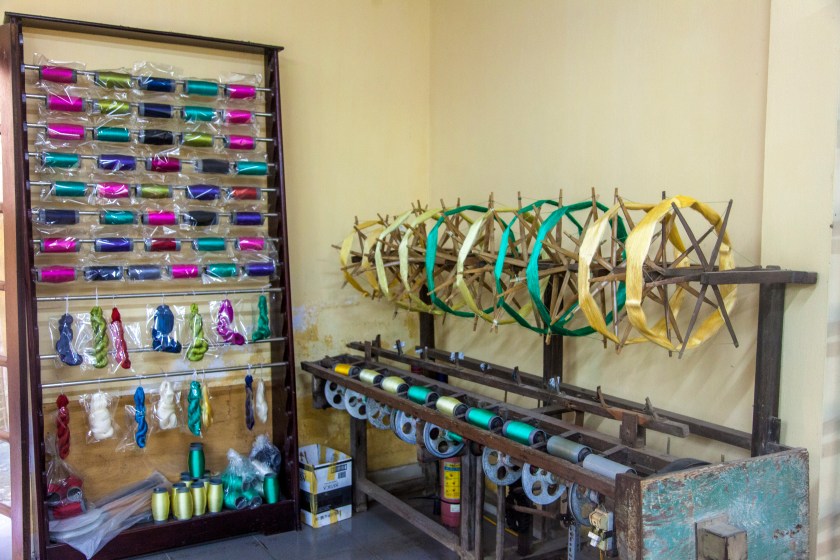
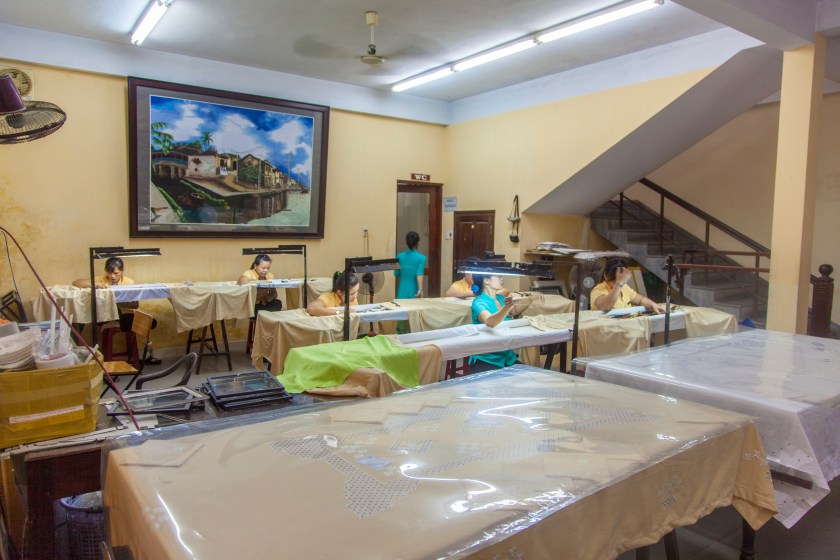
The city is famous for silk production, so we made yet another stop, this time at a silk factory. Here we saw all the stages of silk production – first some gross white worms swarming among mulberry leaves, then the cocoons, and then the thread and the finished fabric. Right at the factory, there is also a store selling ready-made fabrics and clothes and you can also order something from a tailor and get it ready the next, or even the same day. Generally in Hoi An, as we noticed, many ateliers provide similar services.

IMG_2593

IMG_2592

IMG_2596

IMG_2597

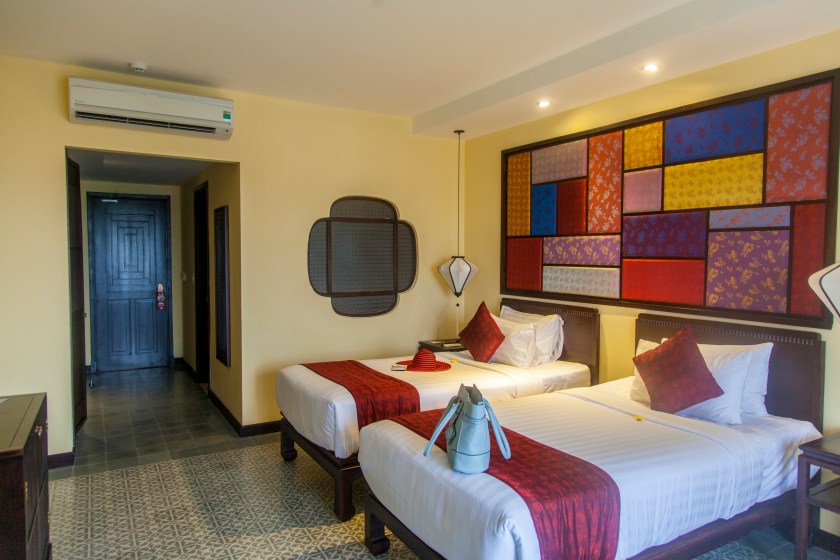
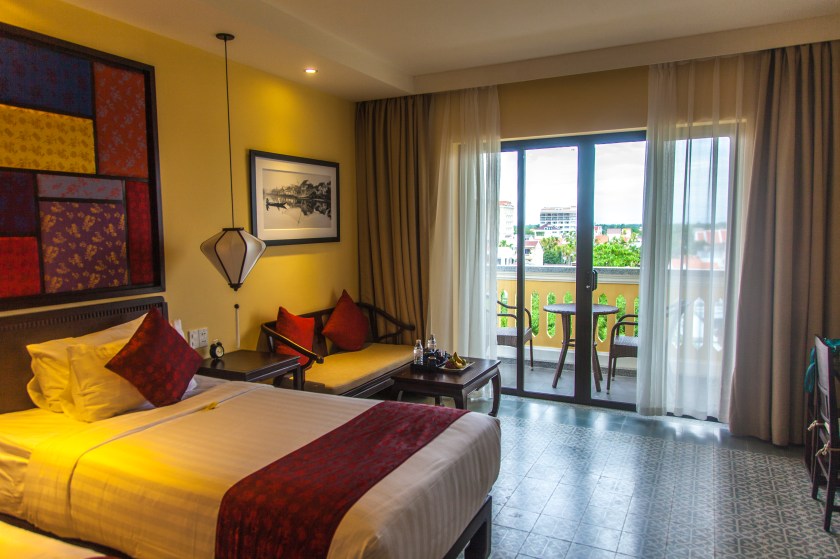
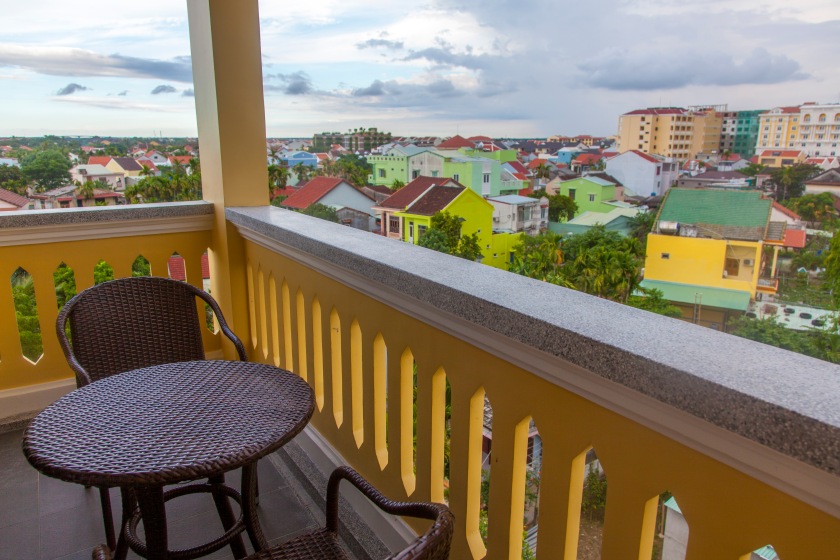
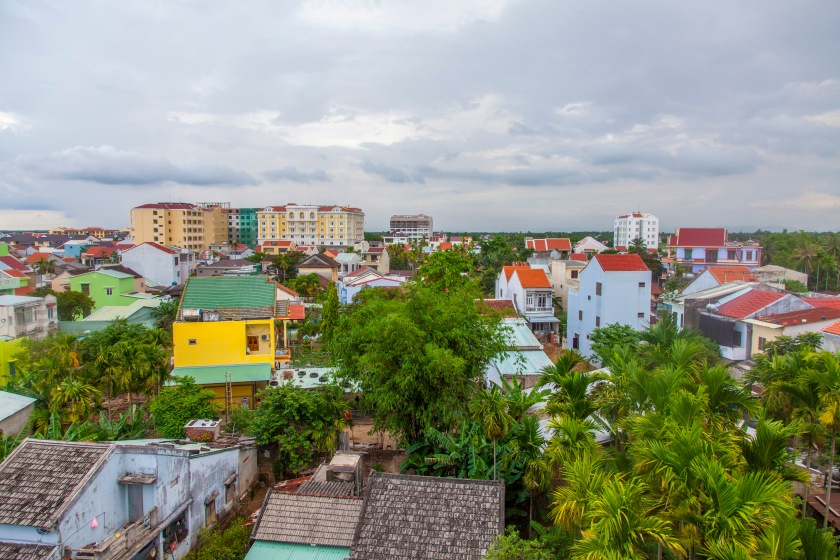
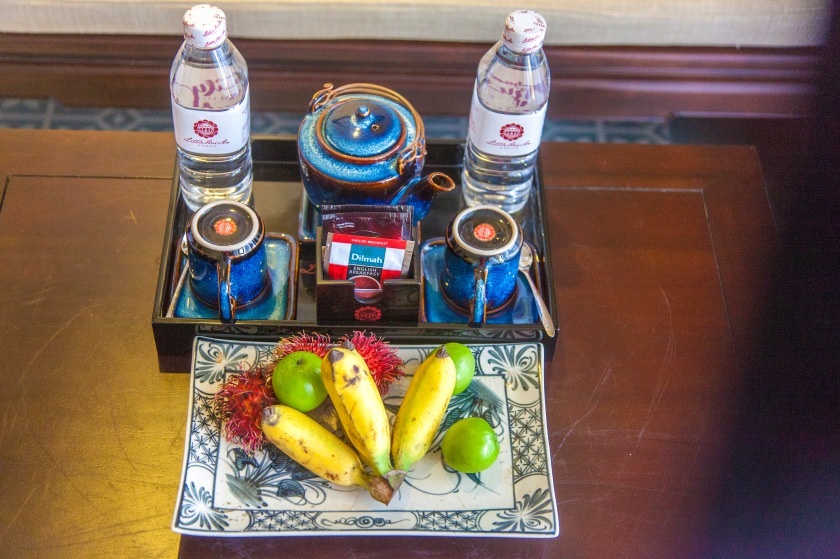
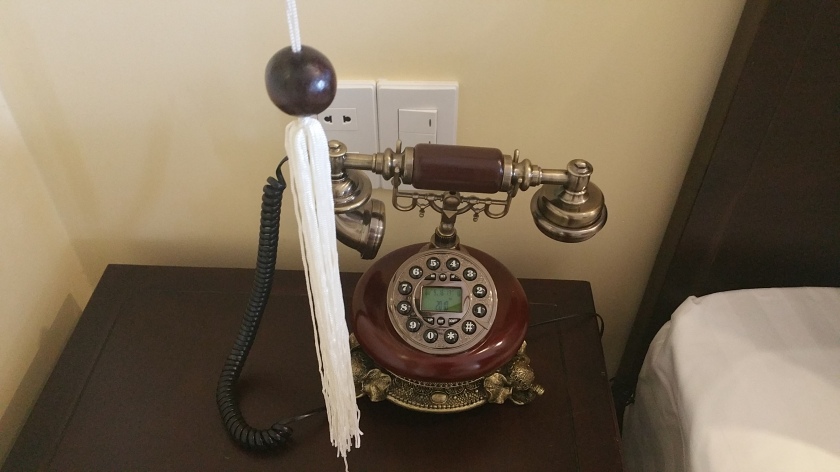
Finally, we got to the Little Hoian Central hotel, which turned out to be a pleasant surprise for us. The hotel is a three-star one, but cannot even be compared, for example, with London three-star hotels, where you get a tiny room and a rather meagre breakfast – this one has an outdoor pool and a spa, the room is huge, with a balcony, and the interior is in the typical Asian Colonial style of the 19th century: even the phone and the plumbing are stylised.

IMG_2609

IMG_2613

IMG_2612

IMG_2607

IMG_2614

IMG_2610

20170609_161829

Since we were extremely tired, the pool and the spa came in really handy: first we washed off all the fatigue in the pleasant water, and then once again went for a wonderful massage.

IMG_2606

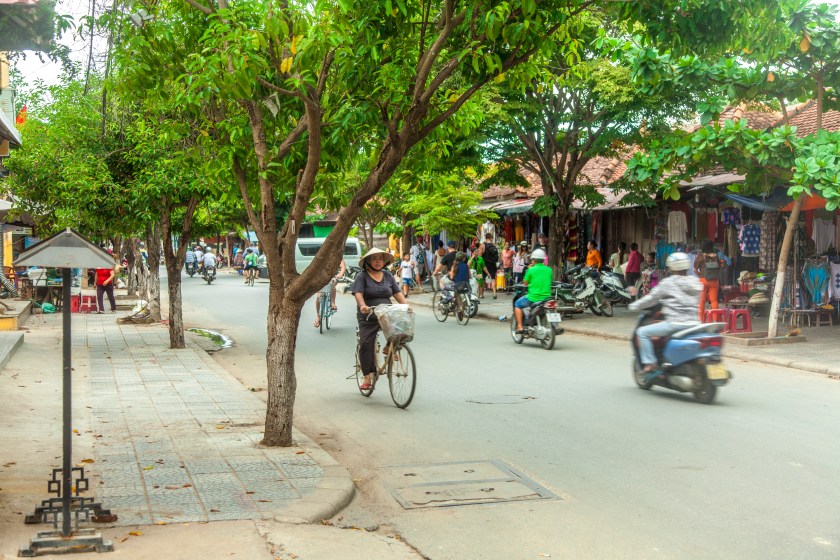
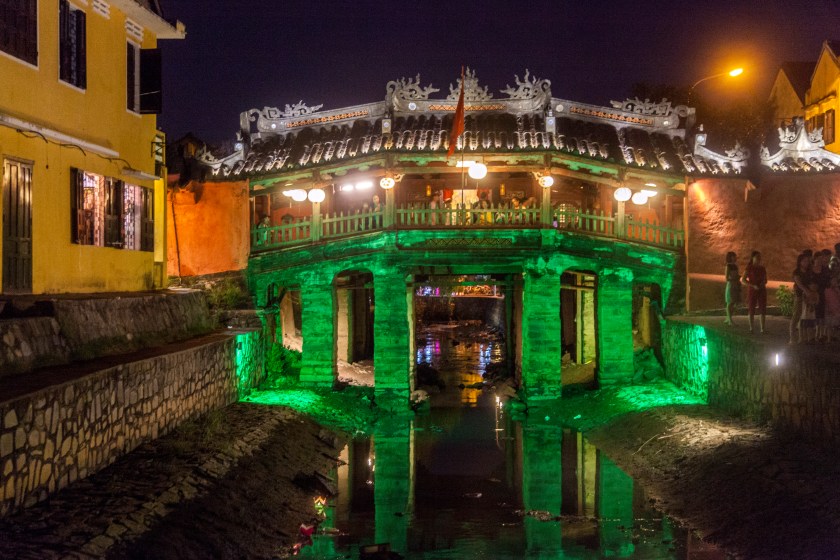
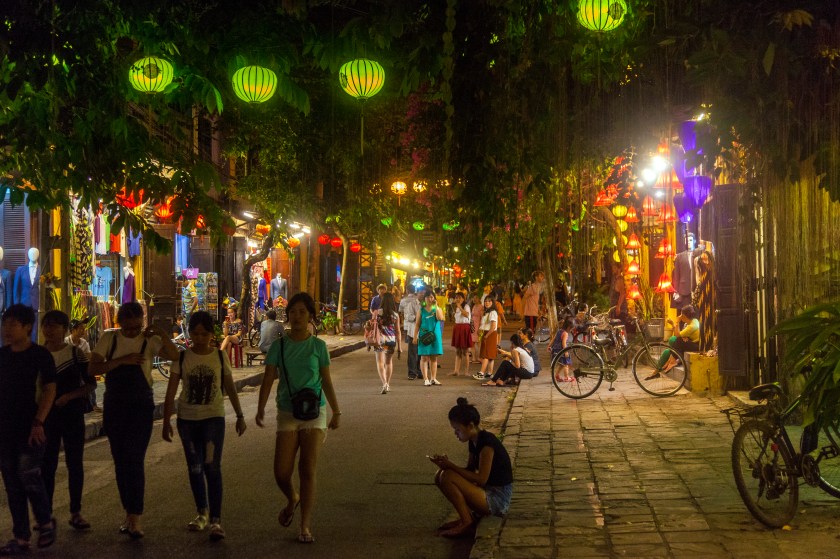
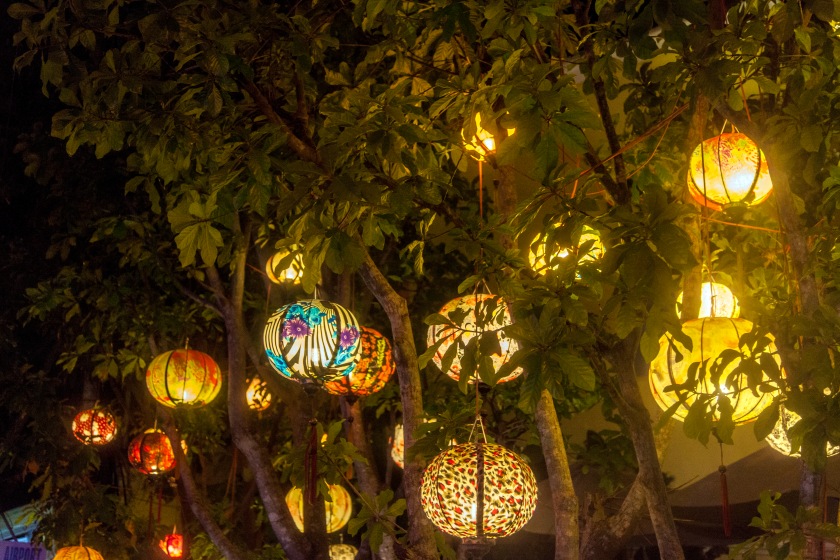
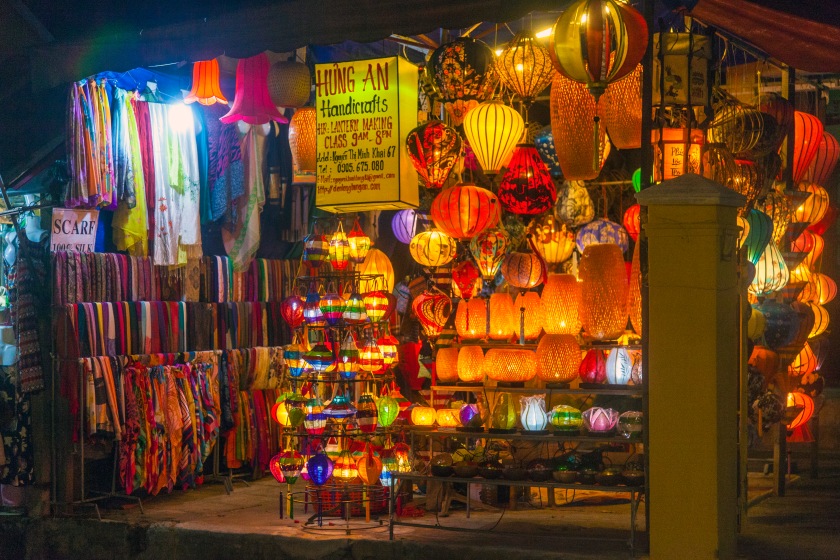
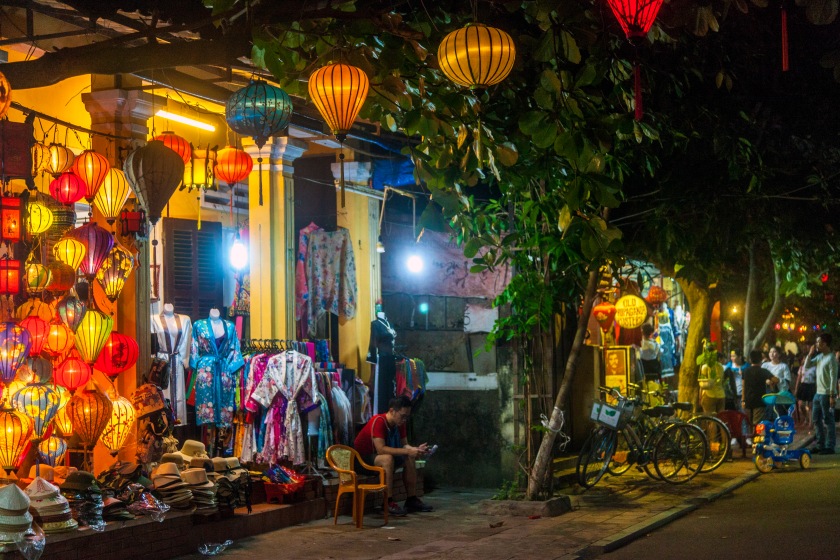
We had the evening free, so we made a sortie to the Old Town. One of Hoi An’s features is silk lanterns, and the whole Old Town is decorated with them, which makes it look particularly cool in the evening. The Old Town is only accessible to pedestrians and cyclists, and boy is it great to finally relax from these chaotic scurrying scooters everywhere! The zone is clearly very touristy, and there are mostly shops selling souvenirs, silk clothes and lanterns. The crowd is very thick, there are lots of foreign tourists, and even more local ones: it’s summer now, children have holidays, so many families travel around the country.

IMG_2622

IMG_2630

IMG_2633

IMG_2648

IMG_2651

IMG_2652

IMG_2658

IMG_2659

IMG_2661

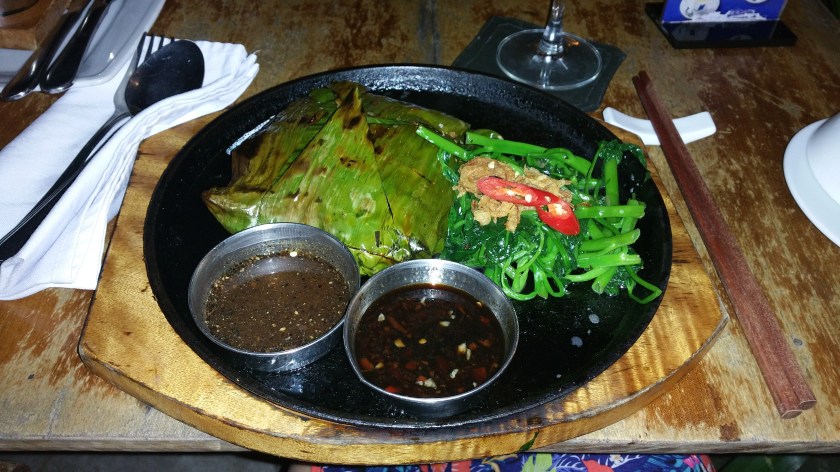
There are also plenty of cafes and restaurants, and we decide to have dinner in one of them, attracted by the nice view of its outdoor seating area among bamboos. It was a good choice – we ordered grilled fish again, and mine was wrapped in banana leaves and incredibly tasty. Plus we were entertained by lovely music: there is an international choir competition happening now in Hoi An, and the performance took place right in the street near our restaurant.

20170609_201850

Posted in English, Hue, Vietnam

Vietnam – Day 4

РУССКОЯЗЫЧНАЯ ВЕРСИЯ ПО ЭТОЙ ССЫЛКЕ. CLICK HERE FOR RUSSIAN VERSION.

8 June 2017

As I wrote yesterday, the Ho Chi Minh part of our trip is over, and this morning we said goodbye to this lovely city. At about 9am we were picked up from the hotel by the travel agency’s driver and carefully delivered to the domestic airport terminal, from which we flew to the city of Hue in central Vietnam, the former capital of Vietnam under the Nguyen dynasty until 1945.

The flight only lasted an hour, and there wasn’t even passport control at the Hue airport – so we basically left the plane, collected our luggage and headed straight to the exit where our today’s guide Lan was already waiting for us.

While still on our way, we already noticed that Hue looked quite different from Saigon – in terms of both vegetation and buildings.

IMG_2397

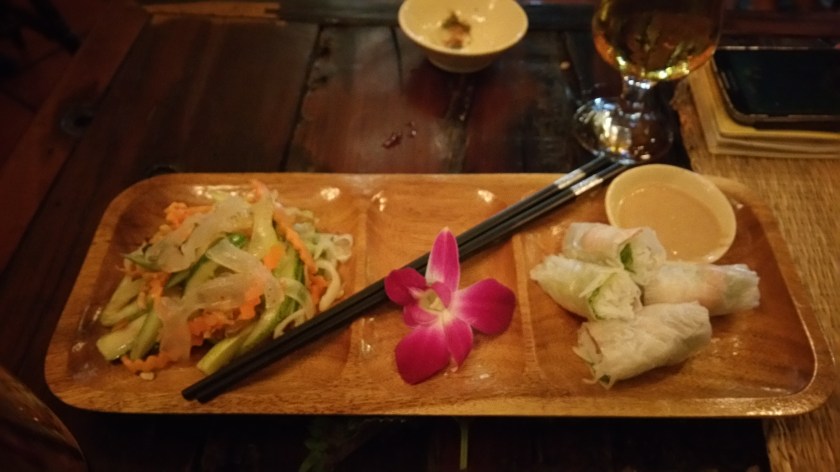
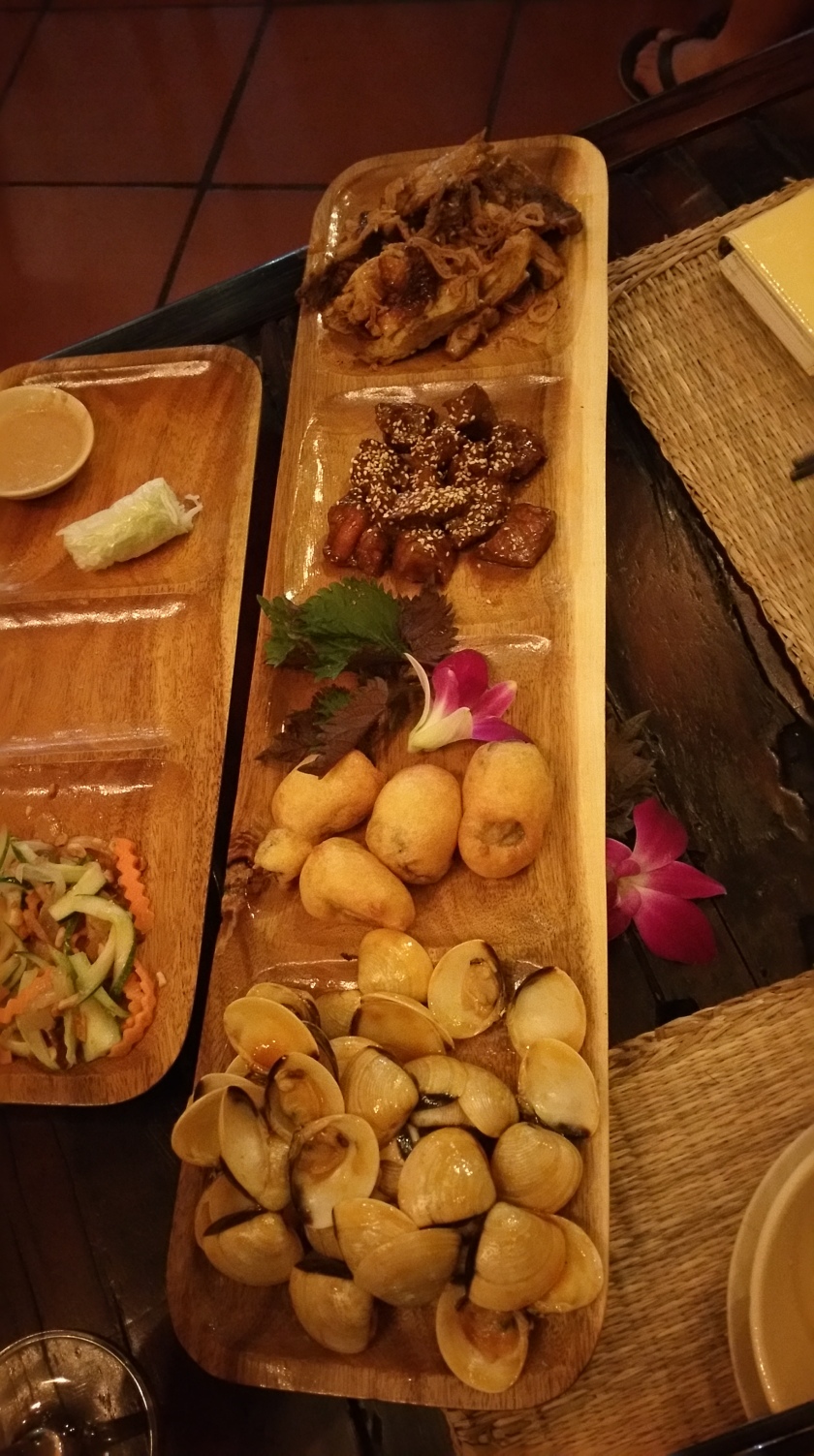
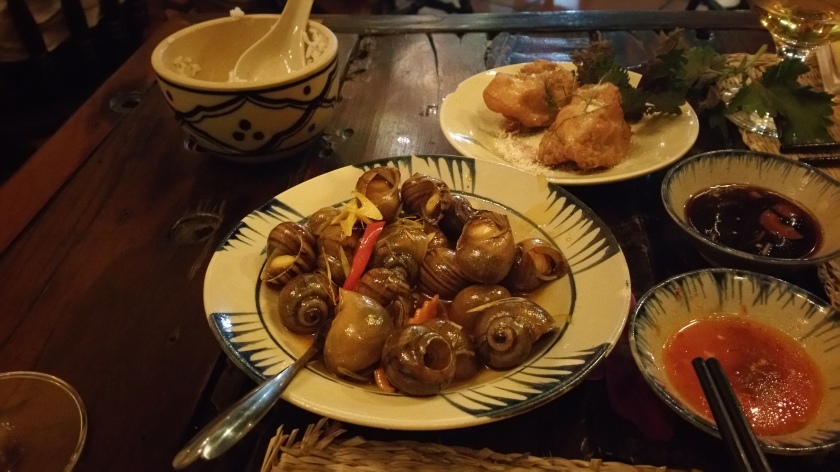
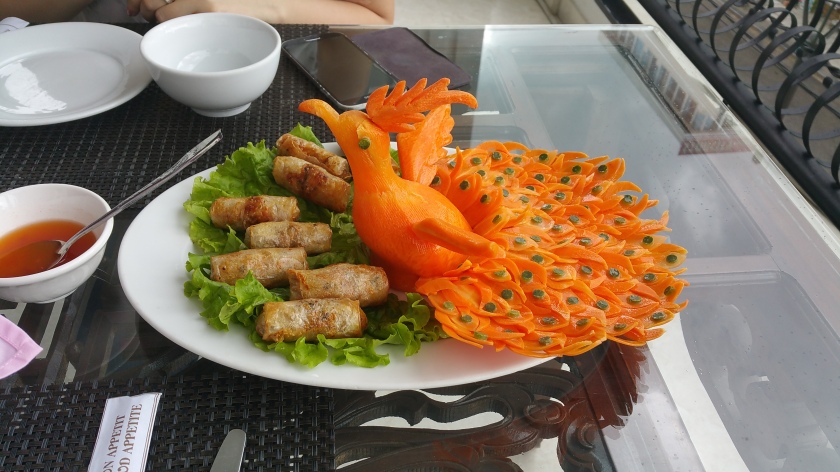
Since it was lunch time and we were already massively hungry, before going to the hotel we were taken straight to a restaurant. The restaurant reminded us of the “Istirahet” in Baku for some reason, even the smell was remotely similar. However, this initial impression vanished quickly, especially when we were seated at a balcony and served a menu with local Central Vietnamese dishes. It seemed that the food tasted differently from that of the southern region, even the spring rolls weren’t quite the same, but again everything was delicious.
20170608_134047

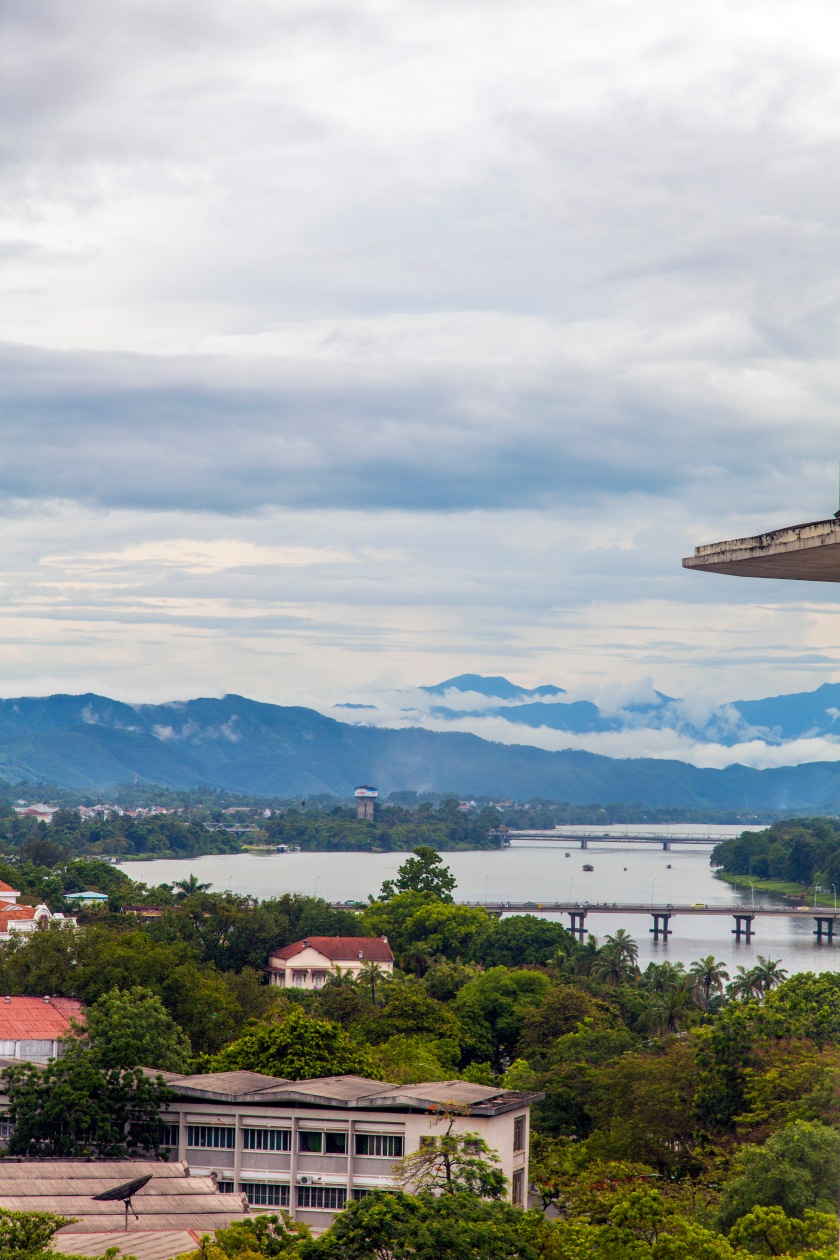
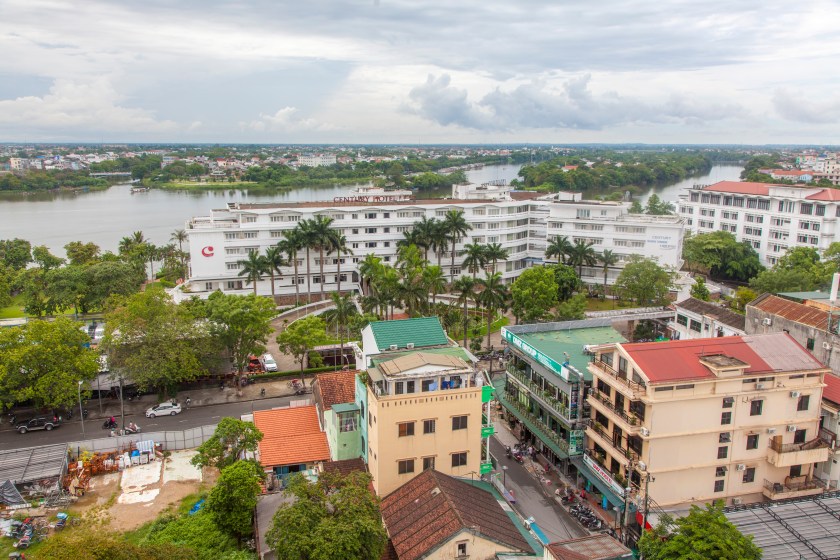
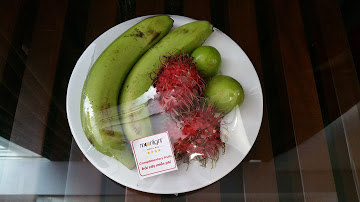
Our hotel is located right in the heart of the tourist district, on a small street with many restaurants and bars. The room is bigger than in the Ho Chi Minh City, plus there is a balcony with a superb view over the Fragrant River, and complimentary fruits in the room (bananas, rambutans and some other unidentified fruit).

IMG_2392

IMG_2396

20170608_143749 (1)

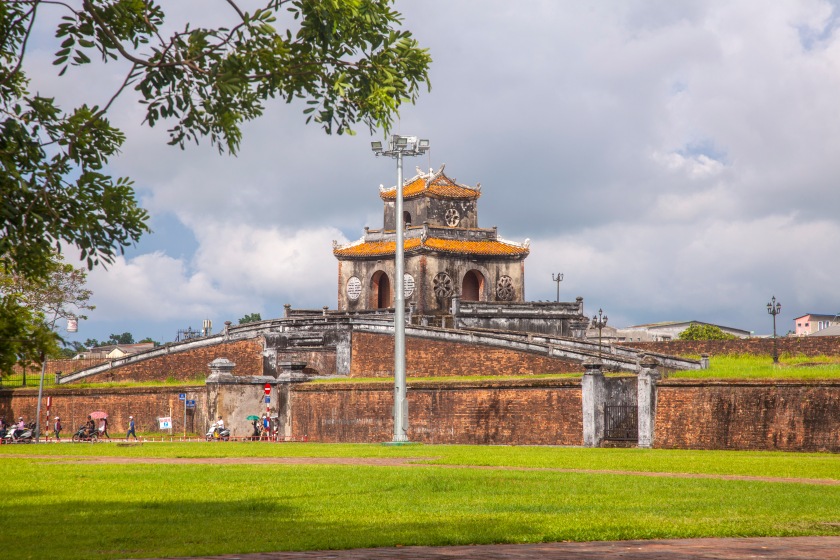
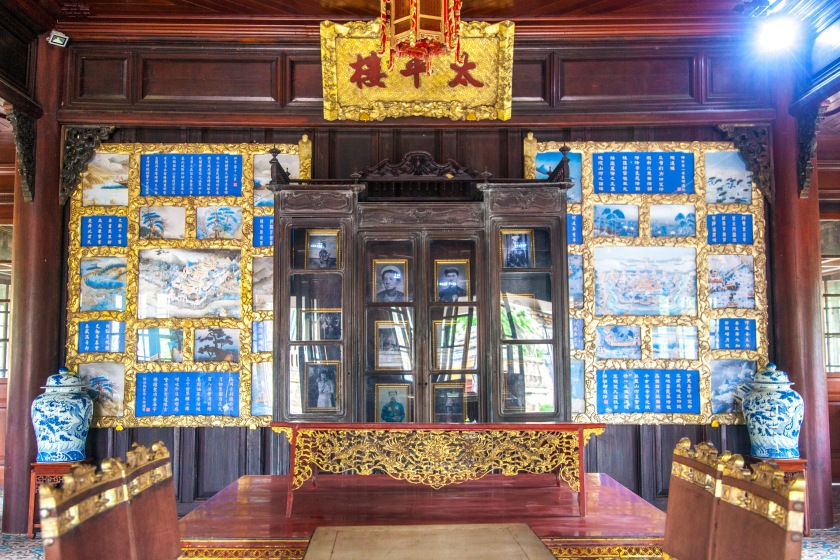
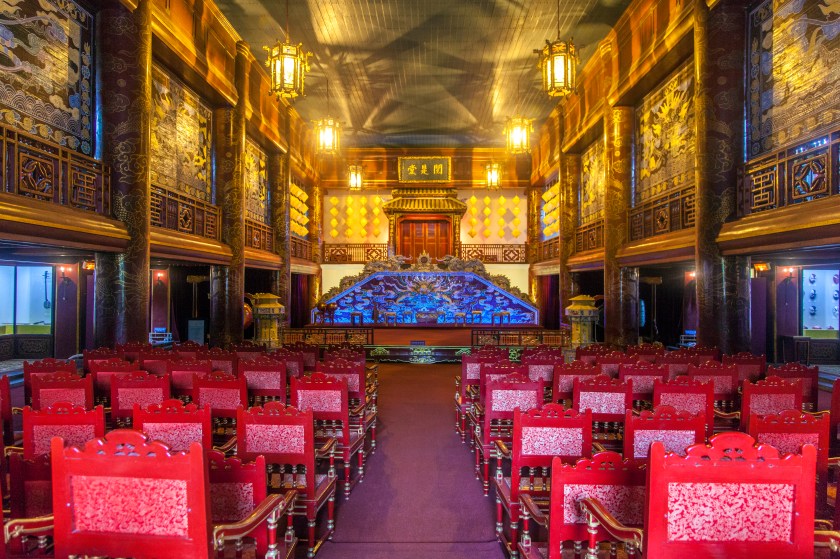
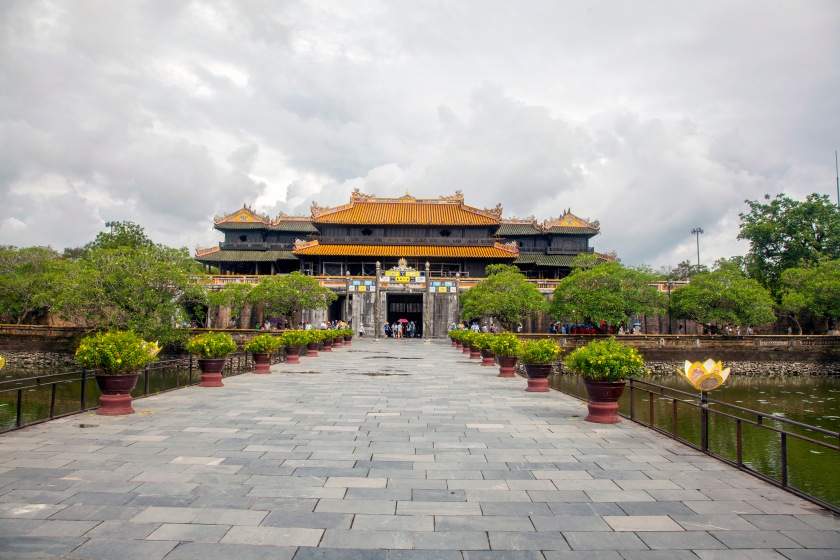
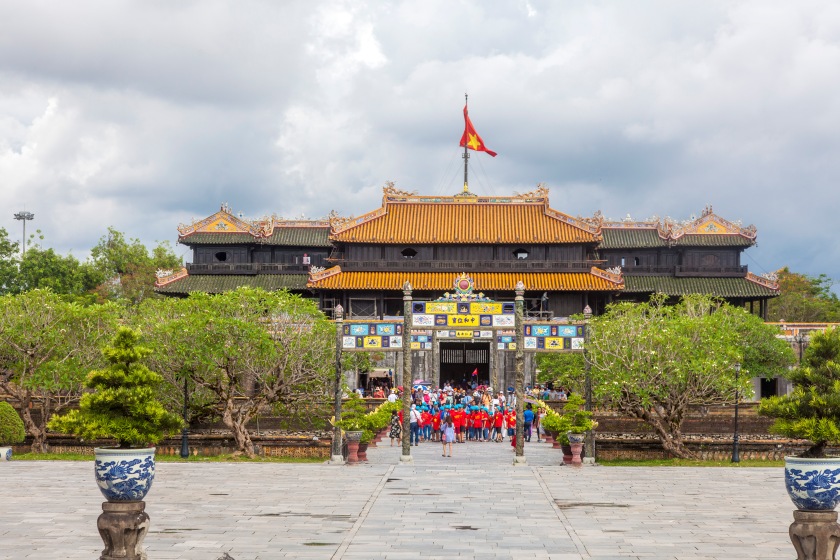
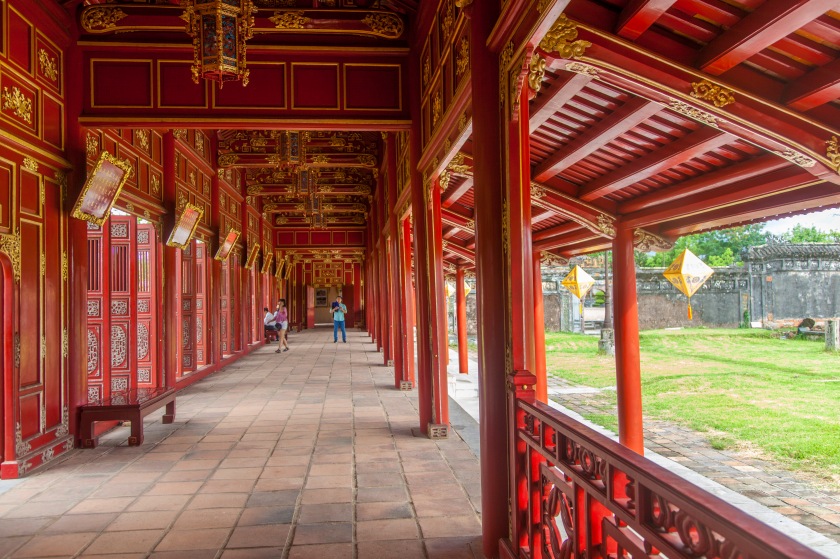
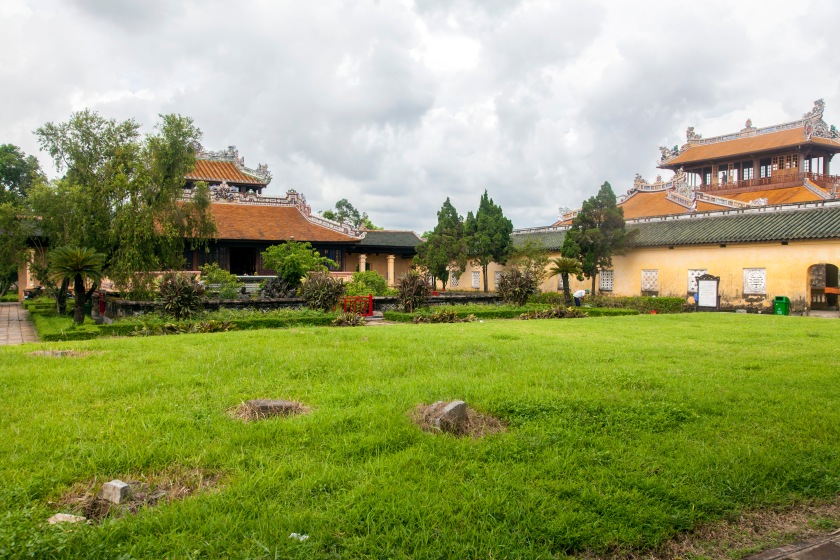
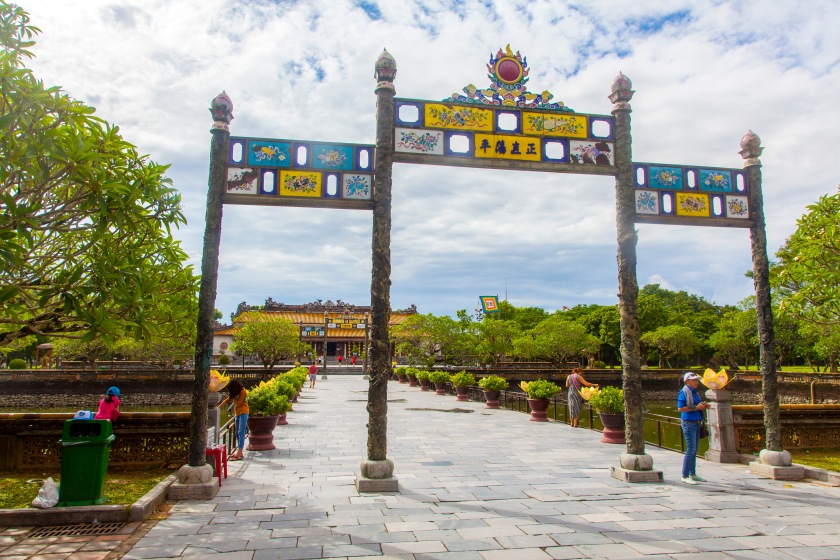
In the hotel, we literally just had time to change our clothes, since we were supposed to go on an excursion with Lan. We headed straight to the Imperial Citadel, which is a huge palace complex with at least a hundred different structures (including a theatre, a library, a meditation pavilion etc.) and was built in the early 19th century in just 27 years.

IMG_2404

IMG_2444

IMG_2451

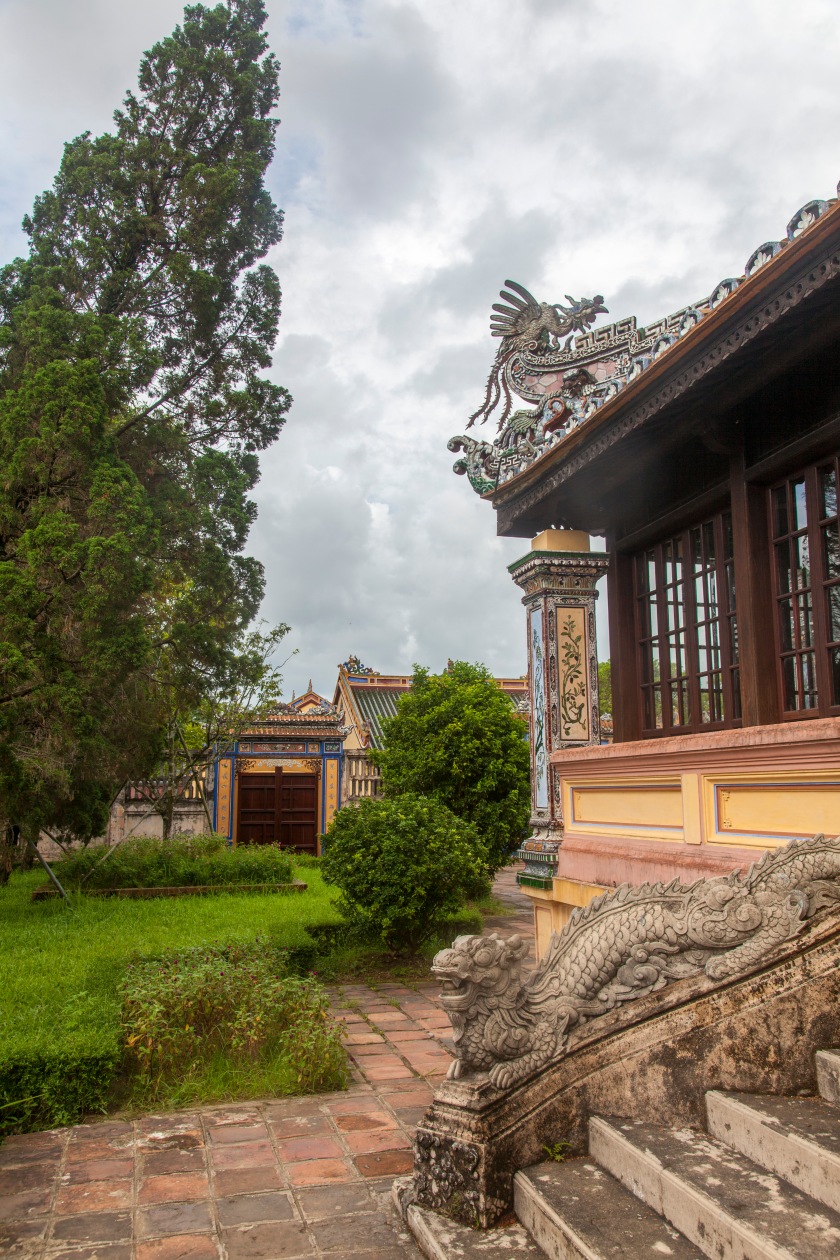
Inside the Citadel was the Imperial City, consisting of several blocks, and the Purple Forbidden City, which served as the residence of the last ruling Nguyen dynasty that existed throughout the colonial era and ended in 1945 with the outbreak of the First Indochina War. As a result of this war and the subsequent Vietnam War, the complex was badly damaged by bombing and today it only consists of the remnants of former luxury. The destroyed buildings are being slowly rebuilt, while the complex in its original grandeur can be admired on either a model or the video animation.
IMG_2409

IMG_2417

IMG_2432

I must say, the Imperial City reminded me of the Forbidden City in Beijing, but I liked it a little more, most likely because of the opulent vegetation all around.

IMG_2434

IMG_2438

IMG_2442

IMG_2454

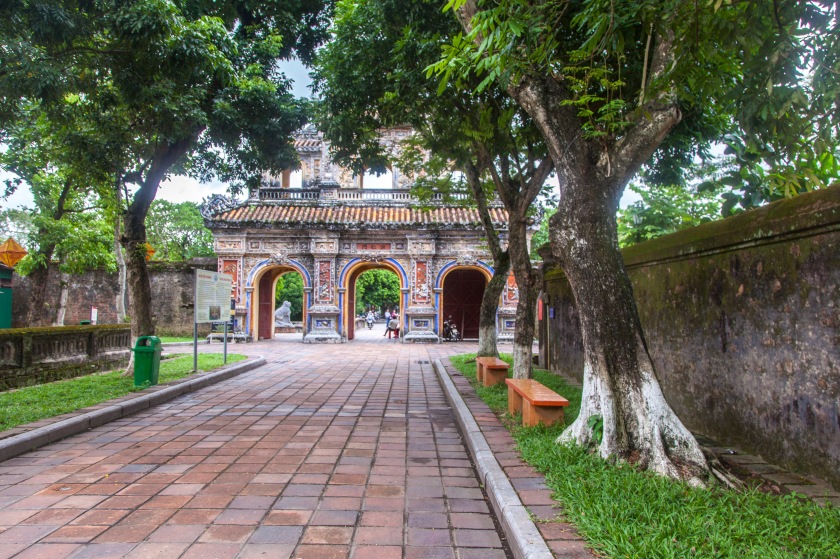
Besides individual pavilions and palaces, there are several gates that survived the bombing, and Lan explained to us that each had been intended for certain people: some were exclusively for the emperor, others for women, others for mandarins of a certain rank, and so on.

IMG_2406

We also got to see the Palace of Supreme Harmony, which was used as a throne room for memorable celebrations. It was very impressive, but unfortunately taking pictures was not allowed.

Then we went to the Imperial Museum, which, as I understood, also belonged to the palace complex, but maybe not, because walking there took quite some time. In the museum, we had to put some ridiculous shoe covers on top of our shoes, and we were the only visitors. Once again, they requested no photography, which was such a pity, since there were a lot of interesting artefacts: lacquered furniture, dishes, jewellery, clothes, and even a set for some traditional board game.

As we were walking from the museum to the car, it started to rain, and on the way to our next destination – the Thien Mu Pagoda – the light rain turned into a heavy downpour, and we had to visit the pagoda under it.

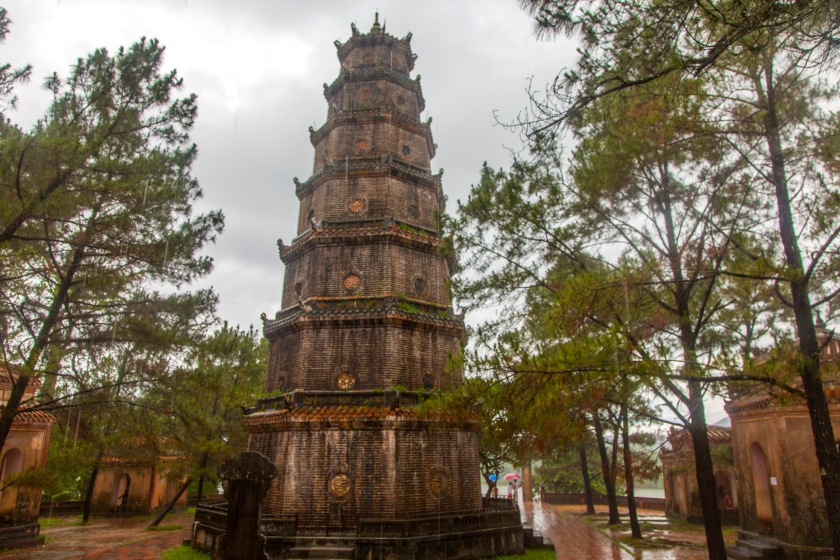
Therefore, unfortunately, the visit turned out to be too brief. The Thien Mu Pagoda, or Heavenly Lady Pagoda, is the oldest in Hue and was built in 1601. In front of the main gate there is a seven-storied tower, constructed some two hundred years later. We did not get in the pagoda, probably because of the rain, or because it was already about 6 pm – and in fact, according to Lan, there was a statue of Buddha Shakyamuni inside, which would have been really interesting to see.

IMG_2462

IMG_2465

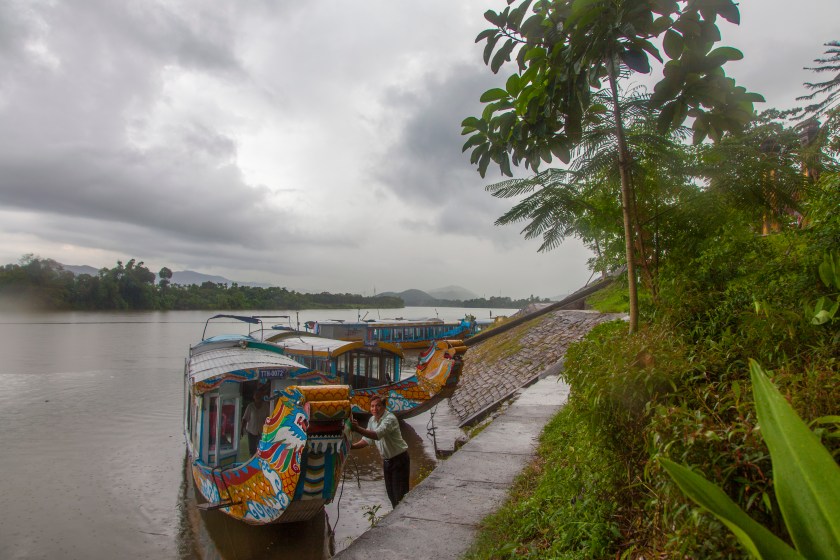
We then got on a boat to get from the pagoda to the city centre on the opposite side of the river, and this trip was not the most pleasant. Actually, even back in Ho Chi Minh City our guide Phuoc had explained to us that the tipping culture is very important in Vietnam and a dollar or two should be given practically to everyone – waiters, drivers, porters – of course, if you’re happy with the service. So pretty obviously we were intending to leave a tip to the boatwoman. But during the trip she began to show us souvenirs arranged on the boat for sale – various pictures, postcards and bookmarks – doing it very insistently, literally demanding us to buy them, which, in truth, didn’t seem quite nice. When we refused, she didn’t even help us get off the boat, therefore we didn’t leave any tip…

IMG_2471

But this little incident was very quickly forgotten when we returned to the hotel and decided to take advantage of the 50% discount on spa services that was offered. We were seated in the lobby of the spa, served some tea and showed a list of services to choose from. Both of us went for one-hour full body aroma-massage, and… oh goodness, it was amazing, such a wonderful relaxing massage from head to toe!

After that, we again felt surge of energy and went for a walk along our tourist street in search of a restaurant, and then a bar or pub. We found the restaurant at once – I’d actually noticed it earlier when we were driving somewhere – it was La Carambole, positioning itself as a French-Vietnamese restaurant. And indeed, the menu had both French and local Hue dishes. Since we still haven’t had enough of Vietnamese food, we can’t yet understand how one could want a cheese platter, for example, but as for fried rice and grilled meat with lemongrass and chili – they are always welcome!

Among other things, there are quite a few hotels and hostels on our streen, and one of the latter had a buzzing bar downstairs, where we saw big company, mostly dressed in the same shirts with bananas (which were hung right in the clothes shop across the road, there might have been some promotion like “buy 20 – get 1 free”), and some guys walked around in sun dresses or pareos with a bikini top 🙂

20170608_195714

20170608_205232

Generally, it seemed that there were more tourists in Hue than in Ho Chi Minh City. On the other hand, the latter also has its own backpacker area, where we hadn’t been in the evening, soit’s quite possible that we don’t have the full picture.

Posted in Asia, English, Ho Chi Minh City, Vietnam

Vietnam – Day 3

РУССКОЯЗЫЧНАЯ ВЕРСИЯ ПО ЭТОЙ ССЫЛКЕ. CLICK HERE FOR RUSSIAN VERSION.

7 June 2017

Today’s Ho Chi Minh City tour was supposed to happen yesterday, but as the presidential Reunification Palace, which was one of the items on our list, was closed yesterday for a government event, the travel agency had to slightly amend our schedule.

IMG_2322

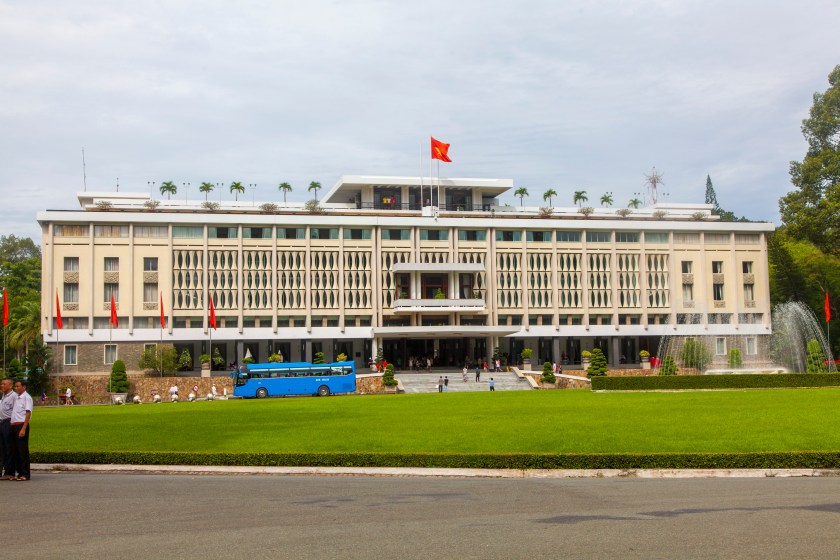
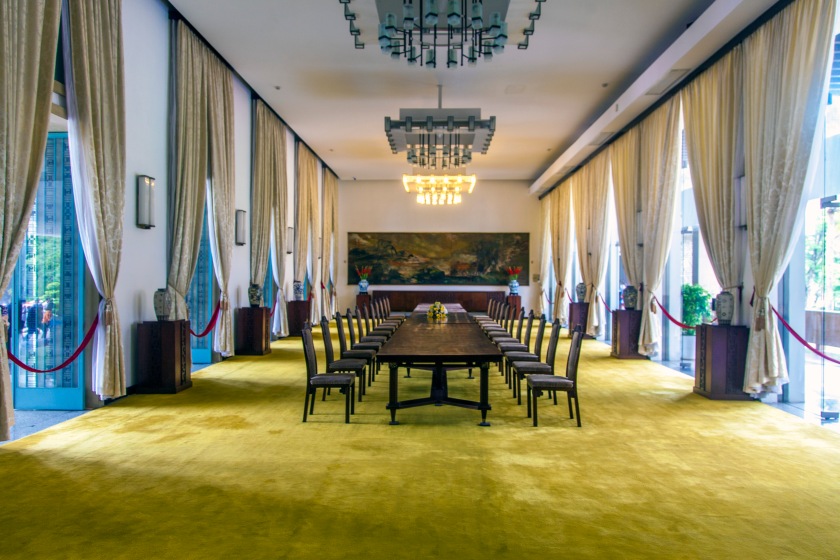
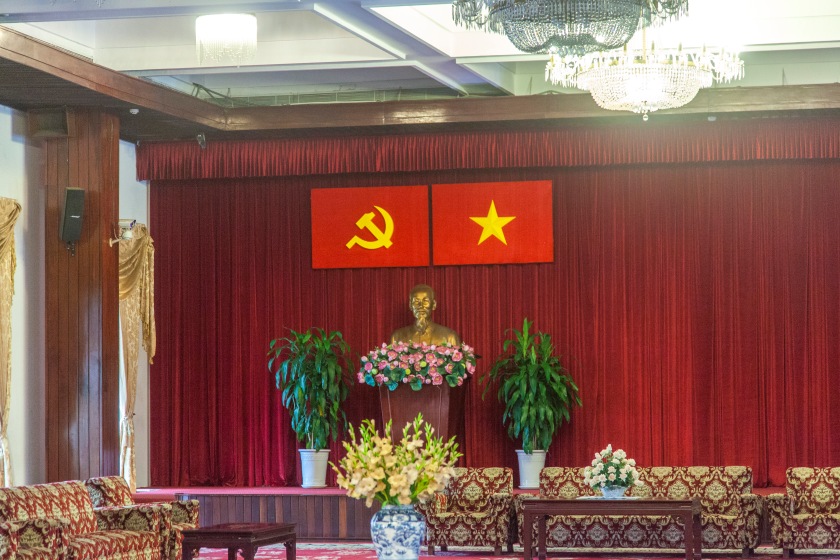
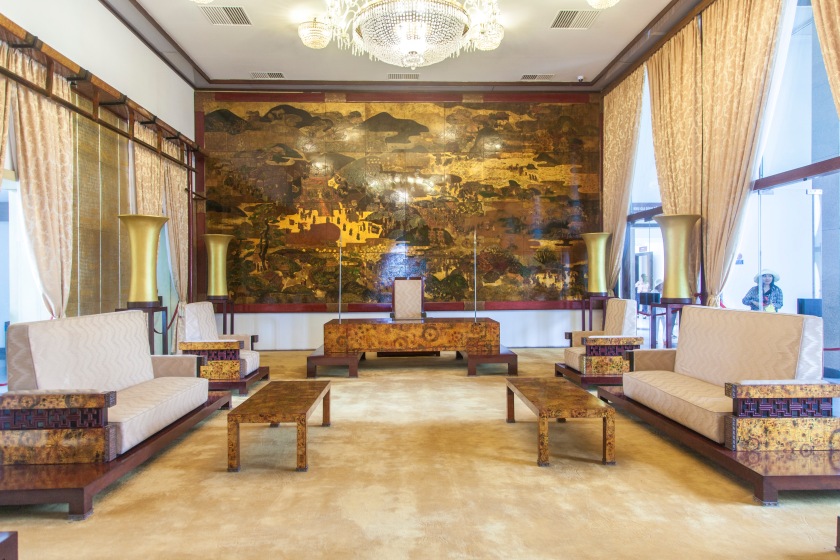
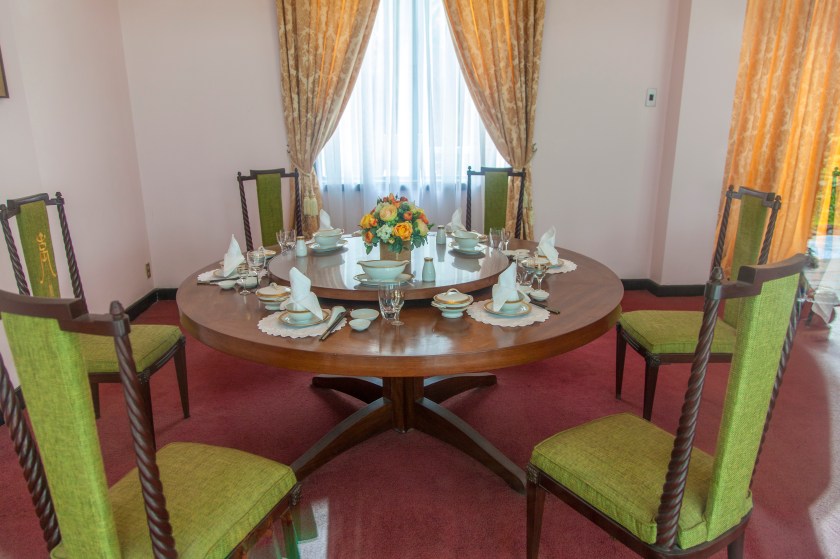
It was actually at this palace that our tour began this morning. Before the war there was the South Vietnamese Independence Palace here, however, it was a different building, a 19th-century one in the French colonial style. During the war, that one was bombed, so a new, more modern palace was built in its place later, becoming a symbol of the unified Vietnam.

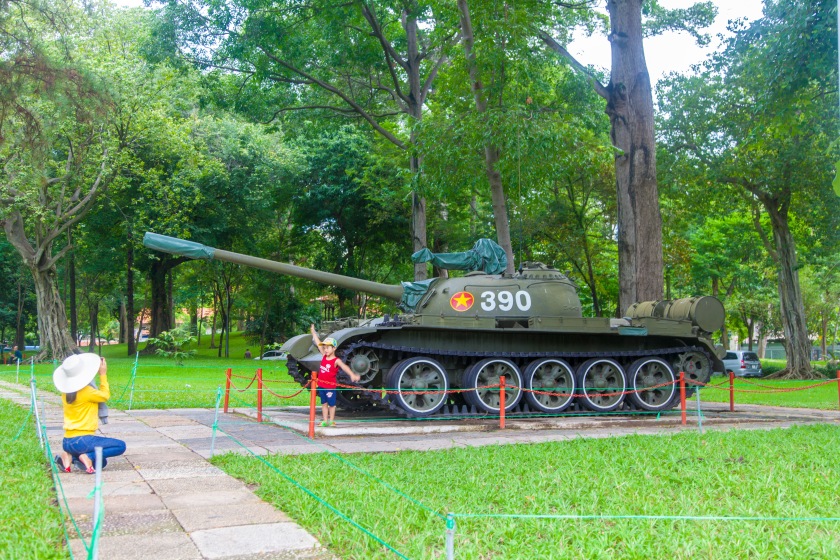
Generally, there was a lot of history today and in the first half of the day it was mainly contemporary history. So, standing next to this tank, which is a replica of the exact North Vietnamese tanks that rammed the Palace gate in 1975 and actually marked the end of the Vietnam war and the victory of the North, Phuoc gave us a brief overview of Vietnamese history since the First Indochina War against the French colonialists, which began in 1946, followed by the Second Indochina War, also known as the Vietnam War of 1955-1975.

IMG_2326

The palace itself has maybe a few dozens of rooms and halls, but only three are currently used for government events. Some of the rest are only demonstrated as a museum, and I don’t even know what they do with the others. The basement, for example, used to be a bunker, and is now closed for reconstruction.

IMG_2330

IMG_2331

IMG_2340

IMG_2341

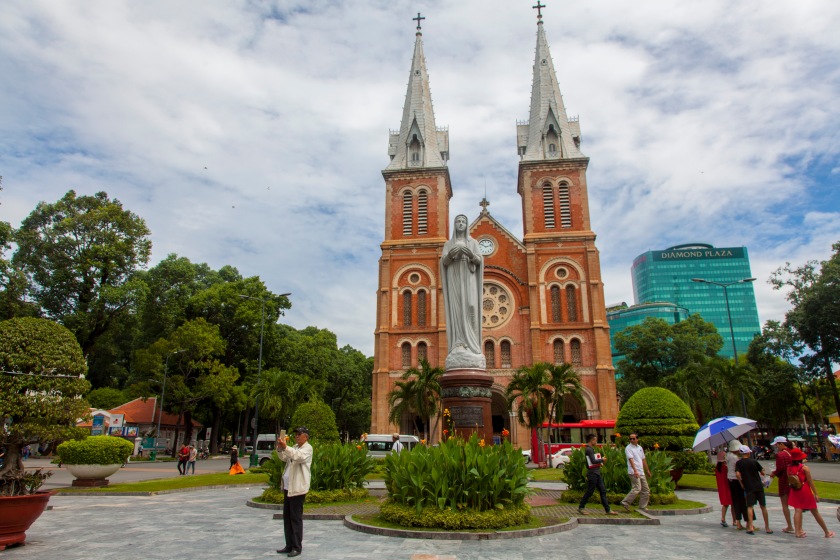
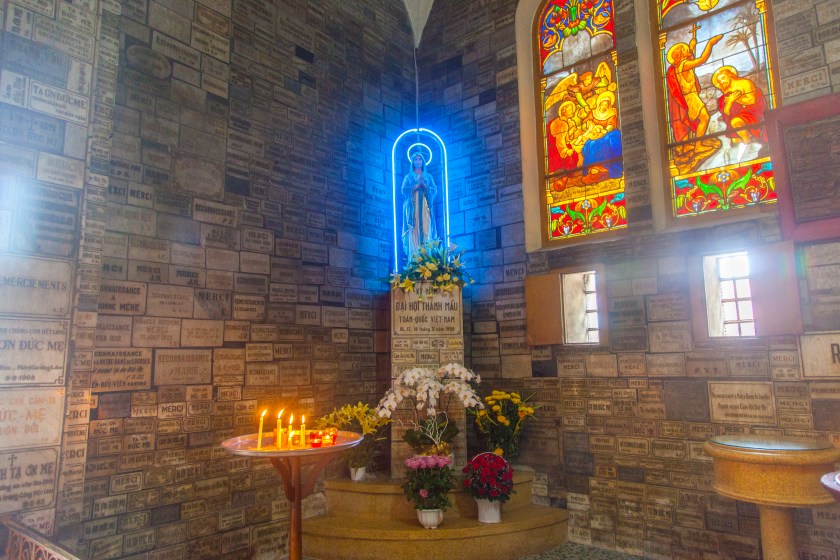
Next, we stopped at the Notre-Dame Cathedral Basilica of Saigon , built by the French, obviously, and also located directly opposite the Post Office building, which is another place of interest. There isn’t particularly much to tell about either, especially that we didn’t spend a lot of time there, just walked in, looked around and left.

IMG_2362

IMG_2355

IMG_2357

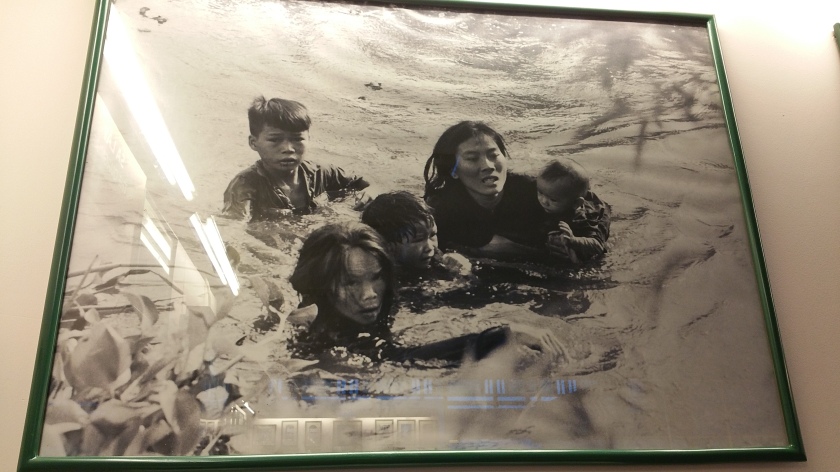
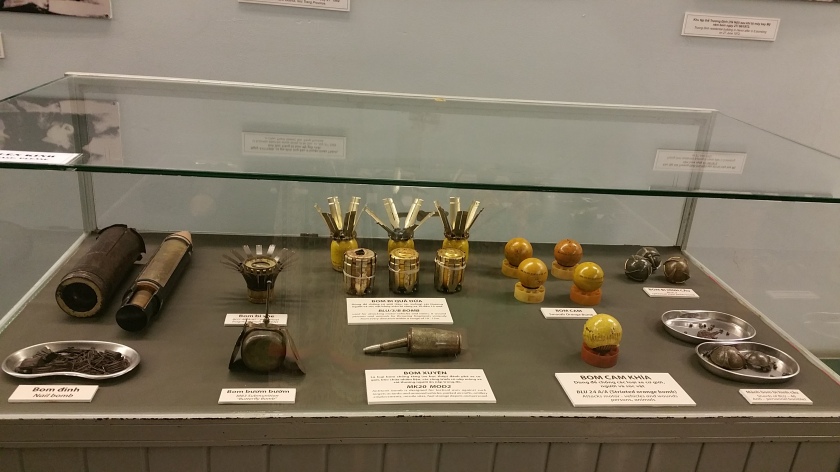
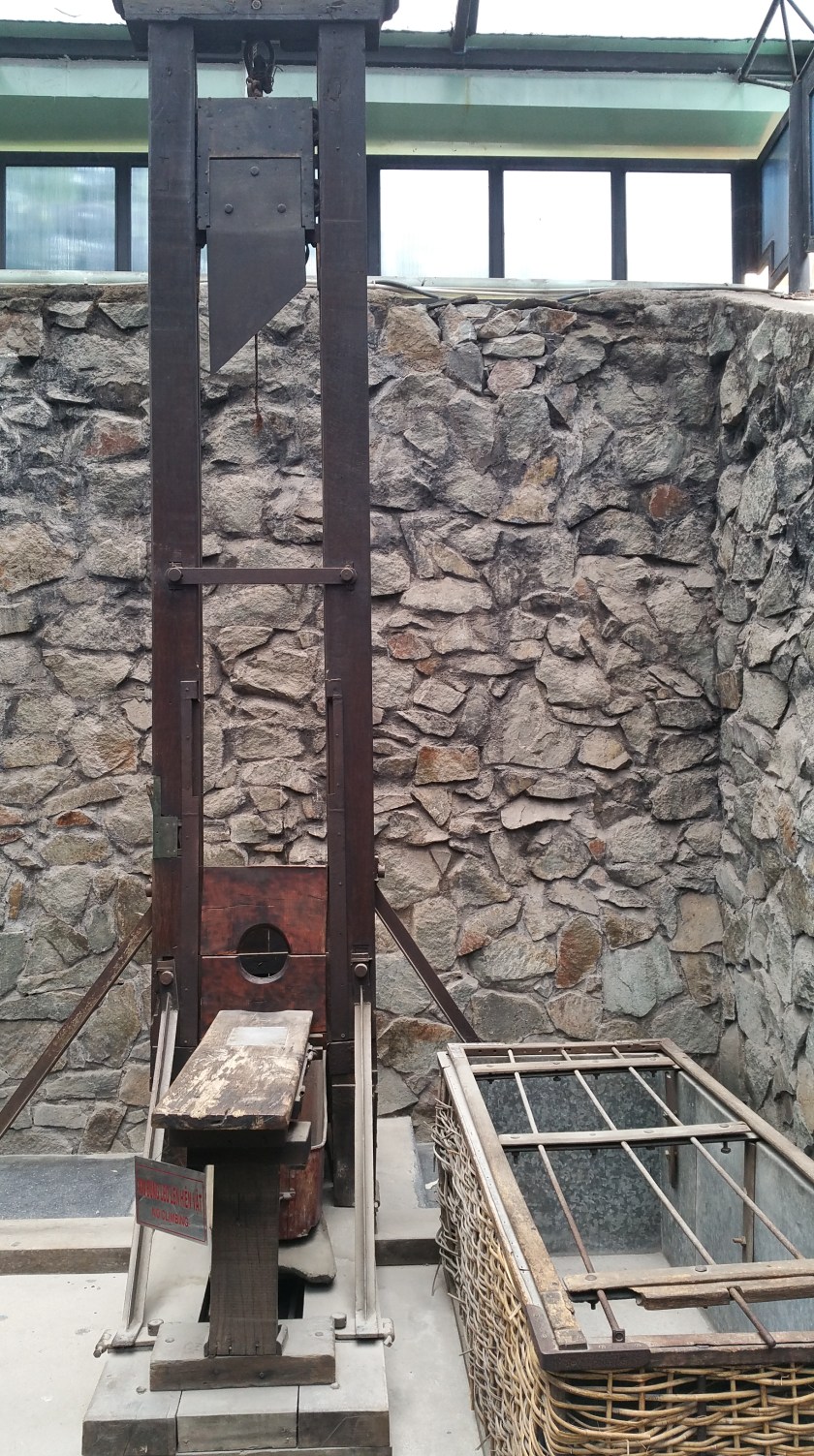
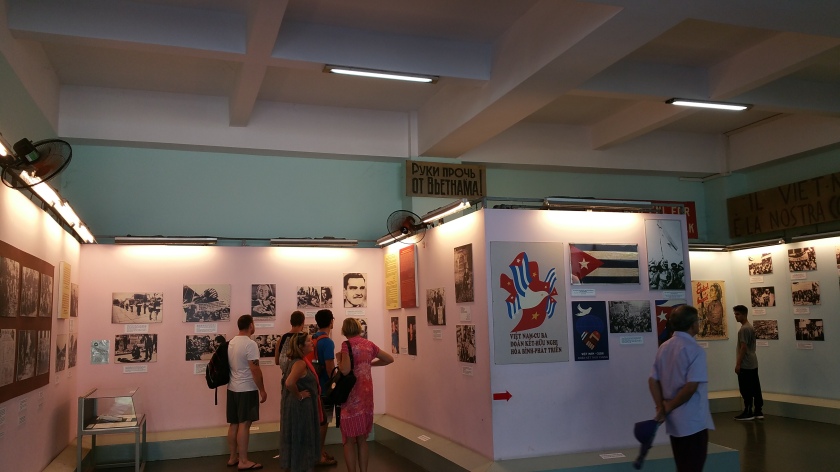
What followed next felt kind of like bitter medicine – unpalatable but useful. It was the War Remnants Museum, which, by the way, before the restoration of diplomatic relations with the USA used to be called Exhibition House for US Crimes. It’s a rather eerie place exhibiting military equipment, war photos (including those of the Songmi massacre and the victims of napalm and white phosphorus bombs), a guillotine, the replica of a South Vietnamese jail for political prisoners, and – most horrible of all! – photographs of victims of Agent Orange (a toxic chemical, repeatedly spread by Americans in Vietnam) with birth defects and mutations. And not only local people had children born with defects, so did also American soldiers after returning home. In Vietnam, there are still a lot of disabled people who are victims of those chemical attacks: we saw some of them both at the Notre Dame Cathedral, asking for alms, and at the museum itself, producing various crafts for sale – unfortunately, the state doesn’t have enough money to support them, so they have to find means to survive on their own.

20170607_105736

20170607_112658

20170607_113416

20170607_114024

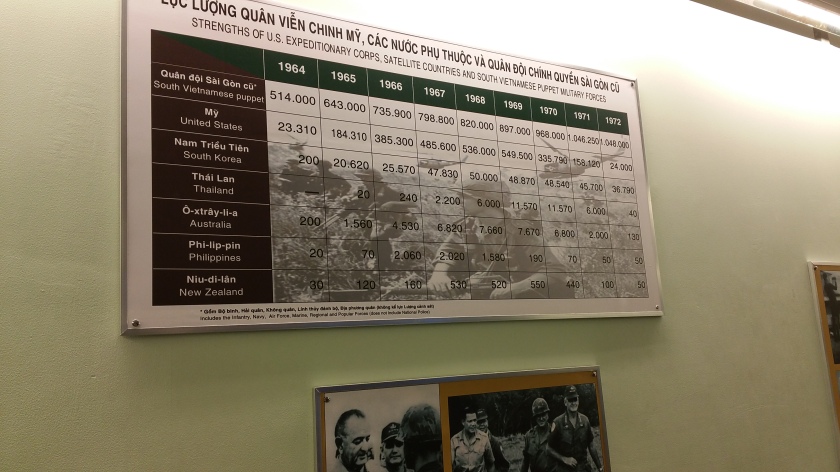
It was all very sad and made me think a lot – mostly about the fact that history doesn’t teach people anything at all, especially in the light of the most recent political events in the world… Now of course, the inscriptions under the exhibits in the War Remnants Museum are characterised by political propaganda, in particular, the northerners are only mentioned as “patriot soldiers” and the South Vietnamese government is called a puppet. We so didn’t expect such evaluative language in the seemingly narrative description of military events, that when we saw a table listing the number of troops from various states, among which the South Vietnamese Puppet was mentioned, we asked ourselves whether the word ‘puppet’ actually meant something different in military jargon, because we simply couldn’t believe that it was meant in its most direct sense.

20170607_105000

20170607_104013

We decided to grab food in a coffee shop right at the museum, and had banh mi –
traditional Vietnamese baguettes (French heritage, as I mentioned before) with chicken, tasting like ordinary doner kebab .

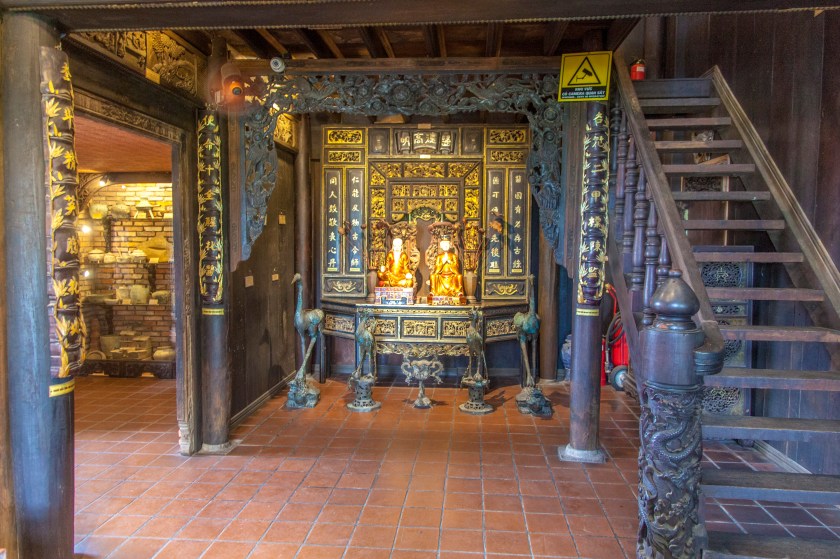
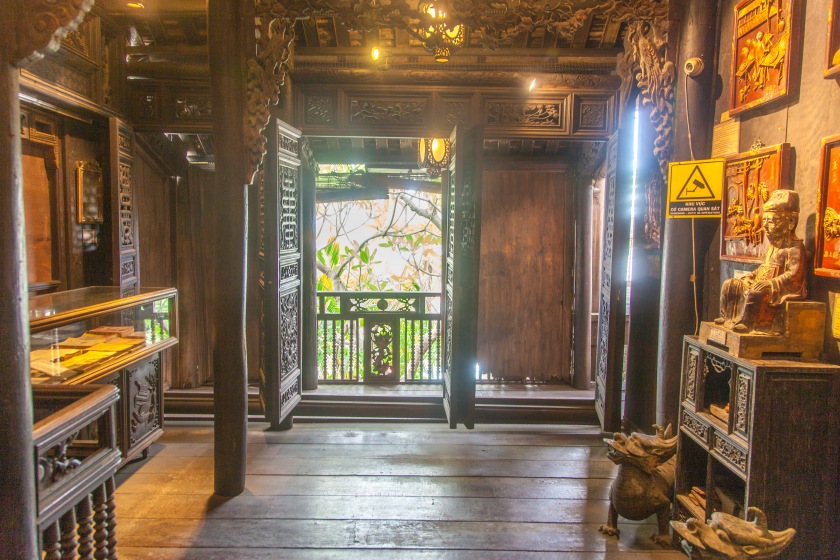
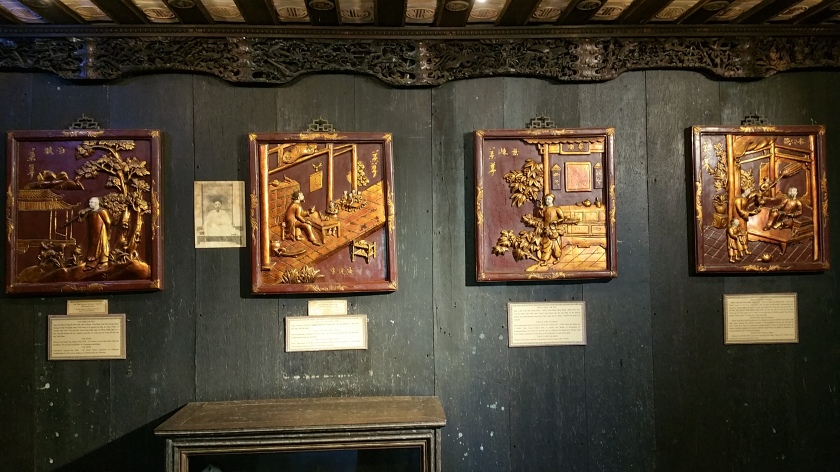
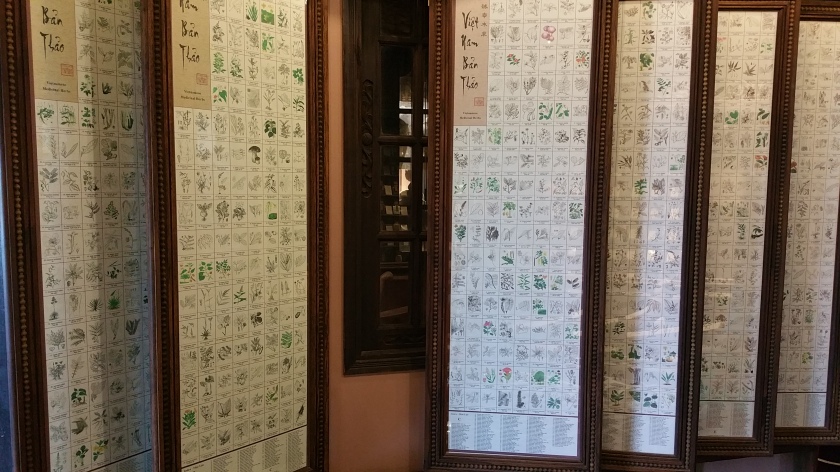
After contemporary history we plunged into more ancient one, also much more positive and entertaining: we went to the privately-owned FITO Museum of traditional Vietnamese medicine. The interior was very interesting, in the traditional Vietnamese style of the 19th century, although the building itself is new.

IMG_2373

IMG_2376

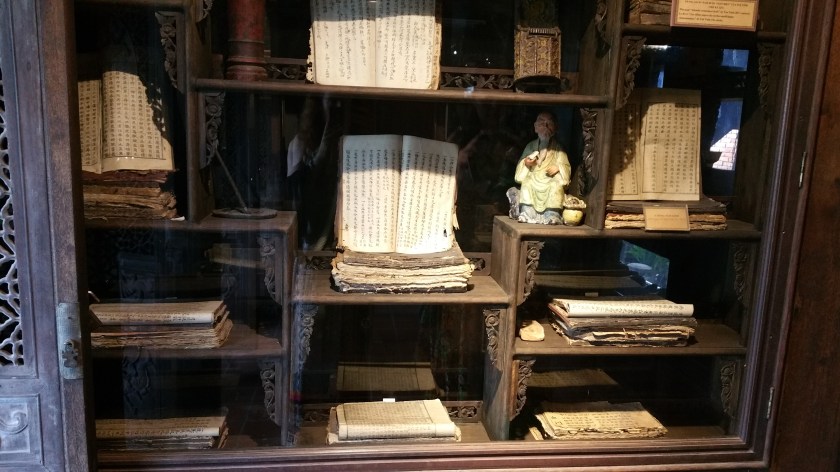
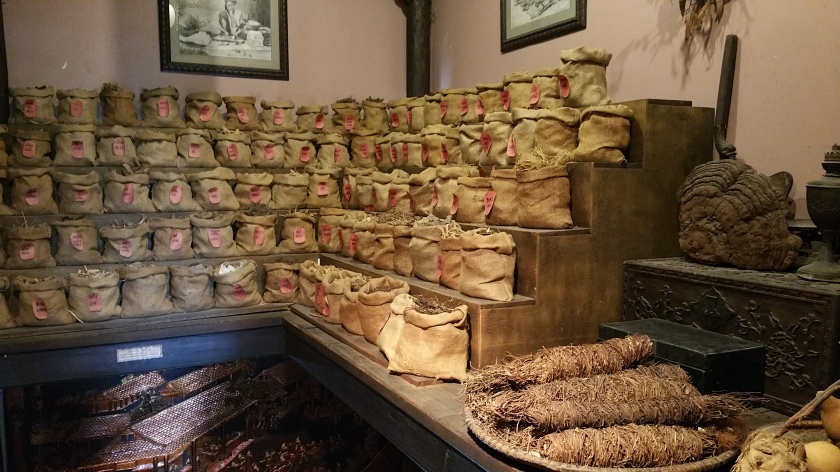
We got to see an introductory video and then a nice lady showed us the exhibits – there was a huge number of antique dishes, medicinal substances (herbs, minerals, mushrooms etc.), tables listing medicinal plants, half-decayed medical treatises by ancient doctors, written in Chinese characters, etc. We were offered to try on traditional clothes of Vietnamese doctors and pose for a photo behind a pharmacy counter. And also, some of the medicines are mentioned in connection with the emperor Minh Mang, although I can’t remember whether he made them himself or had them invented specially for him. But what’s noteworthy is that the emperor had 500 wives and could visit 5 of them in one night!

20170607_124229

20170607_124409

20170607_125118

20170607_125315

By the way, I didn’t mention Chinese characters just randomly. In fact they were used in Vietnam up until early 20th century, when the French colonial government imposed a switch to a romanised alphabet. In this alphabet, the standard five vowels (or six, if “y” is also considered as one) come with all sorts of diacritical marks: not only are there twelve vowels in Vietnamese, but each one can also be pronounced with six different tones, changing the meaning of the word.

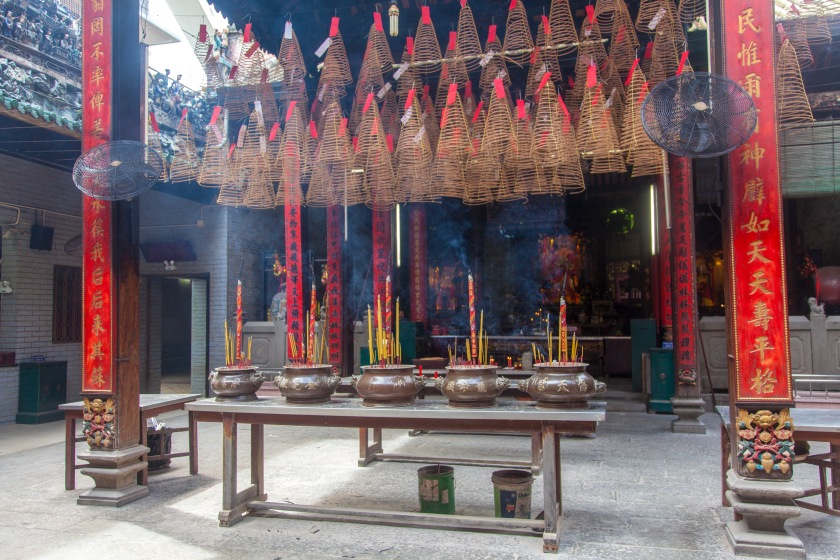
Phuoc tells us all this in the car on the way to the local Chinatown. There are about a million Chinese in Vietnam, many of which don’t even speak Chinese anymore. In Ho Chi Minh City they mainly own wholesale stores. In Chinatown we visited the Thien Hau temple of the Chinese sea goddess. By the way, I’ve already been to another temple dedicated to her in Hong Kong. Among other information about Chinese traditional beliefs, Phuoc told us about the 12-year cycle of the Eastern calendar – in particular that previously before a wedding the bride’s and groom’s horoscope signs used to be checked for compatibility, but nowadays clever couples come up with ways to avoid incompatibility, such as arranging the marriage ceremony at midnight instead of midday, or walking into the house for the first time through the back door instead of the front door.

IMG_2388

IMG_2391

And finally, we visited a lacquer factory. Initially, the technique, like much else, as we have already found out, was brought by the French, but then local craftsmen mastered the skill so much that they pretty much took it to the next level. This work is manual, and very laborious and complex. First, a black wooden board is prepared – which of course should be absolutely smooth – then a picture is drawn on it, then either a part is cut out of mother-of-pearl along the outline of the pattern and stuck to the board, or the contour of the picture is filled with pieces of egg shell (which can even be completely crushed) or paint, and then the painting is covered with fifteen layers of lacquer made of lacquer tree sap, and each layer must fully dry before the next one can be applied. Unfortunately, taking pictures at the factory wasn’t allowed, otherwise it would be very interesting to capture the process of creating lacquerware.

This was the end of the Saigon part of our tour, and we said goodbye to Phuoc. It was about 4 o’clock in the afternoon, and we decided to find an electronics store to buy additional memory cards for our cameras. I must say, the walk was rather stupid: the store which Phuoc had noted for us on the city map didn’t have the card I needed, and the sellers gave us the address of another store, which we spent ages looking for and as a result found out that it was quite close to our hotel. Had we known that in advance, we wouldn’t even have had to drag ourselves that far in this humid heat. We were quite lucky today that there was no rain at all, but the flip side of that is this sticky heat, as the rain would have refreshed the air.

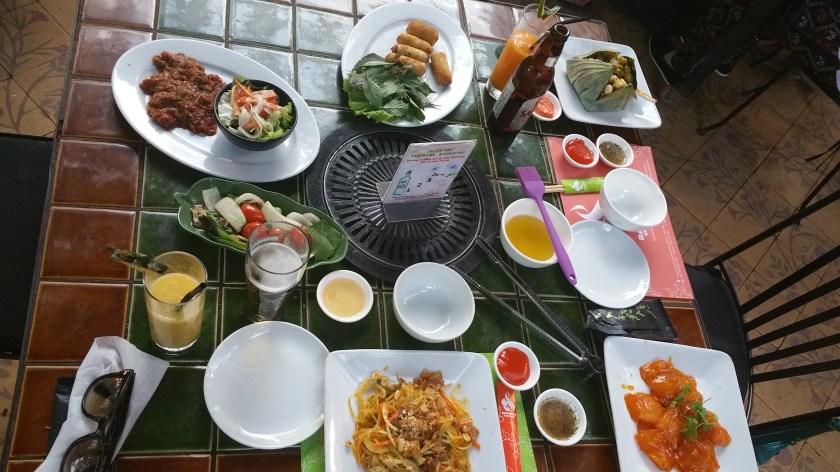
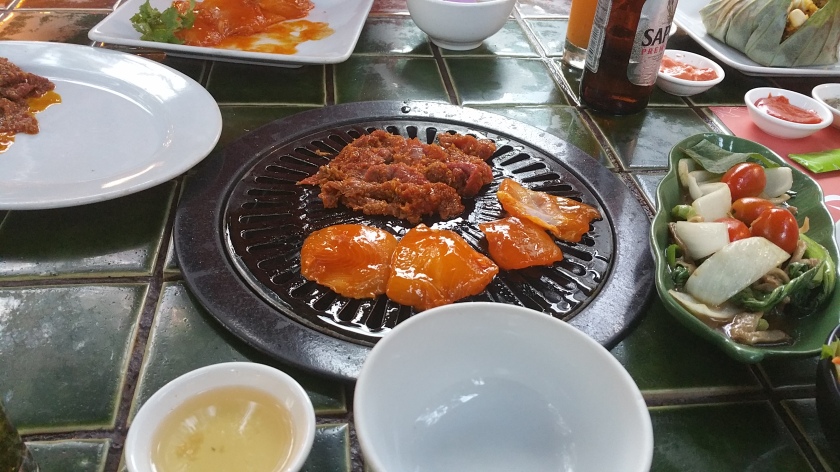
We continued walking until we reached the Barbecue Garden restaurant, which we chose for today’s dinner. The restaurant is open-air, mostly attended by foreigners, and has a very interesting concept: the barbecue ingredients are served raw, which you then have to grill yourself over the gas burner located right in the centre of your table. Once again we really liked everything and the prices were shockingly low: only 32 dollars for two for snacks, barbecue, side dishes, fruit juice, beer and dessert!

20170607_174427

20170607_174726

And after dinner we decided to finally walk up to the river, taking advantage of the dry weather. We reached the river and walked along the embankment, but couldn’t locate that beautiful skyline with illuminated buildings which we’d seen on some postcard. We slightly got used to the traffic, but it still feels stressful for me – I guess, after this in Baku I’ll be able to cross roads with my eyes closed. At some point, we wanted to cross a wide avenue along the embankment, and spent at least five minutes in front of the zebra crossing, because we couldn’t bring ourselves to step into this uninterrupted stream of traffic, before some local girl – thanks to her! – rushed to our help and literally took us across the road, like old grannies!

20170607_194143

20170607_200401

20170607_200443

20170607_201126

Posted in Asia, English, Ho Chi Minh City, Vietnam

Vietnam – Day 2

РУССКОЯЗЫЧНАЯ ВЕРСИЯ ПО ЭТОЙ ССЫЛКЕ. CLICK HERE FOR RUSSIAN VERSION.

6 June 2017

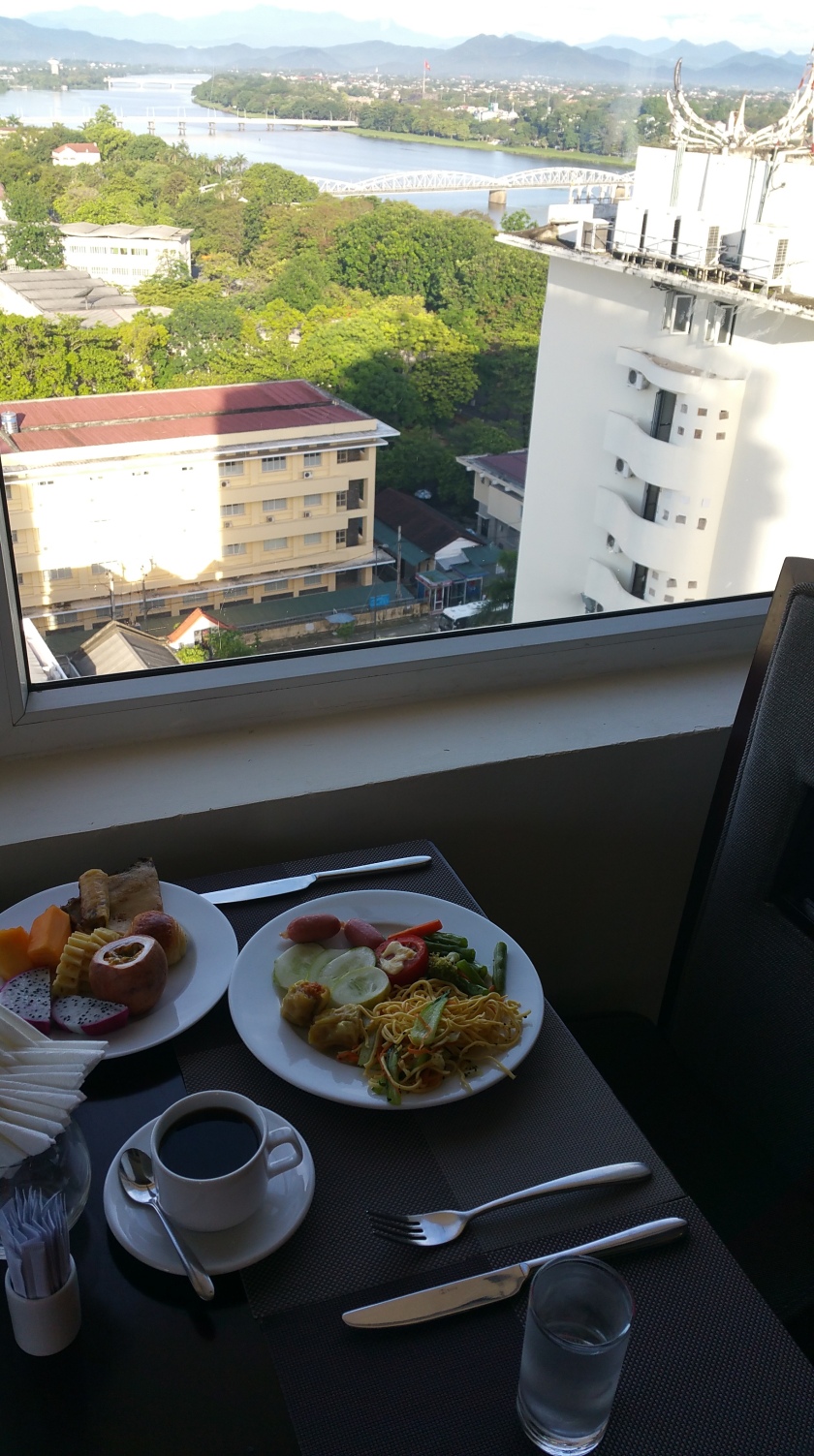
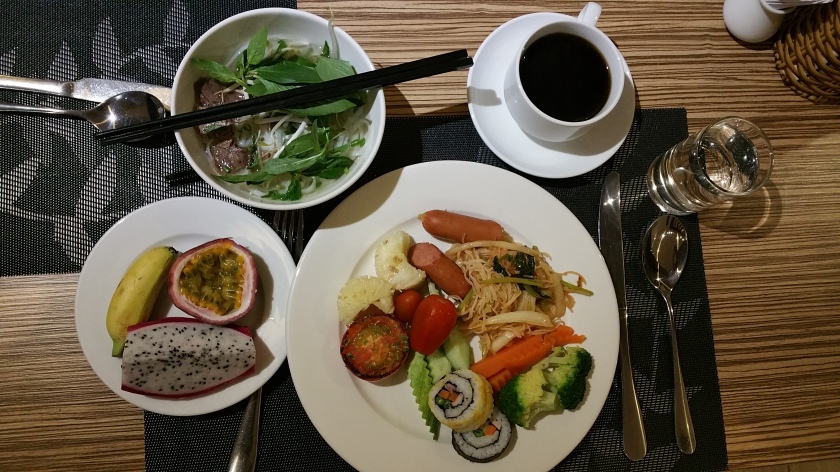
I may well be unoriginal and repeat what I’ve said before, but I will say it again: what’s particularly nice about breakfasts in Asian hotels is that apart from the usual boring cheeses/sausages/croissants/toasts you can get stir-fried veggies, noodles, dim sum and even pho! Which is exactly what we did before heading down to the reception at 8 am, where our tour guide Phuoc was already waiting for us, ready for the Mekong Delta excursion.

20170607_073939

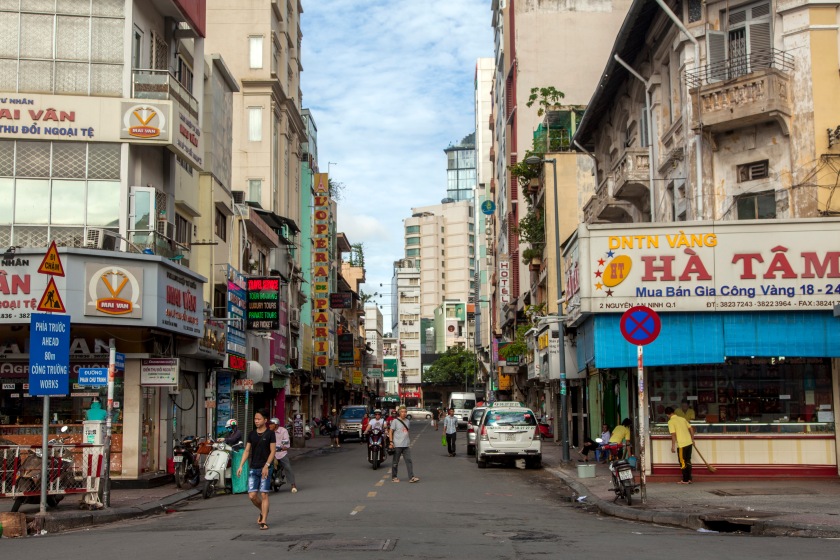
First of all, we took a two-hour drive in a comfortable SUV to the town of Cai Be in the Mekong Delta region. As we were driving out of Ho Chi Minh City, and also afterwards, I was thinking of my impressions about the surroundings. There are places which make you say “so beautiful that it takes my breath away”. This is not the case. The Vietnam, which we have seen so far, is best described by the epithet “charming”. And in many respects, it’s charming precisely by its imperfection, including chaos on the roads; assemblages of narrow buildings, sometimes shabby, not wider than a single window; street vendors on the sidewalks, and so on.

On the way, Phuoc was telling us how people live in country – about low salaries, about taxes and cases of tax evasion, about how, with the emergence of a free market economy, many are striving to own a business, even if a very small one, and that often all family members, including the elderly, need to work as it’s very difficult to make ends meet otherwise.

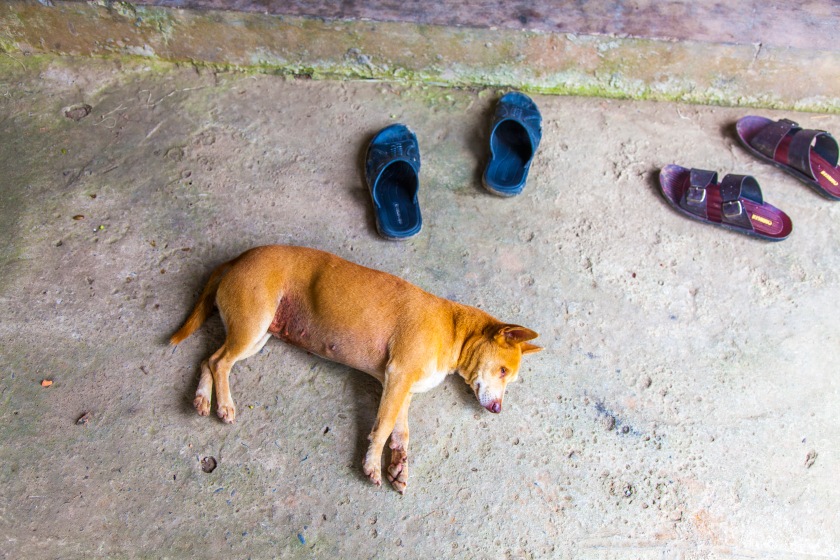
At some point, we started talking about dogs and the fact that in Northern Vietnam people still eat them despite the government’s attempts to ban this. In 1945, a terrible famine raged in the north of the country and it were dogs that helped many people survive (not by their own will though!), so some still believe that eating a dog brings good luck. At the same time, this doesn’t prevent the Vietnamese from treating the dog as a man’s best friend and even to welcome stray dogs in their shops or cafes – it turns out that dog barking somehow sounds similar to the Vietnamese word meaning wealth, so again it’s believed that dogs bring good luck, even without being eaten. As for cats, the situation is exactly the opposite, since their ‘meow’ is consonant with the word meaning poverty.

IMG_2293

On the way, we stopped to visit the “happy room” (that’s the euphemism used here for toilet, which is quite logical for travellers) in some interesting place, looking like either a garden or a restaurant. Through Phuoc’s efforts, the stop turned for us into something like a botanical lecture: she basically showed us every plant and explained how and for what purposes it’s used. We really got the impression that the Vietnamese eat almost any stems, leaves, fruits and roots (well, except for poisonous ones obviously), including banana tree stems, and literally every part of the lotus. Then, already back in the car, she showed us some books about tropical plants, flowers and fruits.

IMG_2183

Another fifteen minutes’ drive – and we arrived at Cai Be, where we had to get on a boat and continue the journey on it. The boat was big – like a sampan – enough for 10 people, but it was just for our mini-group. First, we headed off to see the famous fruit and vegetable floating market. The population in the Mekong Delta area is mainly engaged in farming, and growing fruit is a very profitable business. The local climate and fertile land definitely help. But as for rice, for example, growing it is not that financially rewarding – the market price of one tonne barely covers the labour costs of the workers involved in producing this very tonne. Coming back to our floating market, we were told that in the early morning there are particularly many boats selling goods, and by 10 am (which is the time when we arrived), mostly everything is already sold out with only a few boats remaining. That is, to enjoy the floating market in all its glory, we would have had to spend a night in Cai Be.

IMG_2200

IMG_2213

IMG_2201

Our first stop is a local village with several family businesses. Here, for example, they make coconut candy by boiling coconut milk with sugar and sometimes flavour additives like coffee and chocolate. Coconuts, by the way, are used very extensively here – pulp and milk are used for food, and the shell is used as fuel, for crafts or even for activated charcoal production.

IMG_2215

IMG_2220

IMG_2219

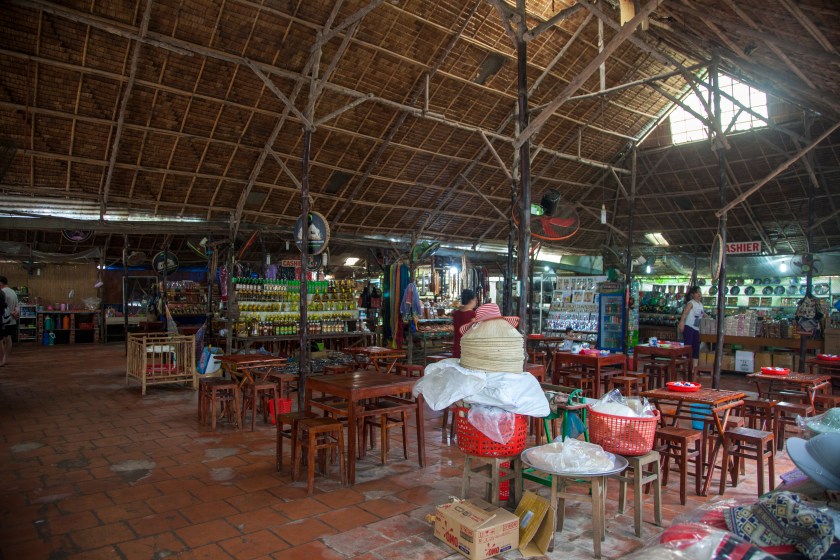
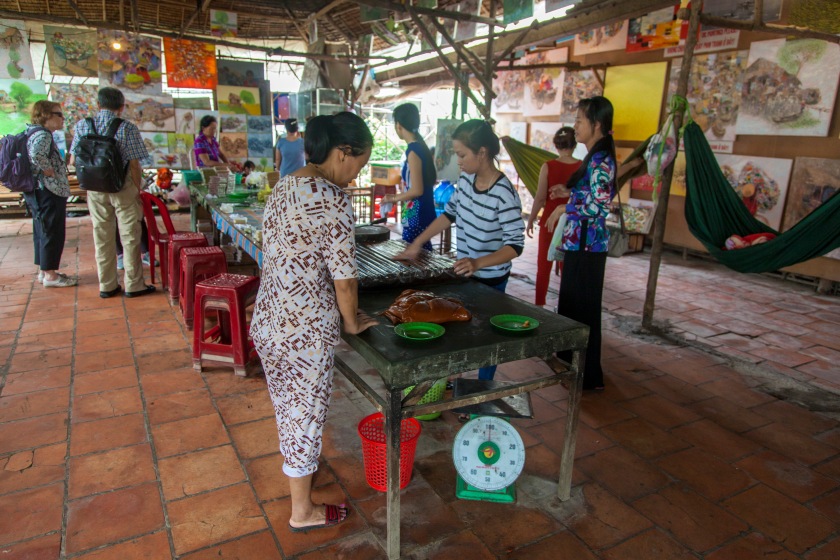
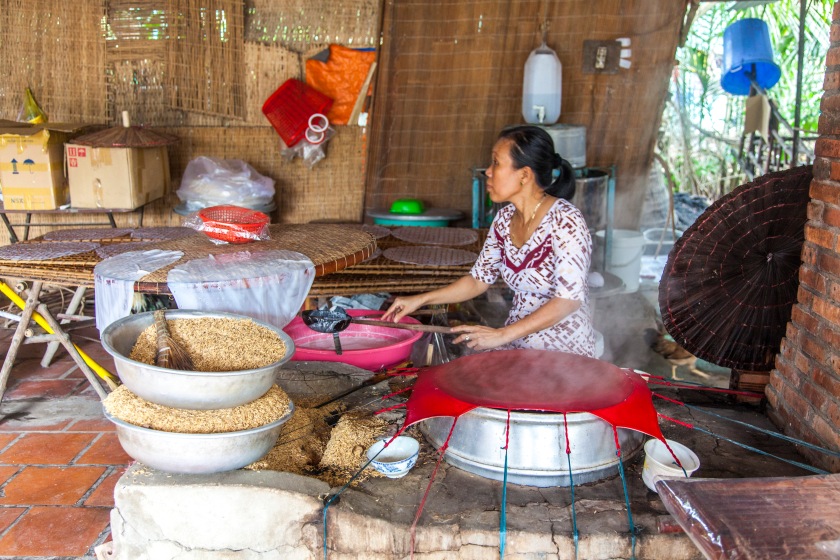
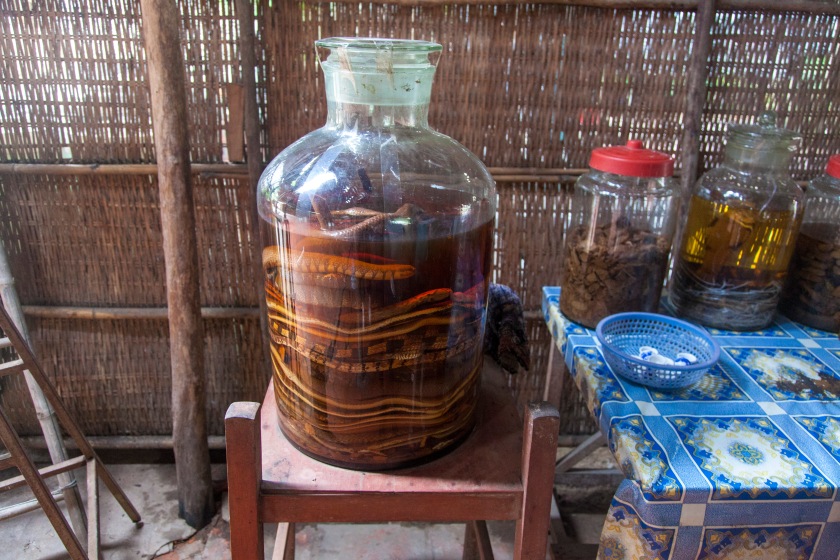
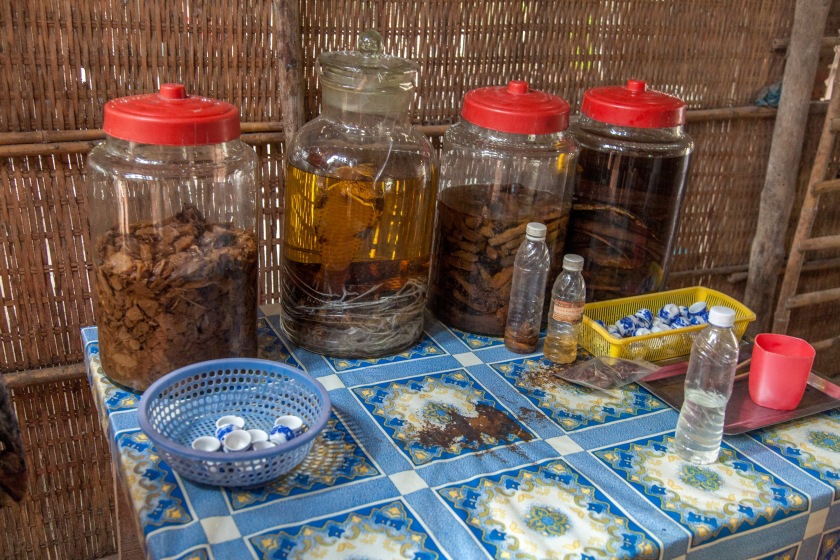
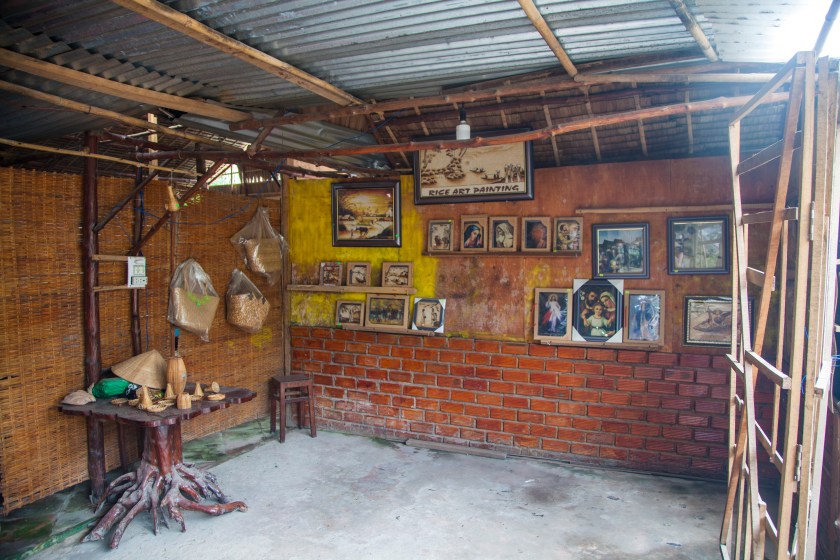
And here there’s clearly a rice business. A woman is making edible rice paper on a brazier. Not far away, rice alcohol is being produced and there are big jars of alcohol infused on bananas, lychees and even venomous snakes. Rice is also used for making pictures – every rice grain gets painted in the appropriate colour and used for the kind of mosaic as in one of the pictures below.

IMG_2224

IMG_2221

IMG_2222

IMG_2225

And a little bit further they are making puffed rice, frying it on a hot pan with hot black sand. Further on, this rice is mixed with various additives – sugar, salt or ginger, and even pieces of pork or beef – and pressed into something similar to the rice cakes that we know.

I have to say, all these braziers and pans make me feel like in hell in this not-very-cool weather, I sweat a ton, but finally we are sat under fans for a cup of jasmine tea with different sweets made of banana, ginger, sesame and peanuts. Jasmine tea here is very special, much more fragrant than, say, in China or elsewhere. Phuoc explains this by a higher proportion of jasmine flowers relative to tea. Enjoying the tea, we look around and notice that they sell all sorts of things here – coconut oil, crafts made of coconut and other trees, some ointment with cobra venom and even the famous Tiger Balm, although not in the familiar little red tin.

IMG_2214

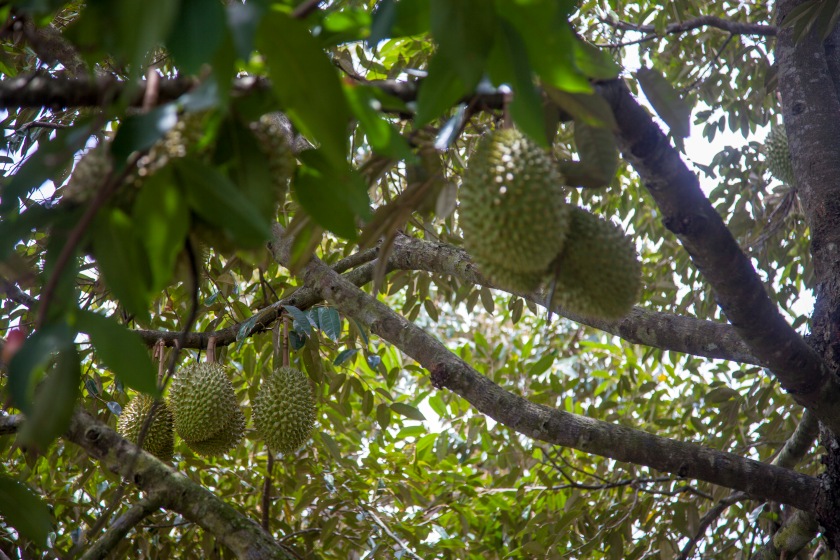
After the tea break, we again board the boat and drive on to the An Binh island, where we are supposed to enjoy fresh fruit and local music. Just as we take a step off the boat and onto the ground, we immediately feel knocked down by the smell of durian, and in a minute, we understand why: right in front of us there are durian trees, laden with large “fragrant” fruits.

IMG_2253

Fortunately, we aren’t offered any, instead on our plate we have pieces of ordinary watermelon, exotic but familiar pineapple and mango and quite unusual guava (something like feijoa and, as it turned out, closely related to it) and jackfruit (similar to durian, a bit smelly too, but, oddly enough, belongs to the mulberry family, and the pulp is bright orange, slippery and sugary-sweet, tasting like either melon or bubble-gum). At the same time, several performers entertain us with Vietnamese songs accompanied by guitar and some kind of folk instrument, and even with small performances.

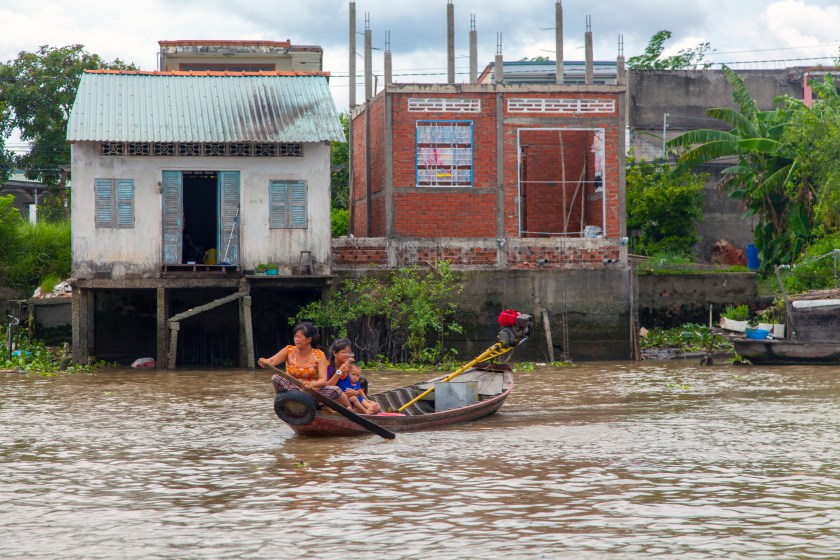
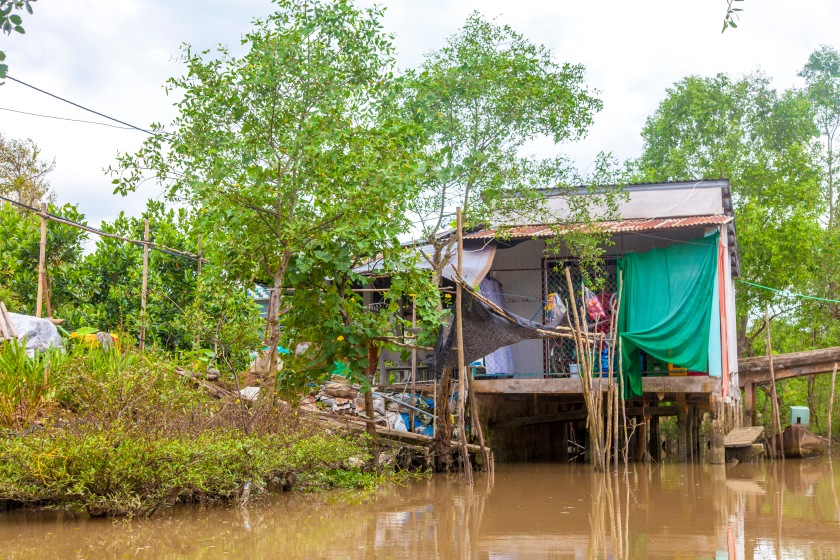
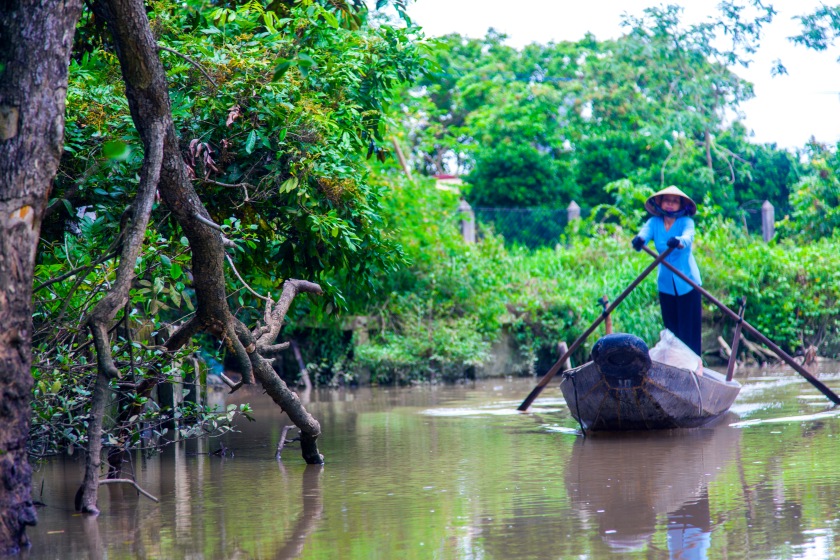
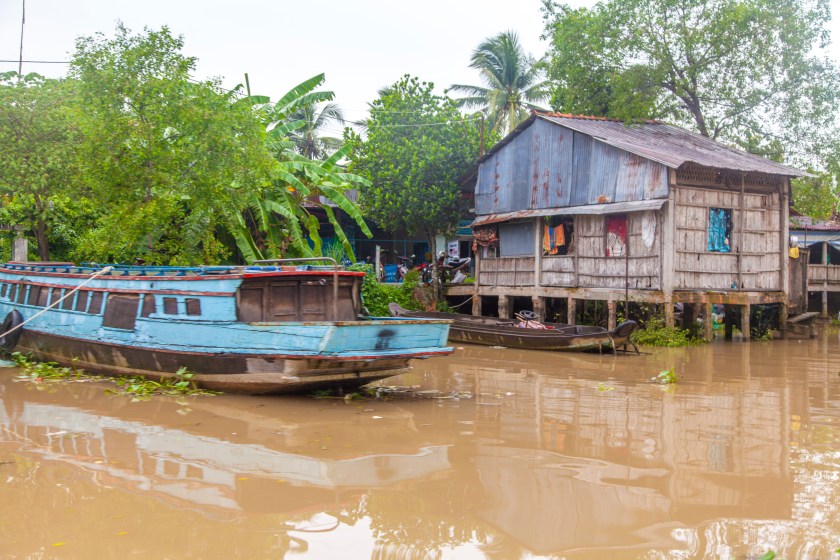
The next item on our schedule is a ride on a traditional flat-bottomed rowing boat along a narrow canal. There are cork trees growing right in the water, which, according to Phuoc, protect the soil from erosion. Generally all the vegetation around is pretty luxuriant, often covered with unfamiliar fruits. Behind the plants one can see houses on stilts. Some of them look better – obviously, the owners are making good money by growing durians – and some are pretty shabby. And yet, as I already said above, there is a particular charm to all of this, especially when you pass by a house where a nice-looking middle-aged lady is sweeping her terrace to the sound of some Vietnamese song playing at full blast.

IMG_2286

Not counting the Vietnamese song, there is a peaceful silence around, broken only by the splash of water under the oars and by boats occasionally passing by.

IMG_2282

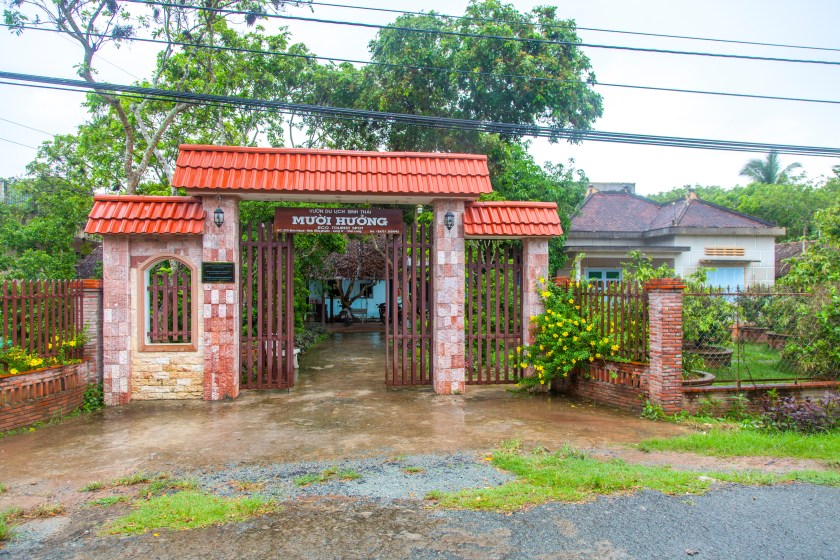
Meanwhile, the helmsman on our sampan is already waiting with young coconuts for us. Once again, so far we are very impressed with our tour, everything seems to be arranged at the highest level! And so, sipping refreshing coconut water, we headed back to the island, moored and walked to an eco-tourism complex with an orchard, where we were served lunch. The lunch was home-cooked and pretty tasty, consisting of fish that had to be wrapped with vegetables in rice paper and dipped into fish sauce, deep-fried spring rolls, grilled shrimps, vegetable soup (we liked it the least) and pork with rice. Fish sauce, I must say, is an extremely smelly substance, but it tastes a lot better than it smells. Phuoc said that the Vietnamese fish sauce is much better than the Thai one, because it is made of anchovies, while in Thailand it’s made of mackerel.

IMG_2298

We washed it all down with Vietnamese coffee, stronger than many varieties of coffee, but less strong than Turkish coffee. That’s when Phuoc told us that the tradition of drinking coffee is a French colonial heritage, as well as colonial architecture and baguettes, and this, in her opinion apparently shared by many Vietnamese, exhausts the list of positive effects of colonisation, absolutely not offsetting the complete plundering of royal treasures.

We also starting talking about the Vietnam War – how Saigon was much more developed, more or less in step with Singapore and Hong Kong, and then, destroyed by the war and the communist regime, fell hopelessly behind – and about relations with China, which are much better than in the 80s, but, according to Phuoc, quite dangerous and could potentially lead to the occupation of Vietnam by China.

Actually, we went into these lengthy conversations for one simple reason: while we were having lunch (luckily, under a canopy), a heavy downpour started. I have to say that we’d been lucky with the rain from the very beginning – all weather websites I know were forecasting it right in the morning and for the whole day. And it only started when we’d already finished sightseeing.

IMG_2301

After lunch, the only thing left was a boat ride to the town of Vinh Long, where our driver should have already been waiting for us. The rain kept pouring. Fortunately, the boat also had a canopy (unlike the flat rowing boat we were on literally a couple of hours ago), but at some point a wind broke out forcing us to put on raincoats so as not to get wet. Because of the rain, we didn’t stop at the Vinh Long market, and headed straight to the pier. As there were only a few metres remaining to the pier, the waves became so strong, making the boat reel so much that I seriously feared that it would scoop up water and capsize. But thank God, it didn’t, and we drove off back to Ho Chi Minh City. The rain was pouring non-stop throughout the whole two-and-a-half-hour drive, but not as intensely as before.

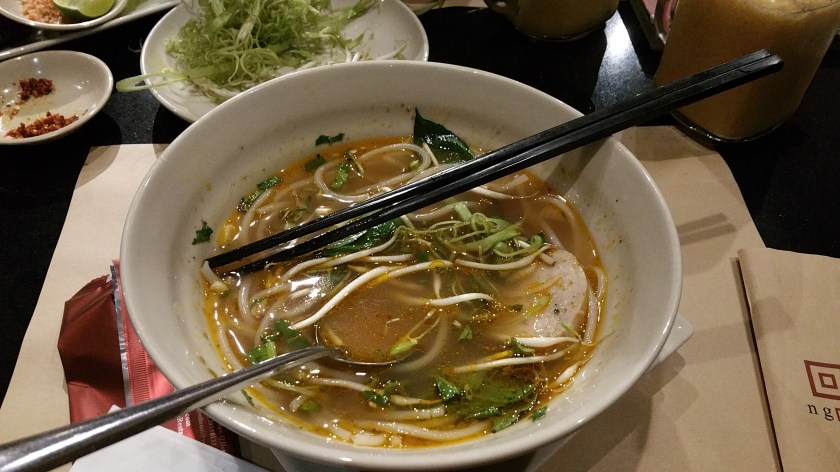
Today we decided to have dinner at the Ngon restaurant, recommended by Phuoc, which turned out to be a good choice. The restaurant is a ten minute walk from our hotel and is located in that fancier area we didn’t reach yesterday. The interior is very pretty with palm trees everywhere. The menu has several sections: Japanese, Thai, Chinese, Korean and Vietnamese, and of course we went for the latter – aren’t we in Vietnam after all? I had bun bo hue (spicy beef soup with rice vermicelli and greens – more precisely, it is the chili pepper served separately that makes it spicy), chicken thighs barbecue and for dessert, something like banana cake with coconut milk – not sweet at all, which I really liked. Generally, I’m enjoying the Vietnamese cuisine and finding it somewhat less intrusive compared to, say, Chinese (which I like as well but tend to have had enough of soon) – mainly because dishes taste precisely like their ingredients and all sorts of sauces and spices are served separately: you can add/dip/sprinkle if you want, but you don’t have to. It all cost us twice as much as yesterday’s dinner (almost 30 USD) – it’s a fancy restaurant after all, but we also ate a lot more.

20170606_192640

Posted in Asia, English, Ho Chi Minh City, Vietnam

Vietnam – Day 1

РУССКОЯЗЫЧНАЯ ВЕРСИЯ ПО ЭТОЙ ССЫЛКЕ. CLICK HERE FOR RUSSIAN VERSION.

5 June 2017

Our Vietnamese trip began last night, when we left Baku for Doha and from the latter, after a 2-hour connection, flew straight to Ho Chi Minh city. The flight, albeit a long one, felt okay, in many respects due to being an overnight one: we literally got on, sat down, went to sleep, woke up – and suddenly it was already brunch time with just two hours remaining.

In general, everything went pretty smoothly, even though getting the visa took ages. First, we had to fill out a long form asking about everything one could possibly ask about, including religion and information about family members. Then we handed the documents to the officer and were asked to wait. And wait. And wait again. In total, the waiting time was less than an hour, but it felt like eternity.

We were anxious that the travel agency representatives wouldn’t wait for us, but obviously they were aware of the speed of the visa issuing process, so of course, our fears were groundless – we were greeted by a nice lady called Phuoc, picked up by an air-conditioned car and taken to the travel agency office to settle the outstanding payment balance. On the way, she showed us some flashcards with basic phrases in Vietnamese and told us about the history of Ho Chi Minh city and how it was only in the 1970’s when it was called so, because its previous name, Saigon, was too reminiscent of the Vietnam war. By the way, the name Saigon, as per Phuoc, is the modified form of the old Khmer “Prey Nokor” (yes, yes, don’t be surprised!), which used to be the name of the city in its pre-Vietnamese (i.e. Cambodian) times.
IMG_2171

The office turned out to be a small room with a couple of computers, piled with boxes and smelling of mothballs for some reason, where we were warmly welcomed, served iced tea, handed an ancient Nokia with a local sim-card to stay in touch with them, and, of course, charged the outstanding payment. Overall, for the time being, it feels like the agency is taking good care of us!

Then we were brought to the Lavender Boutique Hotel, where they left us – nothing is planned for today and we have the evening free. So after freshening up, we went out to explore the surroundings and get some dinner. The moment we stepped out into the street, we felt like in a bath – the air temperature is about 30 degrees Celsius and it’s very humid. The vegetation around is quite tropical with lots of greenery, palm trees, etc.
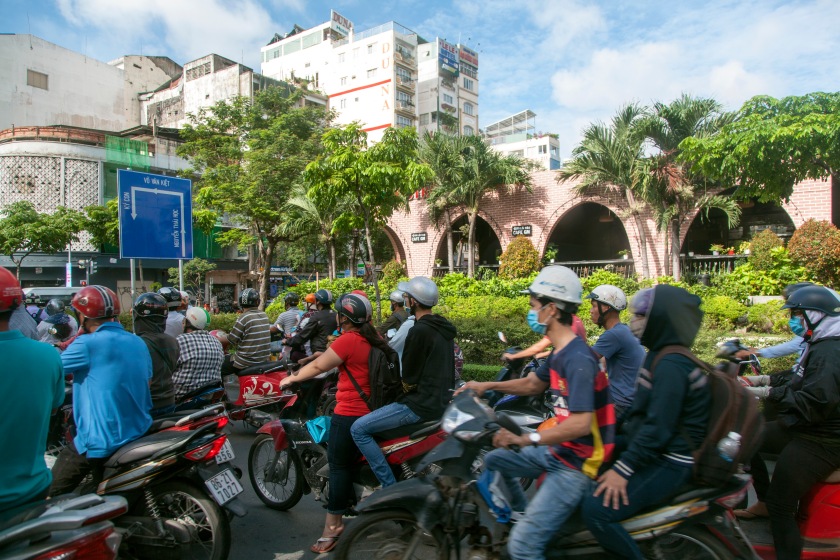
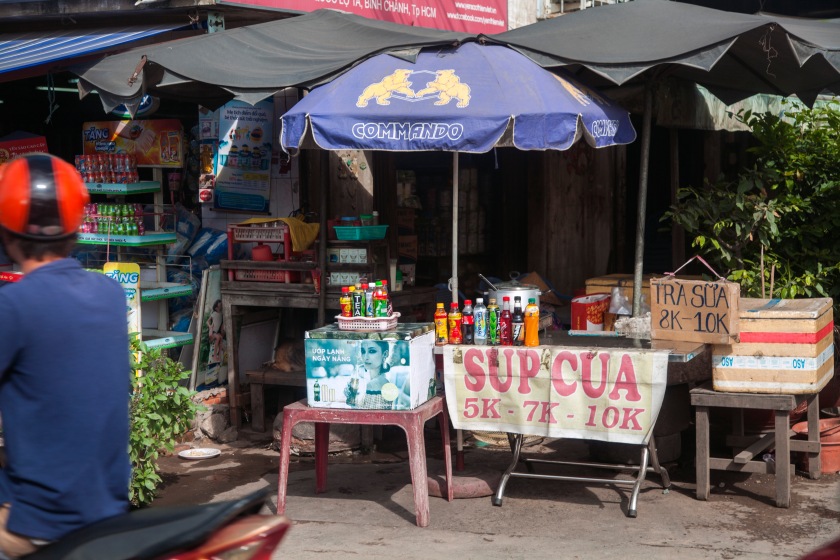
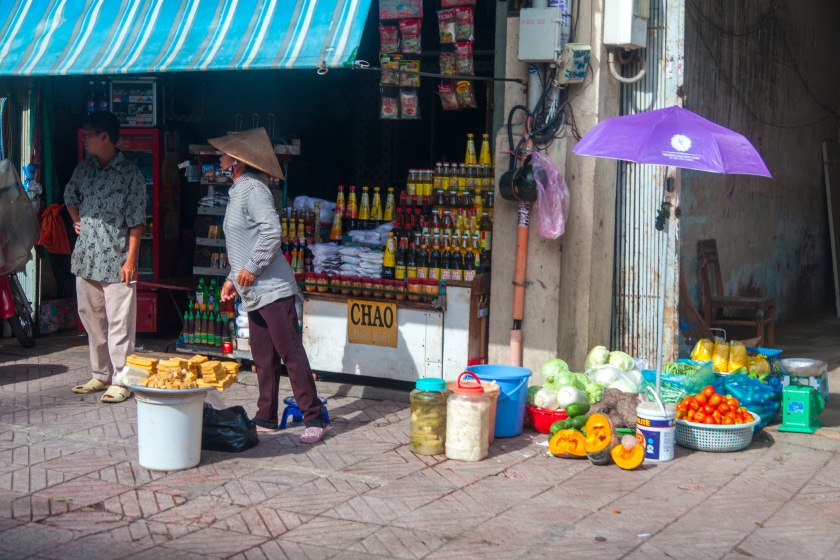
Walking around proves to be very, very difficult. Firstly, one must take into account the crazy traffic: most people here don’t drive a car, but a scooter, which there are lots and lots of. And if car-owners at least follow some traffic rules – that is, stop at the red light and before zebra crossings – you can’t expect the same from motorcyclists, so you have to manoeuvre between them literally risking your life! They even drive on sidewalks! Secondly, the sidewalks themselves are tiled pretty badly – chicken soup to our Bakuvian souls! – and are very uneven. And thirdly, the sidewalks, which aren’t very wide anyway, are clogged up with all sort of things: parked motorcycles, low stools with people sitting on them, street food and fruit stalls. And very specific scents are exuded both by the food and the fruit, as among the latter, durian dominates confidently with its unique smell, and it is at every corner!

IMG_2176

IMG_2181

IMG_2178

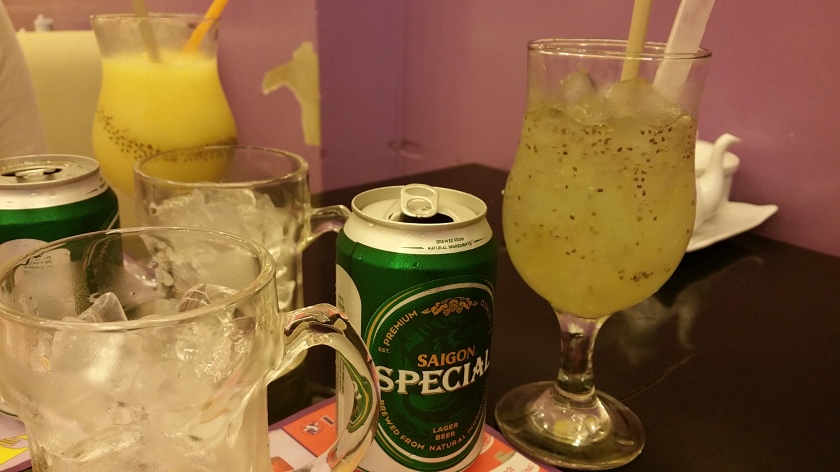
Among all this unglamorous disorder, we discover a nice-looking restaurant, where, as we can see through the window, most customers are Vietnamese but there are some foreigners too, which we perceive as a good sign: the place is, therefore, not very touristy, but still foreigner-friendly. We tried local beer, some drink made of aloe vera with chia seeds and rice noodles with pork, cucumbers, peanuts and something else, and everything was tasty. And it all cost us less than 15 USD for two!

20170605_181240

After dinner we tried to walk to the Saigon River, which was supposed to be nearby, but had to give up as a terrible shower started pouring and didn’t stop for a good half an hour. Our Singapore raincoats, which we’d prudently taken with us, came in handy, but didn’t help much – we still had to wait under canopies every time the rain intensified (that is every 5 minutes), until we finally got our feet so wet that we decided to turn back, almost making it to a fancier-looking area than ours. The people here are obviously accustomed to downpours, especially since now it’s the rainy season – everyone has raincoats, huge umbrellas, even scooters are covered with waterproof covers. While waiting, by the way, we walked into a shopping centre selling clothes, which even smelled of cheap clothes – not a sight that can surprise us, who had seen the Baku street markets in underground passages.

20170605_192715

20170605_192759

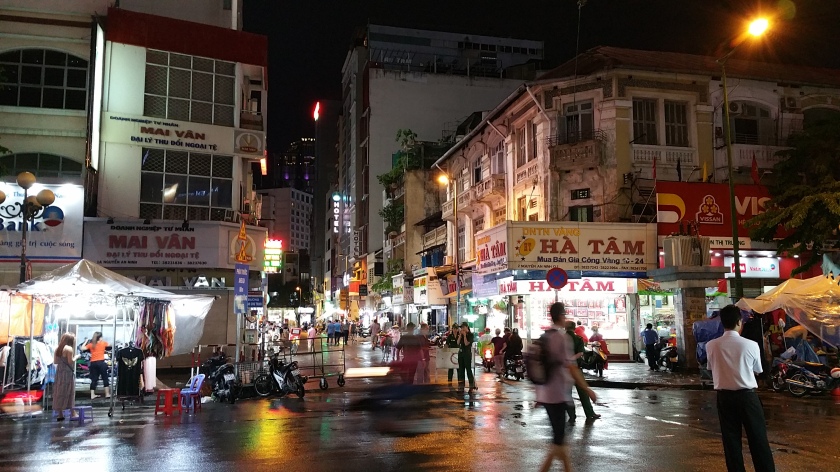
So here are my first impressions of the city: very colourful, much poorer than the previously seen Asian cities (such as Singapore or Hong Kong or Shanghai), scooters swarming all around and everywhere smells of durian.

20170605_193304

Posted in Europe, Georgia

Georgia – Day 2

РУССКОЯЗЫЧНАЯ ВЕРСИЯ ПО ЭТОЙ ССЫЛКЕ. CLICK HERE FOR RUSSIAN VERSION.

27 December 2014

We dedicated our second day to a tour of Tbilisi. First of all, we were taken to the Turtle lake which is located in the posh Vake district. The lake is called like that for a very obvious reason – there are small turtles on its shores. The lake was coated with a thin layer of ice, and the park impressed us with its clean pine air and the sources thereof.

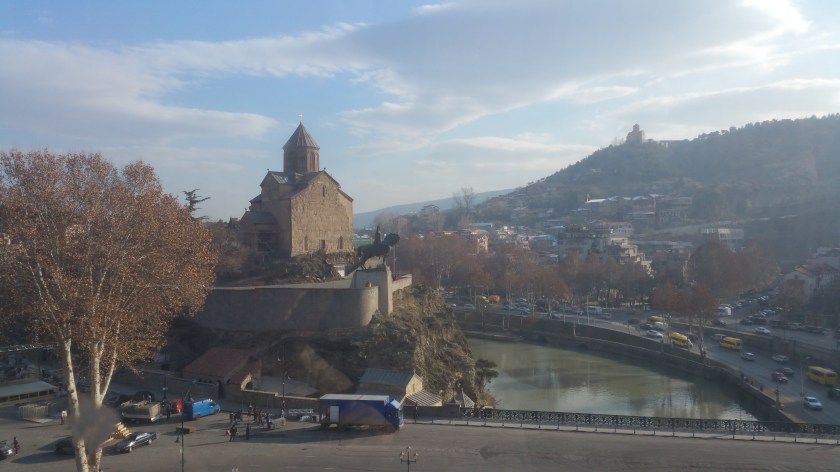
Yesterday we thought that Tbilisi was pretty small, but when we were taken to see it from one of the highest points today, so that not only the old part, but also the new districts were visible, it turned out that the sizes are much larger and the city, extended in length, lies in the cleft between the mountains. In short, the size of the city could be seen well, but the details could not really be made out – it was very foggy. On the way to this lookout point we saw a very original building of the 112 rescue service in the form of a flying saucer.

20141228_120721
One of the planned visits was the Pantheon – the burial place of famous Georgian figures of culture, science and politics – situated on the slopes of Mount Mtatsminda. More precisely, it was our guide who told us about the Pantheon, as we only knew about the graves of Griboyedov and his wife, Nina Chavchavadze. It turns out that these very graves initiated the Pantheon. We came as close as we could by car, and then had to walk, making pretty steep climbs. The guide was encouraging us by showing the place of destination. From this high point, we looked at Tbilisi again, from a different perspective now, and suddenly it turned out that the grave of Griboyedov was just behind us. The grave had a very touching monument to a weeping woman clinging to a cross, and a no less touching famous inscription: “Your spirit and achievements will be remembered forever. Why still does my love outlive you?” With regard to the Pantheon itself, I found all the graves interesting, even though I had only known the names of Stalin’s mother, Zviad Gamsakhurdia and Nodar Dumbadze.

20141228_121124

20141228_121322
After such a spiritual visit we moved on to a purely prosaic activity – food consumption, for the purpose of which we were taken to the Agmashenebeli avenue (former Plekhanov street). By the way, I really liked the avenue, even more than the Rustaveli ave. I can’t now recall the name of the small restaurant we went to, but the interior was purely Georgian, with antique items, such as cameras and phonographs, and reproductions of Pirosmani’s paintings on the walls (we ate our khachapuris right next to the famous “Feast of Five Princes”).

If yesterday we visited ancient churches and temples, today, having driven us through a quarter that was very reminiscent of the Kubinka and generally the area of Teze Bazar in Baku, Zviad brought us to a modern temple, visible from almost any point of Tbilisi – Tsminda Sameba, the Holy Trinity Cathedral. It occupies a large area, around which you can still see construction works, like columns being built and stone carving works going on.

20141228_140522
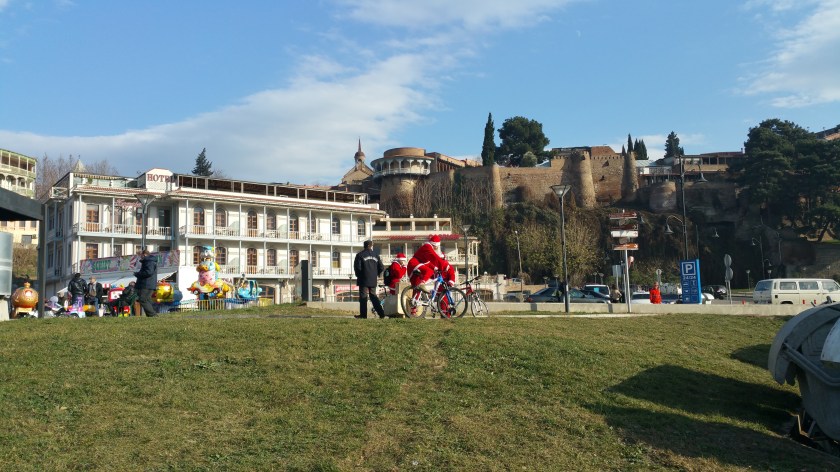
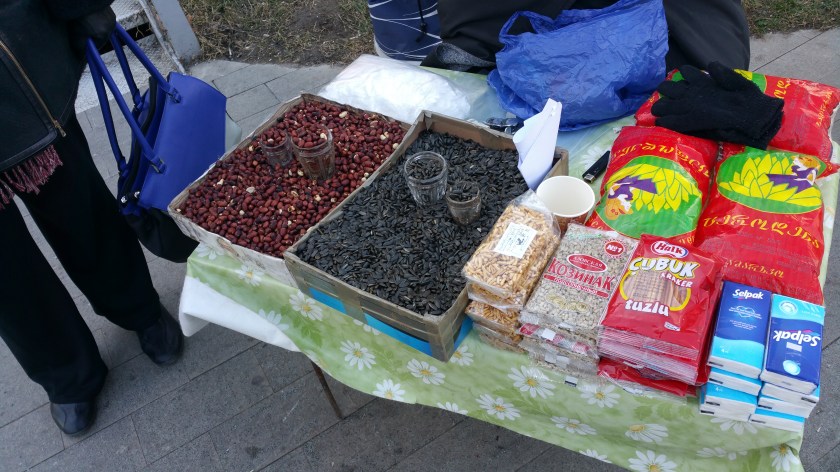
Apparently, the plan of our guide consisted of alternating spiritual visits with pure entertainment – undoubtedly the cableway to the Narikala forthress at the same Mount Mtatsminda was part of the latter. It is not at all scary here – unlike the one I took to the Great Wall in China, where you literally float over the abyss, risking dropping your shoes there (while also afraid to drop yourself!). Here you just sit in a closed cabin for 5-6 people and peacefully look at the Kura and its banks underneath. We didn’t get to see the fortress, but had the opportunity to be photographed with a falcon, and then descended to the Europe Square using the same cableway. We saw a few people dressed as Santa Clauses riding bicycles, and also something that made me really emotional – street vendors of roasted peanuts and sunflower seeds, which are measured with a large or a small faceted glass and then sold in paper cornets: where are the days when we had the exact same thing in Baku?..

20141228_145438

20141228_143903

20141228_144909

20141228_150224

20141228_150422
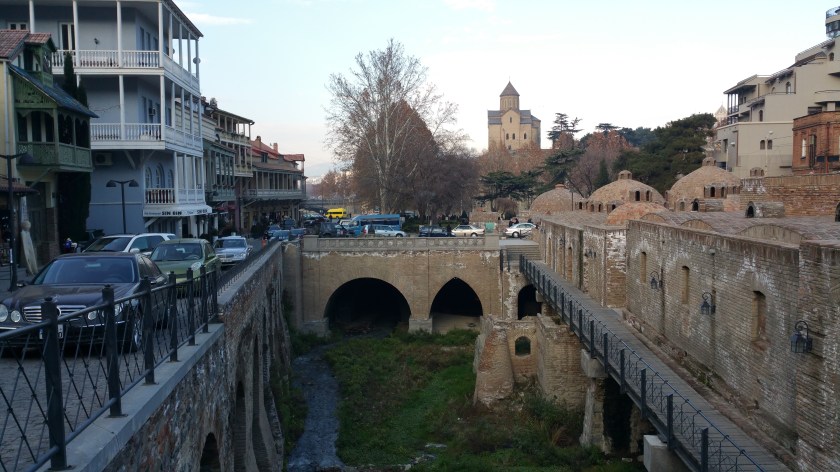
Both today and yesterday we saw a lot of purely Tbilisian houses, clinging on the steep cliffs over the Kura, with a lot of balconies. Today we also went into one of the old quarters. Here we found the famous sulfur baths, which we could sense even from afar for the very specific smell of hydrogen sulphide. We walked up to a waterfall in a narrow crevice.

20141228_151501

20141228_152154

20141228_151855
Ever since yesterday we really wanted to buy churchkhela – the traditional sausage-shaped candy made of grape must with nuts, but Zviad had told us not to buy it not just anywhere but in trusted places, and so he took us to one. The tiny convenience store seemed to have a whole market squeezed in it: they had meat, and cheese, and pickles, and a variety of fruit-vegetables, and well, of course, the coveted churchkhela. Unluckily, we had to wait for the sales assistant of this particular department for quite a while – it turned out that he had been queueing at a supermarket nearby to buy a box of champagne.

Towards the end of the day we went up the Mtatsminda for the third time, this time by a cable car. The first stop was near the pantheon we’d already seen, and the second one led us to a large park, with lots of swings and carousels, with New Year’s songs coming from the speakers, with a house with upturned balconies – as if it was standing upside down. And again I was wrapped in nostalgia – the Baku Boulevard in the days of my childhood looked exactly like this, even the benches were similar. But it’s not that I’m trying to say that anything around looks old and shabby, straight from those times – the park is exactly maintained like this, just as the buildings are restored, as I said before.

20141228_165328
Overflowing with impressions, we ended the day in the khinkali restaurant right near the hotel, where we tried different kinds of khinkali: with meat, mushrooms, cheese – and were very pleased. Thus, our stay in Tbilisi was brief, but very impressive.

Posted in English, Europe, Georgia

Georgia – Day 1

РУССКОЯЗЫЧНАЯ ВЕРСИЯ ПО ЭТОЙ ССЫЛКЕ. CLICK HERE FOR RUSSIAN VERSION.

27 December 2014

We arrived last night, and found Zviad, the guide meeting us, very easily, so logistic-wise everything went really smoothly. The smooth start actually began at the passport control, where each of us was handed a bottle of Saperavi wine – turns out, they are given out to all foreigners entering the country, isn’t that surprising? Zviad drove us a bit around the night Tbilisi, which immediately aroused nostalgia – the non-central streets seemed very similar to the Baku of my childhood. We got particularly excited when shown the river Kura and then the Avlabari neighbourhood, and started quoting the Khanuma movie.

20141227_085802

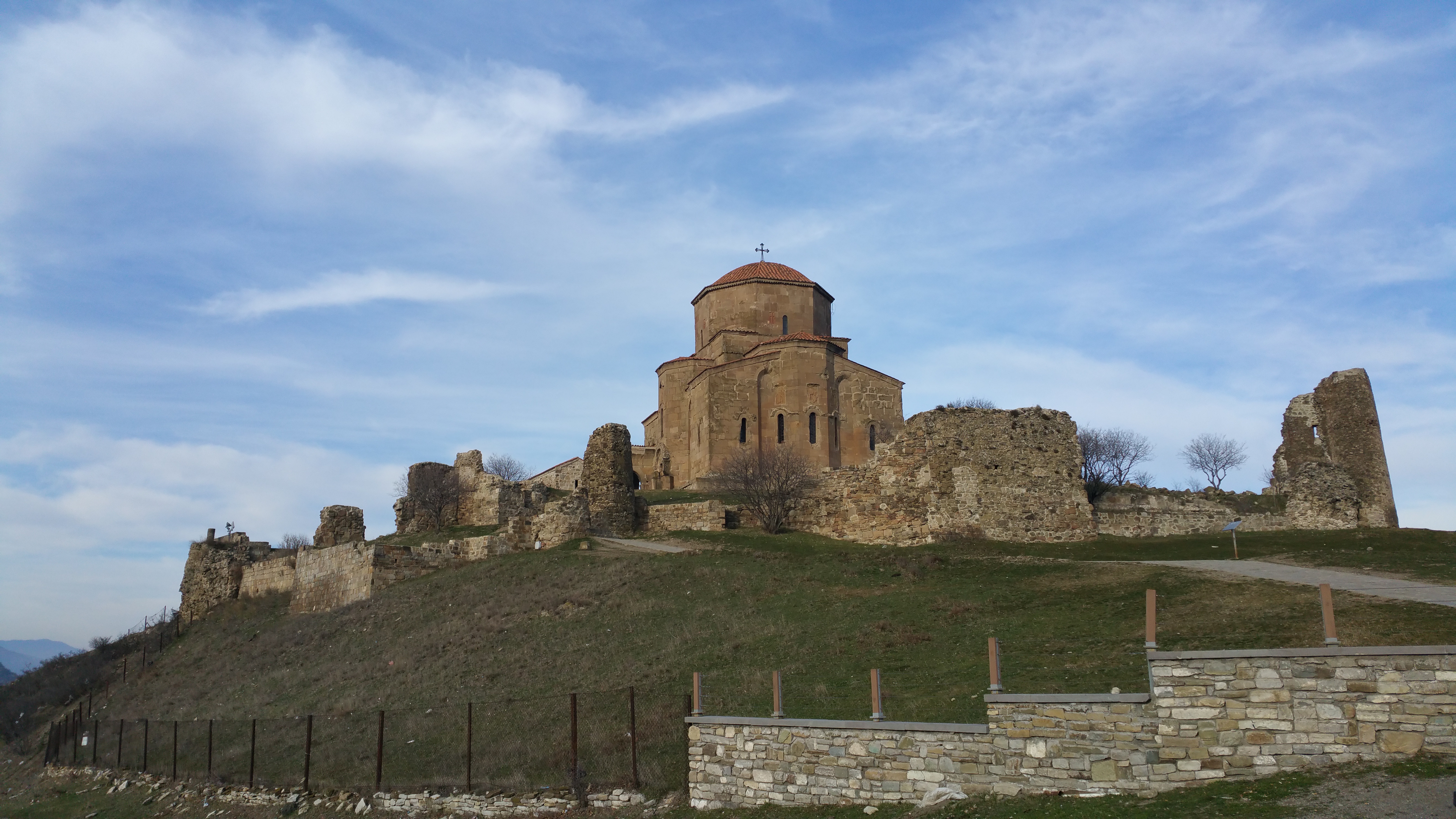
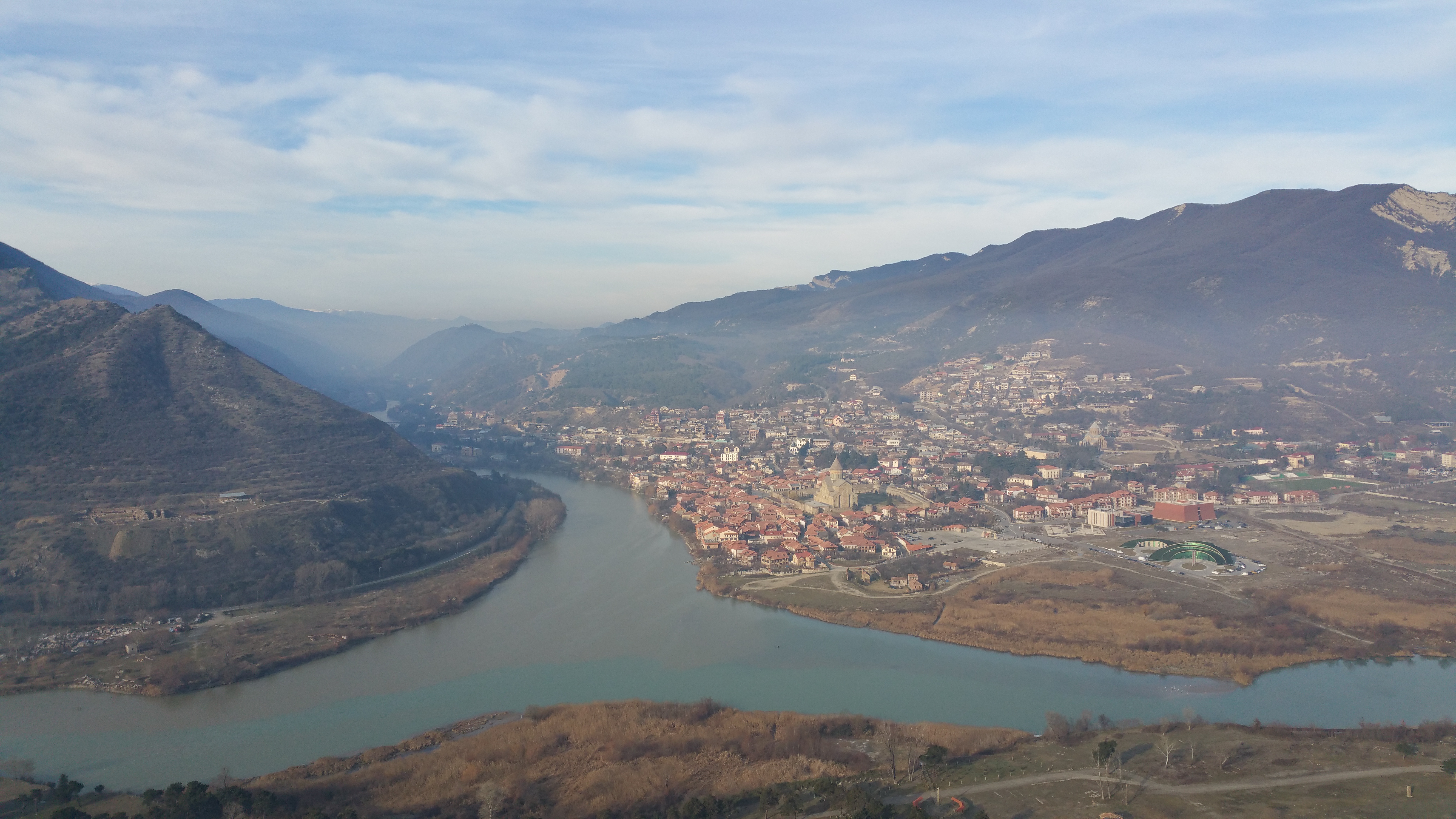
It was decided that on the first day we would make a sortie out of Tbilisi and leave the city sightseeing for the second one. The weather promised to be nice (and honestly fulfilled the promise), even though it was quite chilly near the Jvari (meaning ‘cross’) monastery where we headed first, and the puddles were flecked with ice. The monastery is located atop a rocky mountain, from which one can see the Mtskheta town and also exactly what was described in Lermontov’s poem ‘The Novice’ (‘Mtsyri’): “…where soundingly together flow Aragva and Kura – the place, where, like two sisters, they embrace…”, i.e. where the blue Aragvi merges with the yellow Kura, and the line separating these waters is very clearly noticeable. The reason why the monastery is called the Holy Cross monastery is not because it has the shape of a cross, as one might expect, but because it was here where St. Nino of Georgia, a female evangelist, erected a cross. The legend says that this very cross lies in the foundation of the monastery.

20141227_104035

20141227_104044

20141227_104539

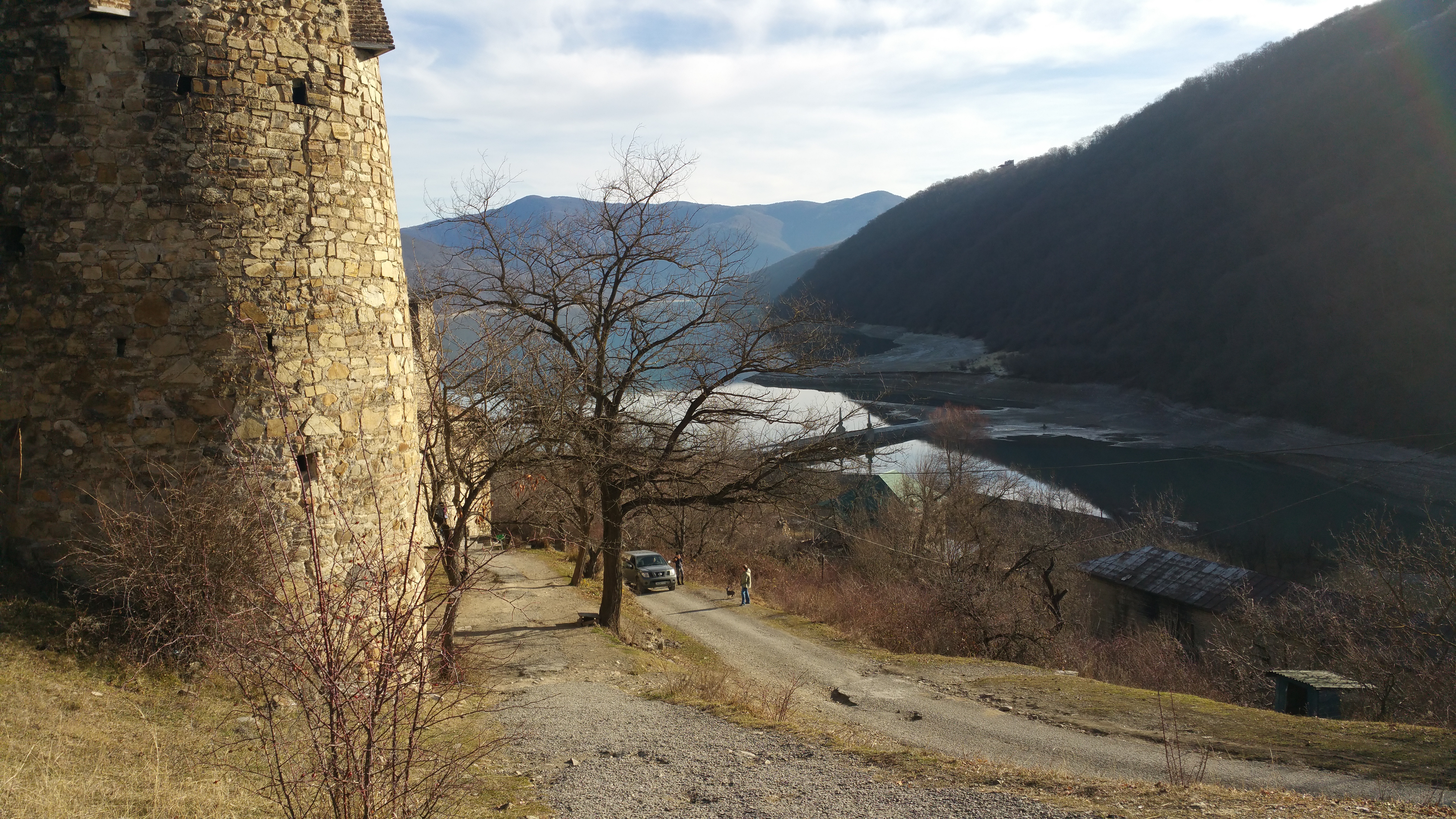
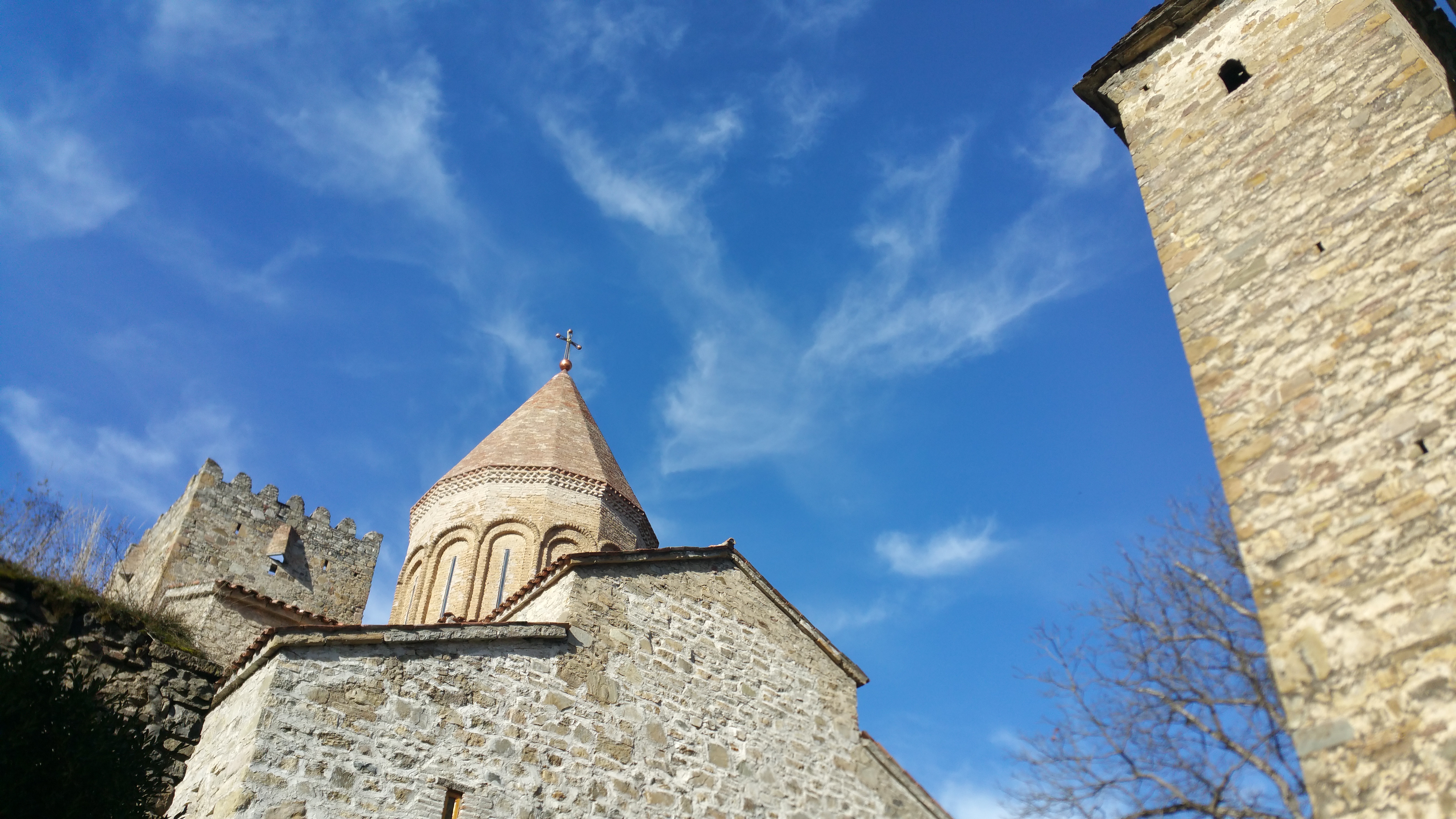
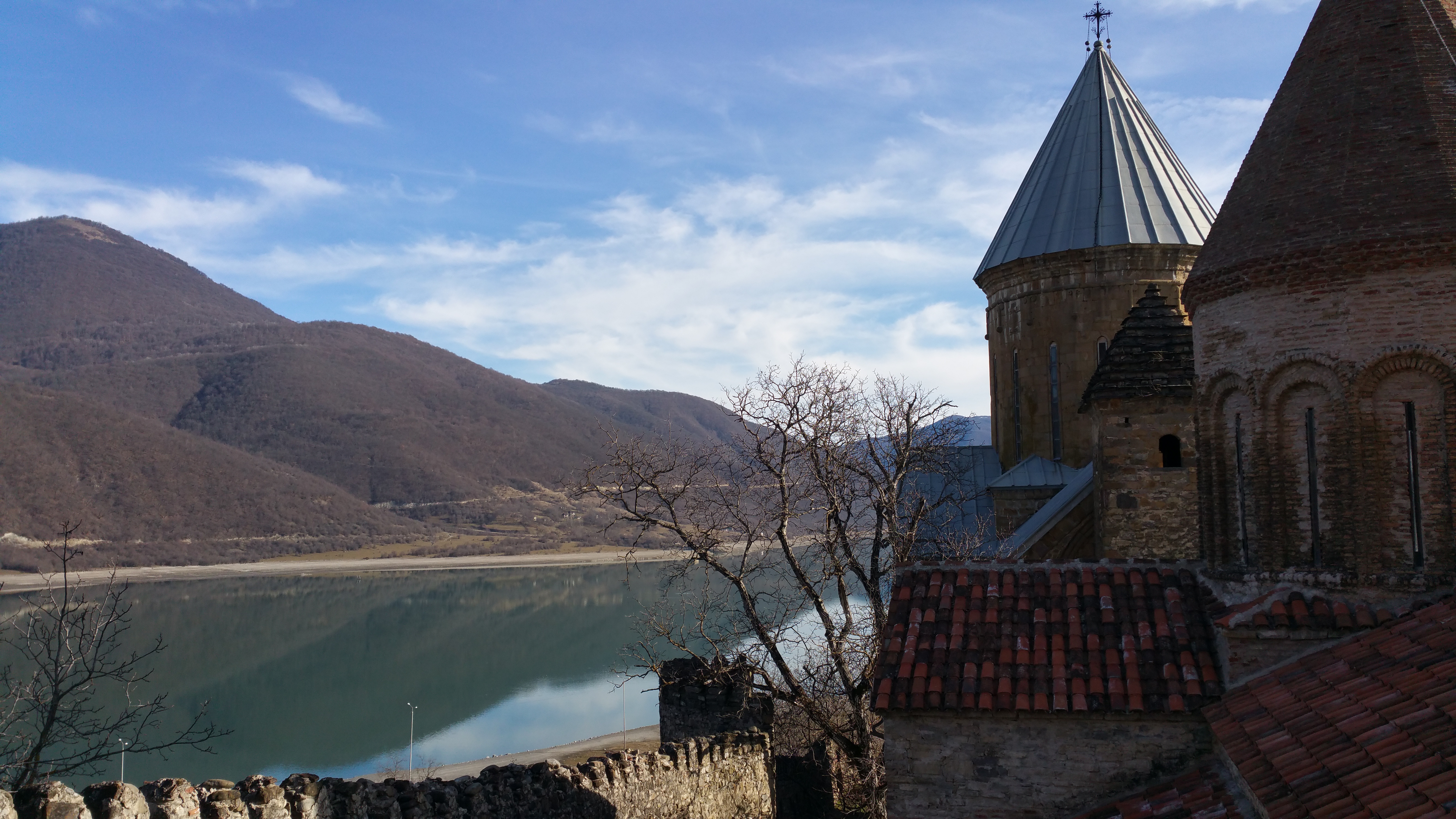
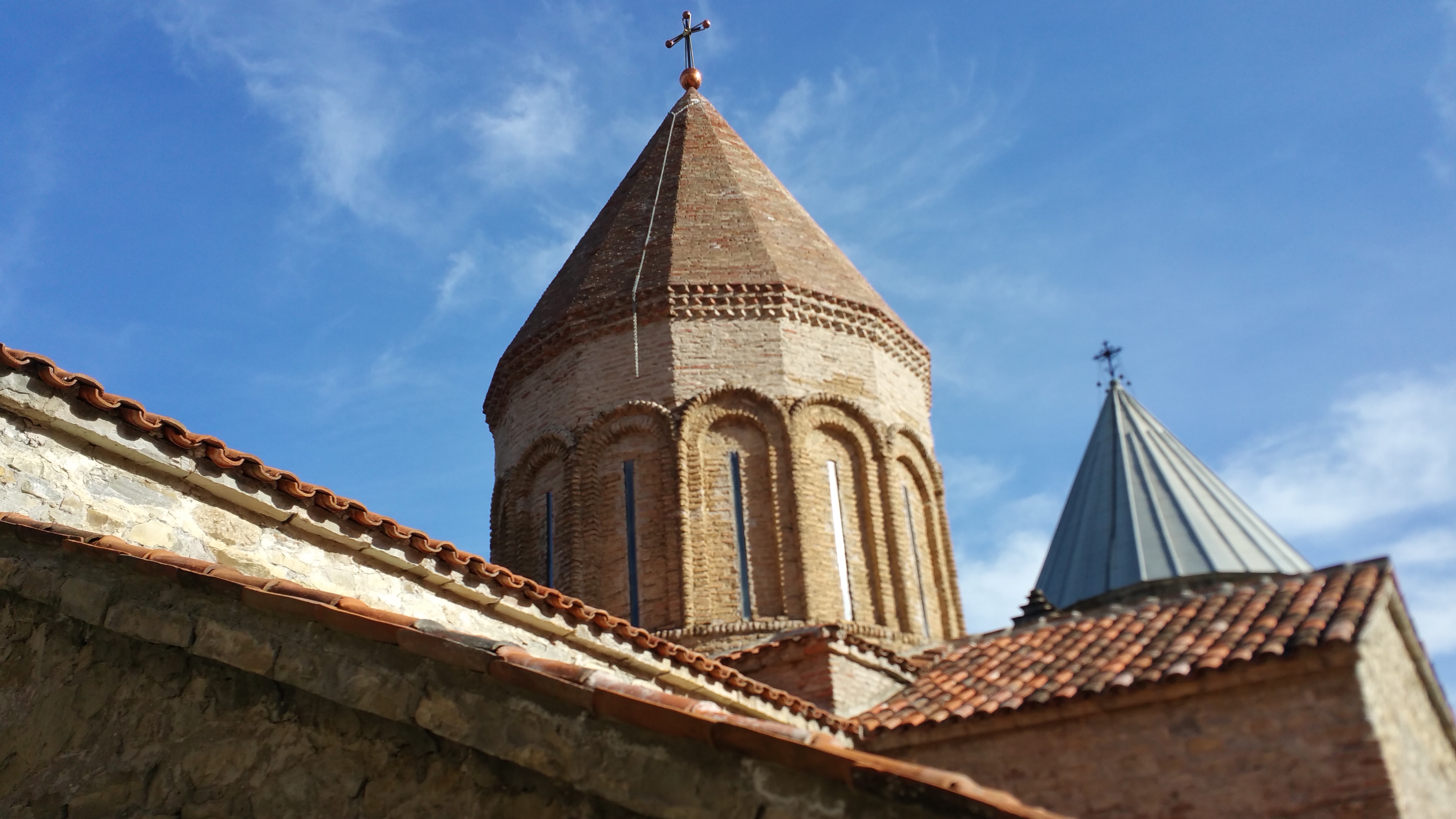
We drove off along Aragvi, on the Georgian Military Highway, to see the ancient fortress of Ananuri. The places around were very picturesque, even though it’s not the best season now – in autumn or spring it must look absolutely spectacular! On our way we took pictures of the Zhinvali reservoir from various angles. It’s also very beautiful, but that’s somewhat overshadowed by the fact that to create this beauty (which of course has practical use too!) three villages had to be flooded. We visited one of the churches in the castle complex, while the other one was closed. Zviad told us that once all the walls in the first church were painted with frescoes, but then during the stay of a Russian garrison in the fortress, they were all covered with a thick layer of lime. Relatively recently a small area was cleared and a really impressive fresco of St. George was discovered. I climbed to the top of the tower, which was quite difficult and scary, considering the narrow passages and steep, broken stairs. But I got the chance to look out of a loophole, although it was so narrow that I couldn’t really see much.

20141227_121051

20141227_121232

20141227_121726

20141227_121742

20141227_121846

20141227_121942

20141227_122617

20141227_123401

20141227_123628

20141227_125548

From here we drove back to Mtskheta and stopped in the old part of the city. In general, as we noted, it is peculiar to Georgia that most of the ancient and old buildings are restored in their original form. Therefore, all the houses are colorful, neat, with traditional Georgian balconies and look very good. There are little shops selling souvenirs, wine, churchkhela (Georgian sweet “sausages” made of fruit and nuts) with sellers strongly beckoning tourists to drink with them all along the road to the Cathedral of Mtskheta. Our guide even argued with someone, reproaching him for trying to “recapture” his guests.

.

20141227_133702

20141227_133713

20141227_133745

20141227_141233

20141227_141303

20141227_141404

The Cathedral of Mtskheta, or Svetitskhoveli (translated as “the life-giving pillar”) is a patriarchal cathedral with the seat of the Patriarch standing right in the centre thereof. It’s a burial place of the last kings of Georgia and various princes, including a few from the Mukhrani branch of the famous Bagrationi dynasty. The Cathedral is one of the three main cathedral in country, symbolising the central Georgia, or the Kartli region. The Alaverdi temple in Kakheti, respectively, represents the east of Georgia and the Bagrat temple in Kutaisi represents the west. Even in Soviet times, it was common among the youth of Tbilisi to wed in Svetitskhoveli, so every spring after Easter endless wedding processions stretched from Tbilisi.

20141227_134636

Instead of the anticipated three hours we spent five on the road, by the end of which we were absolutely starving. We wanted to taste some proper Georgian cuisine, and on our return to Tbilisi we were taken to a restaurant called “Zakhar Zakharich”. The food there was really delicious. Our menu consisted of the kharcho soup, Imeretian khachapuri (cheese pie), aubergines with walnuts, ojakhuri (roasted pork with potatoes and onions), shkmeruli (fried chicken with lots of garlic) and jigar (liver) on the grid. As for the wine, we had red Saperavi in pitchers. In short, we had a great treat and only paid 127 GEL for four of us, which makes about 70 USD , or 54 AZN.

The only thing we could do after that was taking a two-hour nap. In the evening, we walked along the holiday-decorated Rustaveli Avenue, which was right around the corner from our hotel. It was beautiful, but in many ways reminded of Baku – potholes here and there, lots of construction, cars on the sidewalks, cigarette smoke everywhere – as most of the population seems to smoke. However, the walk was still nice.

Posted in Asia, China, English, Hong Kong

Hong Kong – Day 5

РУССКОЯЗЫЧНАЯ ВЕРСИЯ ПО ЭТОЙ ССЫЛКЕ. CLICK HERE FOR RUSSIAN VERSION.

4 December 2013

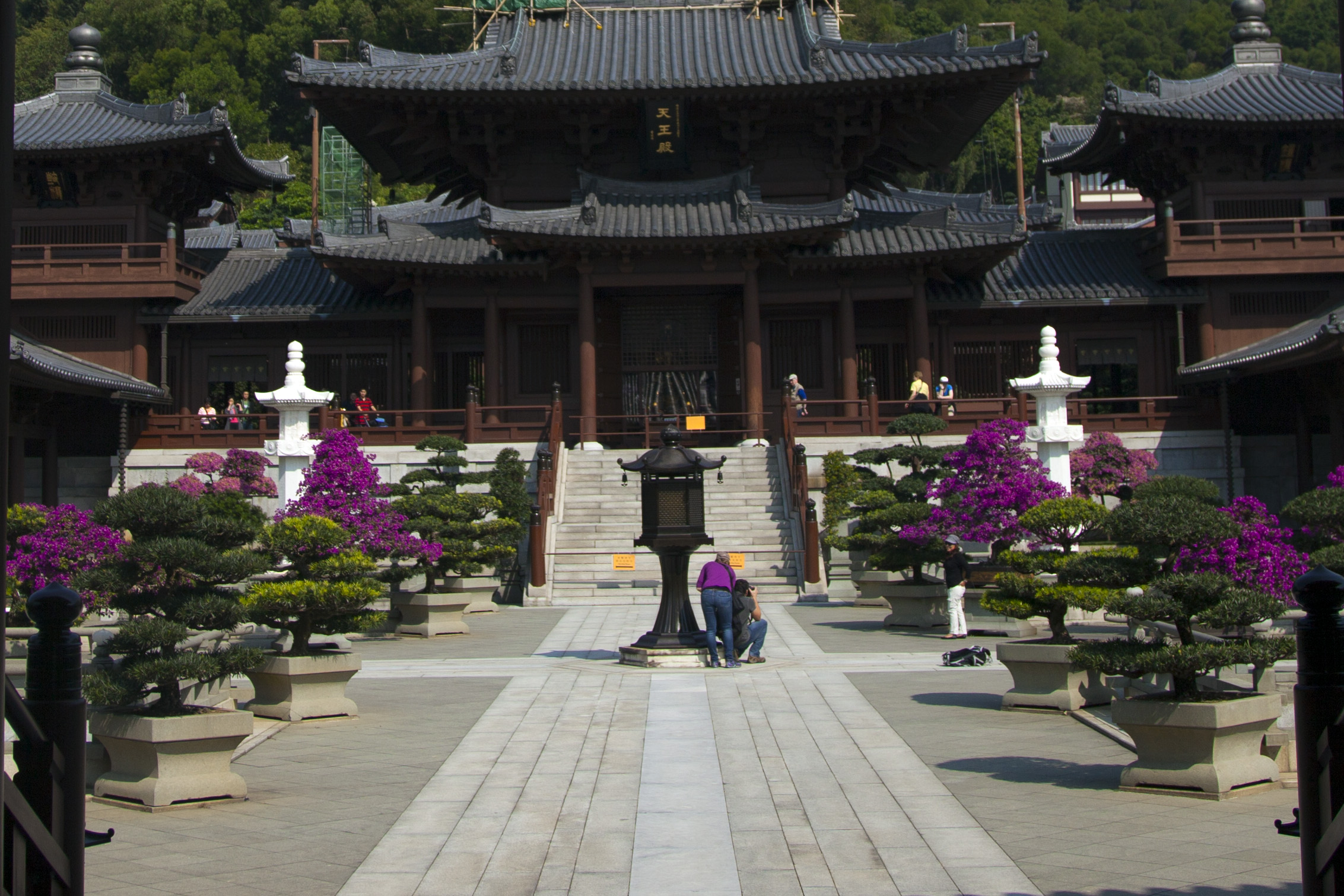
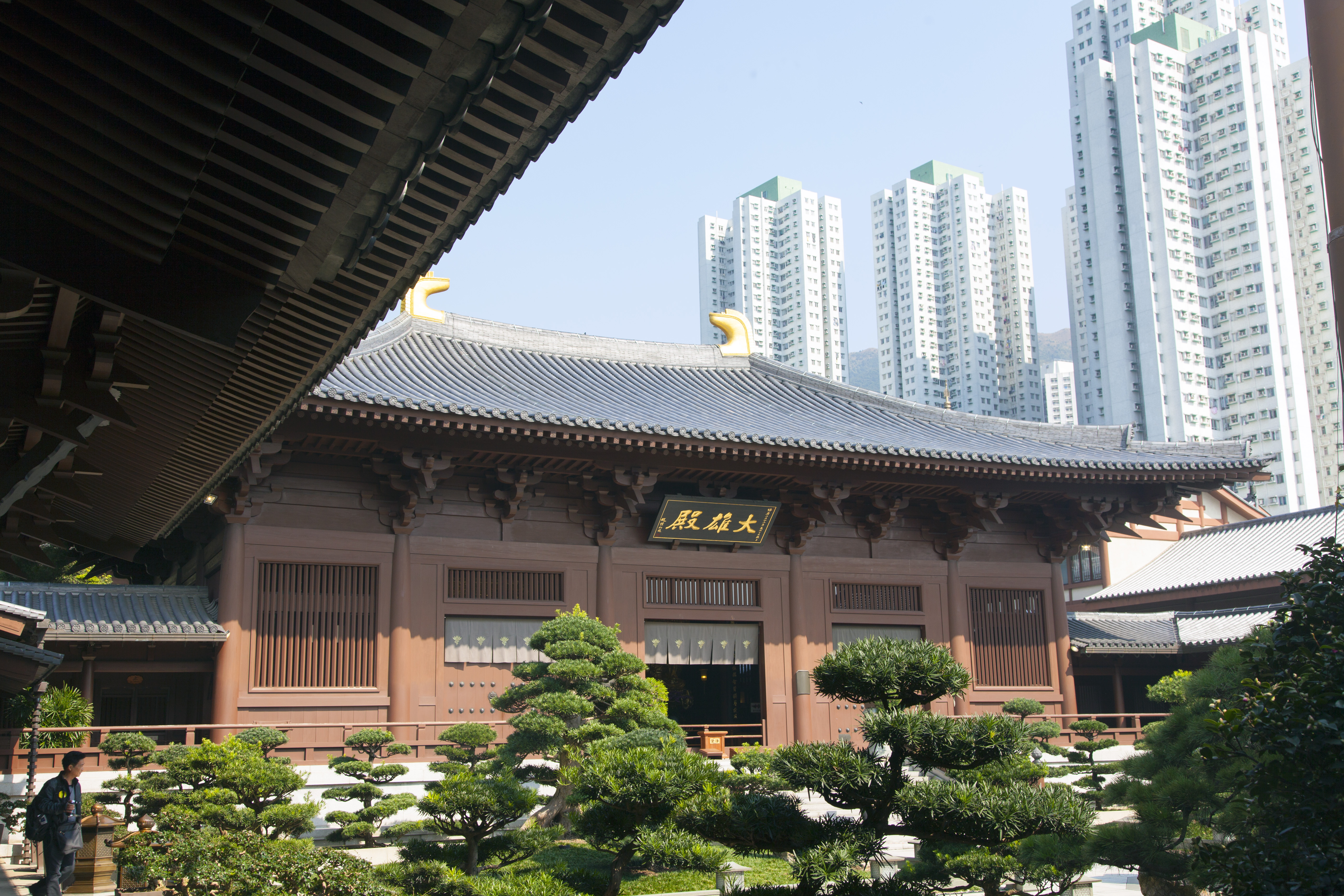
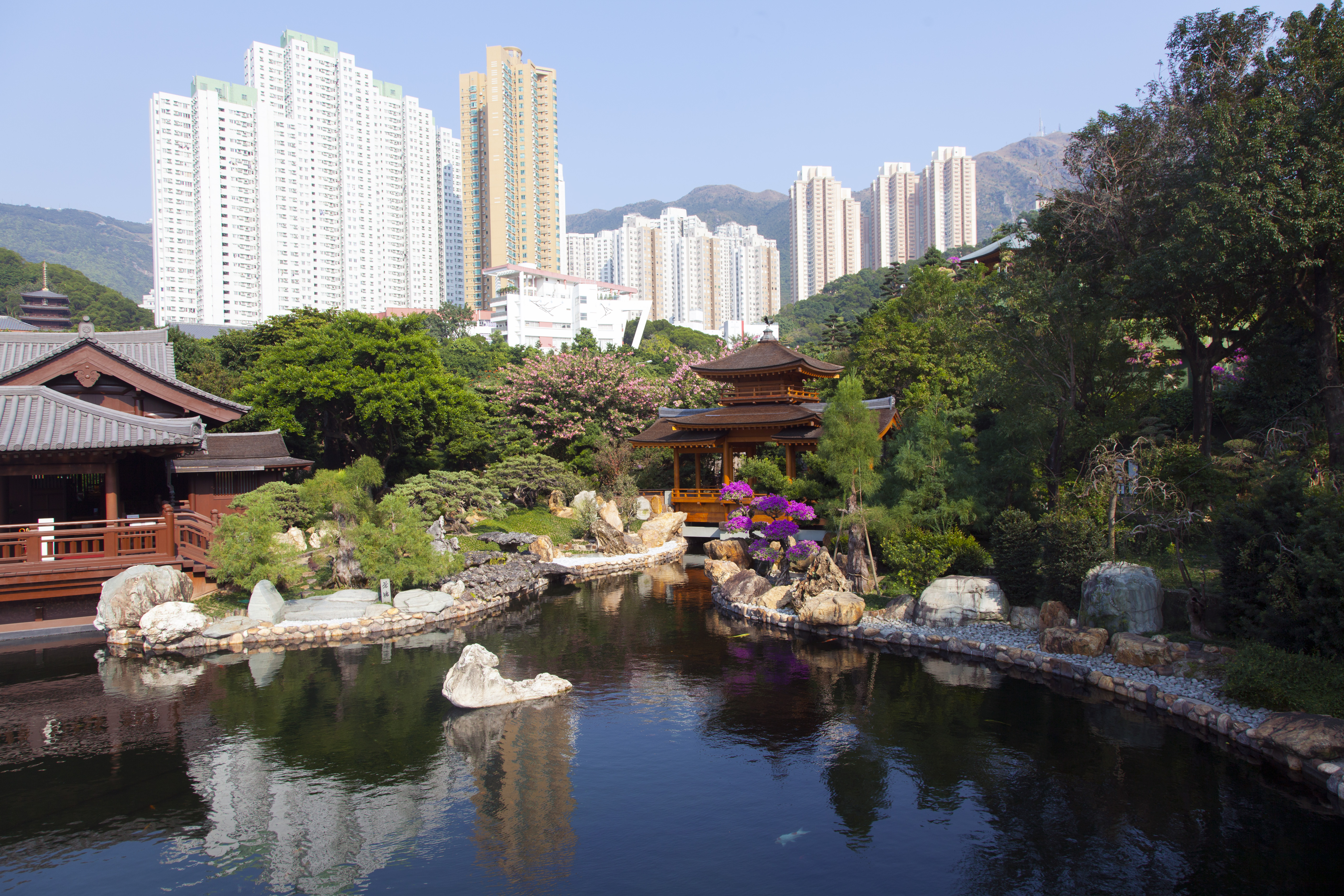
Today we made a particularly good choice, visiting the Chi Lin Nunnery and the adjacent Nan Lian Garden.

IMG_8194

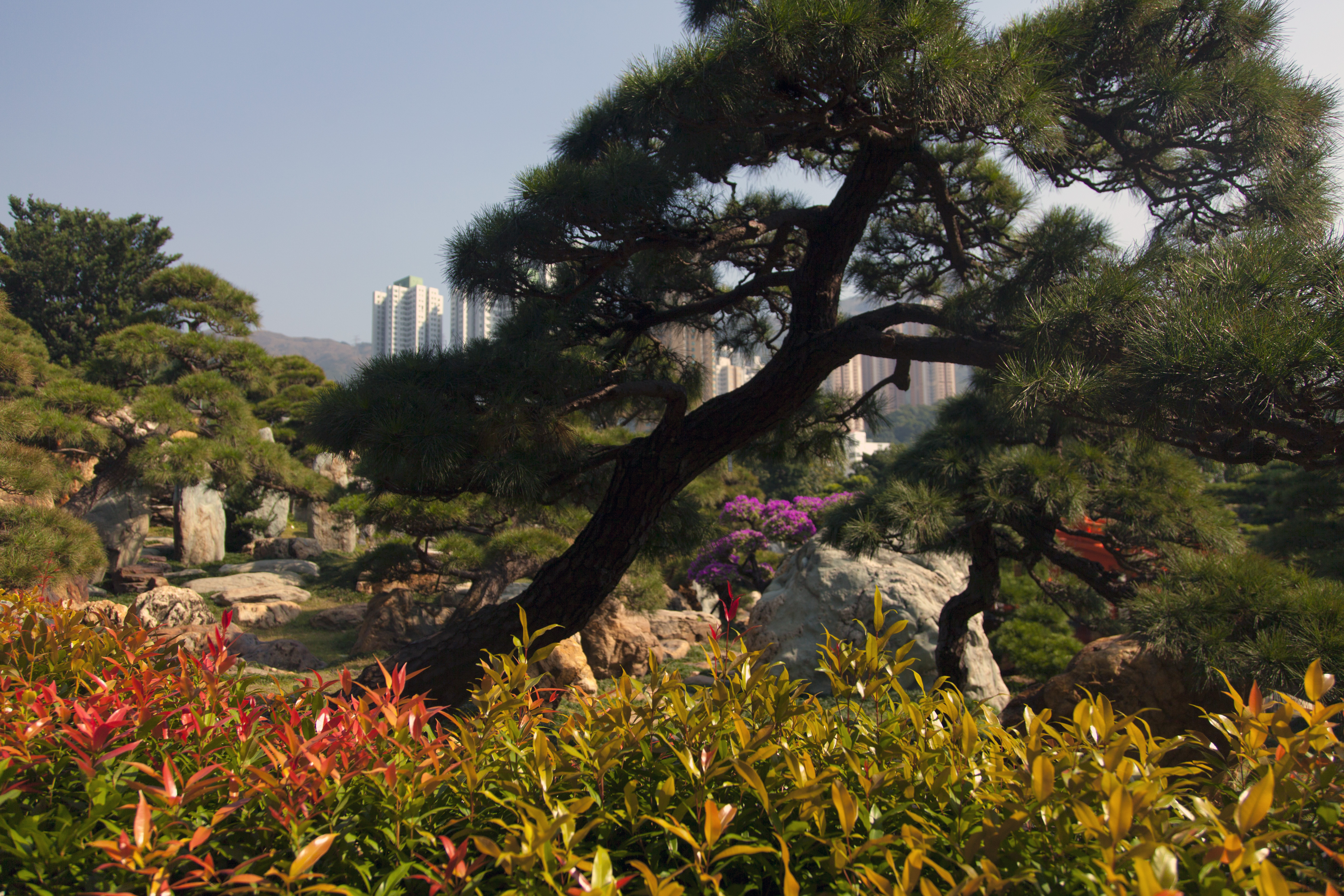
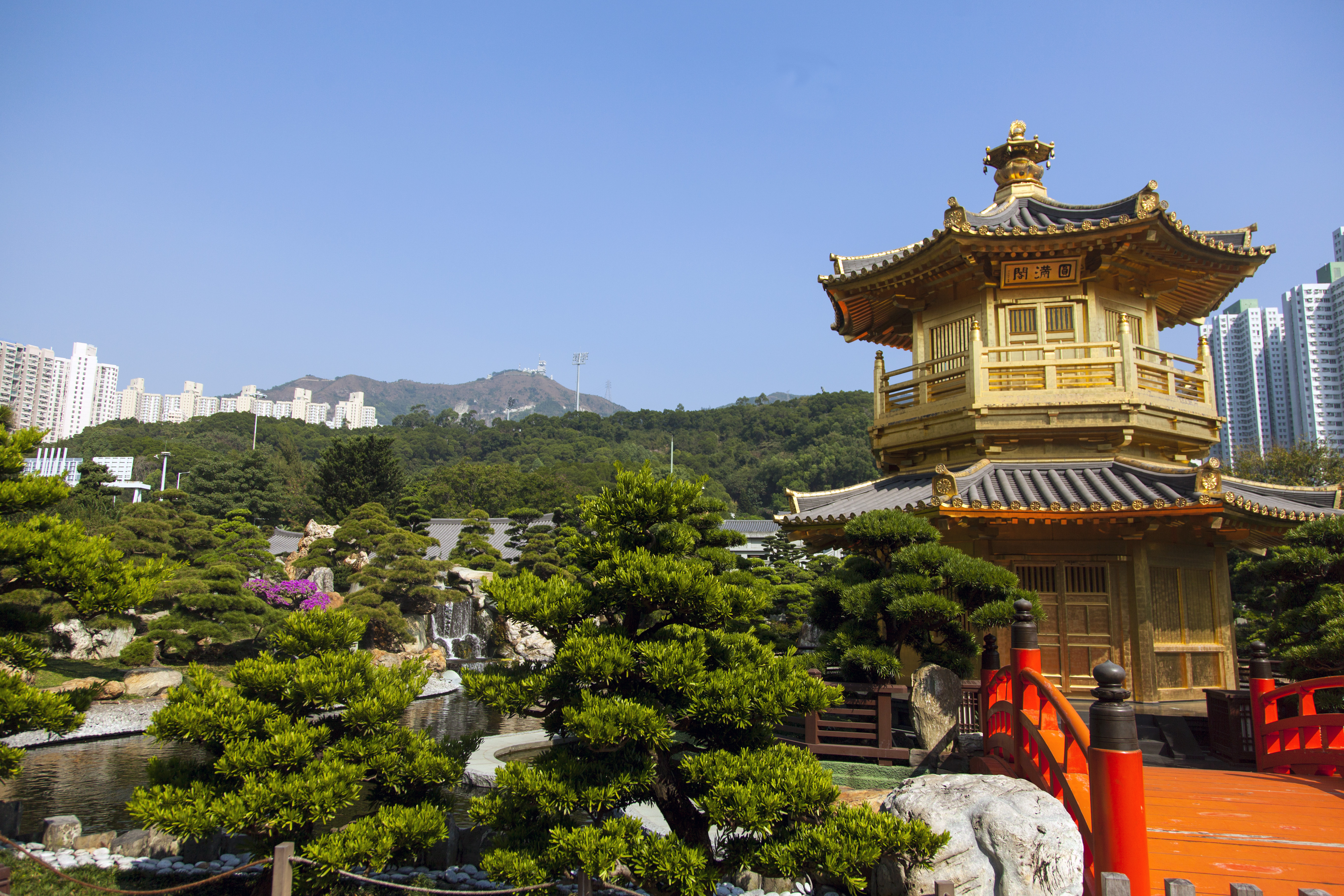
It’s hard even to imagine such beauty, peace and tranquillity as in this garden, which is essentially an amazingly harmonious composition of water, rocks and trees, and also traditional Chinese pagodas, bridges and pavilions. As for the skyscrapers in the background, not only don’t they seem to disturb this harmony, but they actually emphasise it in a rather unique way.

IMG_8210

IMG_8211

Overall, the garden is somewhat oval-shaped, and each turn of the track uncovers a new charming scene, e.g. giant banyan trees, or exquisite bridges over a pond with large colourful fish, or a waterfall with a water mill. And there you are, walking and admiring it all, accompanied by the low-pitch, vibrant, ’nasal’ sounds of guqin, a traditional Chinese stringed instrument, which feels like the most appropriate accompaniment in this place.

IMG_8213

IMG_8218

IMG_8223

IMG_8226

IMG_8232

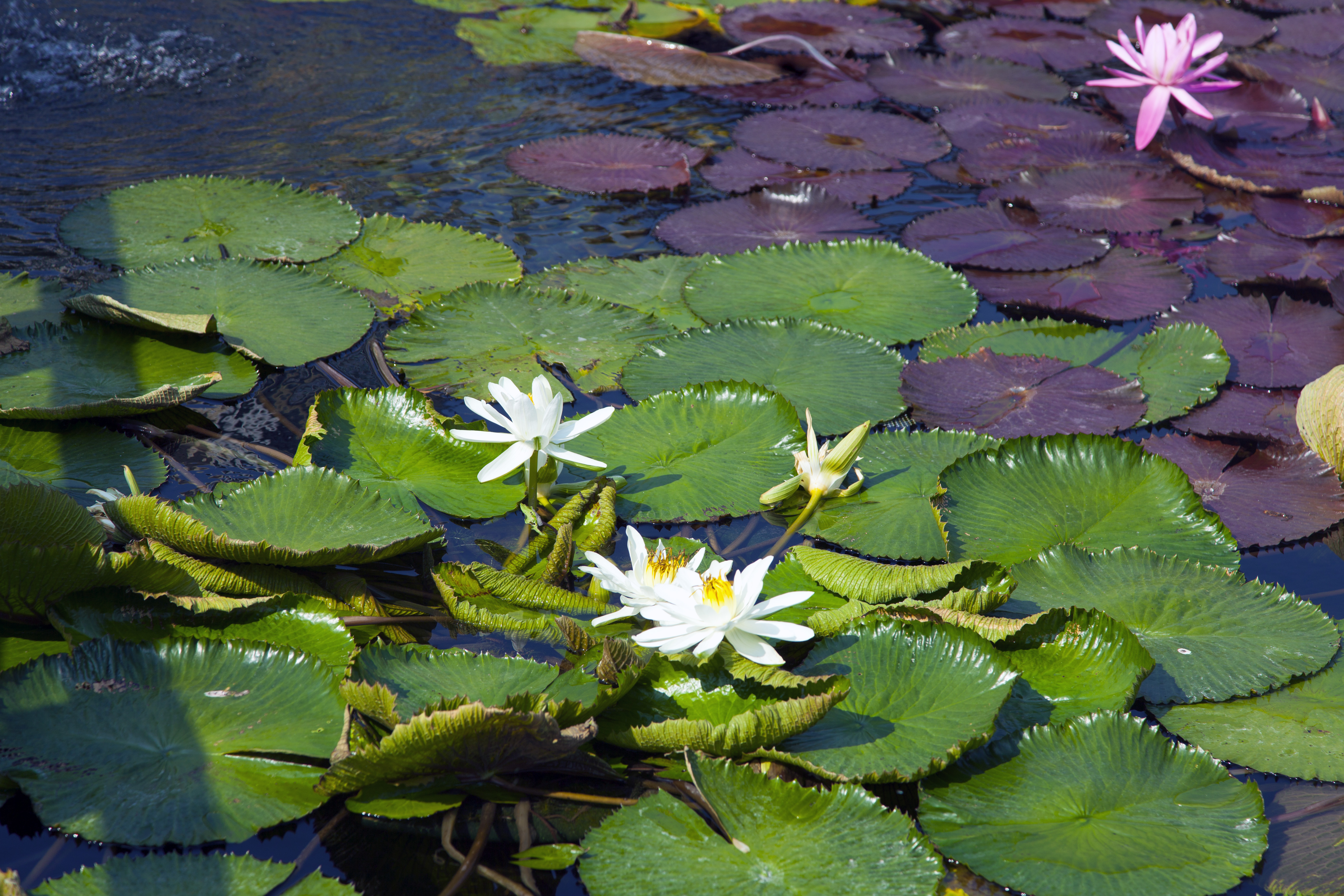
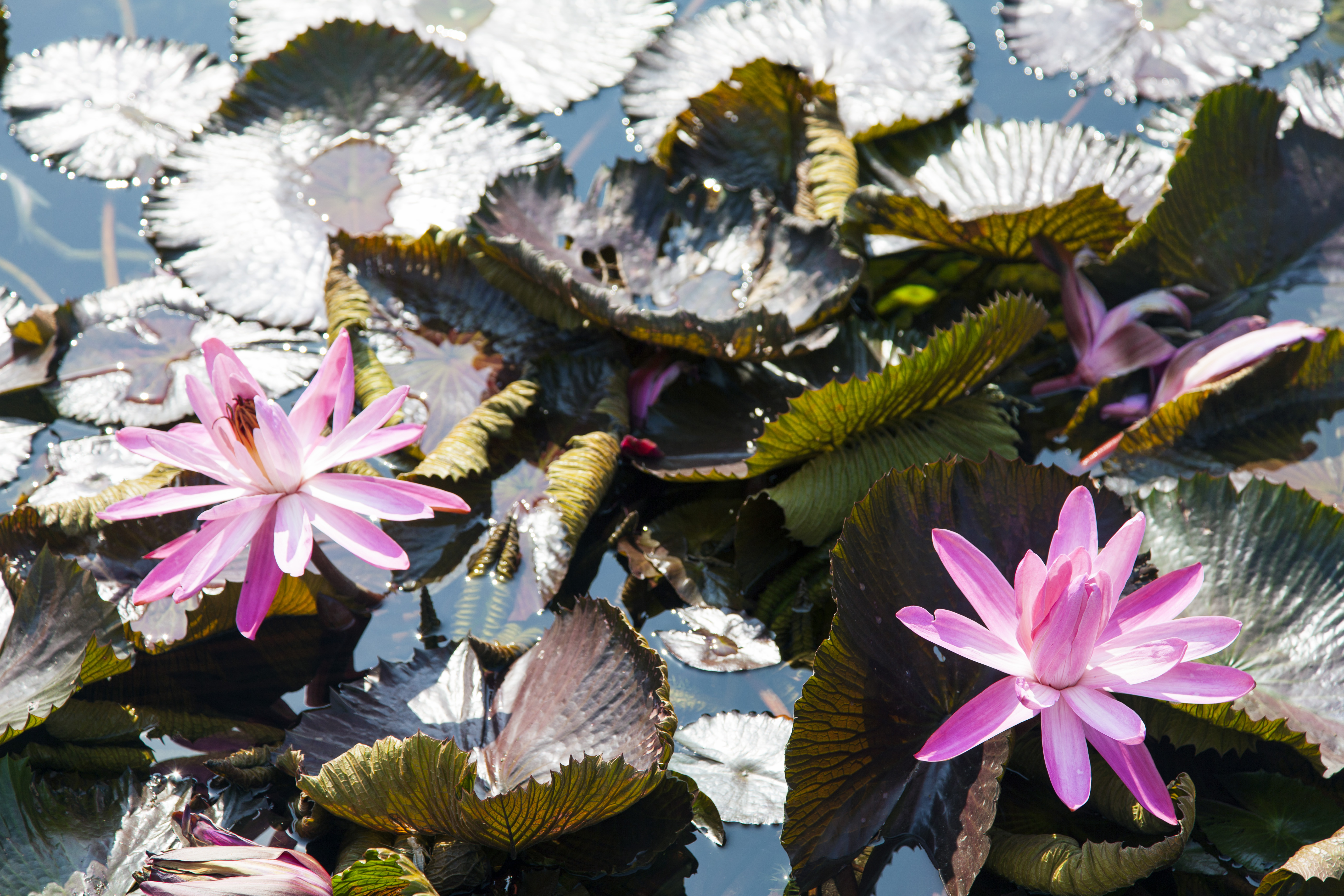
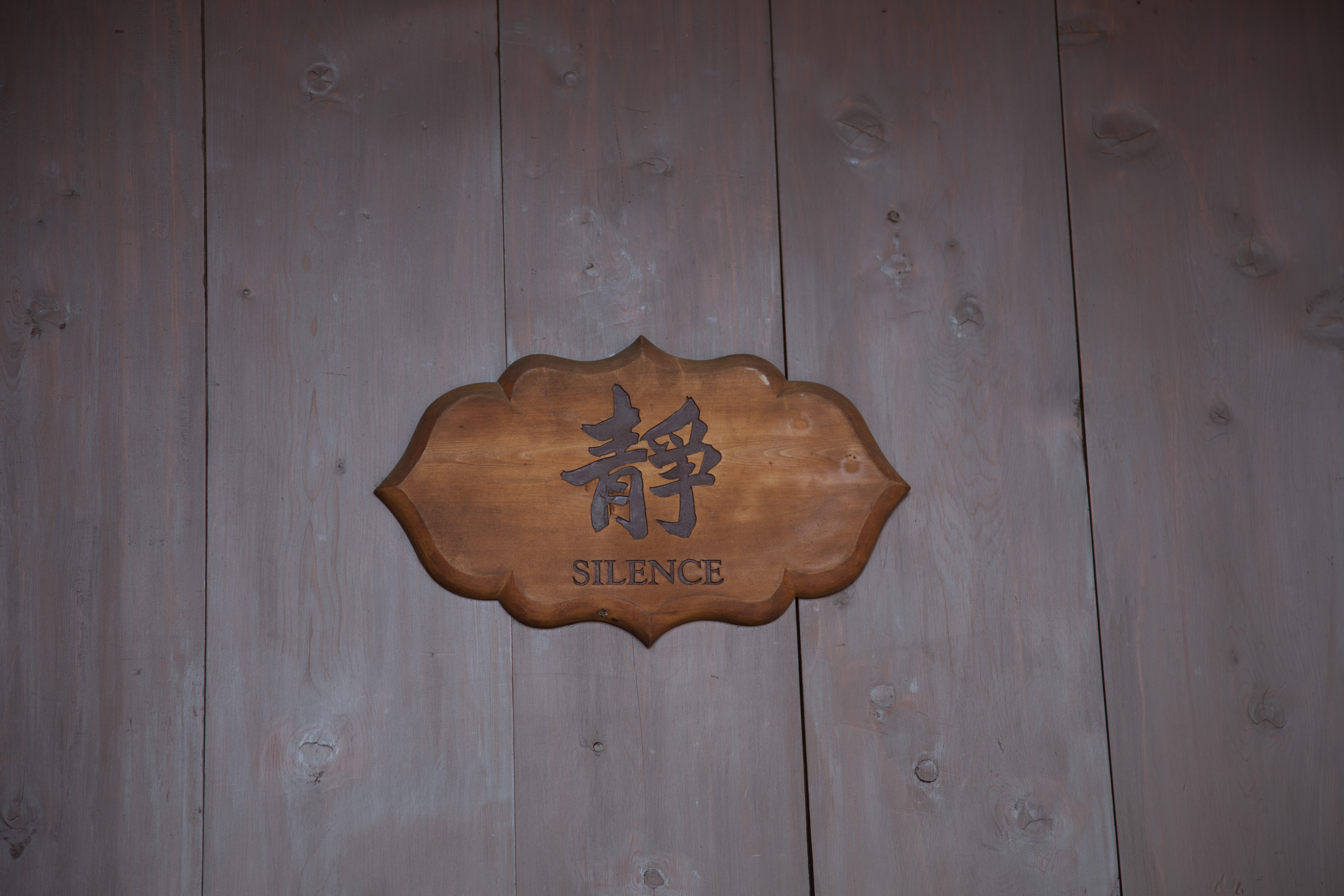
There are some lotus ponds right in front of the monastery. The petals move gently under the light breeze, and you feel like you could spend hours and hours just looking at them – at least, you somehow begin to understand Asians who find pleasure in the long contemplation of beauty. Neither taking pictures, nor even talking is allowed in the monastery, even in the public section (the other section, where the monks actually live, is closed to public altogether). There are sanctuaries on both sides, while in the centre there is a magnificent gilded statue of Buddha Sakyamuni. The monastery is also filled with music, not guqin sounds any longer though, but the chants of the monks. Even though we have nothing to do with Buddhism, still a sense of the sanctity of the place was definitely present.

IMG_8234

IMG_8237

IMG_8241

IMG_8244

IMG_8247

IMG_8250

IMG_8253

IMG_8254

IMG_8256

IMG_8258

As we returned to the Nan Lian Garden, we decided to try the tea ceremony there. The tea house has a couple of requirements: first of all you have to remove your shoes, leave them outside and put on the slippers provided, and also to switch off your mobile phone and put your camera away, as taking photos and videos is prohibited. The order has to be at least one portion per person. And a portion in this case is not one cup but rather 6 grammes of dry tea, which can be brewed in a small teapot six times. But I’m getting ahead of myself here – before talking about brewing I have to mention that there is actually a high degree of self-service here – you fill the iron kettle yourself and put it on the stove to boil, then you call the waitress. She brings you teaware and dry tea leaves, explaining how to brew them. It is actually a whole science (or should I say art?) in itself: you first rinse and fill the teapot with boiling water (the teaware stands on a grid with a drain underneath it). Then you pour the same water into a jug and cups, which thus get rinsed as well. You carefully add the tea to the tiny teapot, fill it with boiling water up to the top, then immediately pour it away – this is how the tea leaves also get rinsed. Now comes the final part: you fill the teapot with boiling water once again, keep it there for just a few seconds, and then pour the tea into the jug (so that it doesn’t get any stronger), from which it can be poured into cups.

IMG_8267

IMG_20131204_130604

It’s worth emphasising that these six grams is a lot for such a small teapot, way more than the portions we are used to. The tea that we had is called Da Hong Pao, which grows high in the mountains and is considered one of the most expensive teas in the world.

IMG_20131204_131835

IMG_20131204_133918

IMG_8266

IMG_8269

IMG_8274

Our lunch that day was quite unusual too – it was vegetarian, as it is always the case with monastery restaurants, with a very high content of various types of mushrooms.

In the evening we went to Lan Kwai Fong yet again. Even though it was only Wednesday and not Friday, the place was way more crowded and fun than during our last visit – which in fact is quite logical. The last time we were here was Sunday, when pretty obviously very few people are keen on drinking and hanging out late before a Monday. And on a weekday, of course, many people want to relax and chill out after a hard day at work – this is exactly why we saw such a considerable number of ‘white collars’ there.

Posted in Asia, China, English, Hong Kong

Hong Kong – Day 4

РУССКОЯЗЫЧНАЯ ВЕРСИЯ ПО ЭТОЙ ССЫЛКЕ. CLICK HERE FOR RUSSIAN VERSION.

3 December 2013

Today was the Big Shopping day. From travel blogging perspective, it may not be the most exciting event ever, but since we’re all human and nothing human is alien to us, it’s still worth touching this topic.

All guidebooks scream that Hong Kong is a great place for shopping, primarily due to the free trade regime. So people flock here from all over the world. In particular, I doubt that anywhere in the world one can find as many jewellery stores as there are here, and none of them stays empty and clientless. Literally on every corner in the central areas there is a Chow Tai Fook store, with slightly less stores of the competing Luk Fook and Chow Sang Sang chains.

If Singapore created the impression that the main idea was to feed as much people as possible, so there were all kinds of eateries pretty much at every turn, it looks like Hong Kong’s ‘task’ is, of course, selling as many goods as possible, so almost at every step you come across malls, shops, stores, outlets etc.

We ended up heading to Harbour City, which is one of the biggest malls. It’s probably that we didn’t have much time to understand how it was all structured there, but we were left with a feeling of randomness – for example, in comparison with Westfield in London. There everything is crystal clear with high fashion brands being concentrated in one section and more democratic brands in a totally different one. Here everything is mixed, and the logic of locating the stores remained totally unclear to us. All the stores were very nicely decorated (Christmas is coming up!) and Christmas songs sounded everywhere, most of which, though, with the exception of the famous Jingle Bells, seemed too schmaltzy and cloying.

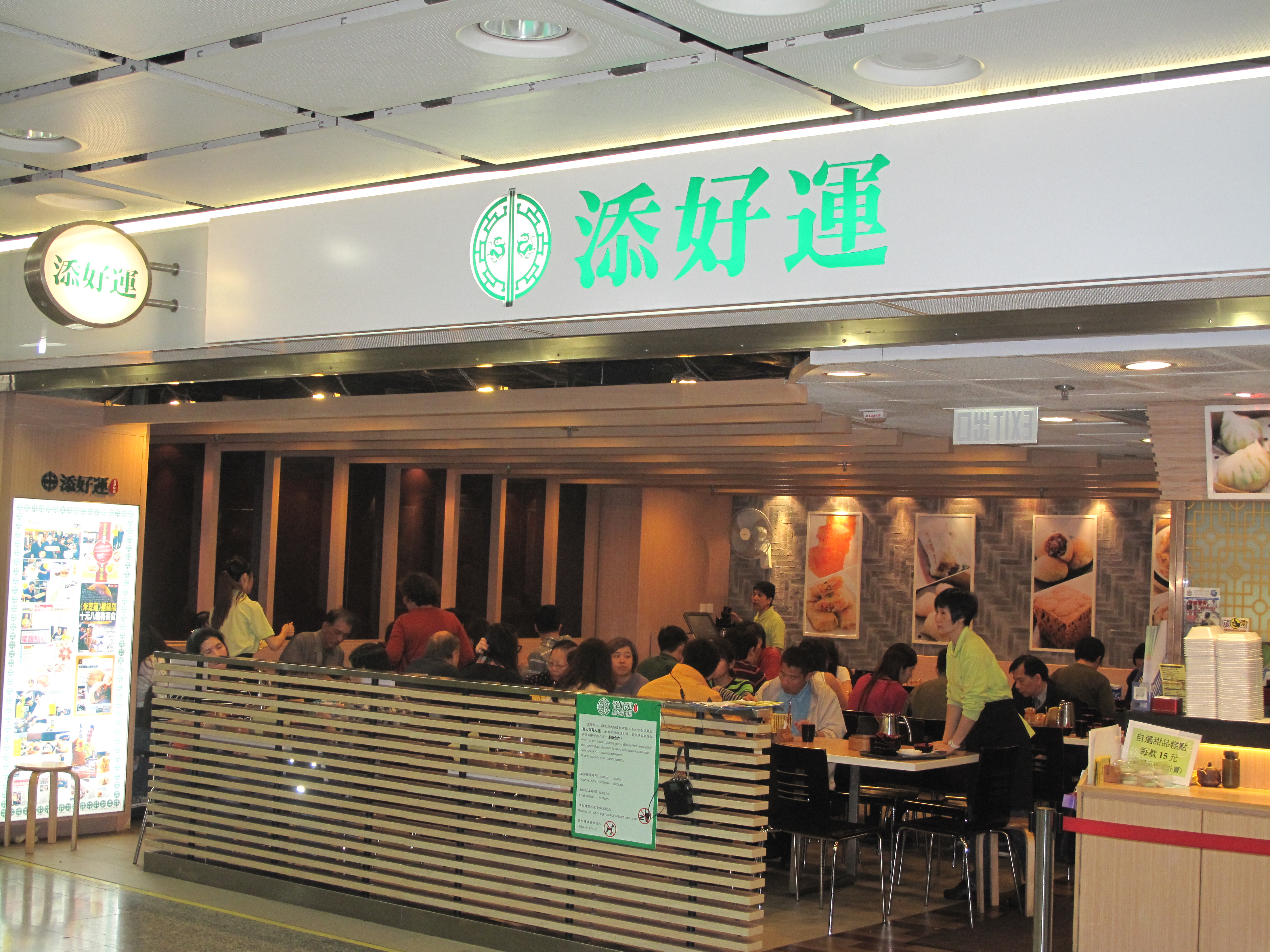
One of the must-do things planned for this trip was having a proper dim sum lunch, and we found that the best place to do so was Tim Ho Wan – it is a chain of restaurants, looking more like small eateries, but with a Michelin star, and by the way, being the world’s cheapest Michelin-starred restaurant. At lunchtime there are always lots of people queuing outside. Everyone gets an order sheet with their number in the queue, so while waiting they could decide what they are getting and tick off those items. When seats become available, the waiters shout out the numbers – not necessarily in order, but rather depending on how many seats there are – in Cantonese, but if they see any non-Chinese among the people waiting, it can be repeated in English too.

IMG_2235

Many people think of dim sum as a variety of dumplings, while in reality it is not just dumplings, but rather a general assortment of small snacks to be consumed together with pu er tea. Originally it was part of the tea ceremony in southern China, and this traditional tea drinking, or “yum cha”, took place in tea houses in the morning. Now “yum cha” has moved to special dim sum restaurants, like Tim Ho Wan, and not necessarily happens in the morning, but still mostly before mid-afternoon.

IMG_2225

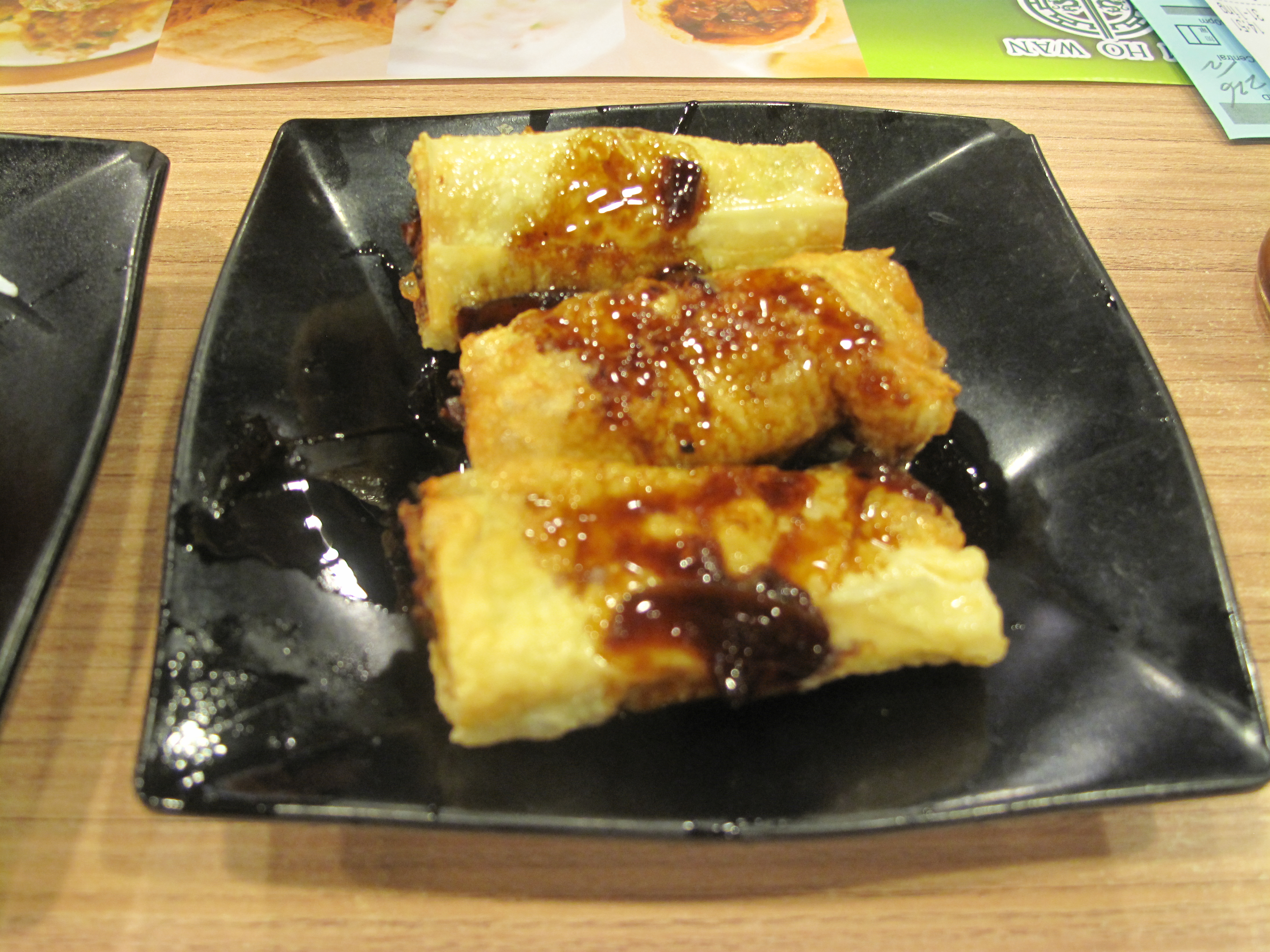
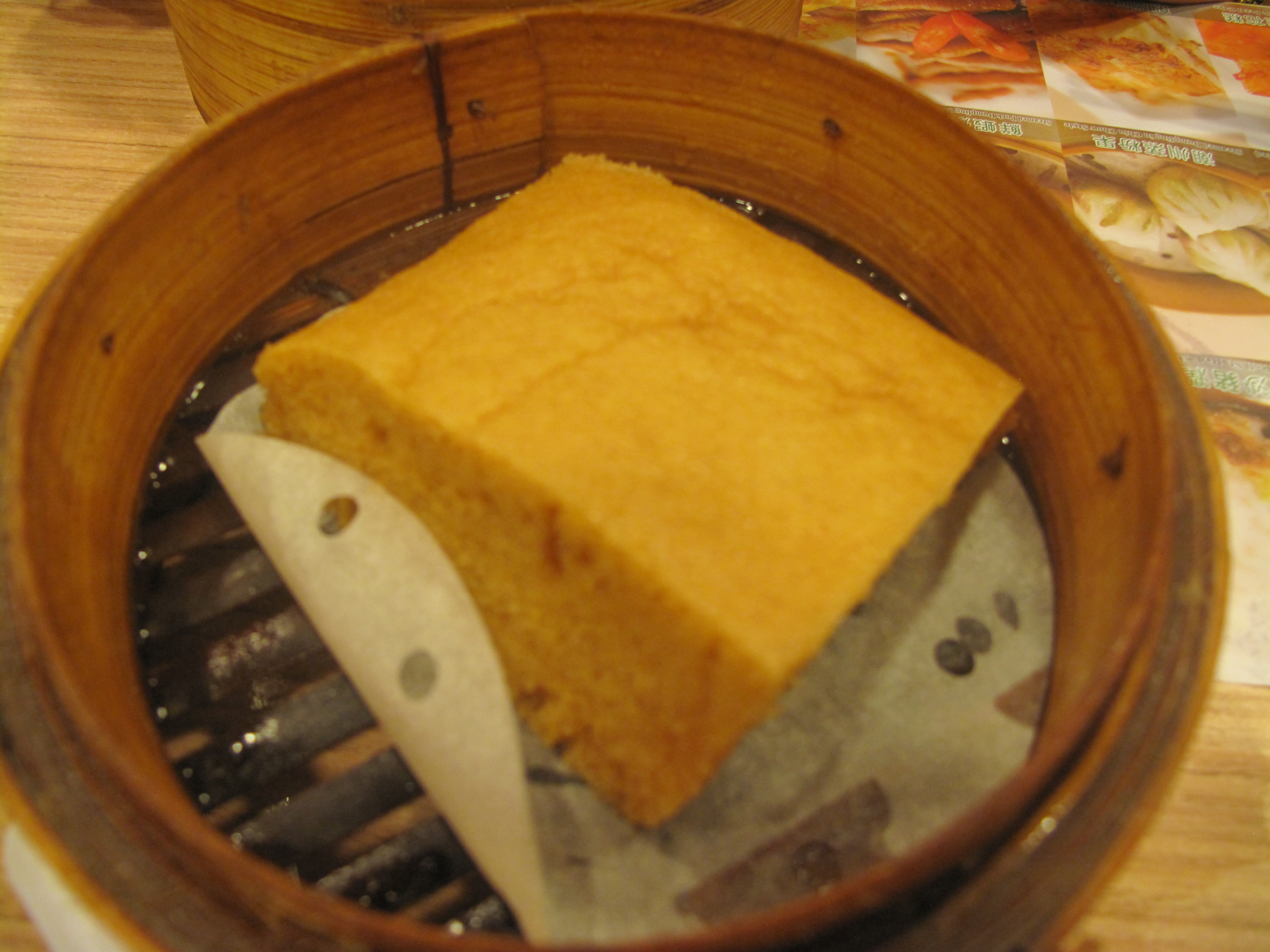
We absolutely loved everything we ordered, which included prawn dumplings (har gow), rice noodle rolls (cheong fun) with Cantonese BBQ pork (char siu), steamed egg cake, medlar & osmanthus jelly. We ate until we were totally full, and it cost only HK $ 112 for two (which makes U.S. $14-15 or 11-12 AZN).

IMG_2233

IMG_2232

IMG_2229

IMG_2234

IMG_2230

IMG_2228

Posted in Asia, English, Singapore

Food in Singapore (bonus post)

РУССКОЯЗЫЧНАЯ ВЕРСИЯ ПО ЭТОЙ ССЫЛКЕ. CLICK HERE FOR RUSSIAN VERSION.

If you have read my previous posts about Singapore, you might remember that I was mentioning the idea to write a separate gastronomic one, where I would describe the stuff I’d been eating during the trip (and other stuff which I had only seen but not necessarily eaten). Those who enjoy food as much as I do will hopefully appreciate.

So, on our first day in Singapore we ended up at the Paragon shopping mall, which, as pretty much everywhere here, had an extensive food court. It seemed logical to actually start the acquaintance with the food in Singapore with a Singaporean cuisine restaurant. There was one here – the Grandma’s restaurant was proudly proclaiming its authenticity.

IMG_1501

The Singaporean cuisine is represented by a large variety of dishes of different origins, which is not a bit surprising given such a diverse ethnic composition of the population. The whole concept of the “Singaporean cuisine” is a kind of mix of Chinese and Malay/Indonesian cuisines, with influences from other Asian and even European cuisines.

The very first thing I ordered was fried red snapper, which I really like – and it was indeed delicious!

IMG_1498

But what I probably like the most was a Chinese (namely Hokkien and Teochew) fried snack called mini ngo hiang – that was spicy minced chicken meat wrapped in very thin beancurd skin.

IMG_1493

In the next photo there are two Malaysian dishes: nasi lemak on the left and curry laksa on the right. The former, consisting of coconut rice, chicken curry, anchovies sambal (a type of sauce), hard-boiled eggs, cucumbers and achar (pickled vegetables), was very nice. The latter – basically a curry noodle soup with prawns, chicken and tau pok (deep-fried tofu) – was pretty decent too, but started to cloy quite quickly.

IMG_1491

Another dish that was either Indonesian or Malay was beef rendang, made from meat chunks stewed in coconut milk and some spices.

IMG_1499

And here is a rather interesting drink called Grandson’s Favourite, made with almond soy milk, grass jelly and palm sugar.

IMG_1492

The next day, if you remember, we were exploring Chinatown; therefore, we had lunch right there, in a Chinese restaurant, of course. It wasn’t entirely clear how the restaurant was called, but Google now suggests that it’s Chinatown Shanghai Kitchen. We ordered a hell lot of food, and it was all excellent.

IMG_1575

Here is the good old sweet and sour pork, which is popular throughout the world and, by the way, as far as I know, belongs to Cantonese rather than Shanghainese cuisine:

???????????????????????????????

This is some quite ordinary roast duck, not the famous Peking one, and not even the slightly less well-known Cantonese one, but nevertheless very tender and tasty.

IMG_1568

And this one is sizzling beef with ginger and onion, also very tender and spicy:

IMG_1562

Chili crab is yet another must-try Singaporean dish, along with laksa and nasi lemak, that we had the day before. It tasted pretty good, although not particularly to die for, was moderately spicy, and very messy to eat: no matter how hard you try to keep it neat, you’ll still end up eating with your hands and getting yourself all dirty.

IMG_1573

In addition to all this meaty-fishy food, we also got a variety of side dishes, such as these noodles with vegetables and some spongy mushrooms, which looked more like pieces of bread:

IMG_1572

Or this asparagus with snow peas and bean sprouts:

IMG_1561

This is sautéed kai-lan, or Chinese broccoli, except that it doesn’t look much like the broccoli we’re used to. I’d never heard of this vegetable previously, but during this Asian trip it definitely became one of my favourite.

IMG_1563

And one more side dish – sautéed Chinese vegetables (pak choi and some mushrooms).

IMG_1570

Later the same day, we discovered the huge food court of the Shoppes at Marina Bay Sands mall, where we were hiding from a heavy downpour. My companions decided to go for tea and cake only, while I, not being a big fan of the latter, opted for a proper meal. After a long indecisive walk along the various food booths, I stopped at the Korean one and got a BBQ set consisting of a seaweed soup, spicy BBQ chicken, rice, fried dried anchovies and cabbage kimchi (that is spicy pickled cabbage). Honestly, I wasn’t wild with delight – whether because I wasn’t too hungry or simply this combination of flavours was not my thing.

IMG_1684

???????????????????????????????

Other booths, as I already mentioned in this post, offered a huge variety of cuisines, mainly Asian ones – this one had Singapore’s local delicacies:

IMG_1671

Yong Tau Foo is a Chinese Hakka dish, which originally used to be a soup with tofu stuffed with meat or fish (hence the name), and now can contain lots of various other stuff like meat or fish balls, seafood, vegetables, crab sticks, mushrooms, and in fact doesn’t even have to be a soup, it can be eaten as a dry dish as well.

IMG_1672

Bak kut teh is a Chinese soup made of pork ribs with various additional ingredients; the name literally means “meat bone tea”. Despite the fact that the dish is of Chinese origin, it is mostly common in Malaysia and Singapore, where it was brought in the 19th century by Chinese workers of Hokkien and Teochew origins.

IMG_1673

As far as I understand, Chinatown Beef Noodle is a chain, serving, obviously, different sorts and varieties of beef noodles.

IMG_1674

One of the elements of Cantonese cuisine is the rotisserie style called siu mei, which includes different meats (pork, chicken, goose, duck) and is very popular in Hong Kong.

IMG_1675

Here you can get Singapore-style fried noodles with various ingredients.

IMG_1677

Nasi Padang is basically steamed rice served with all kinds of meat and vegetable dishes, comes from the city of Padang in Indonesia.

IMG_1678

Ajisen Ramen is a Japanese fast-food chain, serving, as the name implies, different kinds of ramen soup (wheat noodles in broth, with all sorts of toppings).

IMG_1679

Jia Xiang Sarawak Kuching Kolo Mee is yet another chain that specialises in Kolo Mee (a dish of egg noodles with pork, originating from the Sarawak state in Malaysia).

IMG_1680

Continuing the topic of noodle soups, another variation thereof is ban mian, a dish common in Hokkien- and Hakka-speaking areas (in particular, the Fujian province in China, Singapore and Malaysia).

IMG_1681

This looks like the Malay cuisine booth, although I wasn’t able to identify any of the dishes on the signboards.

IMG_1682

The Indian cuisine booth:

IMG_1683

I believe everyone is familiar with the concept of dim sum, as this invention of Cantonese cuisine is widespread worldwide. For those who are not – these are light snacks, served in small plates or bamboo steamers. There exists a great variety of dim sum choices: all sorts of dumplings you can even think of, buns with various fillings, fried chicken legs (the so-called “phoenix claws”), pork ribs, meatballs, even congee, and many, many more.

IMG_1685

Judging by the dishes represented here, this booth also serves dim sum, and not only shrimp dumplings, as the name suggests, but also other kinds of dumplings, as well as the aforementioned chicken legs, egg custard buns, etc.

IMG_1686

And here is Japanese food and, as seen in the picture, many of the dishes are served in traditional bento boxes with multiple compartments.

IMG_1687

More noodles – and they are prepared right here, before your very eyes.

IMG_1688

Philippine cuisine is the least known to me out of all the mentioned above, I would have loved to try it, but didn’t have the opportunity this time.

IMG_1689

The next day I felt the urgent desire to have some Chinese dumplings, so half of us headed to Din Tai Fung, a Taiwanese chain restaurant specializing in xiaolongbao (steamed dumplings).

IMG_7563

As it is often the case in dim sum and dumpling restaurants, you are handed the menu with a pen, and you can mark off what you want and in what quantities.

IMG_1748

Tea and shredded ginger are served immediately and free of charge.

IMG_1749

IMG_1752

We ordered vegetable and pork wonton soup (wontons are a variety of dumplings, wrapped in very thin dough), some rice and my favourite kai-lan, stir-fried Hong Kong-style, with special oyster sauce.

IMG_1753

And then came the dumplings. Minimum portion was 6 pieces, so even though we wanted to try as much as possible, due to the lack of spare stomachs, we had to limit ourselves to two types only. These are chicken dumplings:

IMG_1755

And these are shrimp and pork dumplings, called shao mai (or siu mai in Cantonese pronunciation – and that is how they are best known, due to the already mentioned worldwide popularity of dim sum).

IMG_1754

The next day, we found this eatery on the Sentosa Island:

IMG_7578

The place is pretty small, and the menu, although not extremely abundant, is somehow very diverse in terms of the number of cuisines represented.

IMG_1775

So our selection was quite diverse as well – we, already missing familiar food, started with a mushroom soup and a plain vegetable salad.

IMG_1777

Indian dum biryani is a dish of rice with meat (in this case – chicken) and/or vegetables and spices, a spicy one, as one would expect from Indian cuisine, though in moderation.

IMG_1778

Gong bao chicken is also spicy, and, as one would expect from Szechuan cuisine, not in moderation. Szechuan cuisine is generally characterised by extensive use of pepper – in particular, the combination of dried chili with Szechuan peppercorn (which in fact is not quite pepper, but rather husks of the zanthoxylum plant) creates that sensation of numbing heat, which is a distinguishing feature of this cuisine.

IMG_1780

Another meal we had on Sentosa Island was in Hollywood China Bistro in Universal Studios amusement park.

IMG_1912

IMG_1910

This time we weren’t really up for new exotic dishes so we ordered the familiar stuff. For example, sweet corn soup with egg:

IMG_1905

Here is quite an ordinary dish with a not-so-ordinary name: braised ee fu noodles with mushrooms. Ee fu, also known as yi mein is a Cantonese egg noodles variety made from wheat flour.

IMG_1907

Lemon chicken is quite a famous dish, served more often in Chinese restaurants around the world, than in China itself.

IMG_1908

And this is Cantonese roast duck, with a fragrant sauce – one type of siu mei, which I mentioned above.

IMG_1904

All of this was accompanied by wonderful jasmine tea.

IMG_1900

If you remember, we were spending the first half of the next day at the Singapore Botanic Gardens, therefore, we had lunch right in the Ginger Garden, at the Halia restaurant, whose name actually means “ginger” in Malay. From noon to 2pm they serve a set menu of two or three courses to choose from. The portions are quite small, but delicious and generously seasoned with ginger, just as one might expect.

IMG_7740

Here’s what their starters are like (out of those we tried): these are pieces of home-cured salmon, cucumber and kipfler potato with some rye croutons and English mustard:

IMG_2010

And this is a salad of heirloom tomato, watermelon and goat cheese with black olives and balsamic vinegar.

IMG_2011

The soup of the day was pumpkin soup:

IMG_2012

And then, the main courses arrived: grilled fillet of barramundi fish with local organic mushrooms and Chinese roast duck consommé. The waiter pours the consommé into the bowl from a small pitcher, right at the table.

IMG_2013

One more main – roasted corn fed chicken breast with carrot puree, potato mille-feuille and Brussels sprouts.

IMG_2014

Quite unexpectedly, I really loved the desserts, perhaps even more than the starters and mains. The ginger nougat parfait with caramelised pineapple and spiced pineapple sauce was simply amazing!

IMG_2015

And this is coconut panna cotta with mango, passion fruit, mint and lychee granita.

IMG_2016

But that wasn’t it for our gastronomic adventures that day. After lunch we headed to the Gardens by the Bay, where we stayed right until dinner. The dinner, which we had nearby, at the Majestic Bay seafood restaurant, turned out great. Right near the entrance there stood a few big tanks with live seafood.

IMG_7788

IMG_2066

IMG_2065

IMG_2064

IMG_2063

IMG_2052

We went for the set menu consisting of small portions of several courses, so as to try more different food. The first thing to be served was the snack combo: soft shell crab with lemon buttermilk sauce, some kind of crisps and Japanese scallops with pickled cucumber, grapes and Kyoto dressing.

IMG_2053

The next course was chicken soup with cordyceps (at that time we had no idea what it was, thank goodness – but having googled it later I discovered that it was parasitic fungi!), con poy (dried scallops) and Chinese ham. The soup tasted quite unusually.

IMG_2054

Then came wok-fried pork ribs with espresso sauce – yummy!

IMG_2056

It was followed by stewed 10 heads abalone (familiar to us from our last Hong Kong trip), with tofu and my old friend kai-lan. Generally, abalone tastes quite nice, although I wouldn’t include it among my favourite food.

IMG_2057

Next we had some stewed Boston lobster with bee hoon (South-East Asian rice noodles). The lobster was very good, but for some reason I didn’t enjoy the noodles much.

IMG_2058

And last, but not least, we were served the dessert: essence of mango puree in a whole young coconut (i. e. with soft meat) and a glutinous rice dumpling with fresh cream stuffing. Both were delicious.

IMG_2061

And finally, we had our last meal in Singapore right at the airport, before the flight to Hong Kong, in the Peach Garden Noodle House.

IMG_2081

First of all, I ordered my long-time favourite Szechuan-style hot and sour soup.

IMG_2085

The main course was noodles with roast pork, and broth served separately. The broth had to be poured onto the noodles to turn them into a soup, which I didn’t do – that would be way too many soups for me.

IMG_2089

Hainanese chicken rice is one more dish, considered Singapore’s national (even though it derived, of course, from the cuisine of the Hainan island in China). This dish is served with chicken broth, pounded ginger, dark soy sauce and chili garlic sauce. Overall, it wasn’t bad, but a bit too greasy for my taste.

???????????????????????????????