РУССКОЯЗЫЧНАЯ ВЕРСИЯ ПО ЭТОЙ ССЫЛКЕ. CLICK HERE FOR RUSSIAN VERSION.
25 March 2012, Sunday
The day turned out to be quite authentic. In the morning we met our guide (an official one, of course) and went on a hutong tour. By the way, what is really good about tours here is that usually it’s not just a trip to one place, but rather to several different places, very cleverly connected so, that there is a good balance of walking, riding and climbing.


Likewise, this hutong tour started with two towers, facing each other – the Bell and Drum Towers. Thank goodness, we only had to climb one of them, the Drum Tower. Both towers were built during the Ming dynasty and were used to alert people of the time, every two hours.

In order to get to the hall with the drums, we had to climb sixty very steep stairs, and then nine more. Apart from drums exhibited here, there were also ancient devices used in the past to determine the time, so that servants would know when to hit the drums. The operating principle of most devices was based on the burning of incense, which was calibrated so that it took a set amount of time to burn.
At half past nine four guys and a girl arrived and demonstrated a drum performance. The girl was hitting the largest drum. And the drums, I have to mention, were nothing like those you would typically see on the stage: each one was of the size of a huge barrel, or even two. So, no surprise that the whole city heard them back in those days.

The guide showed us all parts of Beijing from the balcony. It was really interesting to look down on the places we had already seen: the Beihai Park, the Olympic Village, the Forbidden City.


From the Drum Tower we moved to the Bell Tower, but luckily the visit was limited to the ground floor, where we participated in a tea ceremony – not a theatrical one, as in the Lao She teahouse, but with detailed explanations and tasting of different varieties of tea. We were taught how to brew the tea, how to hold the cup with three fingers and how to drink the the tea, sticking out the ring finger and the pinky finger. Interestingly, in some countries the latter was once considered a bourgeois affectation and was highly ridiculed. Here, though, the two fingers sticking out symbolised the tail of a phoenix, which, in its turn was the symbol of the Empress. So this gesture was only made by women. Men also used to hold the cup with three fingers, but tucked the remaining two in – this gesture symbolised the dragon, i.e. the Emperor. We got to taste five different varieties of tea: oolong with ginseng, jasmine tea, pu-erh (in tiles), black tea with lychee and rose flowers, and fruit tea. It would have been a sin to leave this tea kingdom without buying some real Chinese tea, so we purchased two packs – one oolong and one jasmine.
From here we walked to the Shichahai quarter, which, as our guide explained, is a favourite places of Beijingers, with plenty of restaurants, bars and shops. The place is very picturesque, located on the bank of the Shichahai lake. We learned that “hai” meant “lake”, therefore “Beihai” meant “Northern lake”. Then it dawned on us that “Beijing” started with “bei” by no accident, and that is how we figured out that “Beijing” simply meant “Northern capital” (a fact, which probably everyone else knows anyway!)


The journey continued on a rickshaw, which this time was part of the official tour but which we still had to tip.

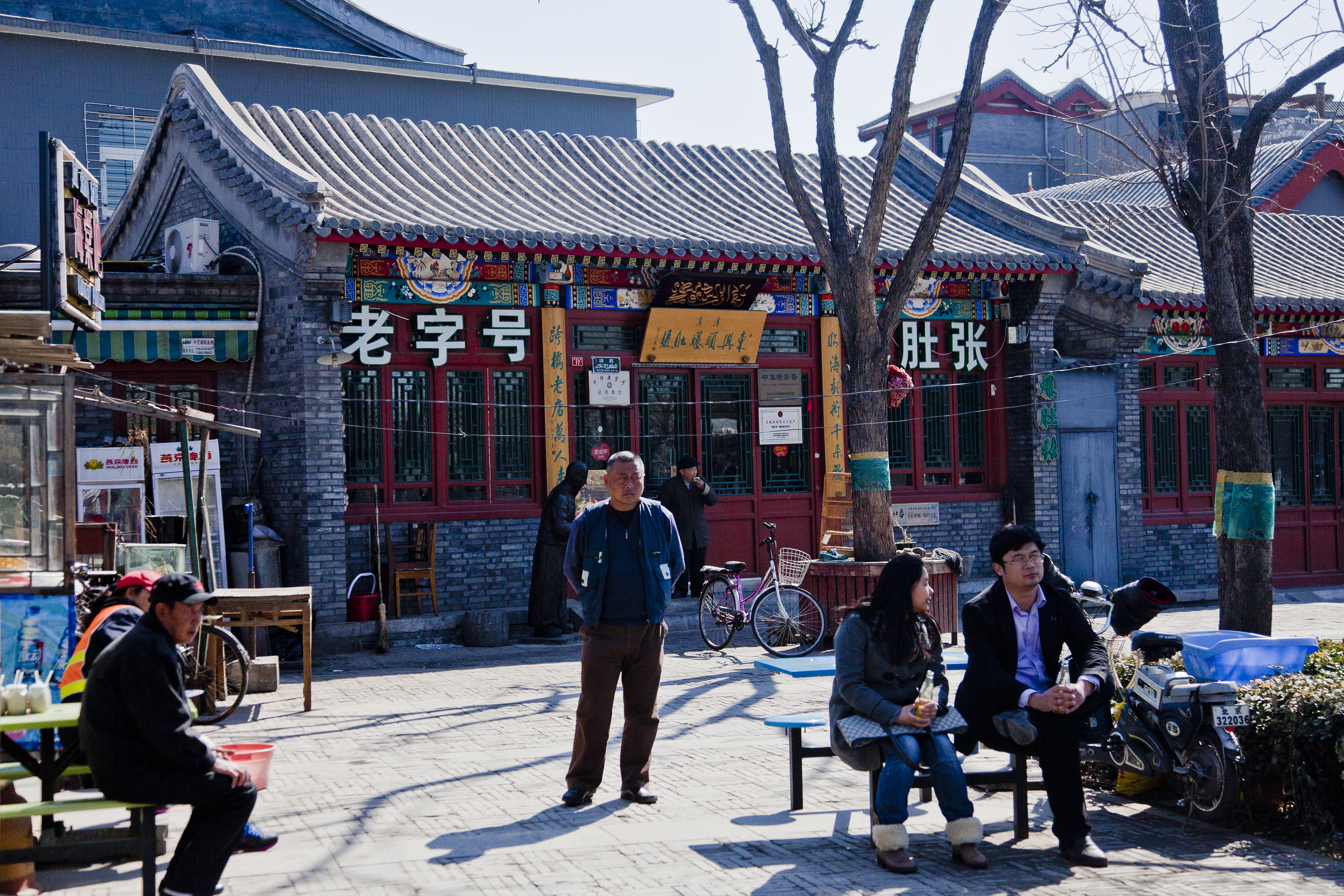
First we visited an exemplary Beijing family. Often people live in hutongs for generations. Clearly, senior representatives of families enjoy living here, while junior ones – not so much.
Right at the courtyard entrance we stumbled upon a wall. The guide explained that, just as high thresholds, such walls were believed to prevent evil spirits from entering the house. A typical courtyard was surrounded by four houses, and, together with them, used to represent the five basic elements of the Universe. The main and the most prestigious house was the one on the north, under the sign of Water – that’s where the parents lived. The house on the east represented the Wood element and belonged to the sons – the support of the family. The western house was associated with the Metal (Gold) element and was inhabited by the daughters. In the southern house, under the sign of Fire, lived the servants. And finally, the yard itself represented the fifth element – the Earth.
In addition to that, the guide drew our attention to the obligatory presence of trees in the yard. The 人 character means “a man”, and if a man is surrounded by a wall on four sides, it makes 囚, which means “a prisoner”. In order not to create such an unpleasant analogy, trees (木) were planted in the yard, but necessarily more than one, because the 困 character means “difficulty” – something that clearly wasn’t desired by the residents.
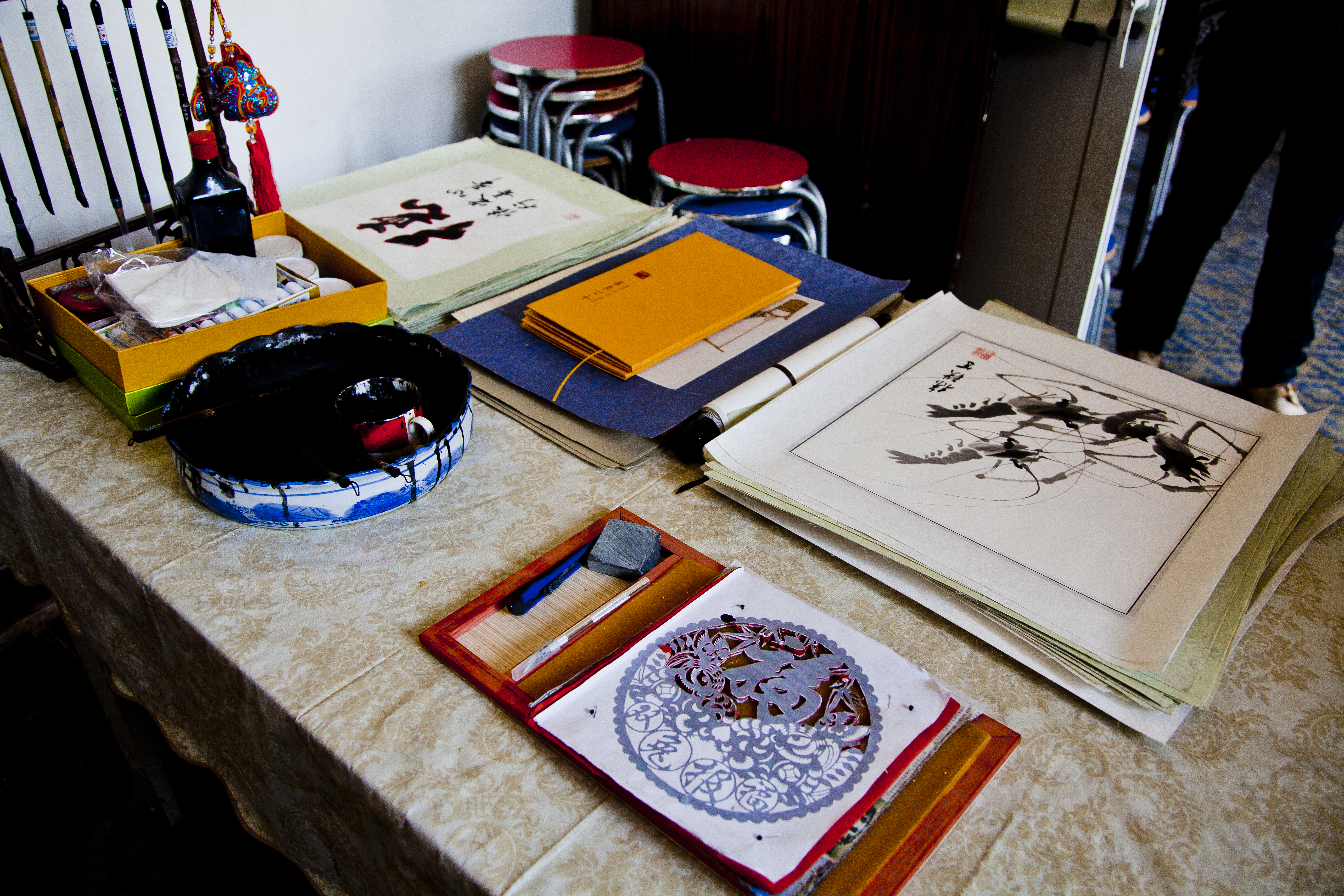
Speaking of characters, I should mention that the Chinese are fond of pasting the “fú” (福) character, which means “good fortune”, on doors, windows and walls. Moreover, they often paste it upside down. This is based on a wordplay: the word “dào” in Chinese means both “inverted” (倒) and “to arrive” (到). So, “Fú dào” at the same time means “Fú upside down” and “Fortune arrives”.
A resident of the house sat us under a portrait of Mao (this was happening in the eastern house, adapted for visitors) and, in fluent English, told us about life in such a house and showed her father’s paintings, made in traditional Chinese style.
Before leaving, we saw other members of her family: her father and her son. The cute two-year-old boy was shy at first, and refused to pose for us when we wanted to take a picture, but then took a fancy to us, escorted us to the door and even said “See you later” in English.
Next, we made a walk through the hutong. In fact, the word “hutong” is of Mongolian origin, meaning “water well”. During the Mongolian Yuan Dynasty each such quarter had a water well, hence the name. Nowadays the term “hutong” refers to these narrow, or sometimes, very narrow alleys.


Like everything in China, the front door design of each house was strictly regulated by the social status of its residents. If the house belonged to a military official, there were two round stones at the entry, decorated with various ornaments, standing on their edges, one on each side. Square or rectangular stones, on the other hand, indicated that a civil official lived in the house. The number of hexagonal wooden beams above the door jambs also depended on the social status of the owner. Twelve beams was the maximum, which was only attributable to the Emperor. Severe punishment or even execution expected those who dared to break this rule (as well as using other privileges of the Emperor: yellow colour, dragon as a symbol, constructing two-tier roofs). Then the number of beams decreased with decreasing social status – so a commoner would content with just two.
We already mentioned the meaning of four cardinal points in the design of Chinese courtyards. About the city as a whole we were told that east was for the wealthy, west for the noble, north for the poor and south for the lowly.
We came back from the hutong and had lunch, after which we visited our last place in Beijing – the Hongqiao Pearl Market, where we had great fun! In order to get to chic, certified pearl jewellery on the fourth floor, one would have to survive three seething and boiling floors full of low-quality Chinese goods (the ones we have oodles of as well). Escalators were located in different places, just as in any other large shopping centre, but in, say, “Marks and Spencer” it’s quite hard to imagine noisy sellers chasing you, grabbing you by the hand and shouting: “What is your last price?”. And this arrangement of escalators made it totally impossible to avoid them.
We had been warned that bargaining was absolutely necessary in China, but we couldn’t even imagine that people haggled so passionately and fervently here. The mall was packed with foreigners, who, apparently, had also been briefed on the rules of shopping in China. Here and there we observed many funny scenes, such as a resentful buyer walking away, a seller running after him, ready to make any concessions just to palm off his fake “Dolce and Gabbana”. A sales girl caught our conversation and cried out in broken Russian: “Come buy a scarf, why don’t you want a scarf?” We left without any scarves, though.
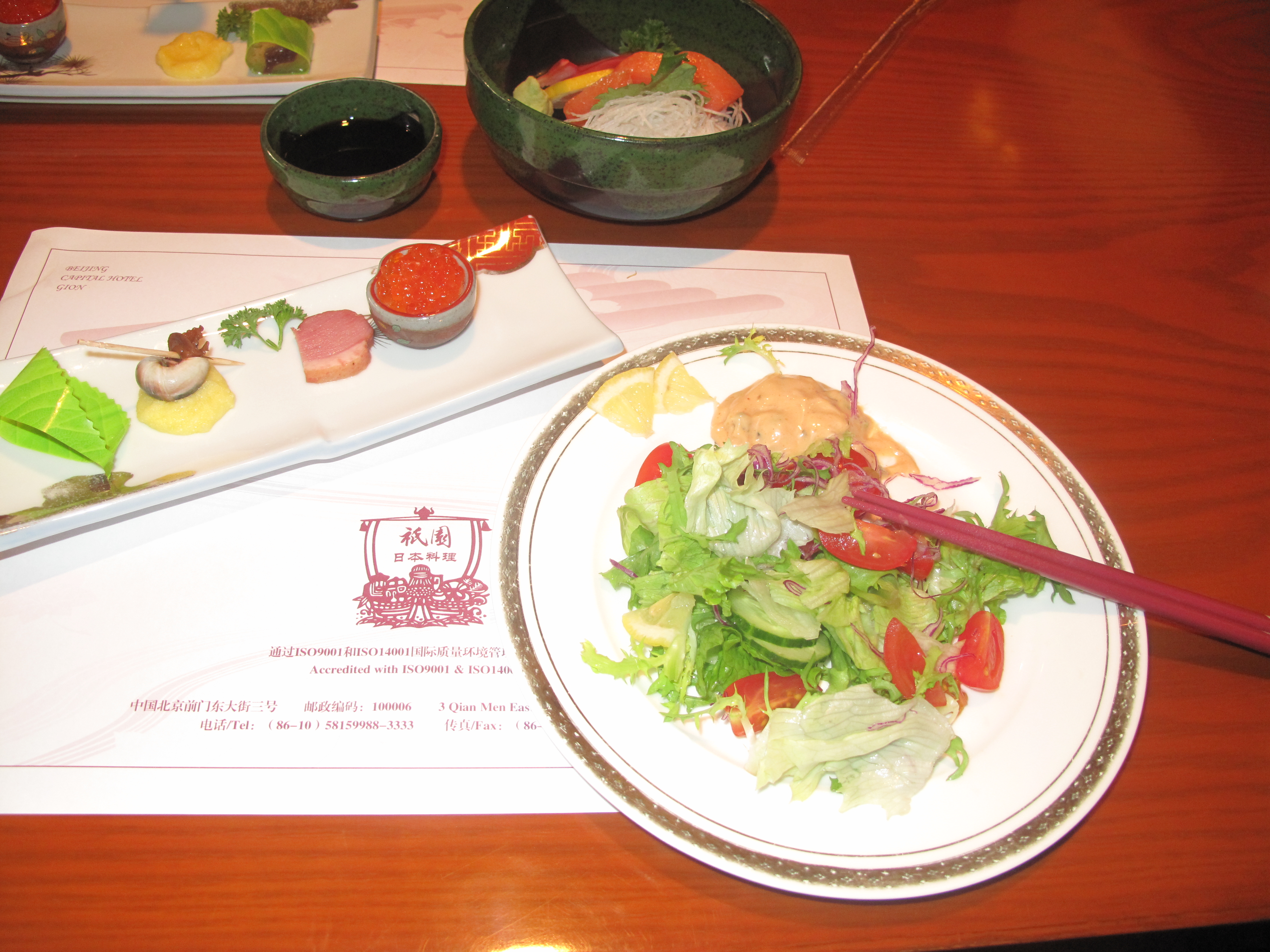
And finally, we had a very, very tasty dinner at the same Japanese restaurant, albeit with more modest portions.
Of course we didn’t get the chance to see everything we wanted to – for example, the Summer Palace, the China Ethnic Museum, the Lama Temple… But still, we spent five useful and fabulous days, full of impressions, in Beijing. Let’s see what Hong Kong is going to be like…