Posted in Азия, Китай, Пекин, Русский

Поездка в Китай – Пекин – День 1 (или даже скорее 0.5)

CLICK HERE FOR ENGLISH VERSION. АНГЛОЯЗЫЧНАЯ ВЕРСИЯ ПО ЭТОЙ ССЫЛКЕ.

20 марта 2012, вторник

Перелет, несмотря на признанной удобство Катарских авиалиний, все-таки оказался утомительным: 10 часов в общей сложности – не шутка. На второй части (Доха-Пекин) удалось немножко поспать, даже при жуткой ночной турбулентности.

В Пекине поразило, что на Arrivals и, соответственно, за багажом тоже, надо ехать на поезде. Это говорит о грандиозных масштабах аэропорта, из-за чего он выглядит пустовато. Чемоданов пришлось ждать настолько долго, что мы уже мысленно с ними прощались и прикидывали, как они без нас путешествуют по просторам земного шара. Уф, все-таки дождались.

В гостиницу поехали на такси, предусмотрительно сохранив на телефоне адрес оной, записанный иероглифами. Ехать пришлось целый час, и въезд в Пекин абсолютно не впечатлил. Типичный вид пригородов Баку (даже автомойки выглядят также), с противоестественно выбивающимися из знакомой глазу картины иероглифами на вывесках и стенах. Думали, что впечатления неяркие из-за нашей усталости, на следующий день оказалось, что так оно и есть: пекинские улицы, как таковые, малоинтересны. Час поездки оказался на удивление недорогим – 110 юаней (в районе 15 АЗН).

Capital Hotel вполне оправдал свою пятизвездочность: начиная от великолепного интерьера холла, массы ресторанов на все вкусы, впечатляющих размеров (два смежных корпуса) и заканчивая необходимыми мелочами в номере, вроде пилки и расчесок.

Всё, на что нас хватило в этот день, это ужин и обеспечение себя культурной программой на время пребывания, при активном участии трех вежливых и улыбчивых китаянок из информационного бюро при отеле. Мы выбрали чайную церемонию уже на завтра, тур к Великой Китайской стене на пятницу и шоу кунг фу на субботу. Промежутки решили заполнить по своему усмотрению. Ночью спали, просыпались, мучились бессонницей, опять засыпали – обычная адаптация к разнице во времени (4 часа) плюс колоссальная усталость.

Posted in Europe, Ischia, Italy

Adventures of the Azeris in Italy – Baia di Sorgeto

РУССКОЯЗЫЧНАЯ ВЕРСИЯ ПО ЭТОЙ ССЫЛКЕ. CLICK HERE FOR RUSSIAN VERSION.

Whoop whoop, it finally happened – the bustling Larissa’s efforts overcame the passivity of the Italian side: they managed to find the tour operator conducting tours in Russian, and its representative came to our hotel to provide all kinds of guidance to its Russian-speaking  guests.

A small group of the latter gathered in the pool area, dominated (or at least, so he thought) by a man from St. Petersburg, with traces of heavy drinking on his face, not speaking any foreign language, and trying hard to show everyone how rich and cool he was: he expressed the desire to have only individual tours, was only interested in Michelin-starred restaurants and said something like “One should use a choke chain on the tour guide, to make sure they only do what you tell them to do”. His aspiration for ‘separatism’ was actually quite convenient for us, as this specimen would be extremely unpleasant to be around on any tour. His wife, by the way, looked quite simple and seemed to feel uncomfortable with her husband’s statements.

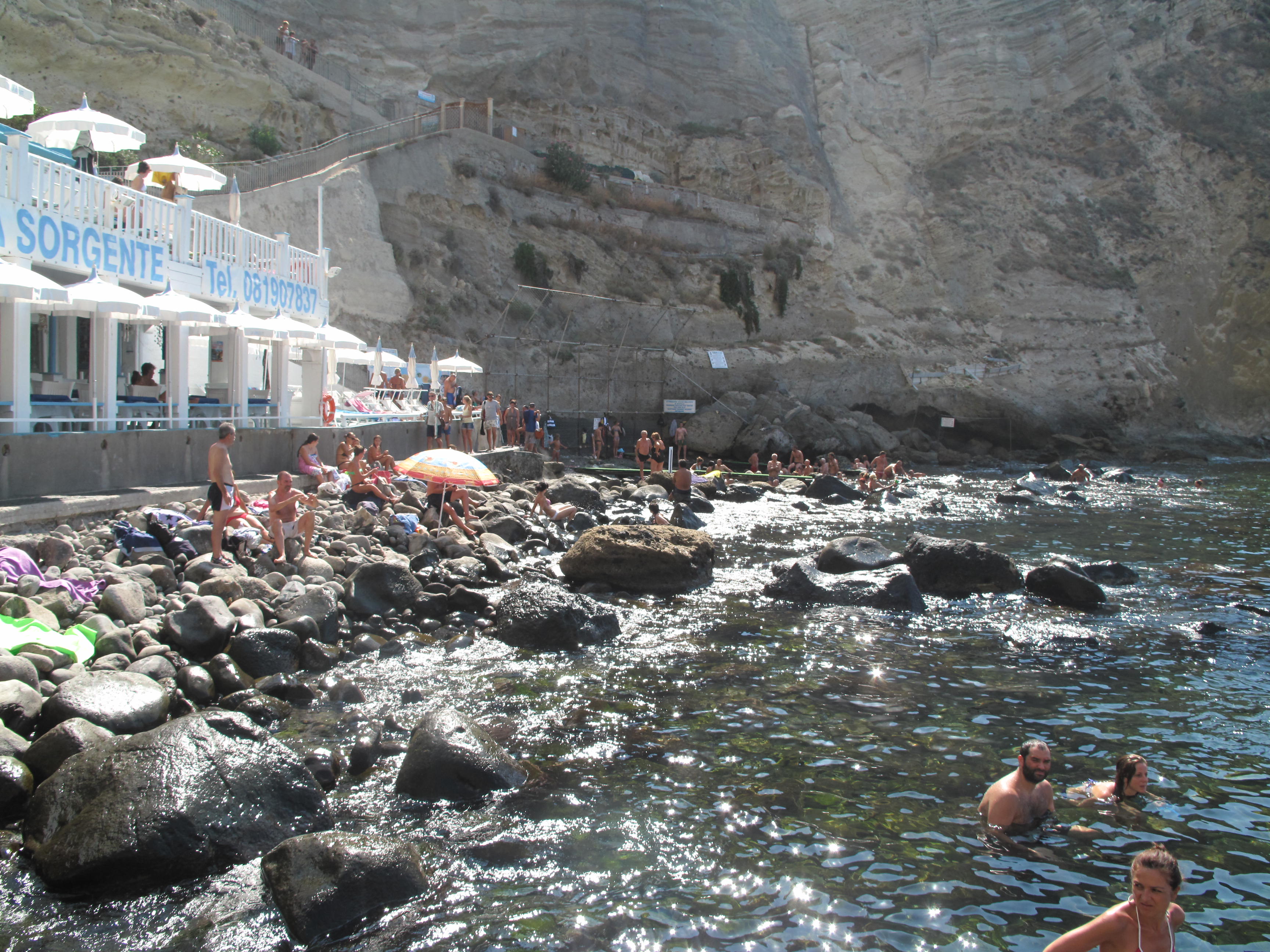
As a result of the conversation with the representative of the tour operator we got vouchers for a tour on Wednesday, and also learned about the Sorgeto bay located right here, near Sant’Angelo, and Le Fumarole beach located on a volcanic basin, heating the sand up to a hundred degrees centigrade. It sounded, though, like all you could to at Le Fumarole was baking potatoes and eggs in the sand, so we decided to abstain from a trip there and visit Sorgeto. As we were explained, the beach there pretty much consisted of natural stone beds with trickles of thermal water at 90-100 degrees Celsius flowing into them from under the ground. Combined with sea water, it results in overall temperature of around 35-40 degrees.

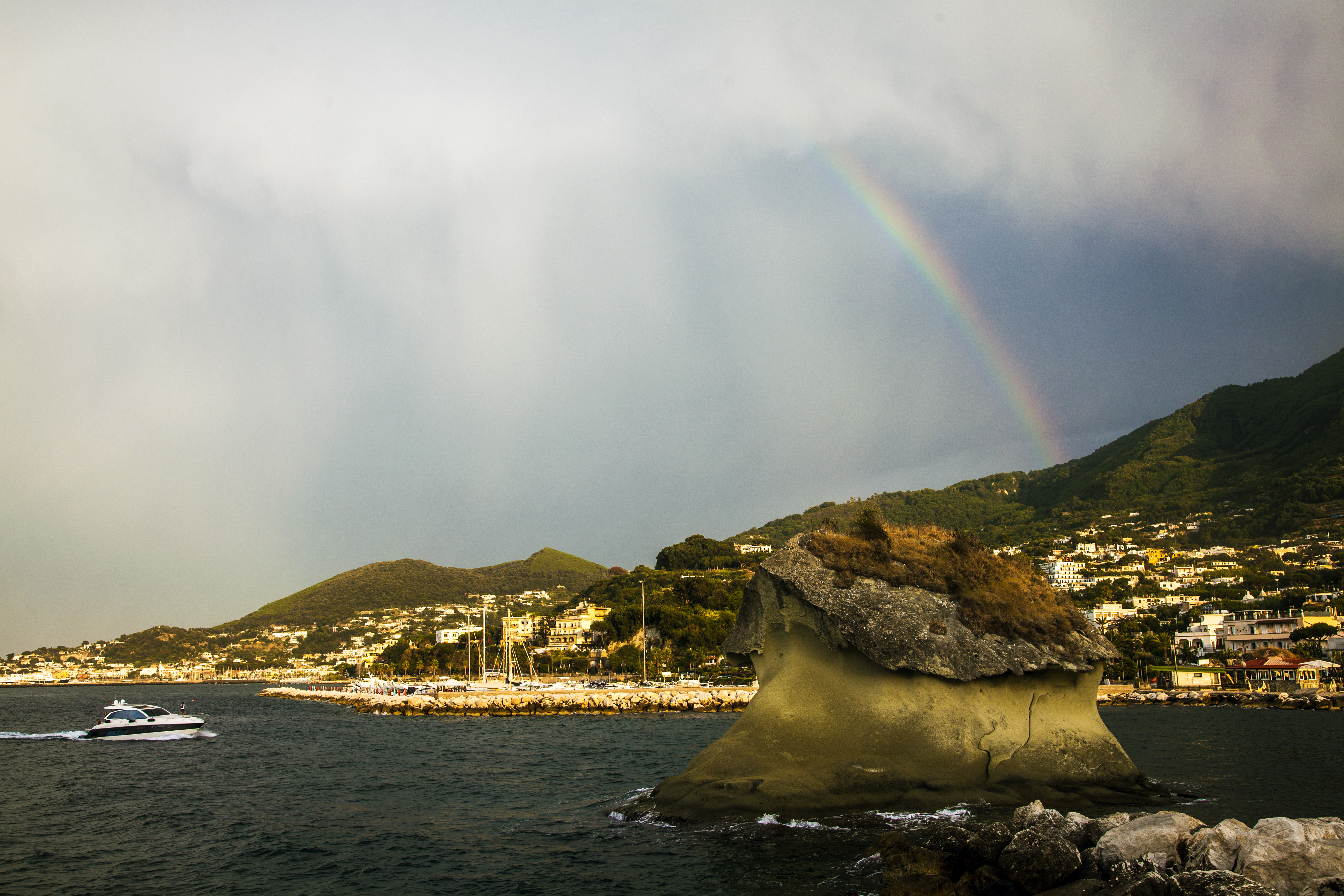
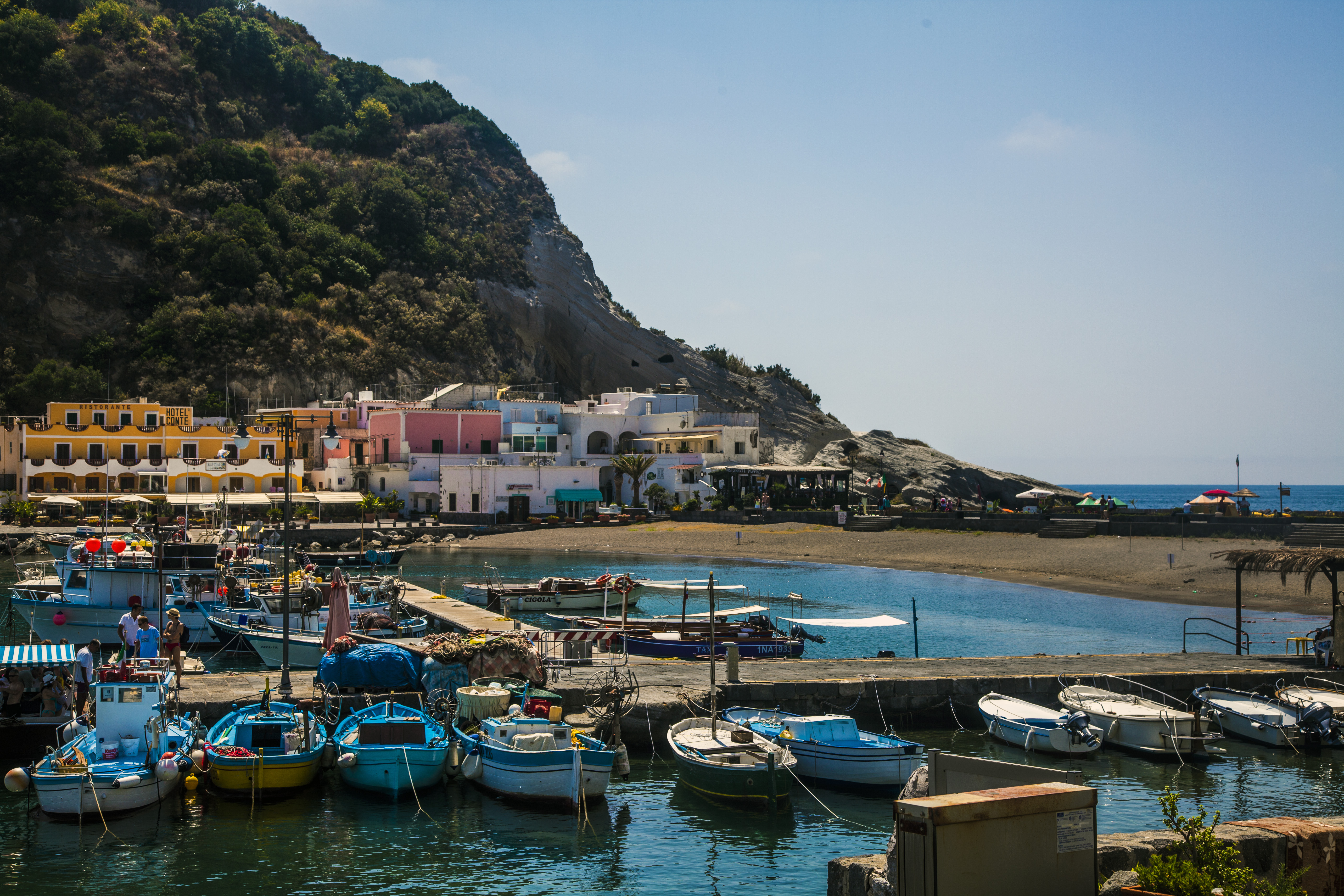
We took a water taxi to Sorgeto. The sailing was very pleasant, and we saw the “Elephant” rock on our way. However, Sorgeto itself, where we had been even encouraged to go at night, did not impress us that much: it was basically a jumble of huge boulders, looking scary to even step on (to us, at least), and even more so to try to lie on – it seemed absolutely impossible. Therefore, we returned to Sant’Angelo on the very next taxi.

Can you spot the elephant?


Baia di Sorgeto


Posted in Europe, Ischia, Italy

Adventures of the Azeris in Italy – Ischia Porto

РУССКОЯЗЫЧНАЯ ВЕРСИЯ ПО ЭТОЙ ССЫЛКЕ. CLICK HERE FOR RUSSIAN VERSION.

All this sightseeing is nice and interesting, but who said one shouldn’t be shopping when abroad? We’d been thinking for ages how to do it, and were first planning to travel to Naples, but then realised it would take us two hours to get there and two more to get back, especially that the opening time of the shops wasn’t very clear. Due to summertime many places here are closed from 1pm till 4pm, working a little in the morning and till midnight in the evening. And besides, August is the month of holidays, culminating on August 15 , the holiday of Ferragosto, which is an ancient pagan festival of the sun and harvest , adapted in Christianity as a day dedicated to the Madonna. Therefore, the working hours of shops (if at all? ) were under big question.

As a result we compromised . We had already mentioned that in general shopping in Sant’Angelo is virtually inexistent, so we were taken to Ischia Porto, the “capital” of the island. We were told that under the order of Mussolini each Italian city should have its own Via Roma, that is the street of Rome – usually it is the main street with all the shops concentrated on it. Ischia Porto is no exception . We arrived there at 6pm, and the street was crowded . However, we saw very little brand shops as such – most of them, just like in Sant’Angelo, contained a hodgepodge of several items by various brands. Still, after walking along the street till 10pm, each of us ended up with some new clothes .

The taxi driver, which was supposed to take us back to our hotel, told us that the price was not negotiable, but would rather be calculated based on the meter. We were pleased with the idea of not having to pay 40 euros this time. Well, indeed, we didn’t have to – the meter counted 60! We tried to argue, but the driver’s reply was that this was the night fare. Why 11pm had to be considered as night already – is an altogether different question, but arguing any further was simply pointless.

Posted in Europe, Ischia, Italy

Adventures of the Azeris in Italy – La Mortella (Ischia)

РУССКОЯЗЫЧНАЯ ВЕРСИЯ ПО ЭТОЙ ССЫЛКЕ. CLICK HERE FOR RUSSIAN VERSION.

From time to time we are promised that a Russian representative of some travel company will come to the hotel to “tell us everything” and organise a tour. But we do not believe in anything any longer and try to entertain ourselves as much as we can. Having gone through the available booklets, we decided to visit the La Mortella gardens.

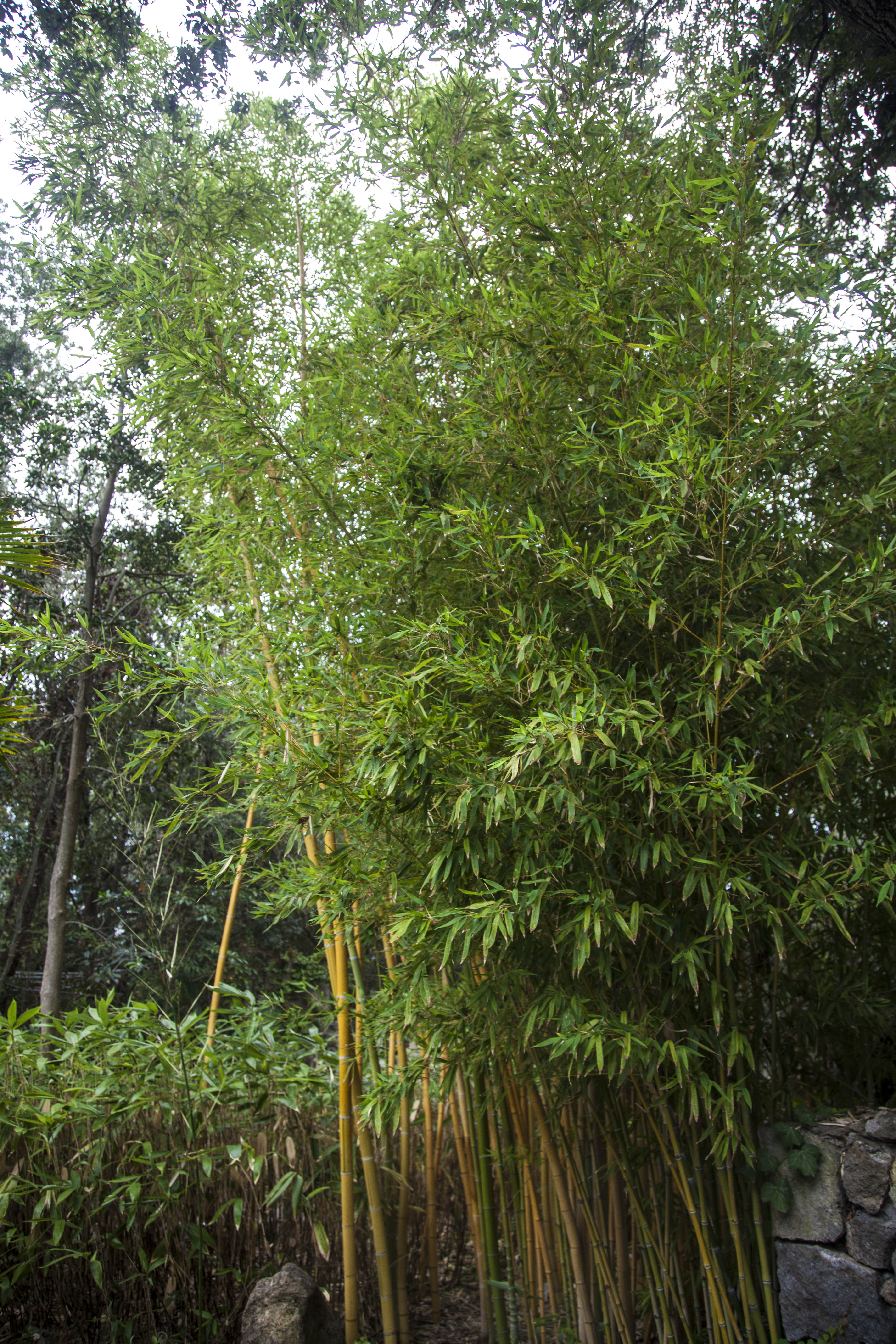
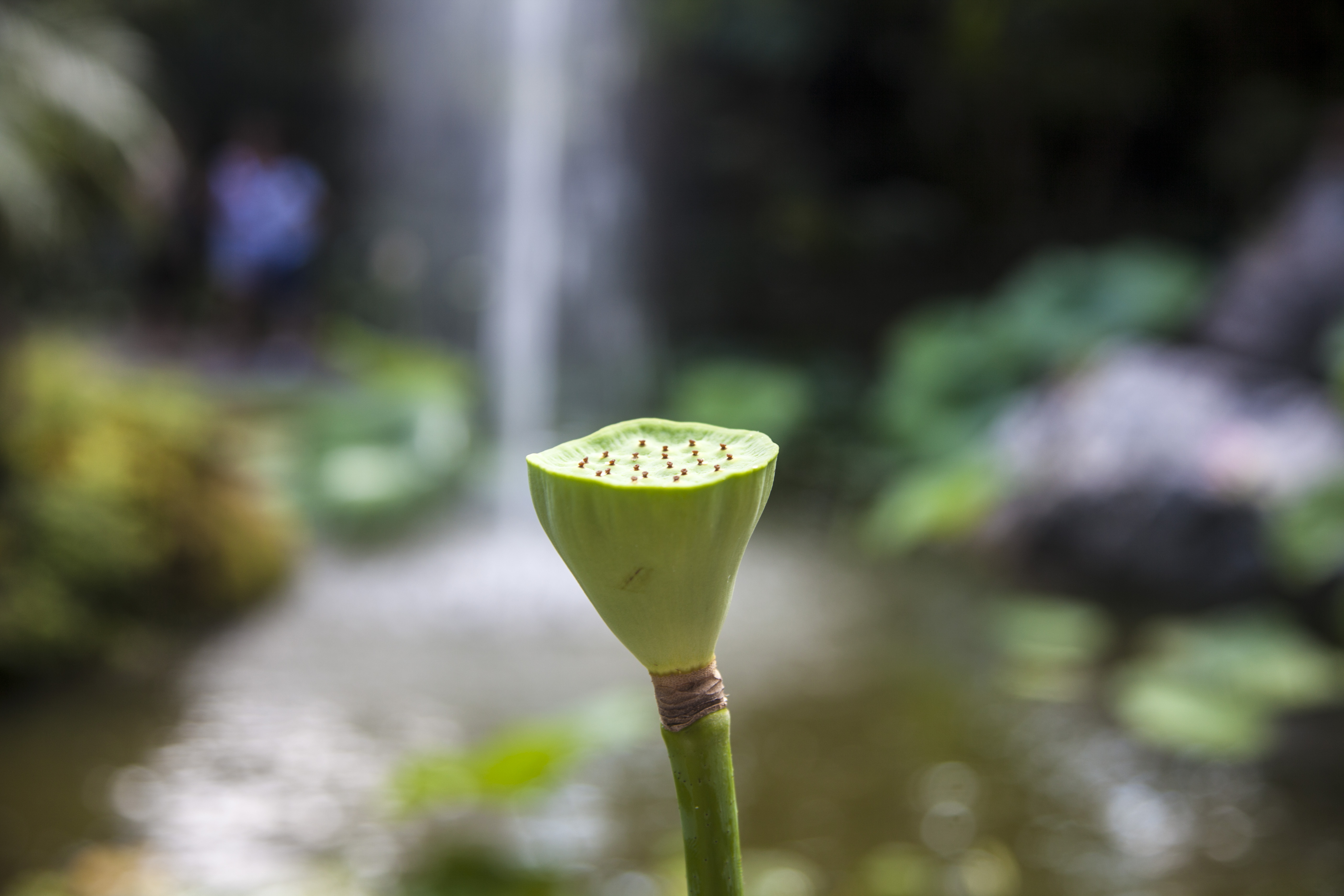
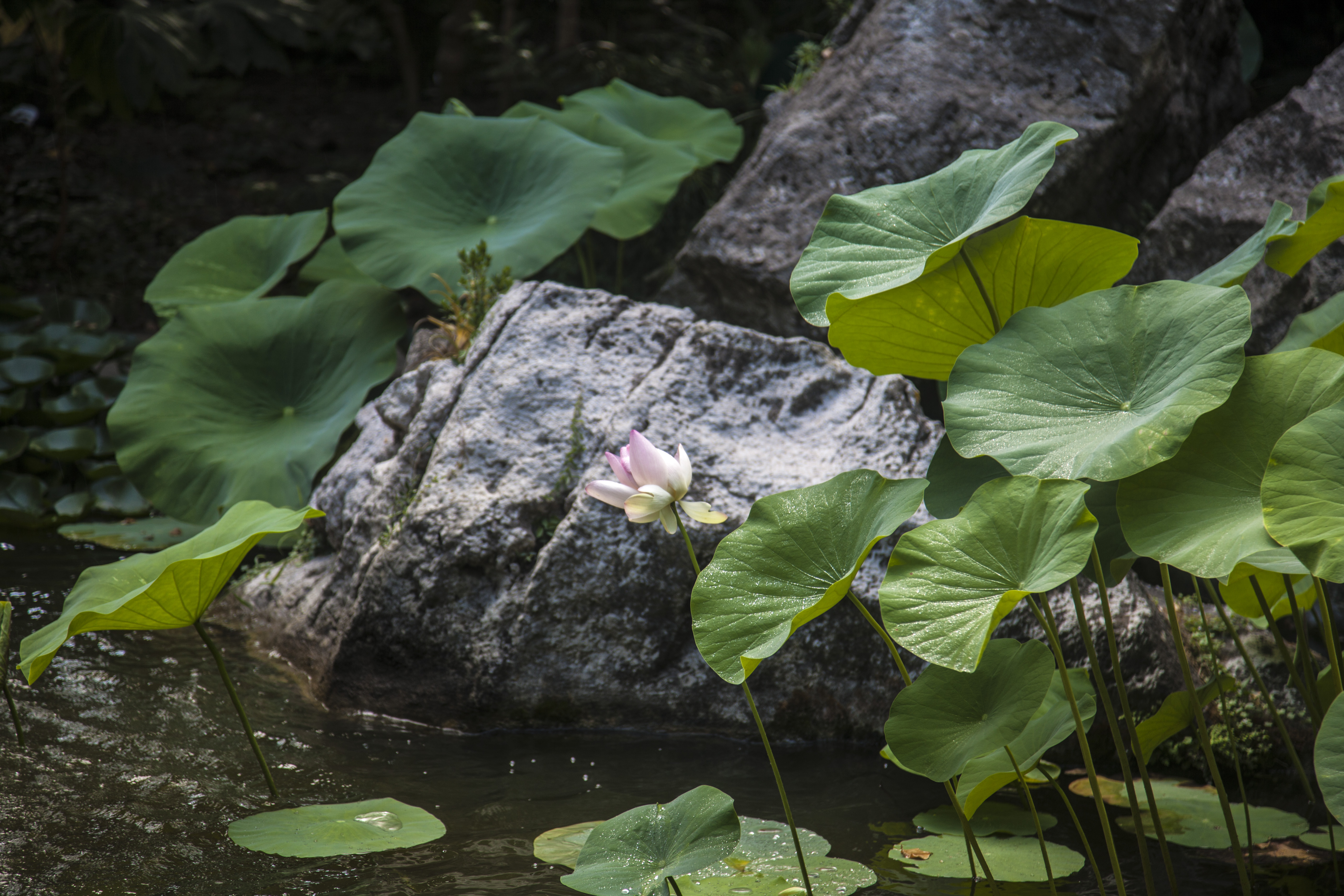
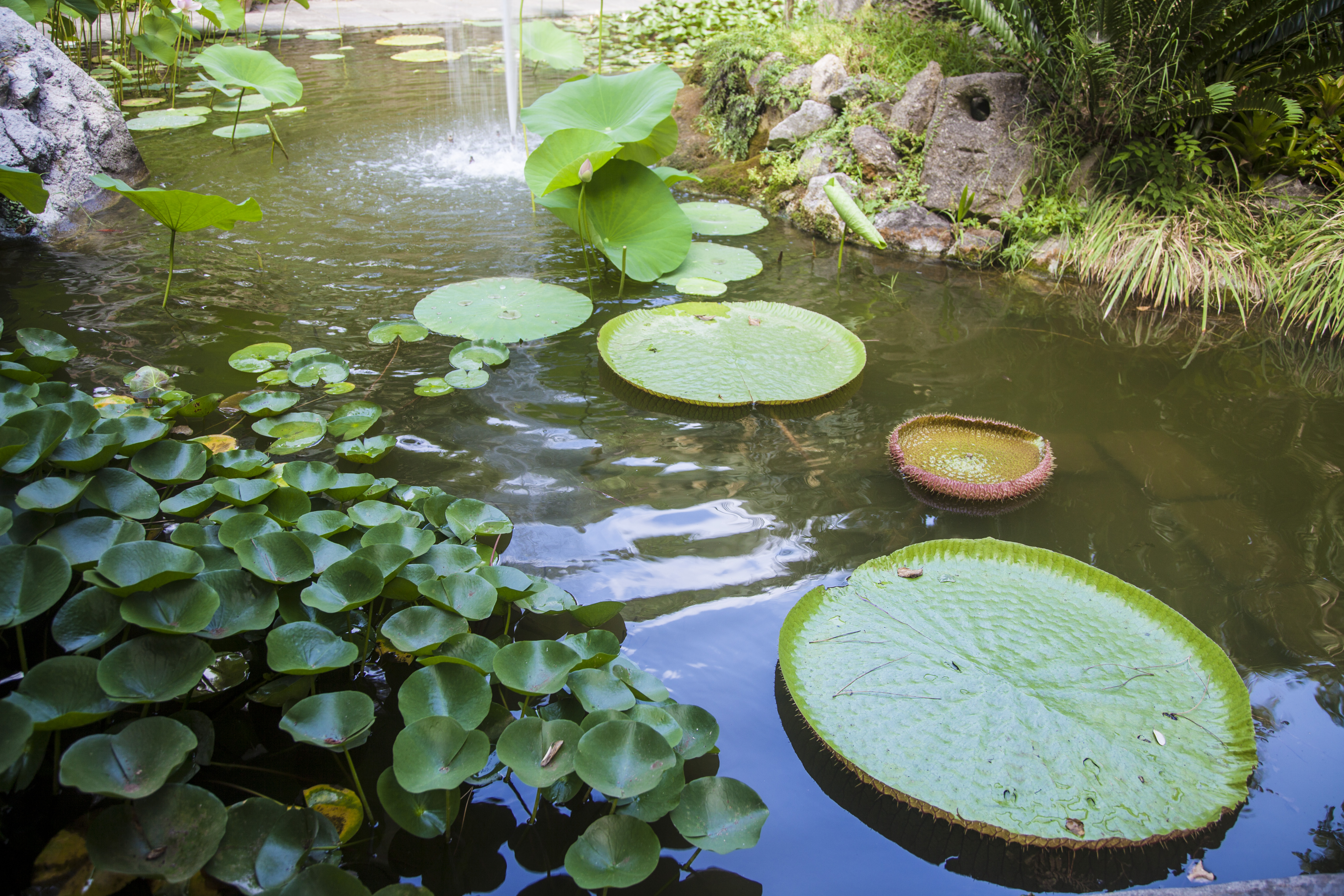
These gardens were planted by an Argentinian gardener who was the wife of the famous English composer Sir John Walton. They settled in Ischia in 1949, and, for the inspiration of her talented husband, she created the lower garden, full of the most rare plants from all around the world, including the giant Amazonian water lily Victoria amazonica, a leaf of which, as we all remember from our school books, can easily hold a month-old baby (dedicated to those lilies is the Victoria House, where water pours into a pool out of a  the ‘bocca’ (mouth) bas-relief); the Chinese paper tree, lotus, bamboos, Araucaria , bromeliads (that’s all I could remember, although there were lots more).

La Mortella - Bamboo

La Mortella

La Mortella

La Mortella

La Mortella - Lotus

La Mortella

La Mortella

La Mortella - Victoria Amazonica

La Mortella

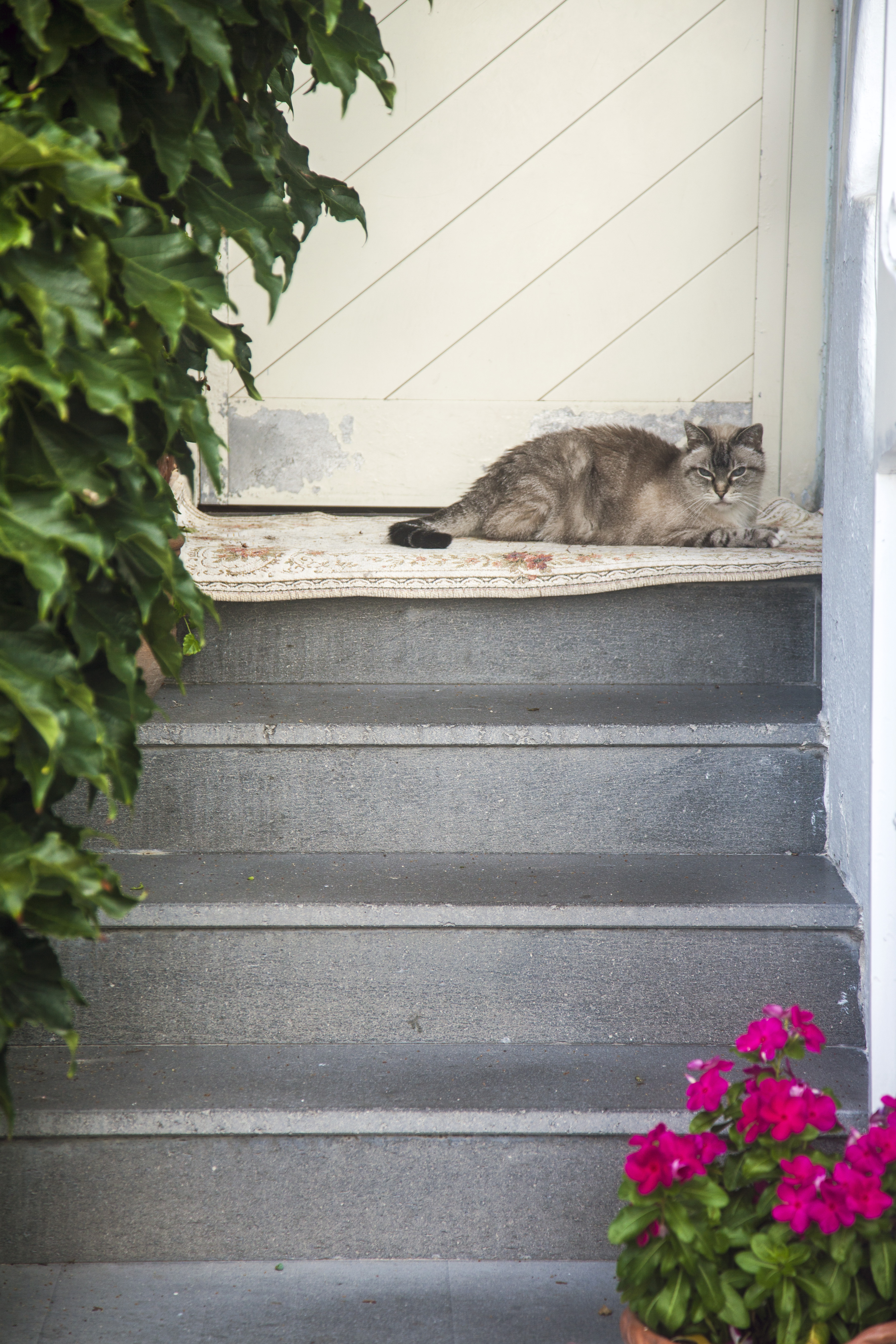
La Mortella - Lazy Cat

The upper garden was created after the death of Sir Walton , in his memory. He is buried right here (and so is Susana – his widow, who died later and who is referred to as the soul of the garden). Clambering up, we saw the Greek theatre , a pool with a bronze crocodile, the Temple of the Sun, the Thai pagoda and a concert hall, where they show a documentary with Lady Walton herself talking about the garden. We did not watch it all, but caught the moment where Prince Charles of Wales was admiring her replicated version of the Victoria House at Chelsea Flower Show in London.

La Mortella

La Mortella - Thai Pagoda

La Mortella - Templa of the Sun

La Mortella - Temple of the Sun

Posted in Capri, Europe, Italy

Adventures of the Azeris in Italy – Capri

РУССКОЯЗЫЧНАЯ ВЕРСИЯ ПО ЭТОЙ ССЫЛКЕ. CLICK HERE FOR RUSSIAN VERSION.

We got our Capri trip almost with a fight. Poor Larissa was really struggling to arrange it for us, but all her efforts met a “brick wall” of the complete apathy of her Italian colleagues. Her requests were passed from one to another, delayed by half an hour, then by another half an hour, and it looked like the trip was about to burst like a soap bubble, when finally, totally desperate, she explained to us how to get there pretty much on our own: take a taxi, then board a boat and then find a tour at the port. She didn’t possess any maps of Capri or guide books, so just had to draw some directions using pen and paper.

Ischia

Ischia

Forio

The boat took about an hour to get to Capri. Fortunately, the day was more or less cloudy, and there was a delightful breeze at the top deck of the boat. We boarded it in Forio and sailed around the whole Ischia, stopping to pick up passengers at all the Ischian ports: Lacco Ameno, Casamicciola and Ischia Porto.

IMG_6481

Larissa had promised us that there would be Russian-speaking tour guides chasing tourists right at the port, but we didn’t want to entrust ourselves to chance and signed up for the Italian/German/English language tour offered directly on board.

Having got rid of this concern, we immersed ourselves in observing other passengers, and were not generally too impressed by their looks. There were quite a lot of sweet couples, gently kissing and hugging, however some of them seemed just plain unattractive. The men looked like a mixture of Julius Caesar with Danny DeVito or Savely Kramarov and the women looked sloppy, scruffy, ready to become coarse in a few years – I’m not trying to be mean here, but you just so imagine them in hair rollers and robe, yelling at their screaming kids!

For reference – the area of the Capri island is four times smaller than that of Ischia, making a total of ten square kilometres. The island is essentially a limestone mountain (as opposed to the volcanic Ischia), so it doesn’t have beaches per se. There are only two towns here, the lower one being Capri, and the higher one is called Anacapri. The water washes away the limestone, which results in the formation of grottos. We took a bus to visit the most famous one of them – the Blue Grotto – once we got off the boat.

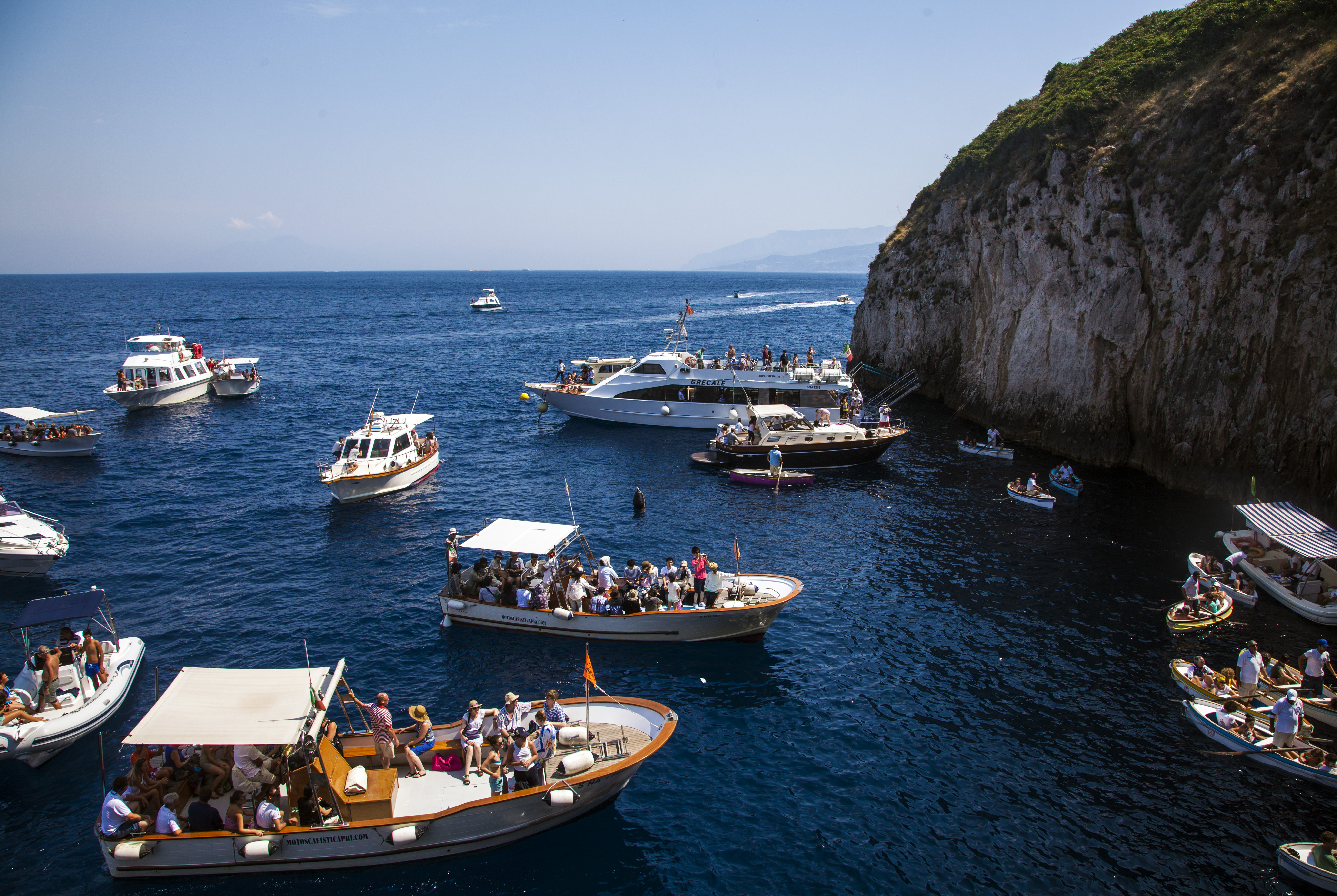
The Blue Grotto

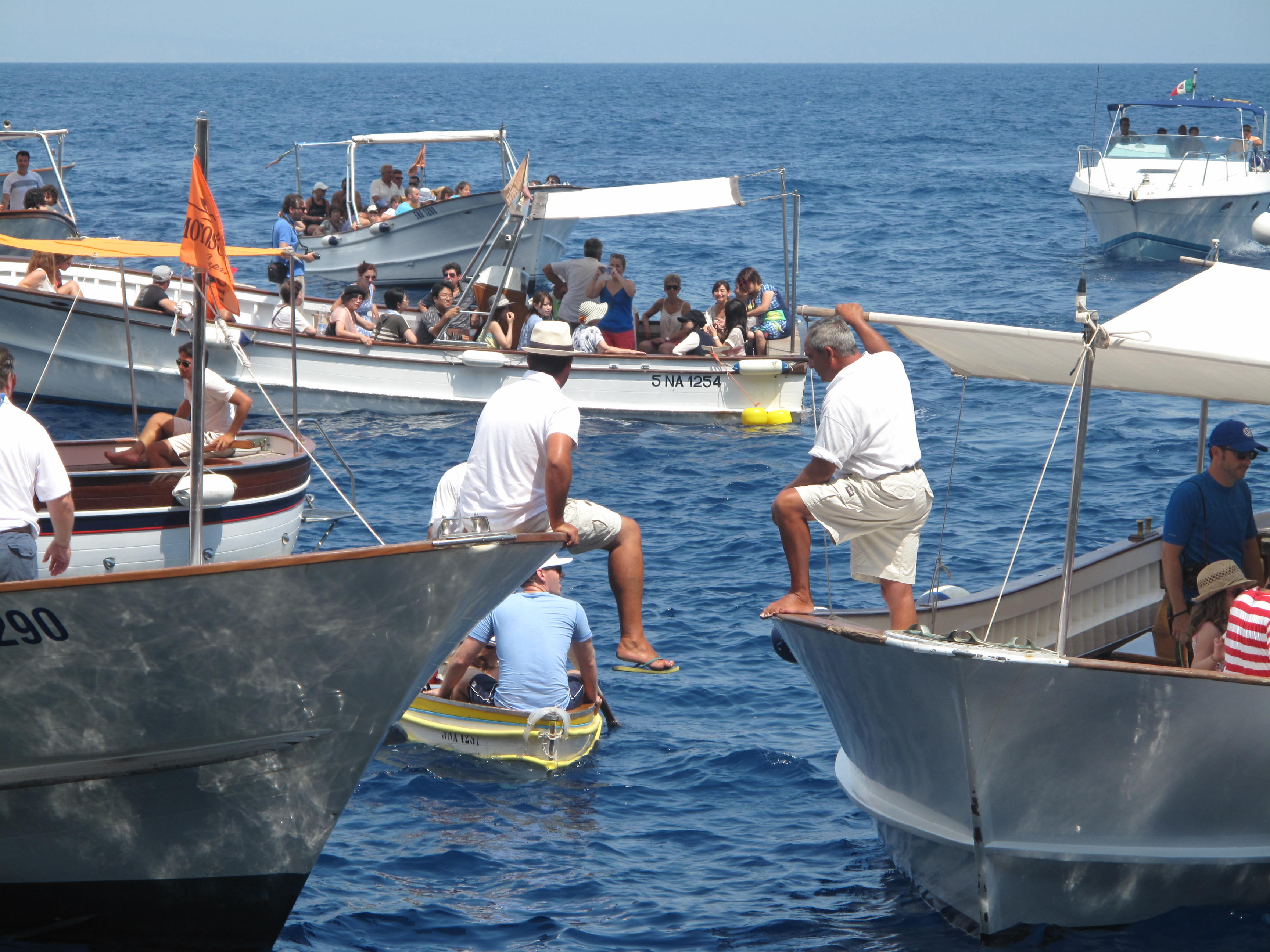
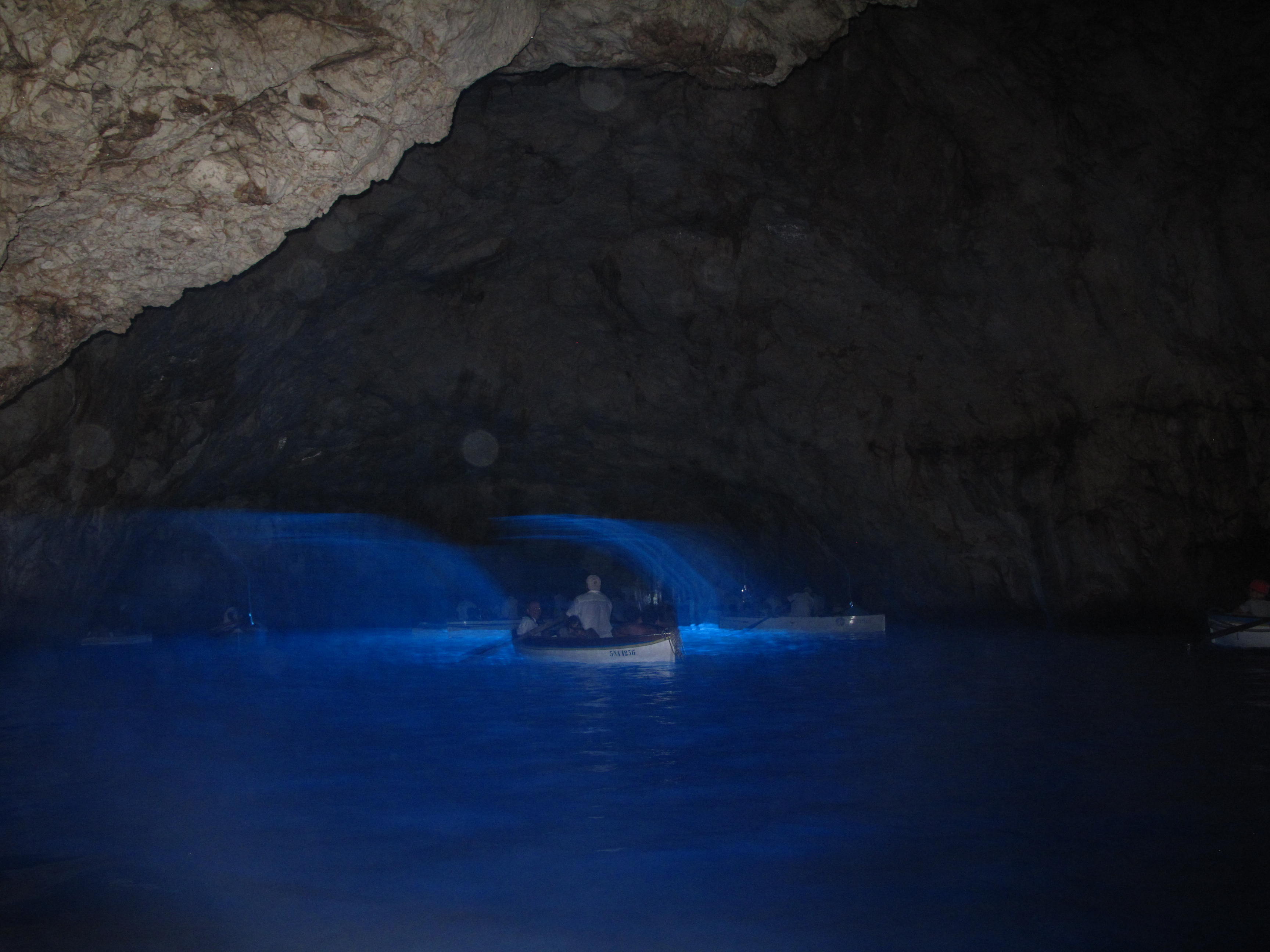
We turned out to be very lucky: the Blue Grotto can be entered only forty days a year (at least, so we were told!), at low water, and we just made it before it closed for today. This is how this all worked: the bus drove us right up to the stairs running down to the water, where there was a myriad of row boats with rowers. We had to wait in a queue; then manage to climb into the row boat, which was not that easy at all; then sail on it to the floating box office and pay there; and then lie down on the boat floor, as the entrance to the cave was very low. We entered into absolute darkness, lit only with occasional camera flashes, and accompanied by many-voiced rendition of “O Sole Mio”. We understood why the cave was called blue only once we turned back: illuminated with the light coming through the inlet, the water and ceiling coving got an amazing blue colour.

The Blue Grotto

The Blue Grotto

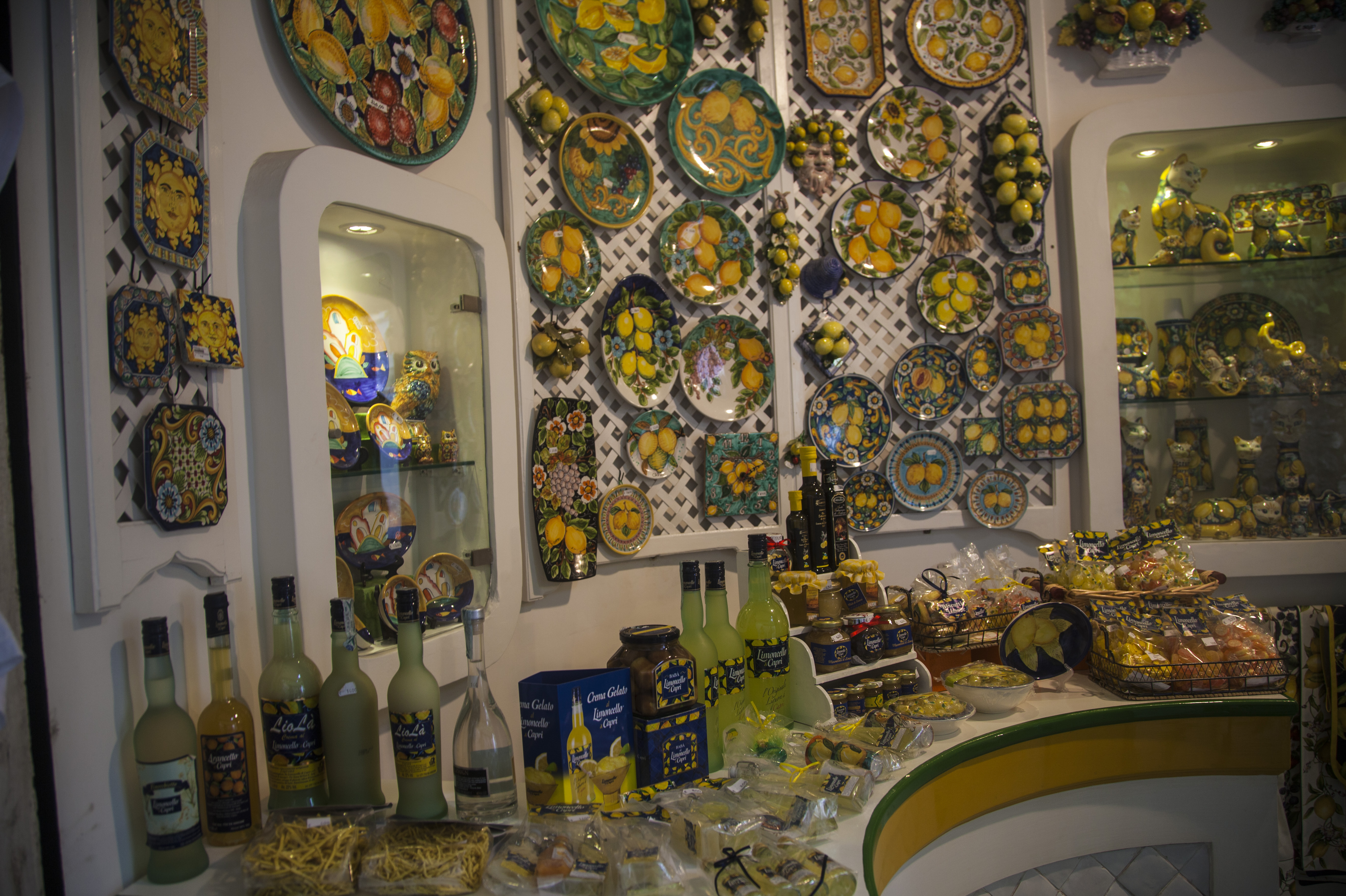
After seeing the grotto, we were taken to the central square of Anacapri. Here our opinion differed with that of Larissa, who had been convincing us that there was nothing to see in Anacapri, and praising Capri – we actually liked Anacapri better, with its magnificent view from the observation deck and a lot of very nice shops. It seems that the symbol of the island is lemon: there are loads of lemon-related souvenirs; there is a lovely refreshing drink made of lemon juice with crushed ice  sold everywhere, and the crown of all is the famous limoncello liqueur. Unfortunately, we only had time to catch a glimpse of all this beauty, as most of the free time we were given was taken by lunch, which our guide Cecilia was so ardently advocating to have right there, that we thought she was receiving commission from the restaurant for referring clients.

View from Anacapri

Anacapri

Later we were taken down to Capri. Here we saw (from the distance) the house of the “stormy petrel of revolution” Gorky, and Cecilia told us that in 1907 he had been visited by Lenin here – there is even a monument to the latter in Capri (which, by the way, no one thought of destroying!). We were told that here is where he was planning the revolution.

Capri

Capri

Capri - Gorky

Monument to Lenin

How did we find Capri? Very cramped, too posh, bristling with villas and gorgeous boutiques with crazy prices. On the narrow roads of what is assumed to be the pedestrian zone there are electrocars constantly scurrying around – we have them in Sant’Angelo too, but there they are not flowing continuously and are therefore not so annoying.

Capri

Capri

Capri

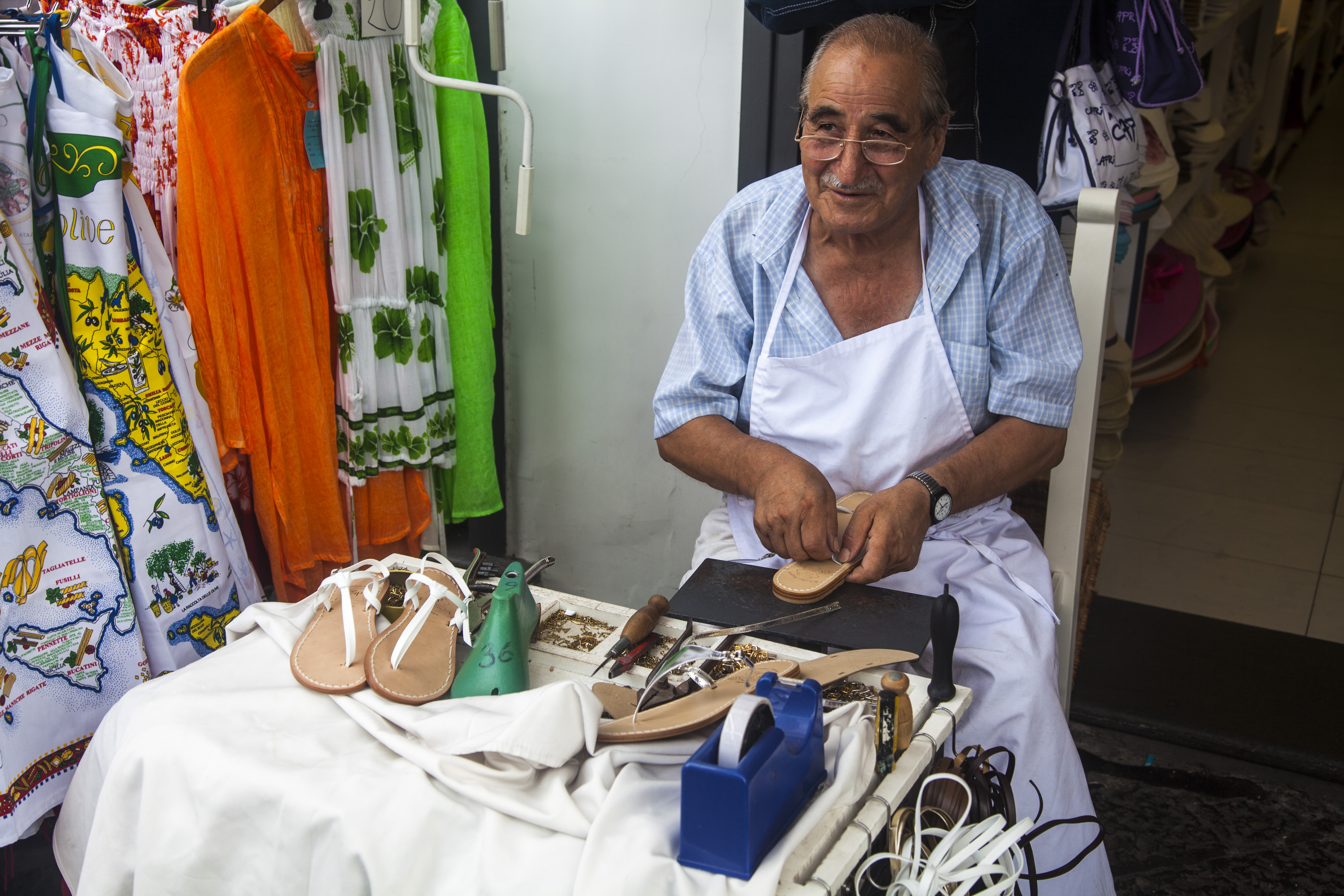
Capri - Shoemaker

By the way, all of this splendour functions only from April to October – in winter Capri becomes dormant, and any connection with Ischia stops. Therefore, as Cecilia said, most Ischians have never been to Capri – in summer they are employed in the tourism sector, and in the winter it’s difficult to get there (via Naples), and there is hardly anything to do as well.

If Anacapri was cool and pleasant, in Capri, despite the occasional drizzle, and perhaps because of it, it was very hot and humid. In this swelter we visited the Augusto Gardens and took numerous pictures of the famous Faraglioni rocks.  This stuffiness made the above mentioned lemon drink (la granita) the main highlight of the garden visit. Oh, Larissa, Larissa, we thought, this is where we should have been sitting on a terrace of some restaurant, staring at sauntering tourists and scurrying electrocars, instead of doing so in Anacapri, which instead was perfect for walking.

The drizzle finally ended with a magnificent rainbow that we saw on our way back.

Ischia Porto

Ischia (Casamicciola)

Ischia (Lacco Ameno)

Ischia

IMG_6567

Ischia

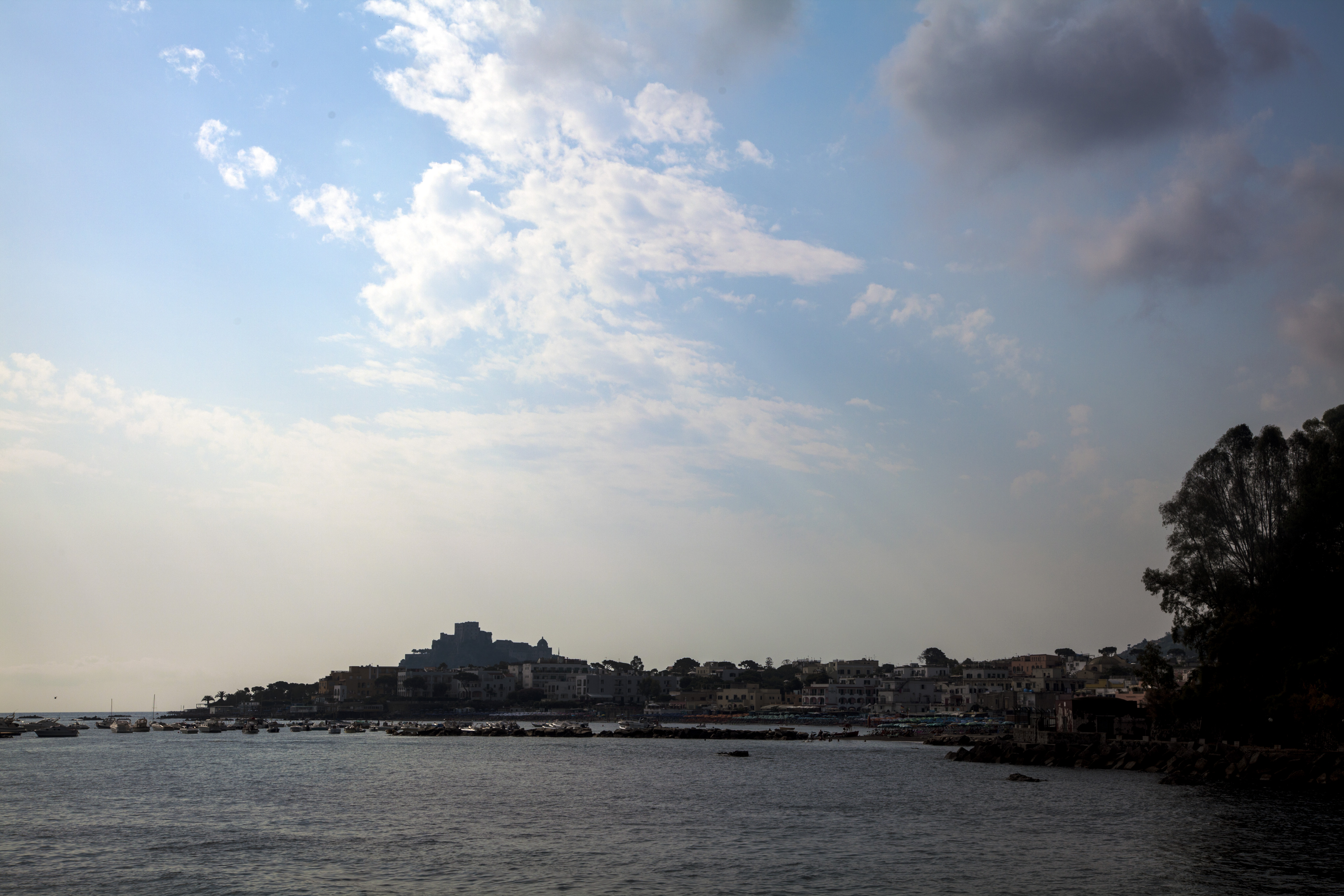
Ischian sky

Sant'Angelo - way back

Posted in Europe, Ischia, Italy

Adventures of the Azeris in Italy – Ischia

РУССКОЯЗЫЧНАЯ ВЕРСИЯ ПО ЭТОЙ ССЫЛКЕ. CLICK HERE FOR RUSSIAN VERSION.

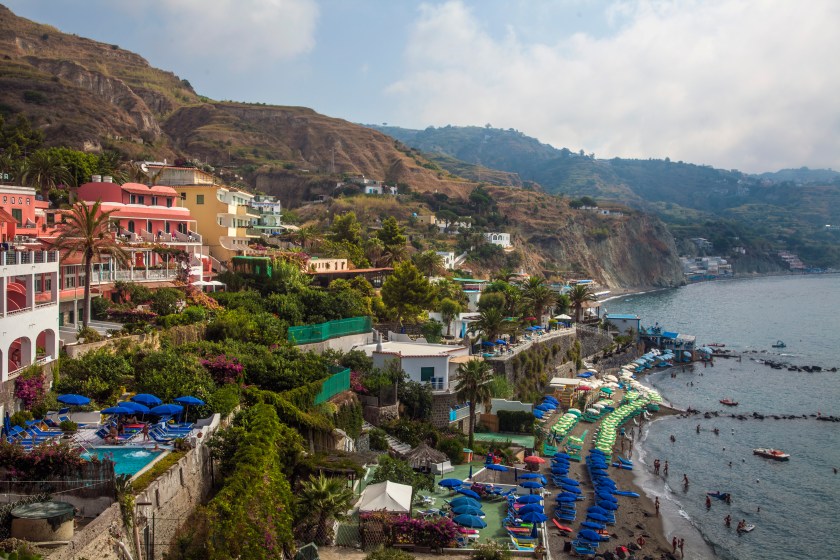
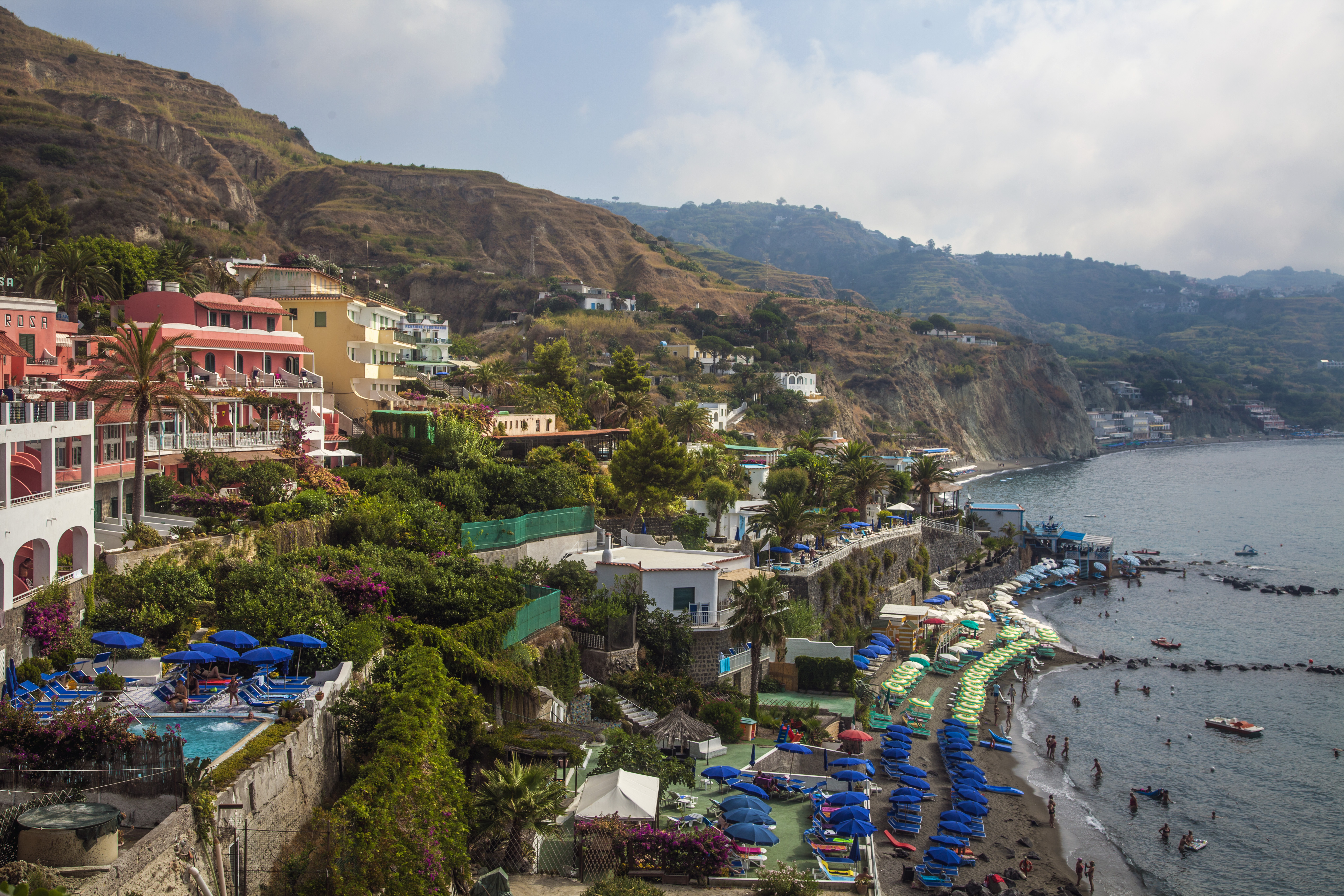
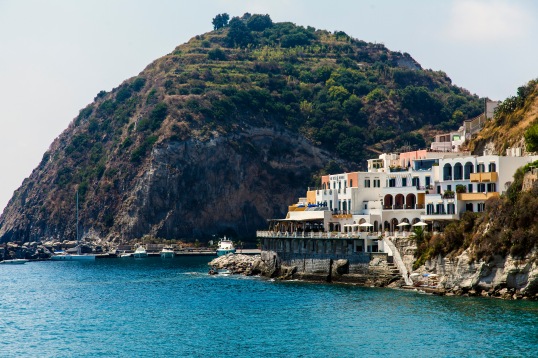
On our first day in Sant’Angelo we took a look around. At first glance our hotel seemed small, labyrinthine and beachless. We stared in disbelief at a small stone slab under our balcony with a couple of sun loungers and pool ladders leading into the sea. Look, we were saying to each other pointing into the distance, that hotel there has got a magnificent sandy beach. Had Booking.com simply duped us like that? It hadn’t, as it turned out. A huge spa area, covering the entire hillside, with a variety of pools – with thermal water, sea water and fresh water, hot and cold – and also part of the same beach which we had been drooling over – were all part of our hotel complex. Then we faced another problem: in order to reach it, we had to walk quite a long way up and down the stairs and paths under the baking sun. Looking ahead, I can say that in the following days this road did not seem as painfully long, as for me personally, I sometimes swam all the way from the stone slab to the sandy beach instead of walking there (about five hundred metres across the sea).
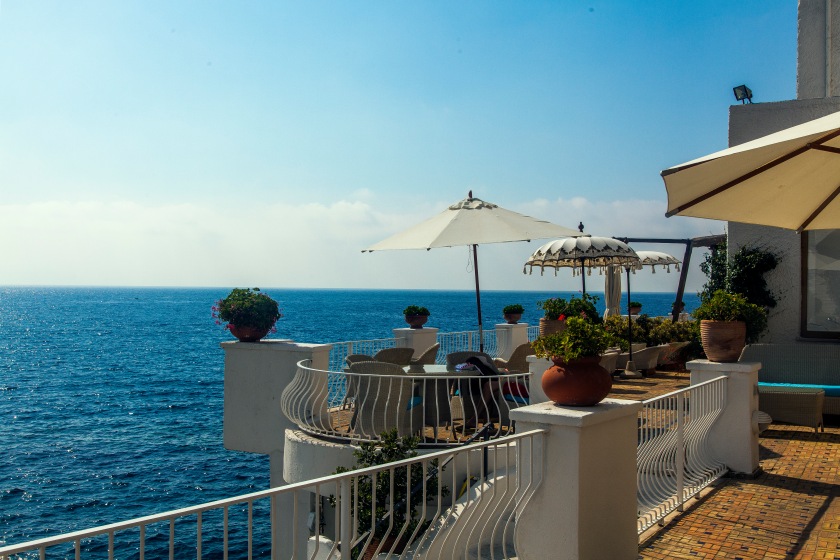
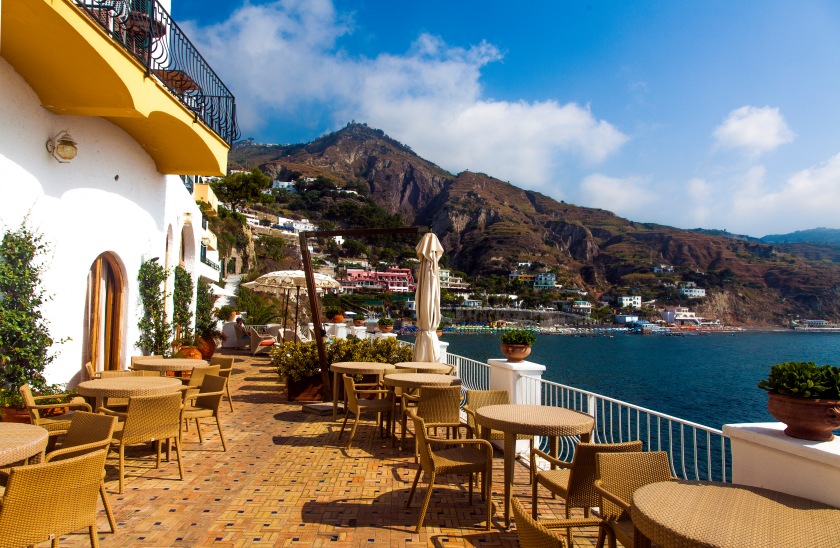
Sant'Angelo, Ischia

Sant'Angelo, Ischia

Sant'Angelo, Ischia

The Tyrrhenian Sea is clear, blue, moderately salty (not as salty as the Adriatic), the only problem is going in and coming out: the sand here is quite different from the dense and compacted one we have at the Caspian Sea, on which one can walk without falling through, the local sand actually looks more like tiny pebbles.
Sant'Angelo, Ischia

Sant'Angelo, Ischia

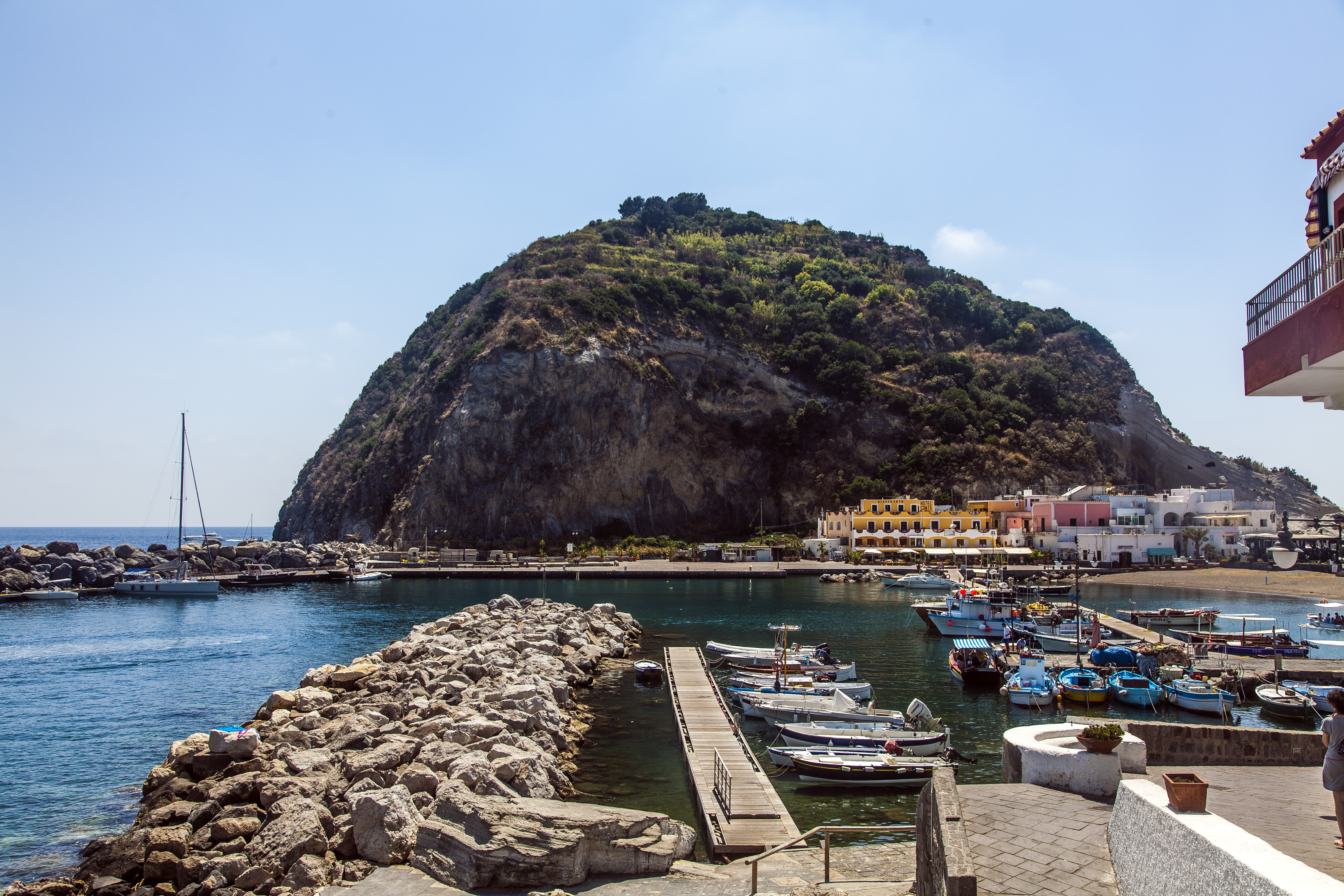
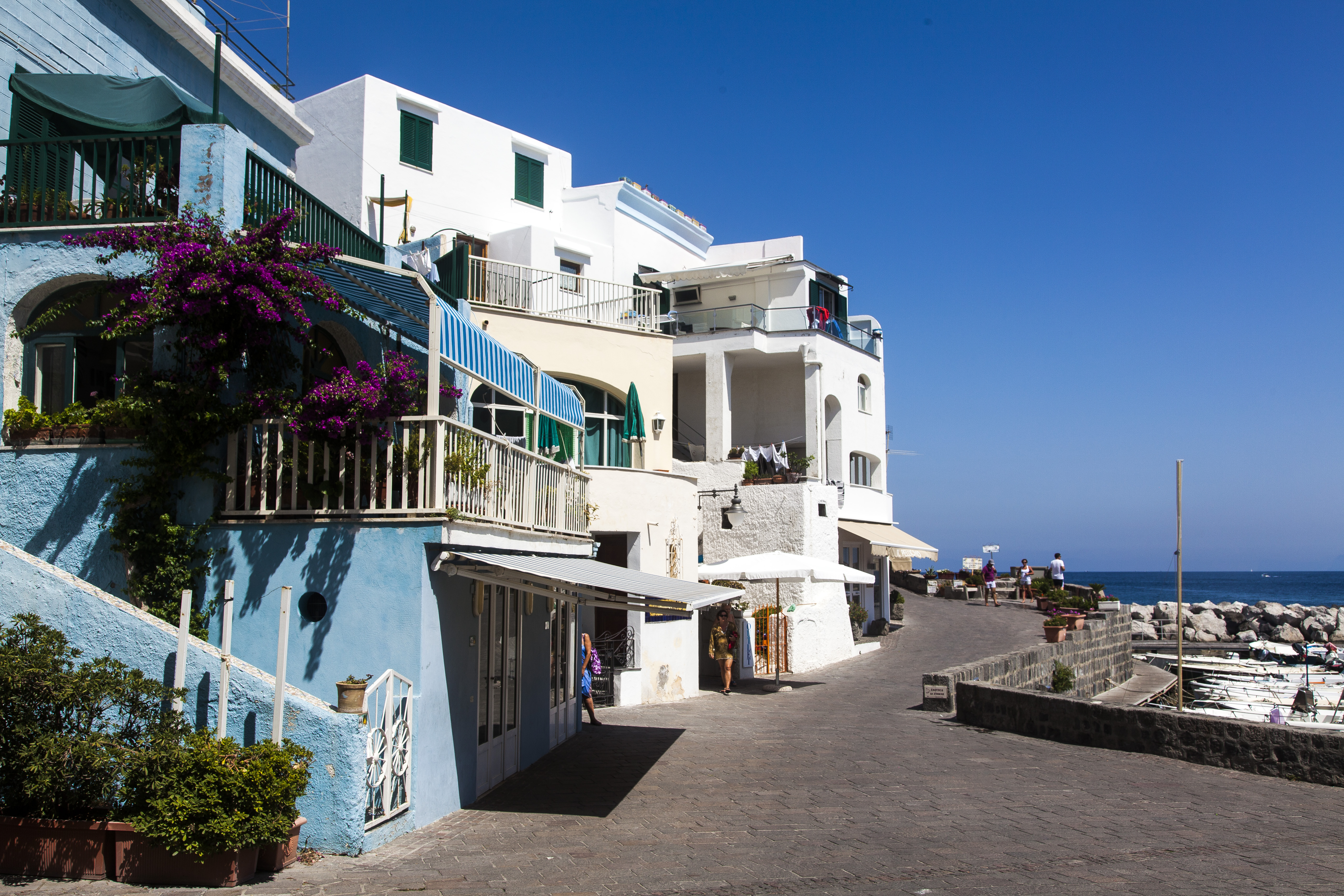
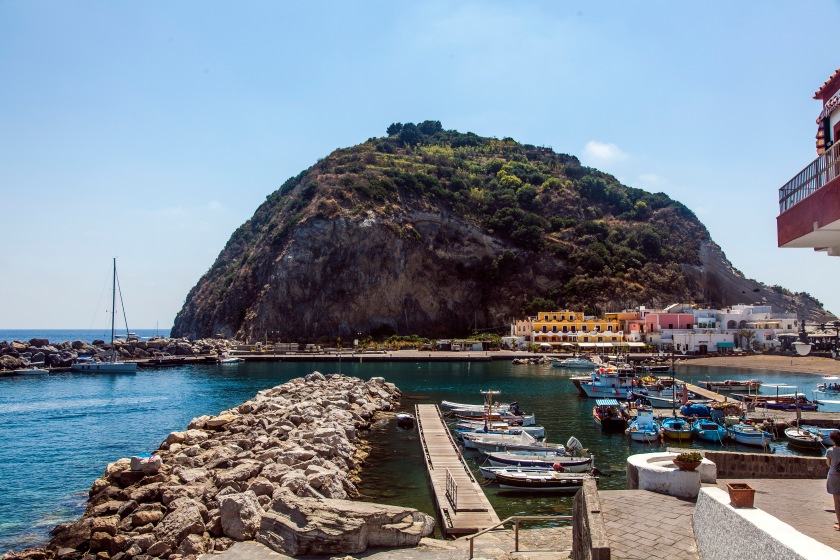
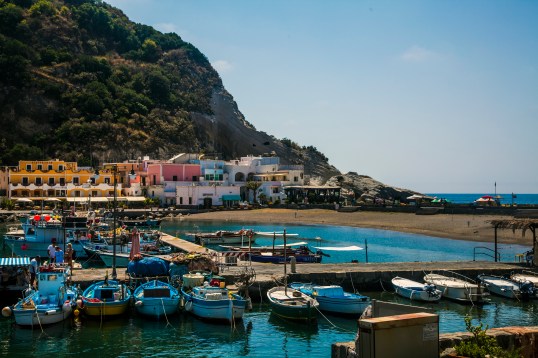
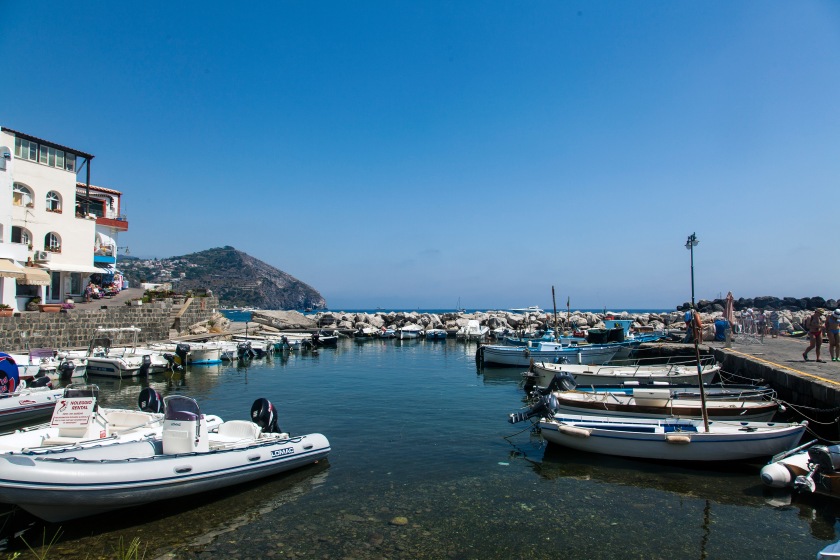
So what can I say about Sant’Angelo? It is a village, situated in the south of the island and is connected by a thin isthmus with a small peninsula, which is basically a lava formation. In the very heart of the village there is a pedestrian zone comprised of a square and a few adjacent streets, dotted with restaurants and shops. The shops look tempting at first glance, with closer examination, though, it turns out that a lot of them sell very cheap trash or the same kind of trash, but at exorbitant prices.
Sant'Angelo, Ischia

Sant'Angelo, Ischia

The food here is quite good, but rather unvaried: seafood, pizza and pasta. Interestingly, there are virtually no soups. The atmosphere in this area is very Italian with music playing, people dancing, children screaming, their mothers yelling at them, someone fishing and small mongrels barking furiously. Somehow the children are mostly girls: it’s either that a century of peace awaits Ischia, or for some reason boys are kept at home.
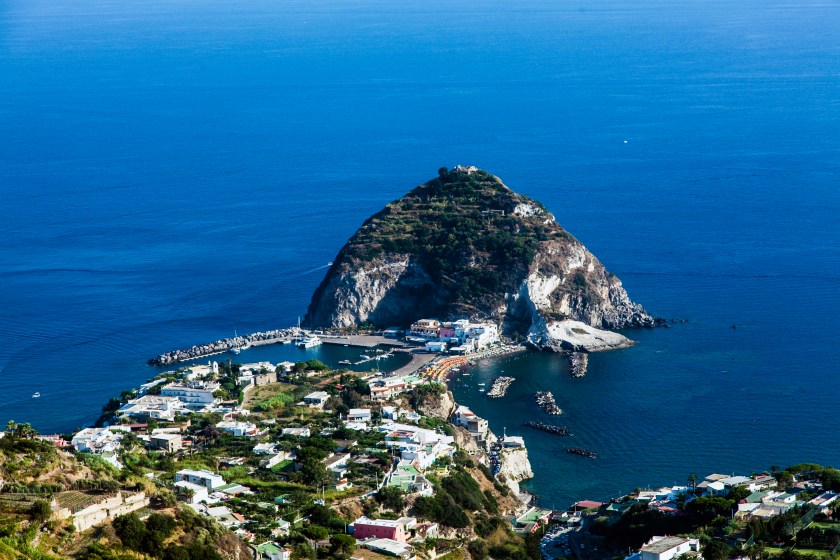
Sant'Angelo, Ischia

The vacationers here are mostly Italians themselves, there are also a lot of Russians, some Germans, French and British, and that’s pretty much it. There are no Chinese or Japanese tourists, which is surprising – I think you’d agree that places without crowds of either, cause some suspicion.
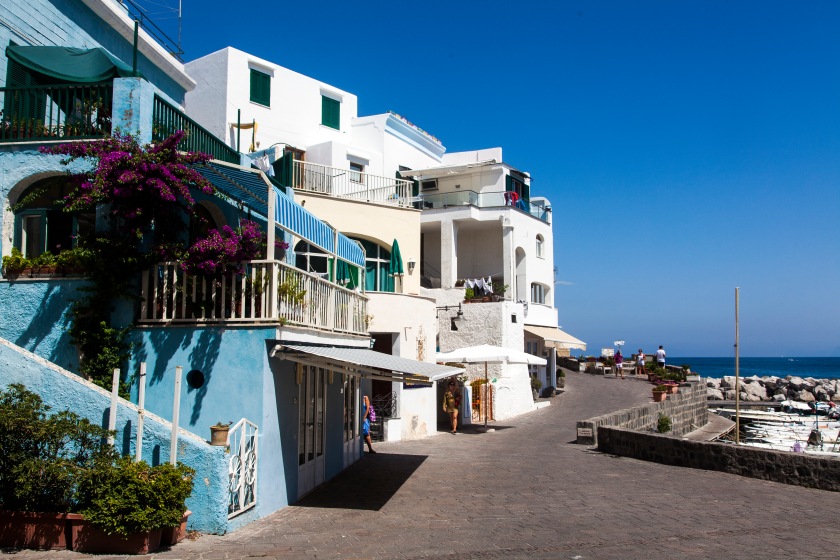
Sant'Angelo, Ischia

Sant'Angelo, Ischia

Here our observation of the locals’ laziness got developed and validated. To begin with, the vacationers swim surprisingly little – if you see someone swimming in the sea, most certainly they’ll turn out to be French, or Russian, or those writing these lines. Italians prefer to float lazily on mattresses, or not to go down to the sea altogether, lying around the pool instead. As for the staff, it is astonishing that any simple request grows into a big problem requiring a vigorous discussion between a few people.

For instance, on our very first day, as we usually do arriving to a new place, we tried to book tours and excursions, naively believing that this should be an easy and usual practice for the hotel. We came to the reception, and the girl working there readily laid out several maps and brochures, noting the places which she would recommend to visit, and considered her mission completed. We let her know that we weren’t going to call any tourist organisations or taxi services ourselves and clearly hinted that we expected these services from the hotel, in accordance with the notices on the walls. The girl was surprised and puzzled, and called a colleague to help. He pulled out a few more maps and brochures, and, in his turn, showed the places, which, in his opinion, would be interesting for us to visit. We stood our own and tried to persuade them into organising something for us. Finally, he remembered with relief, that they had a Russian lady named Larissa working for them, and she would come in the evening and help us.

Unlike the Italians, Larissa took up the matter enthusiastically. She told us that only the day before she sailed to the Amalfi coast on a private yacht with a Russian couple for 1,500 euro. We asked her to take us at least on a tour around Ischia – and a cheaper one preferably! – and agreed for the next day. Larissa had been living in Italy for the past seventeen years, so had perfectly mastered the talkativeness of the locals. However, these talks ended with zilch: she didn’t manage to get the day off.
Then we went back to the reception and importuned the girl until she finally called us a taxi. This is how we literally wrung out of them a trip to Forio and Ravino Gardens. Gino, the driver, turned out to be a nice fellow, who couldn’t speak a word of English, though – however, he knew a couple of phrases in German and for some reason was using them every now and then communicating with us. Here it’s worth pointing out another feature of the Italians – they are normally nice and willing to help, unless they are playing the big boss. So Gino voluntarily offered to take us not only to Ravino Gardens and Forio, but also to drive us around the whole island, for just a little extra payment.

The Ravino Gardens are basically a small botanical garden dedicated to cacti and succulents only, which are more numerous and diverse than in the famous glasshouses of Kew Gardens in London. The specialty of these gardens is their own very tasty cactus cocktail.
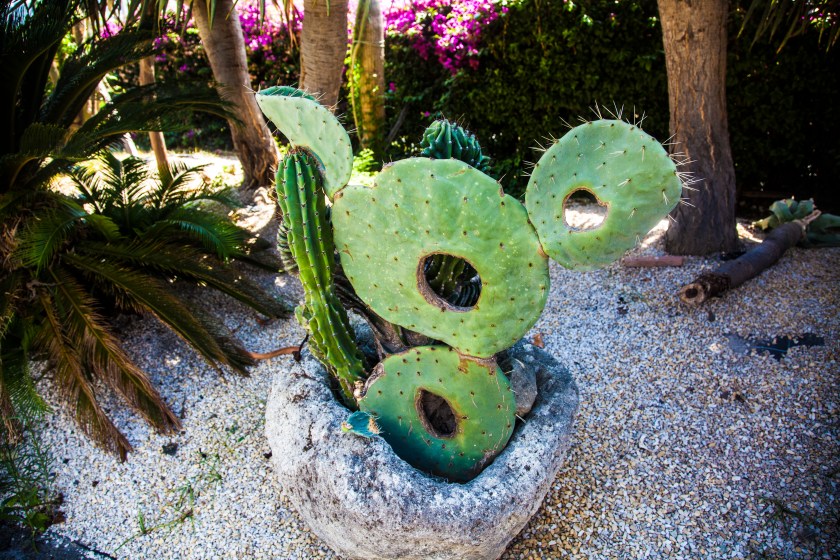
Ravino Gardens, Ischia

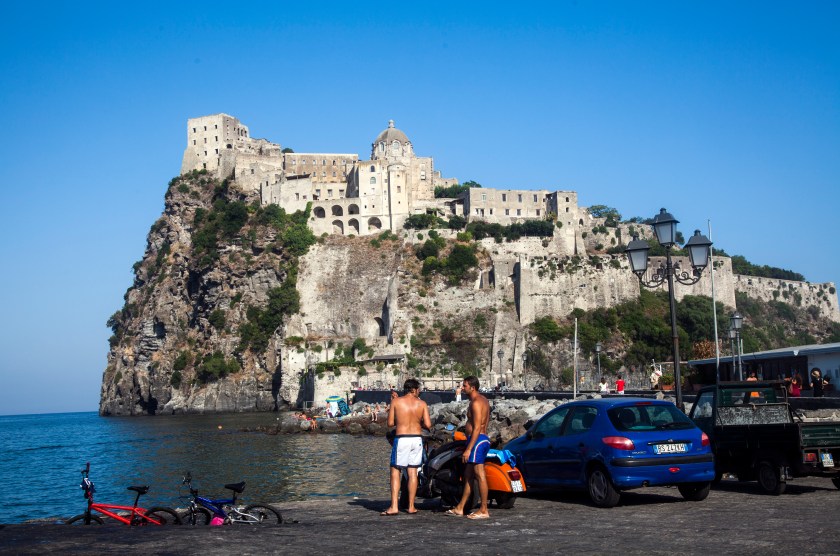
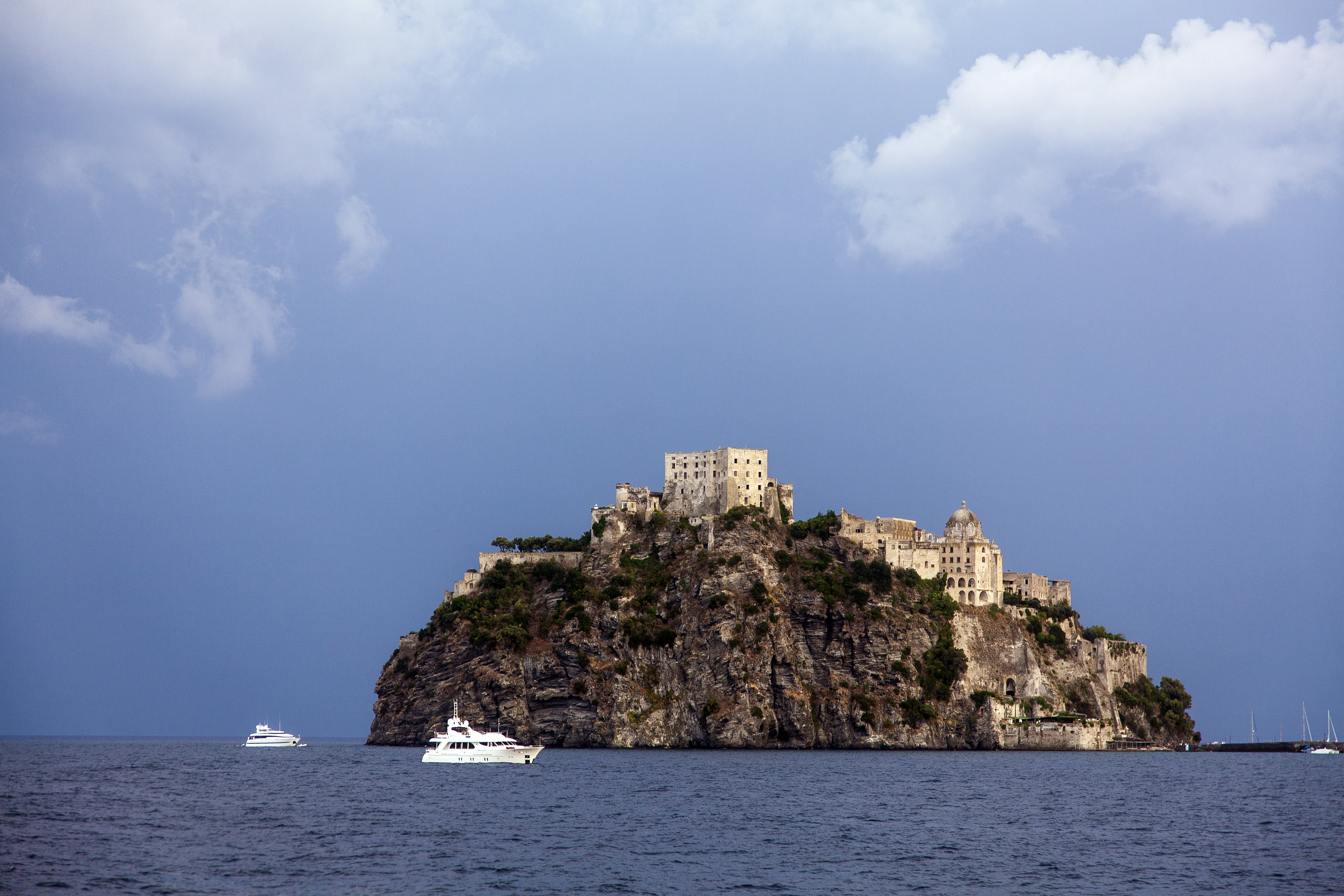
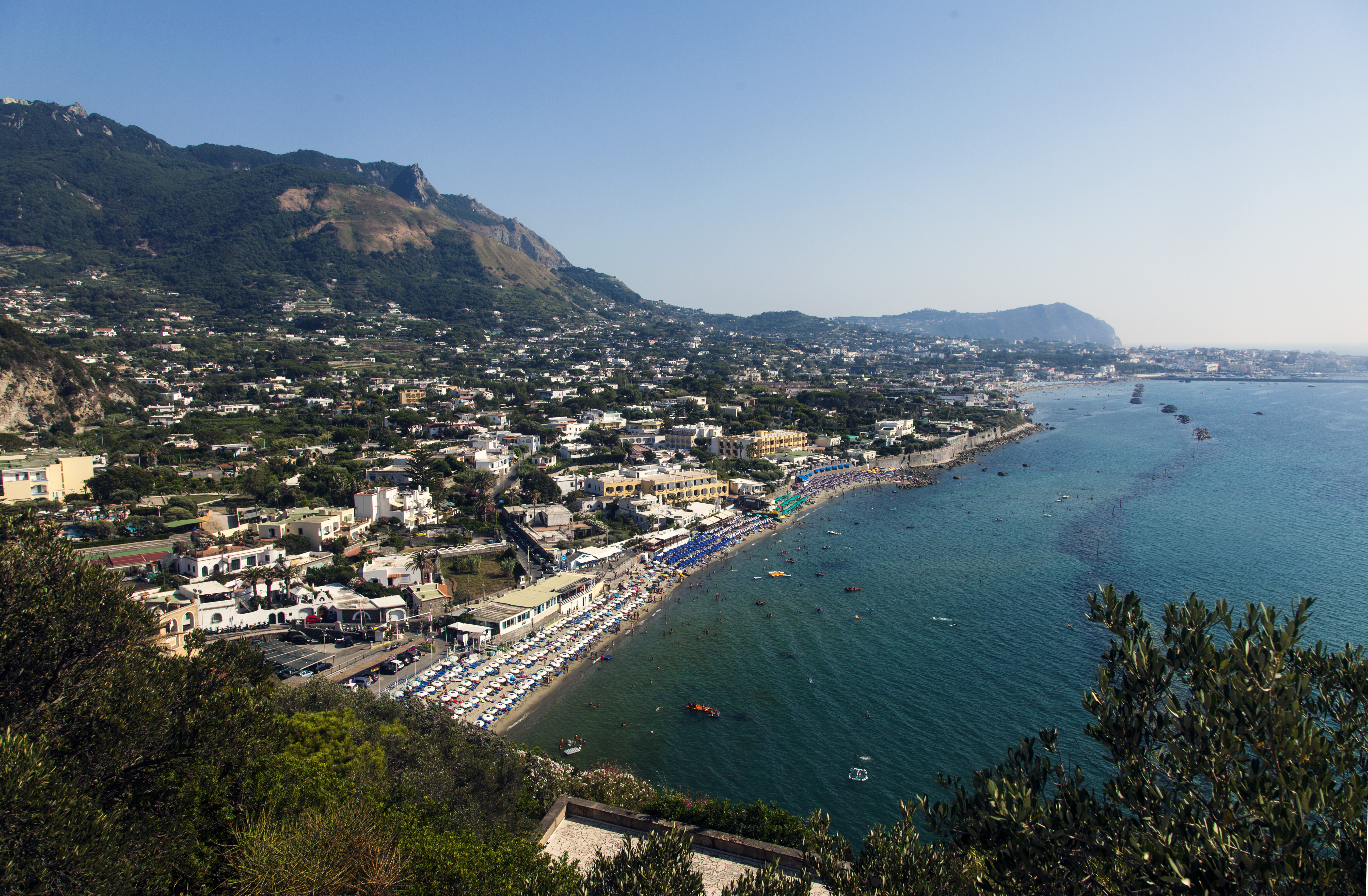
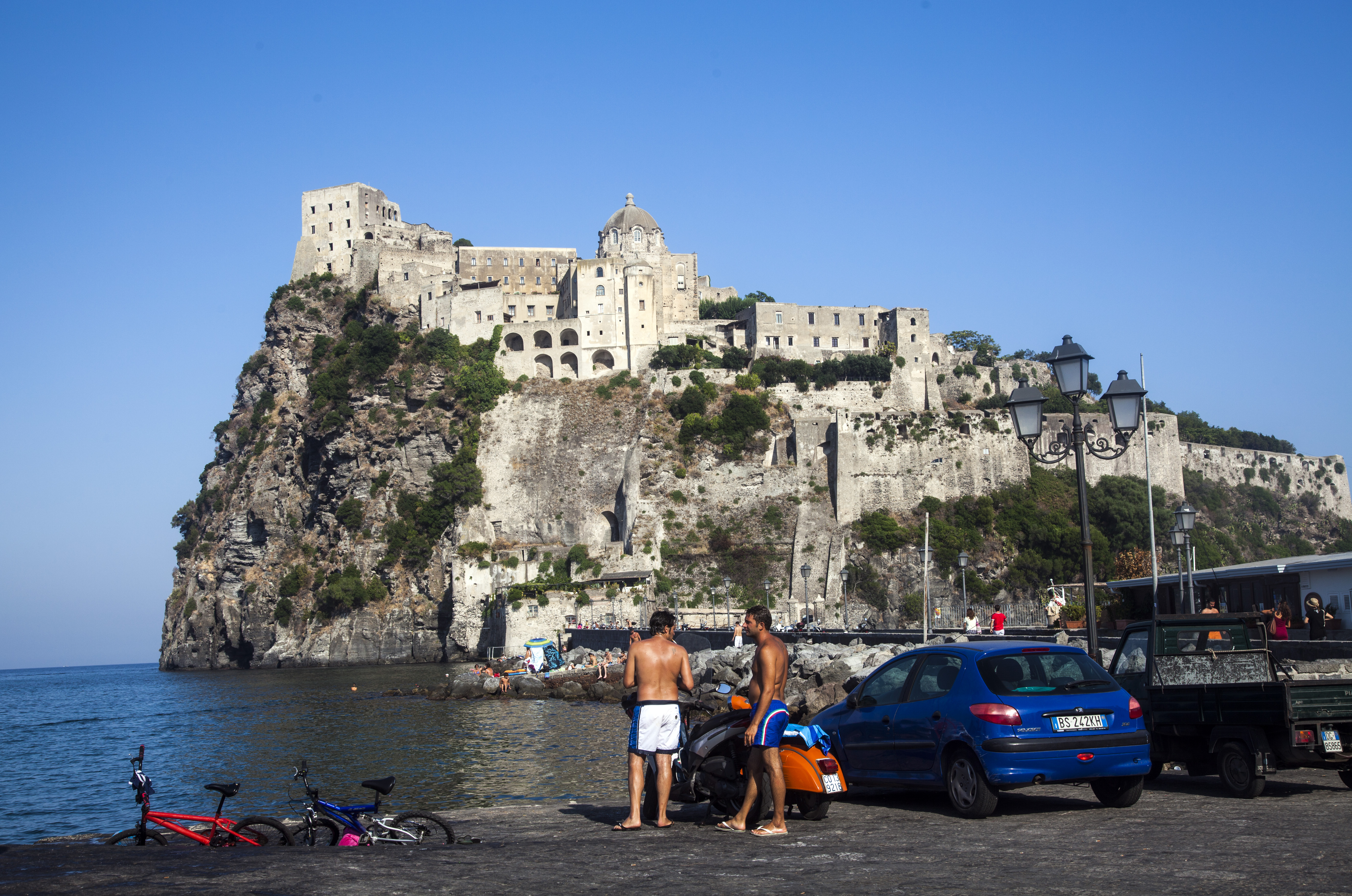
Driving us around the island, Gino still somehow managed to give us explanations in his Italian-German and diligently stopped in the most beautiful panoramic places for us to take pictures. So we pretty much saw almost all of the towns of Ischia: Forio, Lacco Ameno, Casamicciola, Ischia Porto (where we took a look from afar at the Aragonese Castle, a local landmark on the top of a cliff), Barano.
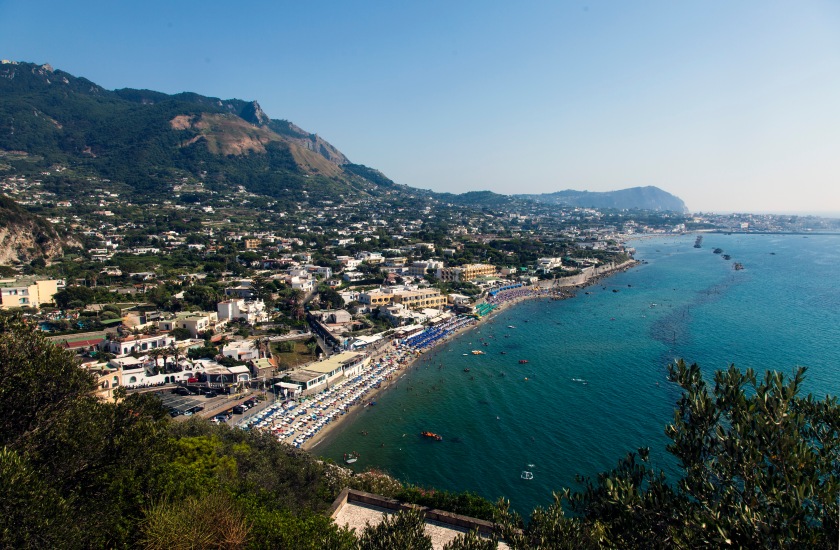
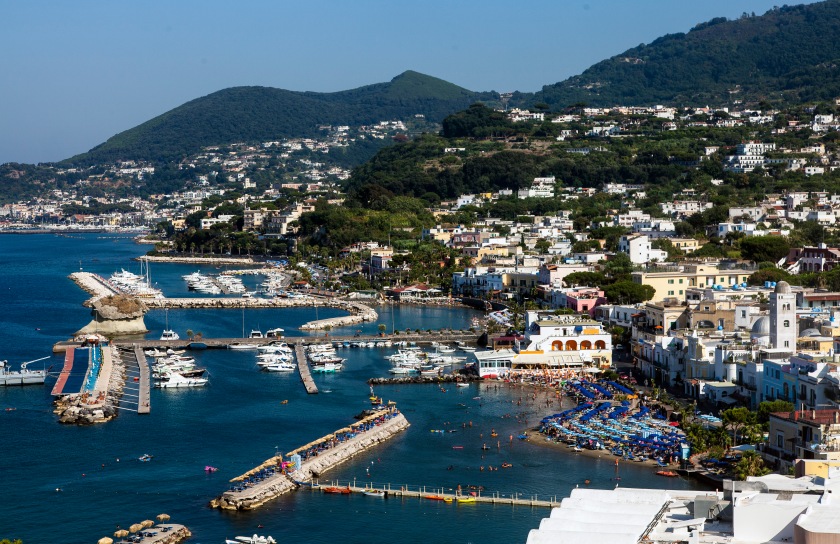
Forio, Ischia

Lacco Ameno, Ischia

Ischia Porto

Ischia Porto - Castello Aragonese

Ischia Porto

Ischia Porto

Posted in Europe, Italy, Rome

Adventures of the Azeris in Italy – day 3

РУССКОЯЗЫЧНАЯ ВЕРСИЯ ПО ЭТОЙ ССЫЛКЕ. CLICK HERE FOR RUSSIAN VERSION.

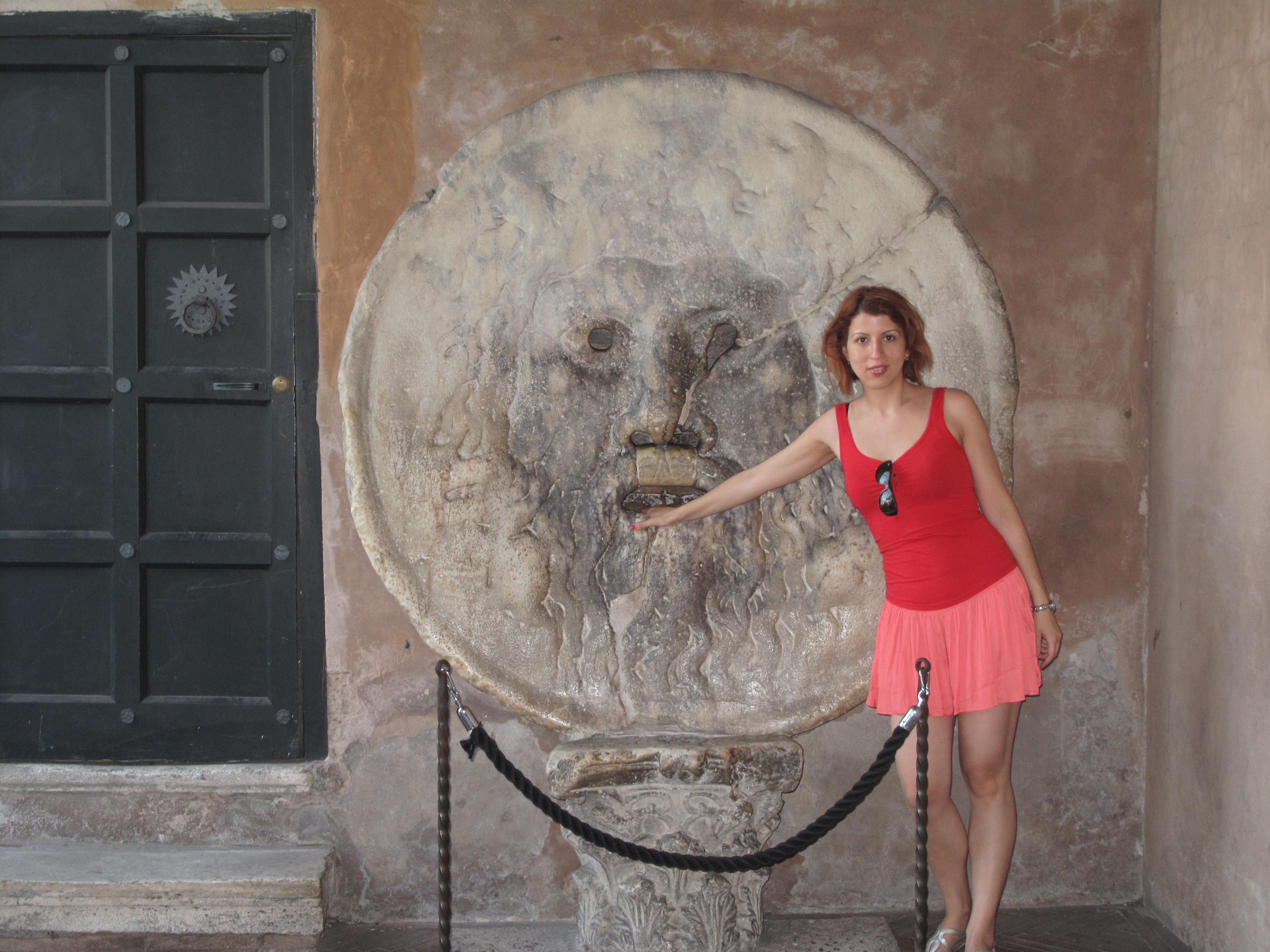
We still had a half more day in Rome. Our company had to split as part of it vigorously decided to go shopping. The other part, including me as well, didn’t mind shopping either, but somehow felt the urgent need to verify our own honesty by putting our hands into the Mouth of Truth. Here we were particularly lucky: a whole cavalcade of Japanese tourists arrived in several buses exactly AFTER us and formed a hopelessly long queue, while we reached the Bocca della Verità pretty quickly. It was only allowed to take one picture per person. Having confirmed that our hands remained intact, we left this place without visiting the church of Santa Maria in Cosmedin – we weren’t really up for it. We tried to find a taxi to catch up with our shopping companions, but there was none anywhere in sight, so we willy-nilly had to go back to the tour bus stop and spend ages (at least, 25 minutes or so!) waiting for the bus under the scorching sun.

The Mouth of Truth

Between this stop and the one leading to Via Corso with lots of shops, there was a trap awaiting us: the Vatican with its non-visited Sistine Chapel. We looked at each other: “Shall we get off here?” – “Yeah, let’s get off. As for the shopping, the hell with it!”

At the Vatican we were delighted by the virtual absence of a queue. Little did we know then, and only later we could appreciate the full extent of our mistake – this time people were entering the Basilica the proper way: through the Museum and the Sistine Chapel, which is completely the opposite side.

And then we met either a fairy godmother or a snake temptress who was persistently inviting us to join a private tour to the Museum, which would allow us to skip the queue, as there was no way to get into the Chapel other than via the Museum. But the tour was to take at least two hours of pure time (i.e. without all the preparation) and by the time it ended we were already supposed to be on our way to the airport. So we basically decided to waste our money: pay the full price, and then skip not only the queue, but also the Museum itself with this 1000+ chambers.

Our Italian-American guide apparently took after his Italian father in being extremely talkative – he eagerly explained us every single step we would have to make, starting from the purchase of the tickets. For us, however, his every word felt like a sharp knife, as it was stealing our precious time. Somewhere in the middle of his speech he was joined by a compassionate Italian lady, who tediously explained us that there was absolutely no way their company could charge us half price for the tour, even though we were going to skip the Museum. Although we hadn’t even asked for anything like this, we had to nod understandingly.

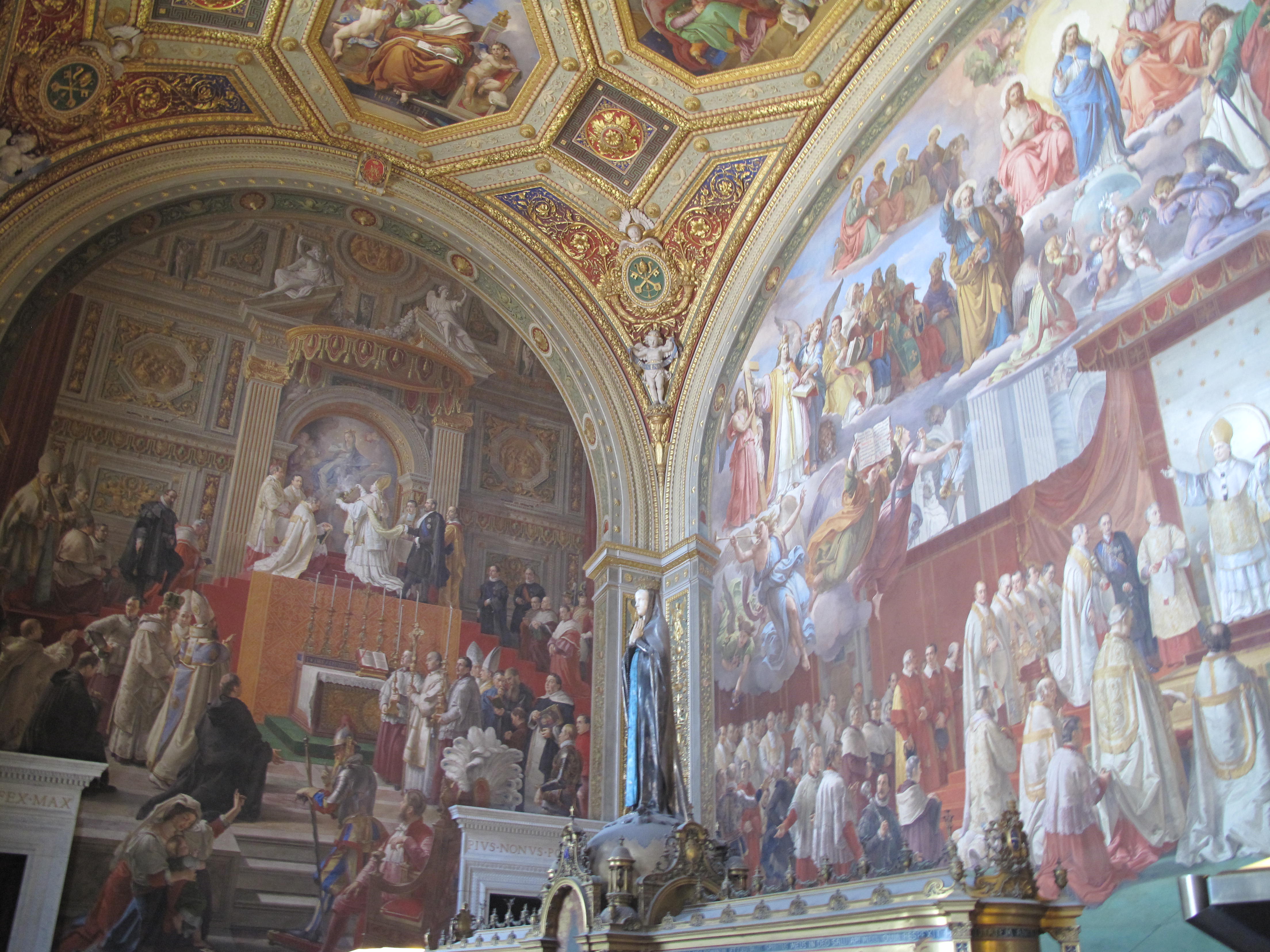
Eventually, we have our tickets in hand, our guide bids us farewell and starts his tour for the others – and off we rush through the museum chambers, full of sculptures, tapestries, maps, mosaics, etc. We only manage to catch a glimpse of this and that on the run, lingering for literally a second in front of anything particularly eye-catching. Very beautiful indeed, but terribly stuffy and packed with people – by and large we would hardly be able to survive a two-hour tour anyway!

The Vatican Museum


The Vatican Museum

And the Chapel is still quite far, we accelerate and accelerate…  Finally, swathed in shawls once again (it’s also a holy place!) we enter the Chapel. Michelangelo’s paintings on the walls and ceiling are utterly amazing, it is a pity, though, that we can’t appreciate all the details – the unpleasant surprise is that it is so crowded that there isn’t even room to sneeze, therefore no chance to walk around and look. By the way, taking photos in the Chapel is not allowed, but I managed to sneakily take one or two – it is quite blurry, but at least you get the idea.

Sistine Chapel

Still, we anyway felt great satisfaction by the Chapel itself and the fact that we had chosen contemplation thereof over meaningless shopping.

We were lucky to find a taxi right next to St. Peter’s square, and as a result we reached our hotel even before our companions.

Then we headed to the airport where our flight was delayed by about an hour. The transfer in Naples worked perfectly: a minivan took us to the port, where the driver got us tickets for the boat, and on our arrival to Ischia we were picked up by another minivan with a frail elderly driver, who nevertheless famously placed our luggage on the car rooftop.

We had been perceiving Ischia as some kind of a small town – it turned out to be a large island. The minivan drove us for about an hour in the dark until it dropped us at the start of the pedestrian zone of Sant’Angelo, where it took us ten more minutes to drag our suitcases to the hotel.


Posted in Europe, Italy, Rome

Adventures of the Azeris in Italy – day 2

РУССКОЯЗЫЧНАЯ ВЕРСИЯ ПО ЭТОЙ ССЫЛКЕ. CLICK HERE FOR RUSSIAN VERSION.

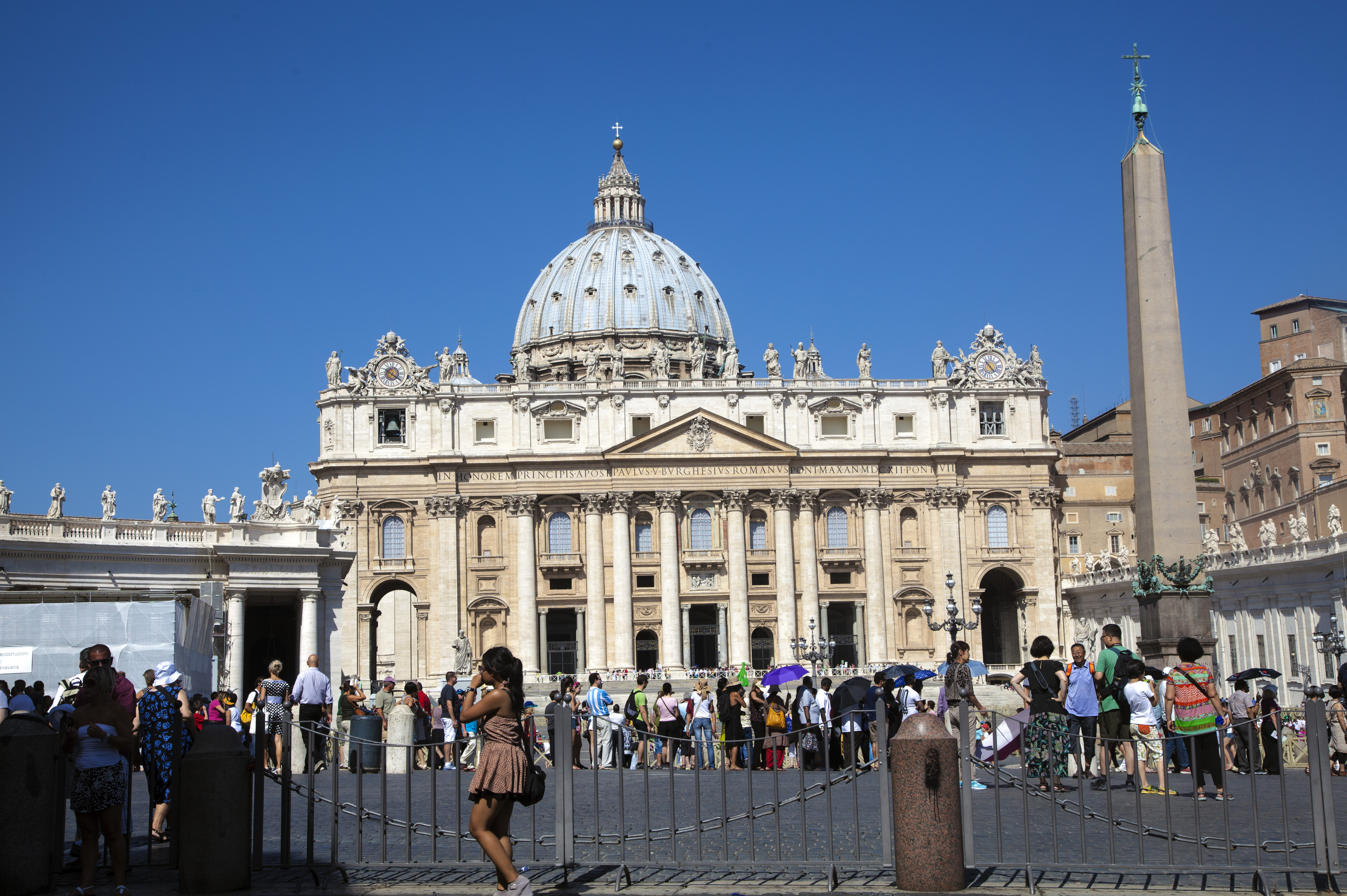
The next morning, on Sunday, we confidently walked down the beaten path to the tour bus which drove us off to the Vatican. The queue, twisting, was encircling the entire St. Peters’ Square and looked so long that our very first idea was to turn back and leave. Then we looked closer: it turned out to be moving very fast, so we joined it.

The Vatican

And then it was as if an angel made us ask two Russian girls standing behind us to take our picture, which they did. But what was the most valuable part of this contact is that they told us that we would not be allowed in the holy place with bare shoulders and knees. It was then that we realised why the Square and the whole nearby area was swarming with vendors selling ugly cheap shawls, and we bought a couple.

The forty-minute queue resulted in us finally getting into the St. Peter’s Basilica. This is not the place, talking about which one would want to ironise. It is beautiful with its majestic dome, magnificent paintings and the sound of organ (it was exactly the time of the Sunday Mass). We were walking around, staring and admiring, but our eyes, nevertheless, were looking for the entrance to the Sistine Chapel – was it here at all? Finally we asked someone and it turned out that it was closed on Sunday (right, one should have thought about that!)

Instead of the Chapel we were led to a grotto, where many popes are buried. I would say this was the least interesting part of our visit to the Vatican. On the way out, as an act of kindness, we gave the shawls to some other unfortunate barelegged and bareshouldered girls, who faced an unpleasant surprise after waiting in the queue: the guards were inexorable and wouldn’t let them in.

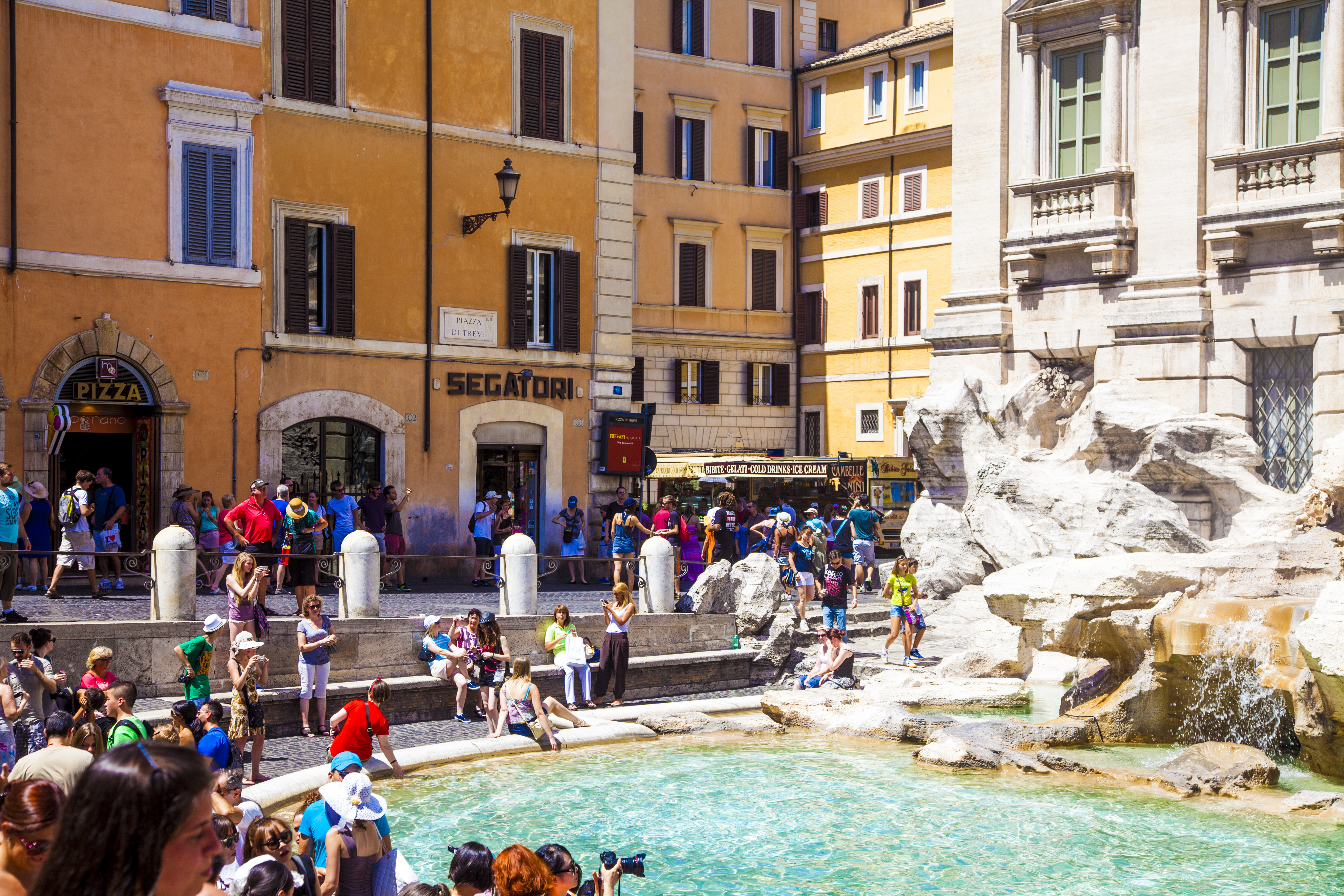
The bus took us further, following the same route at yesterday, but didn’t bring us anywhere close to the Trevi Fountain, which we were planning to visit – again because it was Sunday – but left us in what seemed a bit of a remote area not far from Villa Borghese. It looked like the only solution was to take the taxi loitering nearby. But the driver turned out to be a decent chap (or maybe simply too lazy to move), so he told us that it would literally take us a couple of minutes walking down the street to reach the fountain. Well, let’s say, he exaggerated a little, but in any case the steep narrow road took us where we were intending to get. We diligently pushed our way to the fountain, threw some coins and made wishes.

Fontana di Trevi

Fontana di Trevi

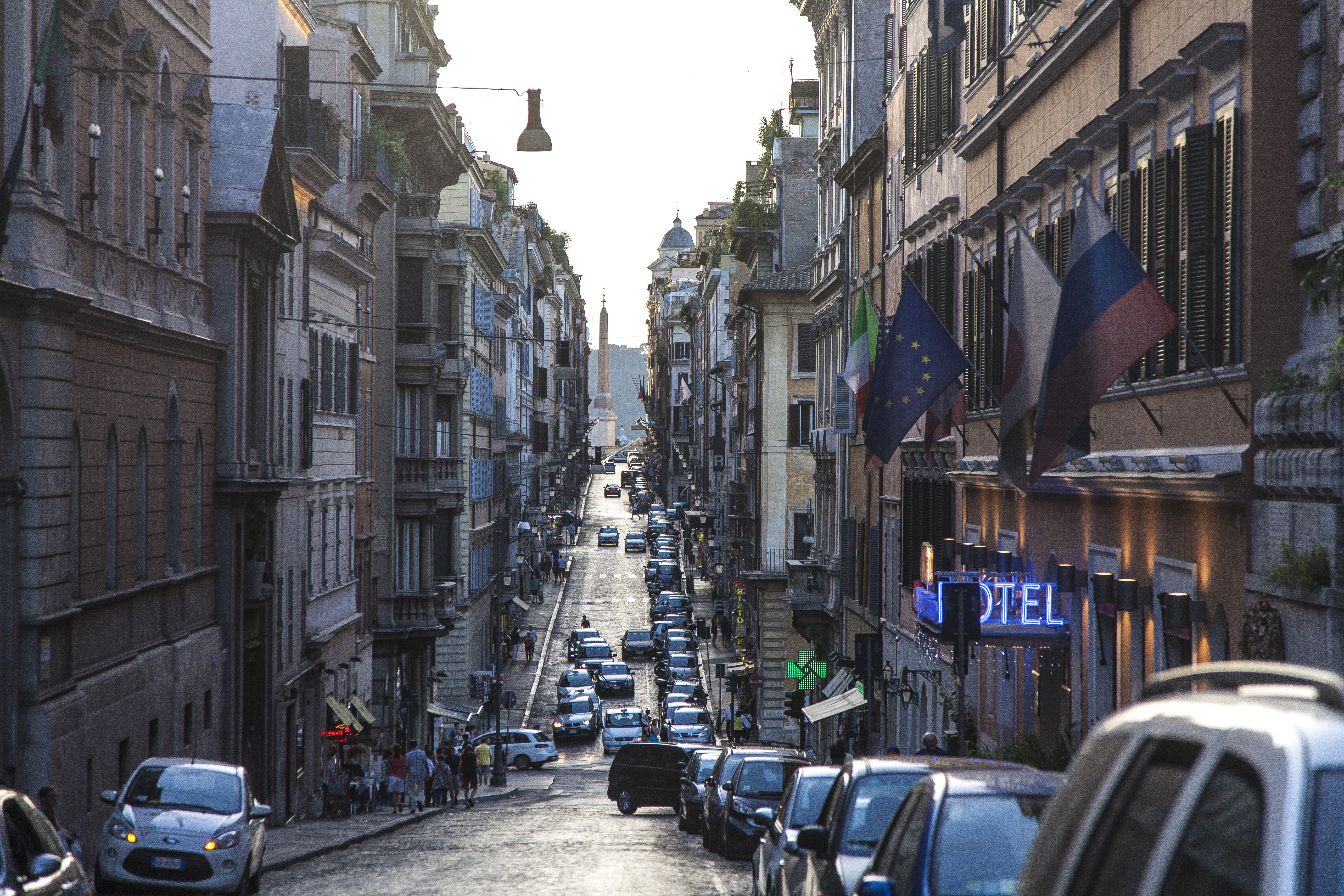
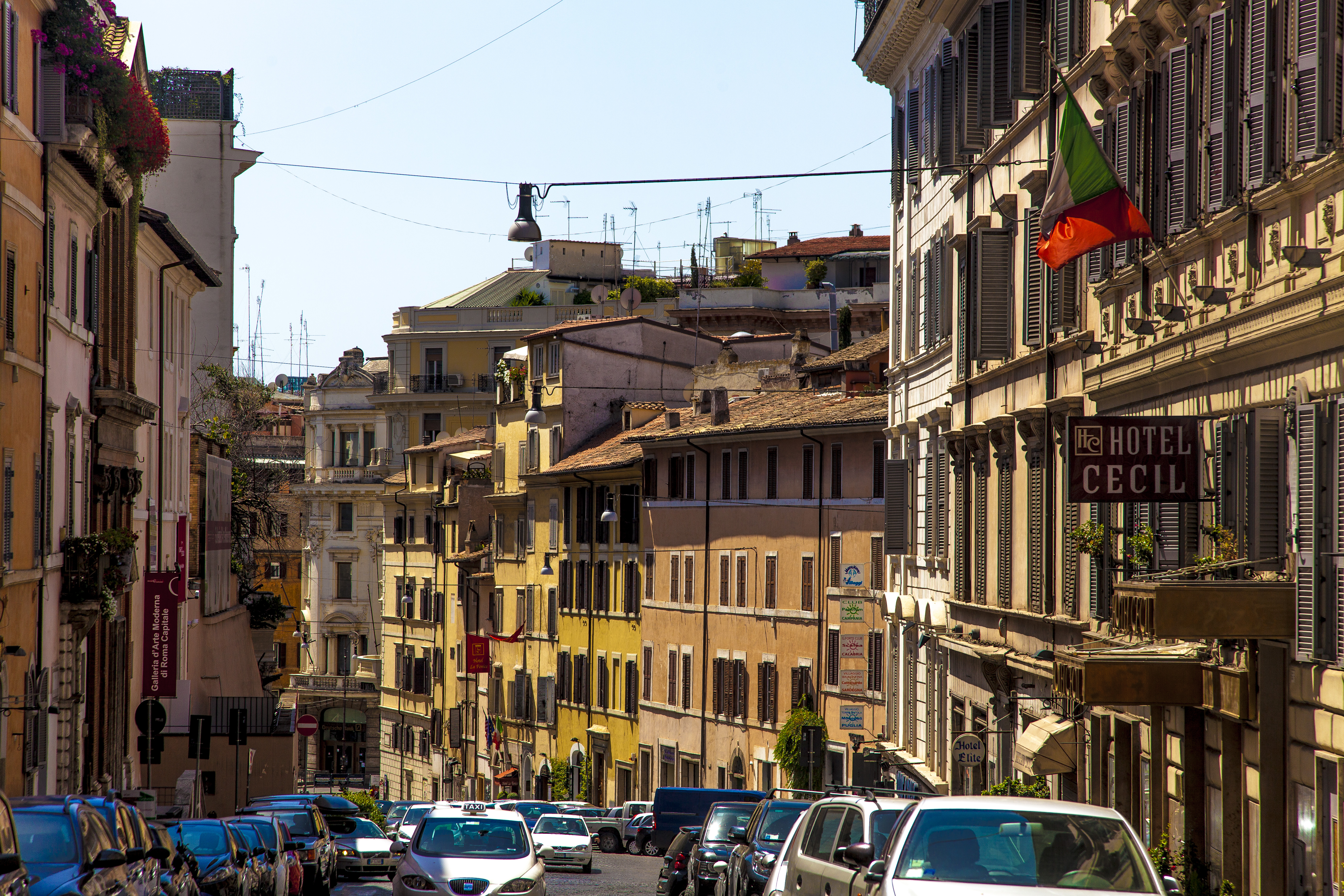
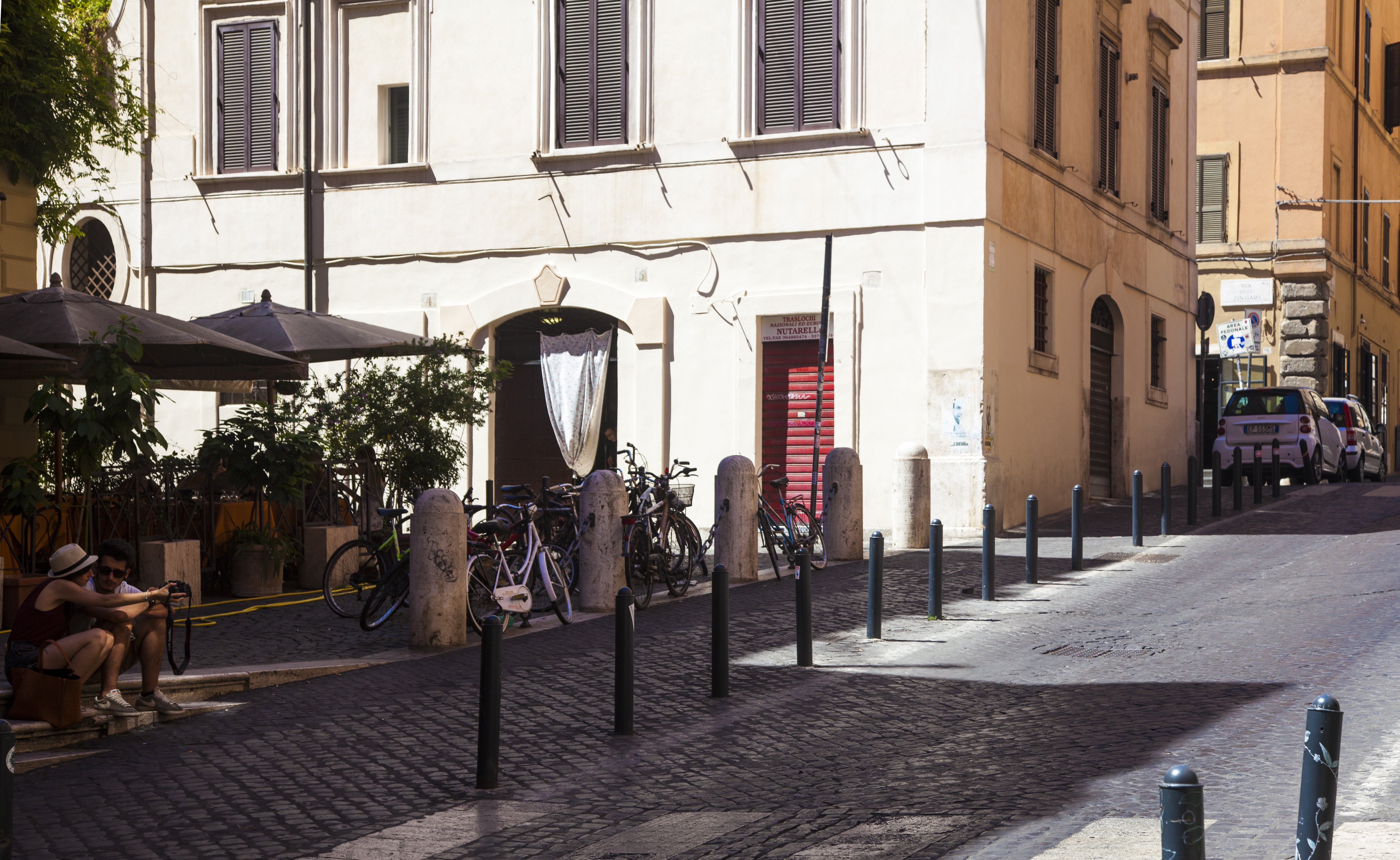
Rome

Rome

Rome

Rome

Rome

On our way back I started feeling unwell because of the heat, so had to go back to the hotel, where I just lay on my bed, like a beached seal, for a good two hours, although duty was calling me to continue sightseeing. The next item in line was the Mouth of Truth, where Audrey Hepburn and Gregory Peck’s characters put their hands in the unforgettable “Roman Holiday”. Unfortunately, when I got better and checked  the Internet, I realised that it had relatively short working hours and was closing at that very moment! In that case we decided to follow the example of the “Dolce Vita” characters and head to Via Veneto. The guide in our bus had promised we would spot celebrities and paparazzi hunting for them, we saw neither though.

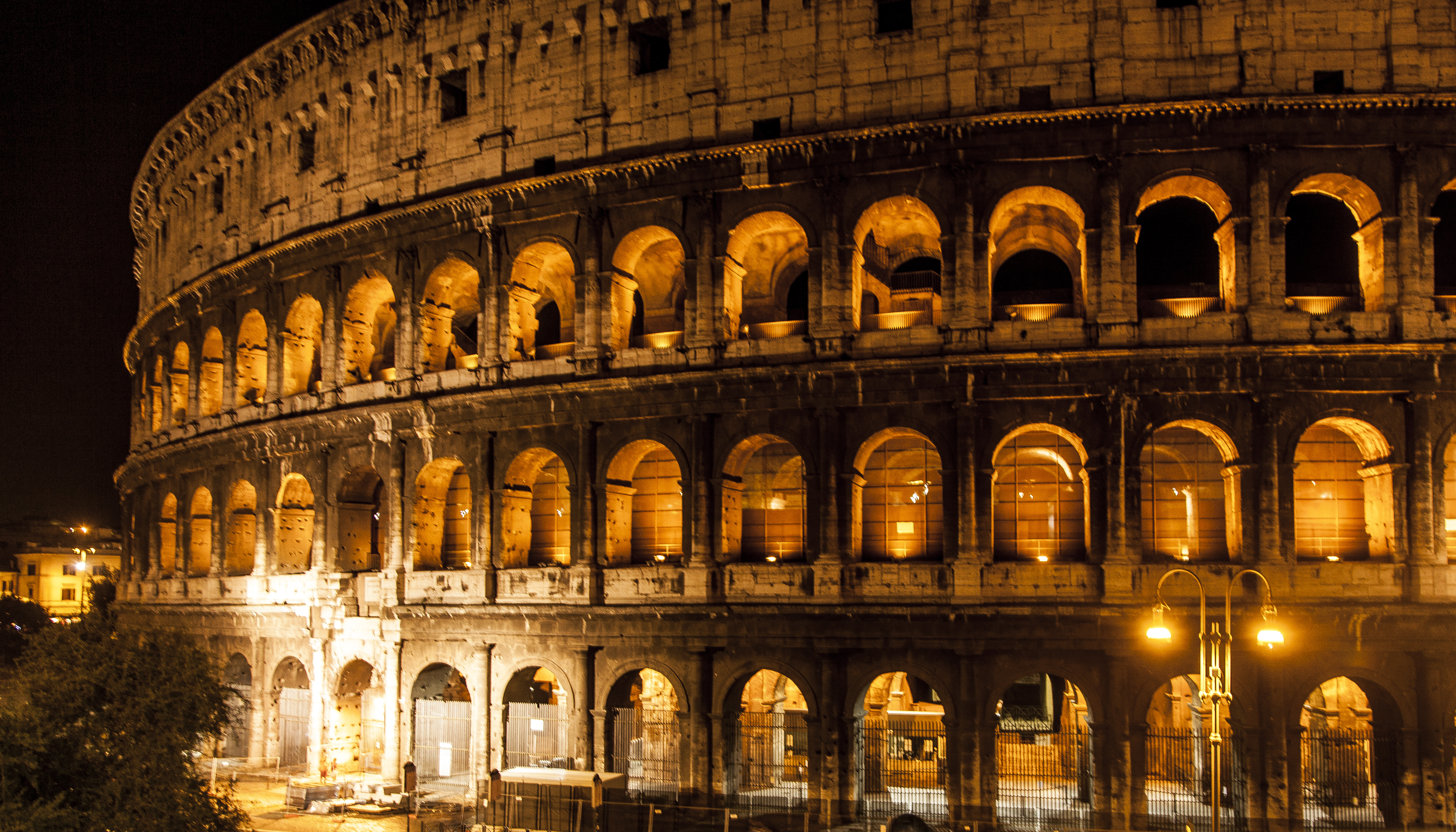
Colosseum by Night

Posted in Europe, Italy, Rome

Adventures of the Azeris in Italy – day 1

РУССКОЯЗЫЧНАЯ ВЕРСИЯ ПО ЭТОЙ ССЫЛКЕ. CLICK HERE FOR RUSSIAN VERSION.

The Italian embassy can essentially be considered the territory of Italy. Therefore, our Italian adventures started from there. First impressions: disorder and outdatedness, colloquially speaking, looks like a Mickey Mouse organisation (later, our stay in the “Big Italy” only confirmed this impression). Simplest things like online appointments, electronic filling of application forms etc. seem to be unheard of here. Their own regulation, posted on the wall of the embassy, saying ​​that documents must be submitted no later than five working days prior to departure, is totally misinterpreted by the embassy workers, who would not accept the documents any earlier than five days before departure (as one might imagine, this allows virtually no time for any changes or corrections). Those who come to apply for visas know none of this, of course – they arrive decorously, queue and wait… The consul, with the face of a gendarme, appears at 9.30 am and begins to check the documents himself. All those who have naively came in advance are mercilessly sent off, receiving a mark in red ink on their application, with the date they should come and the consul’s signature. Others are kindly accepted, but are picked at for every little thing (like a photo being stapled and not glued, or lack of the zillionth stamp, etc.)

Everyone’s faces carry this I-don’t-feel-like-working-but-definitely-feel-like-acting-all-bossy expression. Quite a lot of the “mainland” Italians look and act exactly the same.

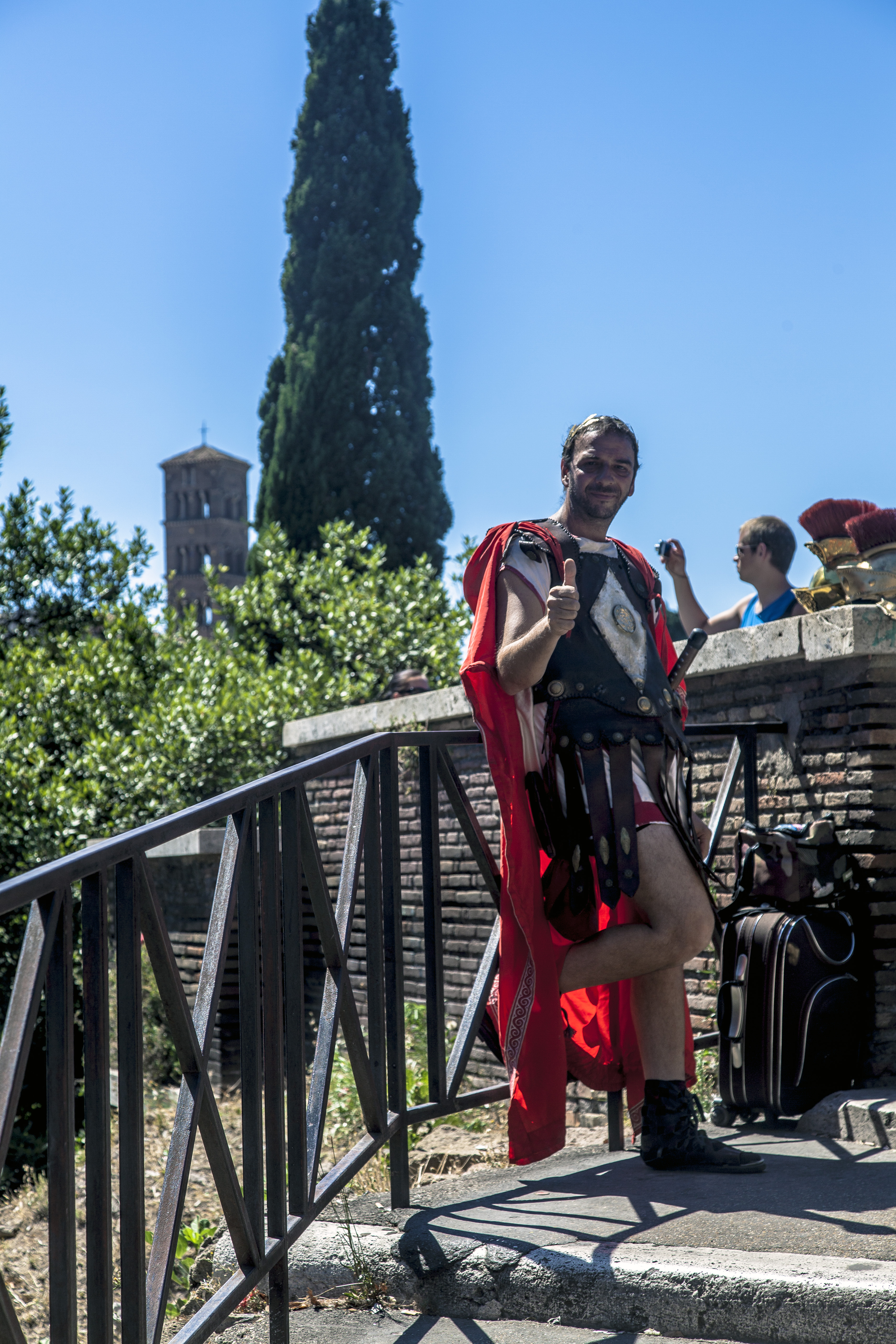
As it had been forecast, Rome greeted us with a 40°C heat, thankfully, a dry and therefore, bearable one. The hotel receptionist was a Russian-speaking lady from Moldova, and she worked well and efficiently. We basically had two days to spend in Rome (one full and two halves), so the most reasonable thing to start with was a city sightseeing tour, and we rushed off to find one. It was a pleasant surprise to see that the Colosseum was just around the corner – right until we remembered that we had booked the hotel with this thought in mind, so it was actually no surprise at all. As we approached the Colosseum, we were literally attacked by sellers of all kinds of stuff like hats, umbrellas, water, as well as “gladiators” and other “ancient Romans,” offering themselves for photos (for money, of course). Unfortunately, all of this merchandising fraternity could express themselves only in Italian and had absolutely no clue where the bus stop was (as we’d been told in our hotel, it was somewhere near the Colosseum). Everyone knows that the Colosseum is a round and a rather large building. We diligently walked all around that whopper – there were no signs in sight and people passing by continued to know nothing about this. Finally, we managed to find the stop ourselves, caught the bus, perched on its upper deck and indulged in the journey through the Eternal City.

Posing "gladiator"

Colosseum

It’s all very beautiful – the sculptures, the ruins, the palaces. Everything is covered with the spirit of antiquity, you feel yourself in a huge museum under the sky. But somehow it didn’t touch the delicate strings of my heart, like, for example, London or Hong Kong.


Via Leonina


Roman ruins


St. Peter's Basilica


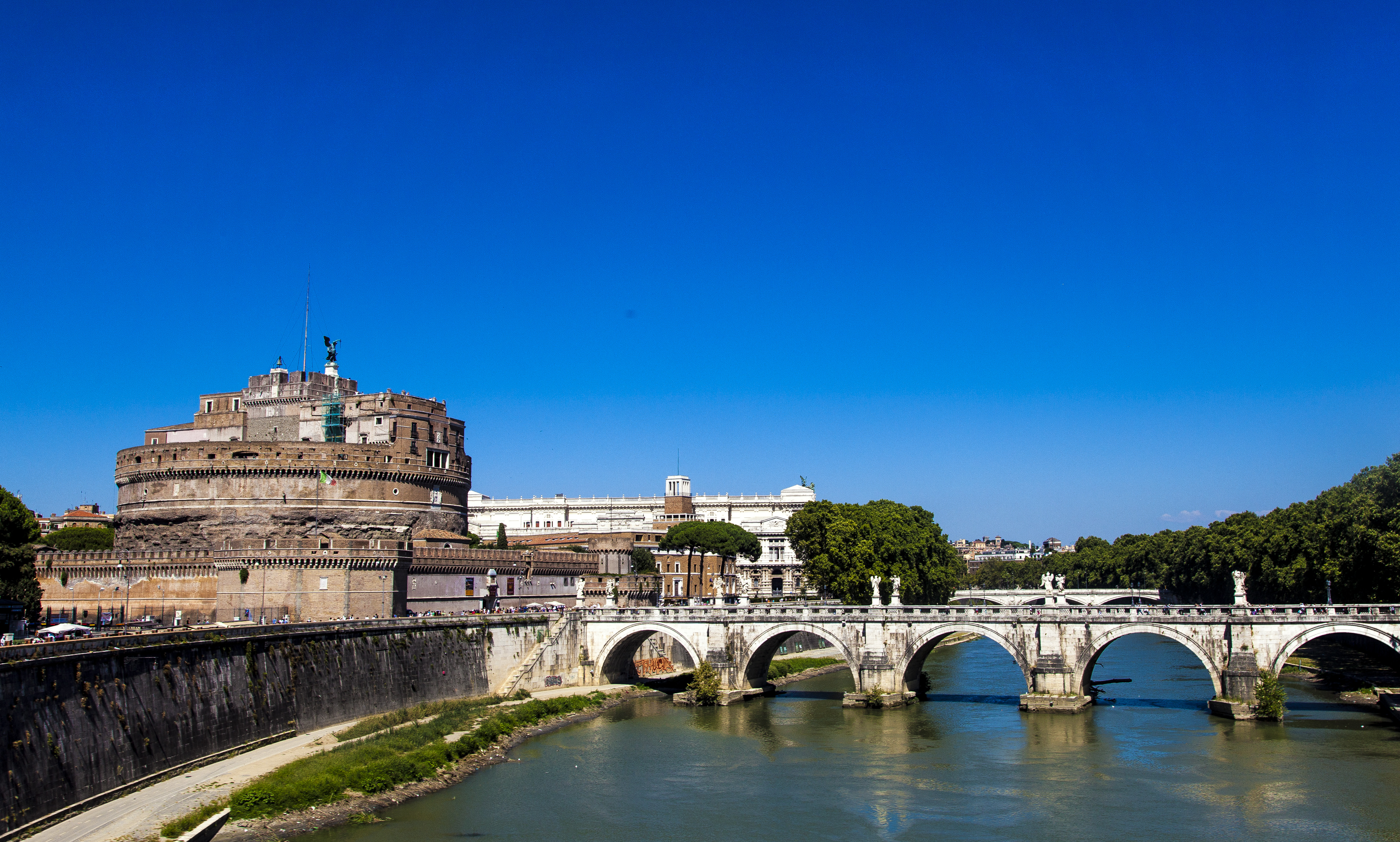
River Tiber


IMG_6294

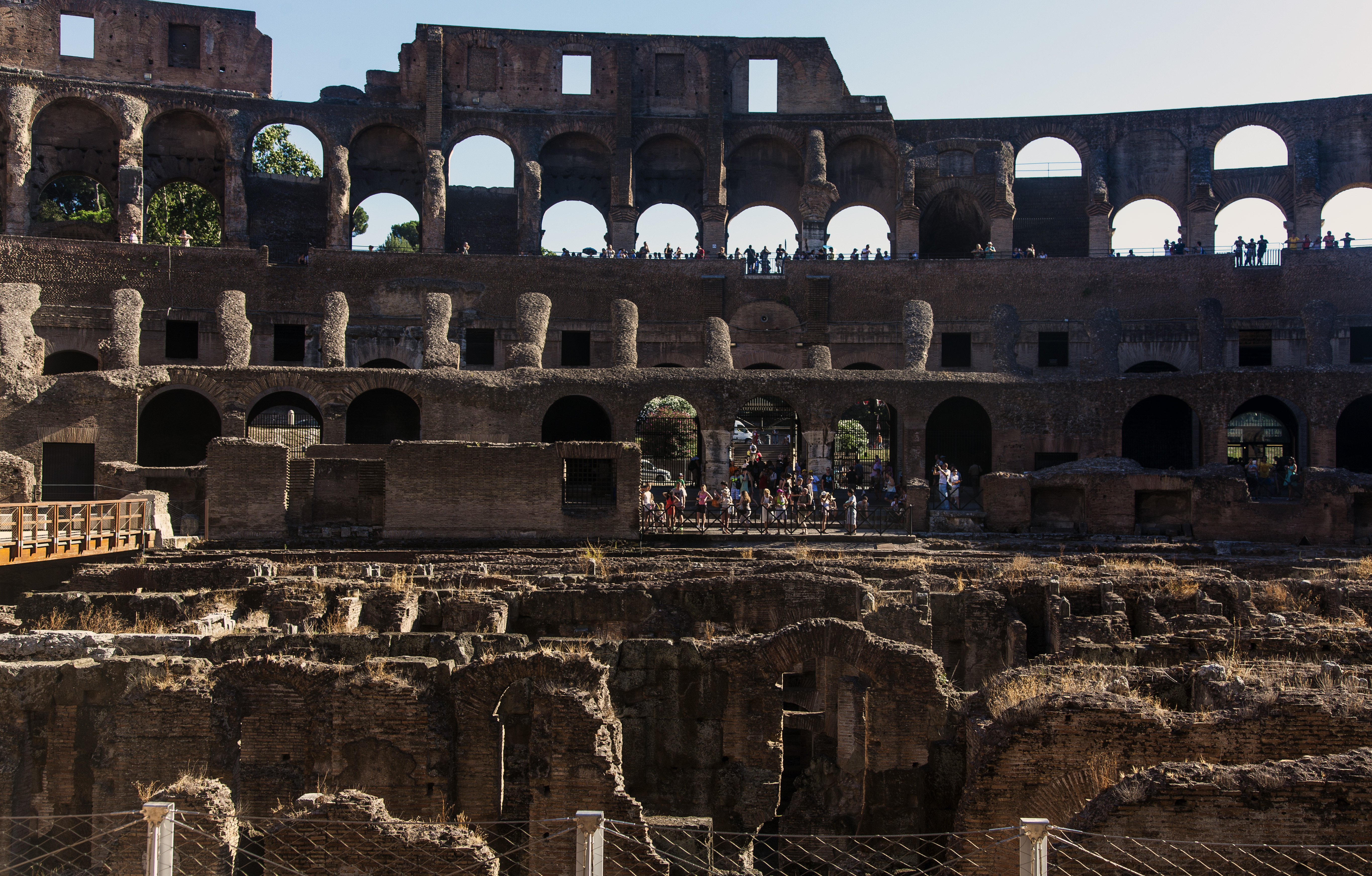
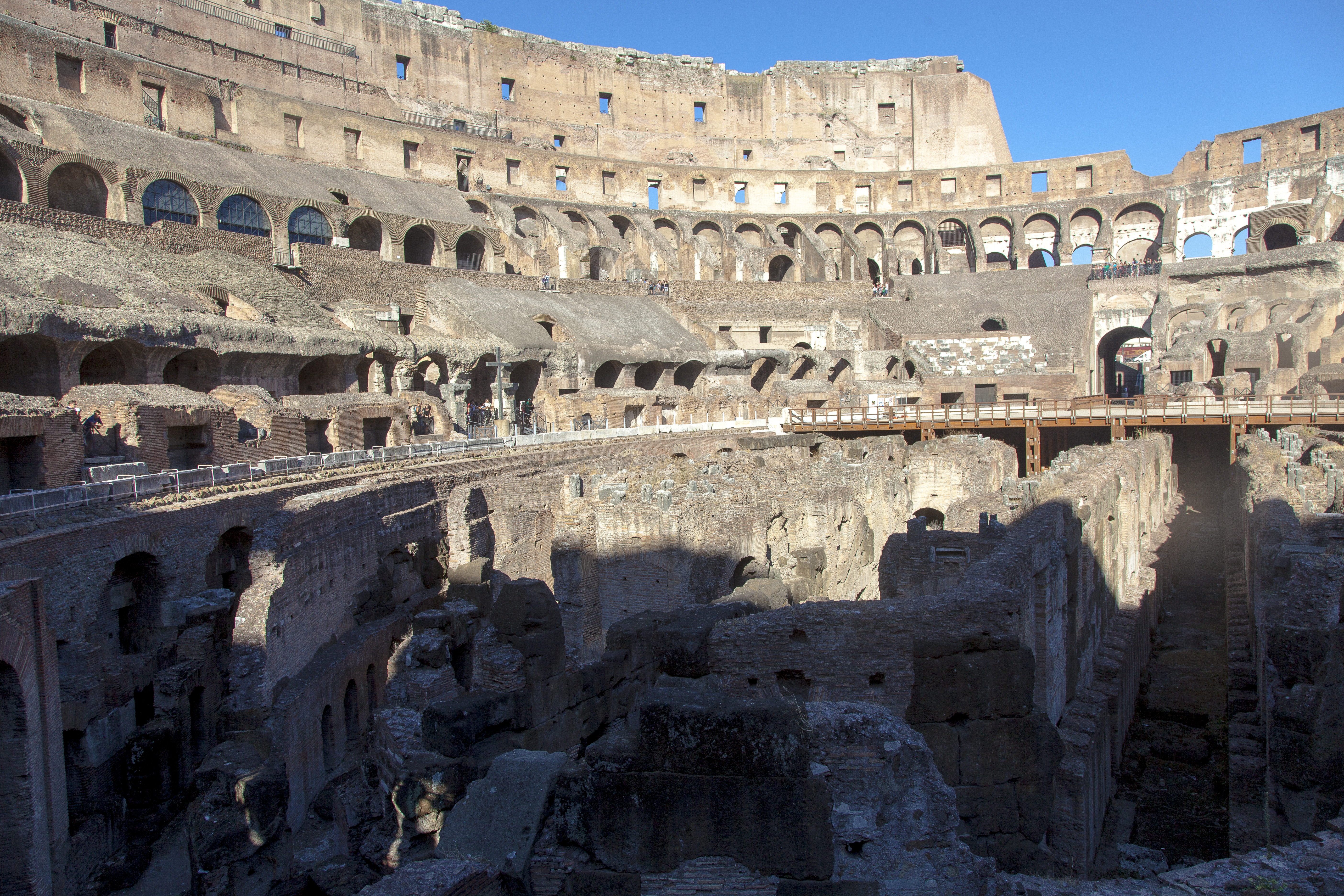
As our tour tickets were valid for 48 hours, we decided to do a full circle without hopping off, and completed the tour with a Colosseum visit. It certainly is a fascinating feeling when you think of these stones being about 2000 years old. There were world wars, and they were standing there; there was Napoleon, and they were standing there; there was the Holy Inquisition, and they were standing there; there was the fall of the Roman Empire, and they were standing there… We climbed to the top and saw part of the arena and the maze beneath it, imagining a defeated gladiator and a crowd of spectators, roaring “Finish him! Finish him!”

Colosseum


Colosseum

Posted in Croatia, Dubrovnik, Europe

Croatia – Days 9 & 10

РУССКОЯЗЫЧНАЯ ВЕРСИЯ ПО ЭТОЙ ССЫЛКЕ. CLICK HERE FOR RUSSIAN VERSION.

1-2 Septebmer 2012 – Saturday/Sunday

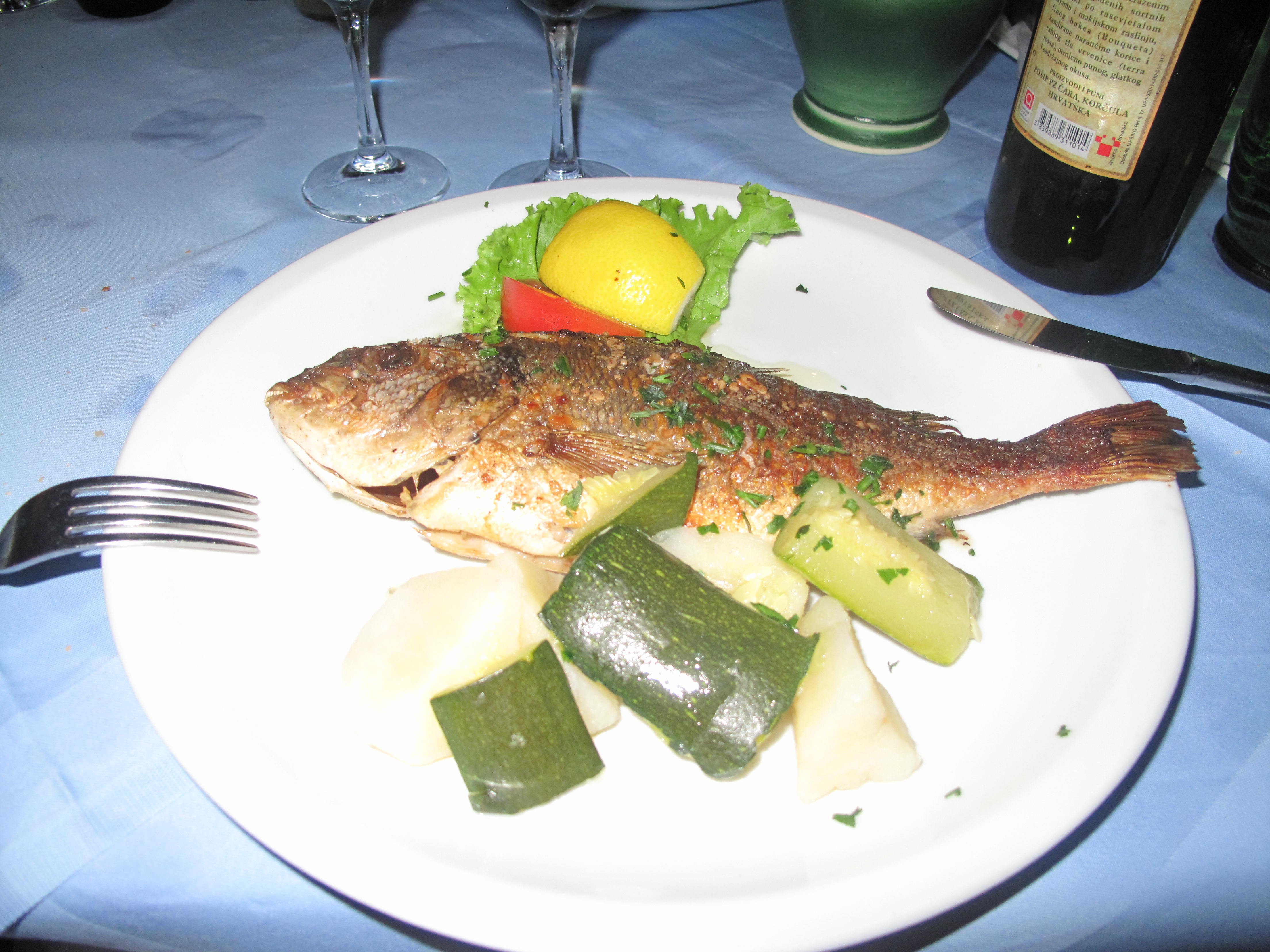
After spending a very lazy Saturday (we had lovely seafood dinner in the evening – oysters, mussels bouzzara and amazing fish!), on Sunday we hit the road once again – for the last time during our stay in Croatia.


The transfer to the Split airport was supposed to be a long one (as attentive readers would remember from the earlier parts, it takes about 4 hours), but the driver took a different paid highway closer to Split, which made our journey a little bit shorter.


As for the driver – that was a really interesting guy, who used to work in the police previously as he himself told us. All the way to the airport he just kept calling somewhere (apparently, the police) and complaining about other drivers violating the rules. We even had to stop at the Bosnian border, as because of our driver they stopped some car with Italian numbers, and he had to witness. The driver of the Italian car was to pay a €1,300 fine, by the way.