Posted in English, Europe, Lisbon, Porto, Portugal

Portugal – Day 3

РУССКОЯЗЫЧНАЯ ВЕРСИЯ ПО ЭТОЙ ССЫЛКЕ. CLICK HERE FOR RUSSIAN VERSION.

April 18, 2023 – Wednesday

We got up in the morning and, as usual, had breakfast. We were supposed to take a train to Porto at noon, but when we arrived at the station, we discovered that it didn’t exist – the train had been cancelled due to a strike, like all the 12-o’clock trains throughout the entire month. What can I say – wonderful. Even more wonderful was the fact that the app sold us the ticket without batting an eye and didn’t even notify us about the strike.

We had to buy tickets for a later train, at 15:30, and then spent a long time looking for a place to leave our luggage so we wouldn’t have to drag it around. We found one across the street from the station and went to get some coffee. But first, we wandered around Alfama, from where we made our way to Restauradores and had coffee there.

Then we returned to the station, boarded the train and, thank God, we were off. On the train, we encountered some American fellow passengers who couldn’t grasp that, in addition to the seat number on the ticket, you also have to check the carriage number – instead of trying to chase away people already sitting in a seat with the same number.

In the end, we arrived in Porto quite late – it was already around 7 p.m.

We got to the hotel by Uber and went out for dinner at a restaurant, where we once again ran into loud Americans, who talked non-stop at the next table all evening, and we learned their entire life story and all their family problems.

Posted in English, Europe, Lisbon, Portugal

Portugal – Day 2

РУССКОЯЗЫЧНАЯ ВЕРСИЯ ПО ЭТОЙ ССЫЛКЕ. CLICK HERE FOR RUSSIAN VERSION.

April 18, 2023 – Tuesday

The second day in Lisbon was marked by queues. But – first things first. In the morning, we got up and tried the wonderful, varied breakfast at the hotel (I was the one actually “trying” it   – my friend was having it for the third time), with smoked salmon, waffles, pancakes, and the like.

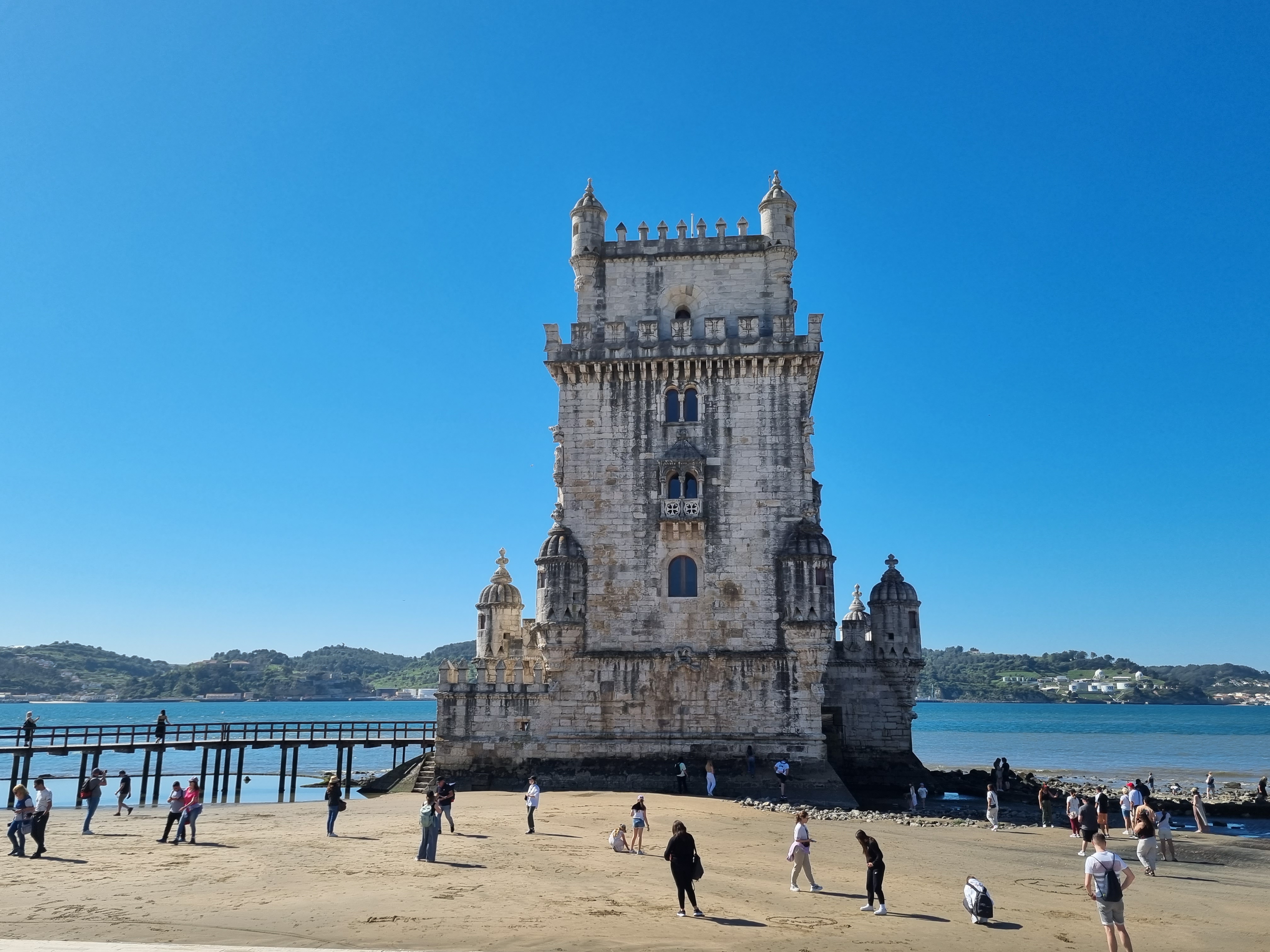
Then we went to the Belém area – it’s like a suburb of Lisbon. The idea was to see the Jerónimos Monastery and the Belém Tower. We got there by city bus – an authentic route through non-touristy areas.

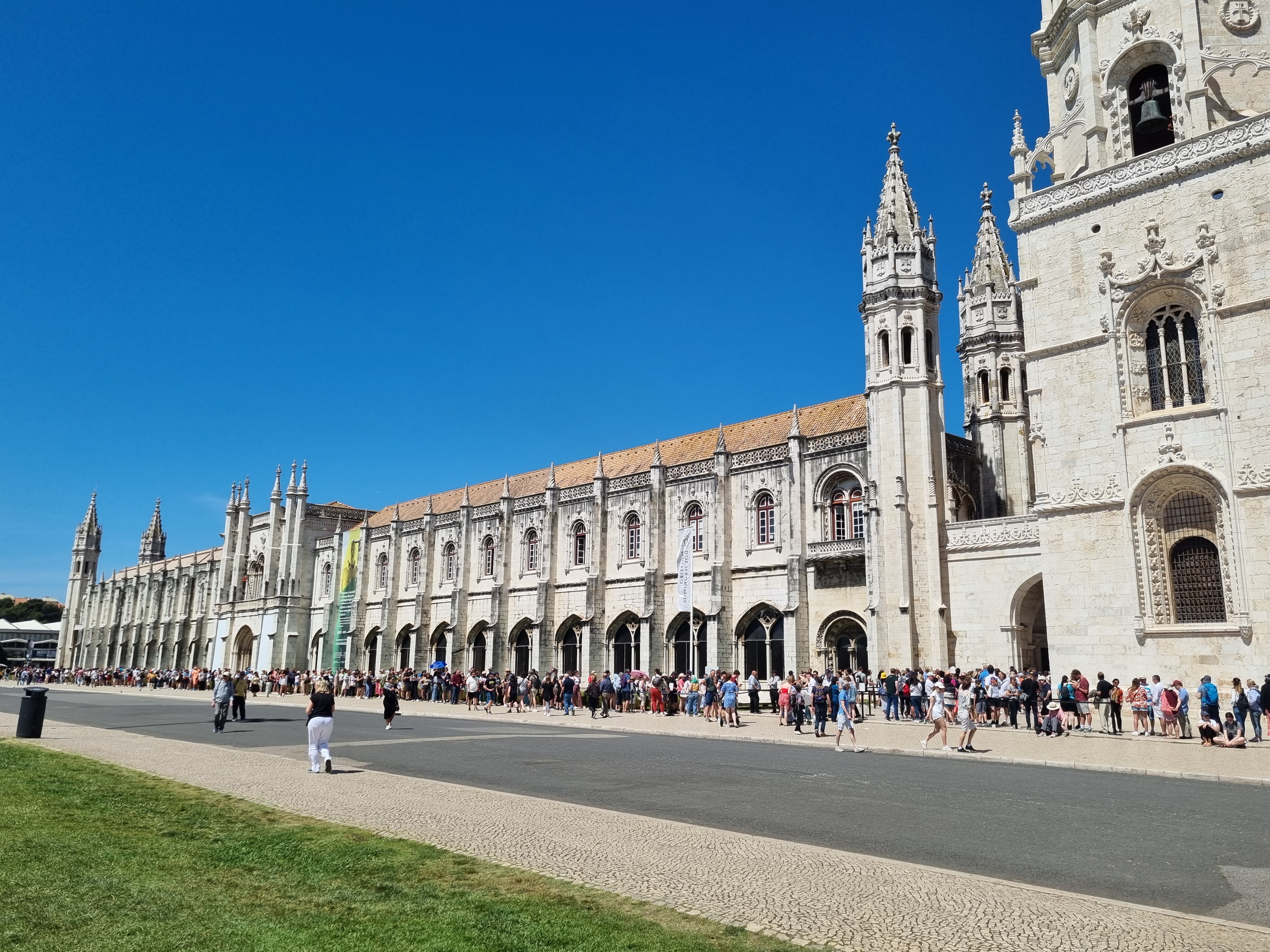
When we arrived at the monastery, we saw a queue. No – that’s not quite right – we saw an incredibly long QUEUE and probably about 15 large tourist buses. We didn’t really feel like standing in that queue, so we decided to head straight to the Belém Tower, figuring we could return to the monastery later and check whether the queue had dispersed, assuming most group tours visit the monastery right when it opens.

It was about a 15-minute walk to the Torre de Belém, but there we found quite a long queue as well. It turned out there were two reasons for this: first, entrance to the tower is free on Tuesdays; and second, they only let people in in small groups, after the previous group has left, to avoid overcrowding in the narrow spiral staircases and confined spaces.

The tower was built back in the 16th century, in honour of Vasco da Gama’s discovery of the sea route to India. It looks very interesting from the outside, but I’ll leave the question of whether it was worth standing in line for 40 minutes under the scorching sun to go inside open.

After the tower, we gave the Jerónimos Monastery a second chance and went back to see how things were going there. But the line hadn’t gotten any shorter, and the sun continued to scorch mercilessly. So, after googling photos of the monastery’s interior and deciding it wasn’t worth the long wait and completely burnt shoulders, we dealt with a more pressing matter – and went for lunch at a French-Portuguese restaurant, where all the staff spoke good French and worse English. I never thought I’d have to speak French in Portugal.

By the way, about English – overall, I’m pleasantly surprised. Almost everywhere we go, people speak it very, very well. I hadn’t expected this from Southern Europe, based on past experience.

After lunch, we returned to the centre and headed to another monastery – São Vicente de Fora. This turned out to be a very good idea, because unlike Jerónimos, there was practically no one there. And it’s completely unclear why – the interior is very beautiful, many rooms are decorated with azulejos, and you can also visit the pantheon of the Portuguese Braganza dynasty and see azulejo panels based on the fables of La Fontaine. An interesting observation – the masters of azulejo painting were not very good at depicting animals, and the dogs and cats turned out rather odd, with human eyes and pig ears.

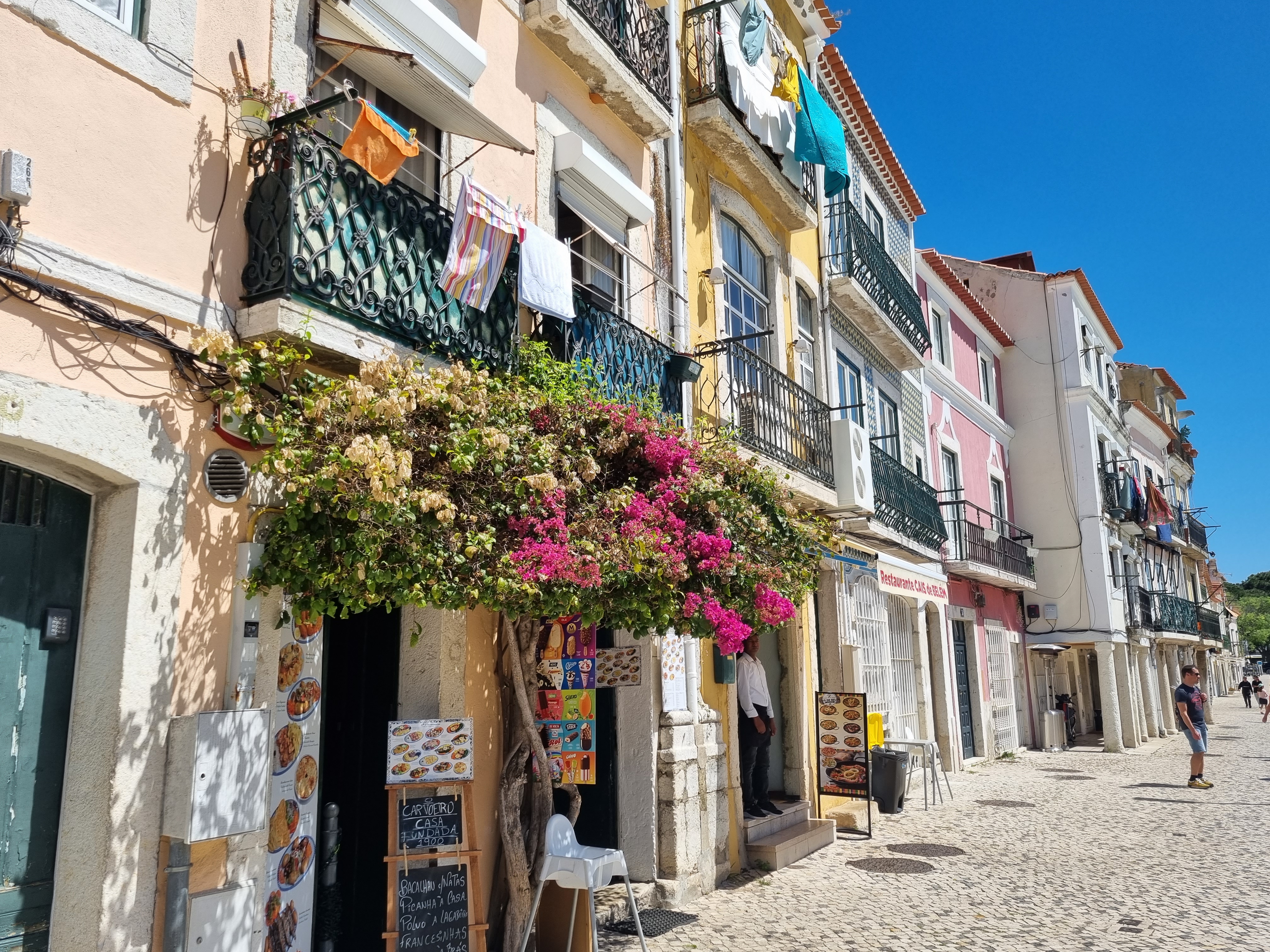
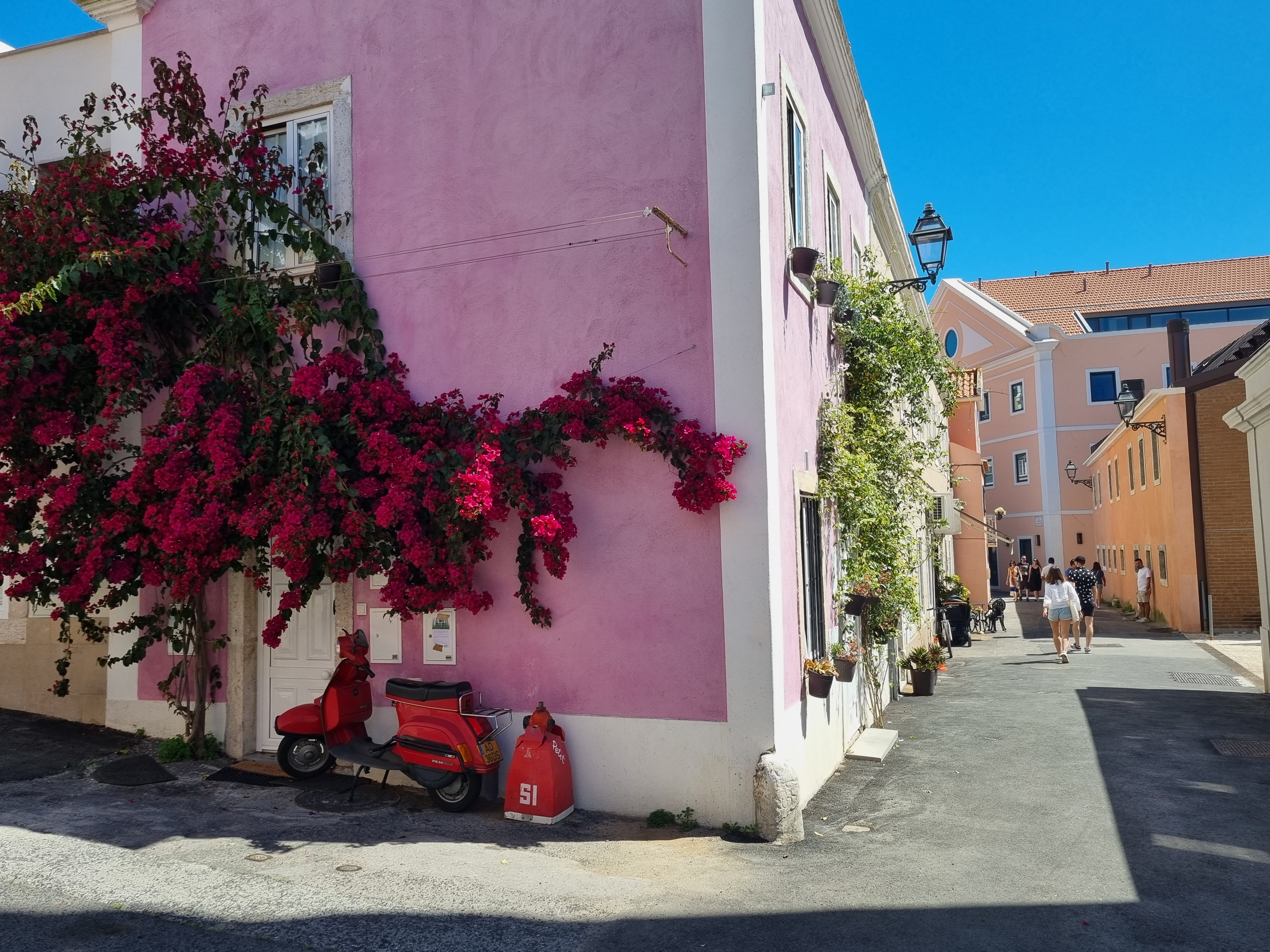
In the evening, we walked around the Alfama district, which I really liked. It’s very colourful and authentic, with beautiful architecture, trams, hanging laundry, and a chaotic street layout. This is the oldest district of Lisbon – the only one that survived the devastating 1755 earthquake.

Posted in Asia, English, Himeji, Japan, Osaka

Japan – Day 8

РУССКОЯЗЫЧНАЯ ВЕРСИЯ ПО ЭТОЙ ССЫЛКЕ. CLICK HERE FOR RUSSIAN VERSION.

30 May 2025

Today, completely unintentionally, we woke up at 6:30 a.m., but it turned out to be a good thing, since we had a long day of traveling ahead: from Kyoto to Himeji, then on to Osaka, and finally back to Kyoto.

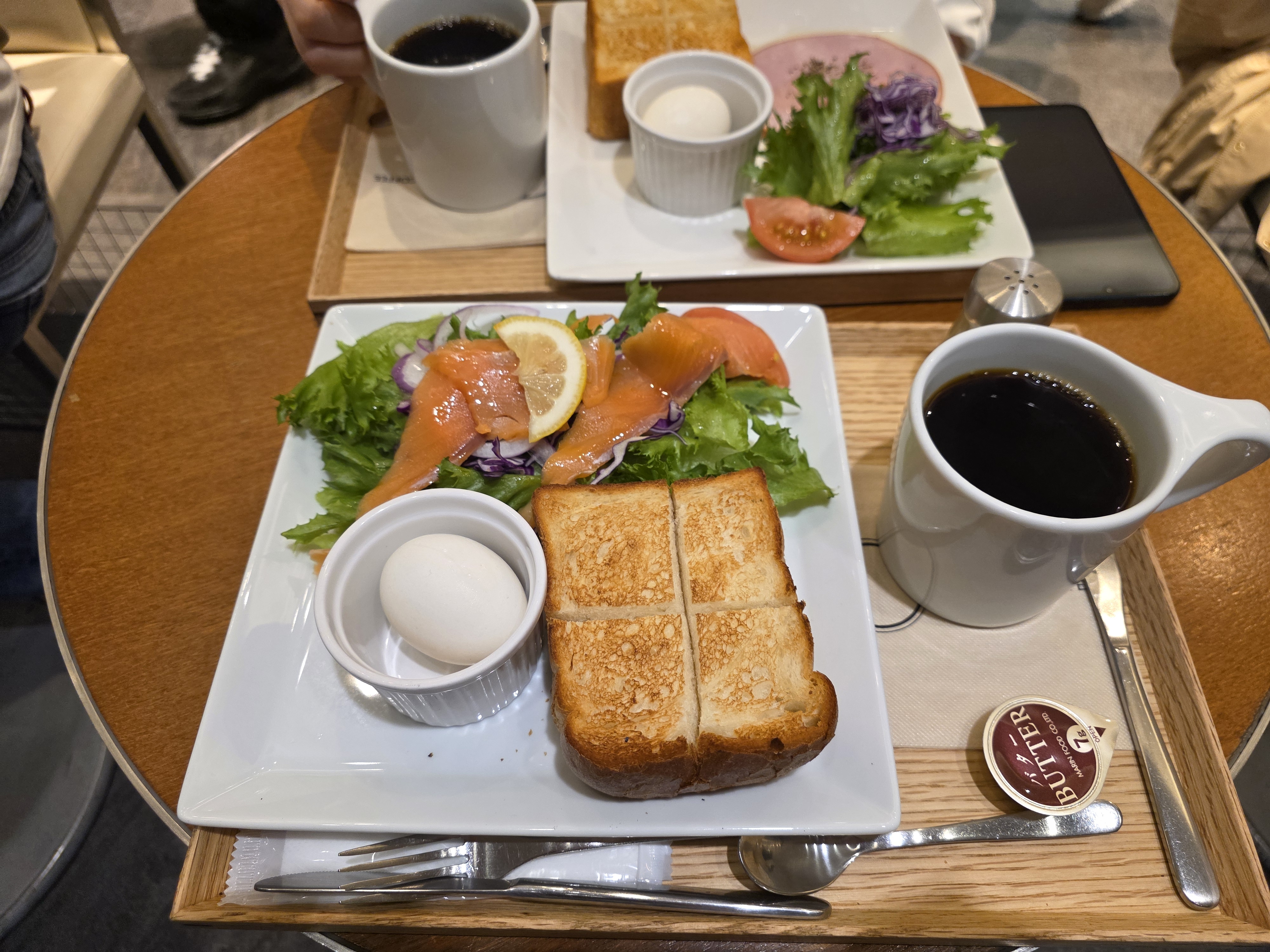
As a result, we left an hour earlier than planned. But before heading out, we walked to Kyoto Station and had breakfast there – we had delicious toasts made with Japanese milk bread, topped with egg and salmon in my case, or ham in Rena’s.

At the station, we took an express train (not the Shinkansen, just a regular limited express) to Himeji.

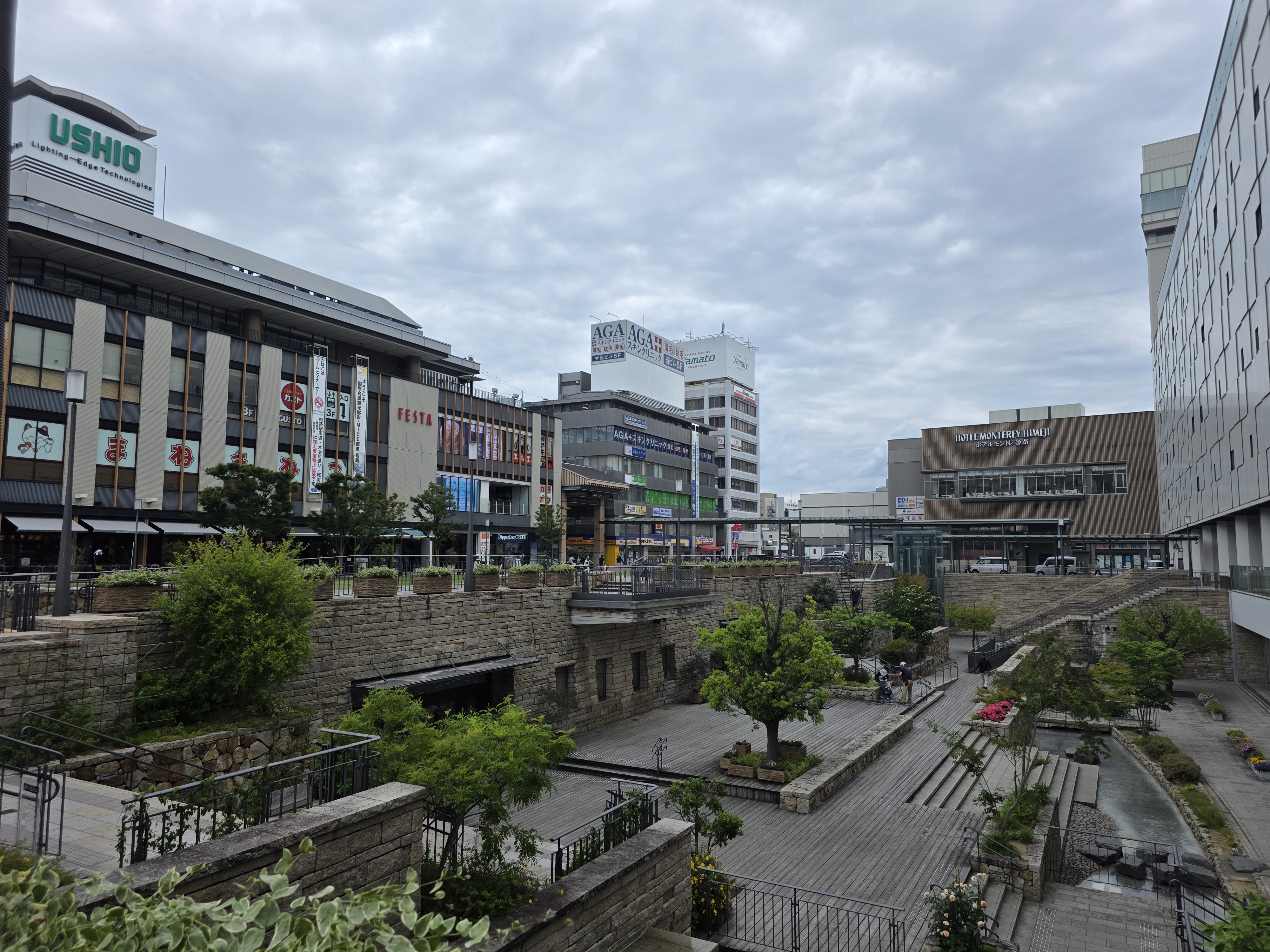
The sole reason for the trip to Himeji (which took about an hour and a half, by the way) was to visit its famous castle. From Himeji Station, we walked down one of the main streets towards the castle. Honestly, there wasn’t much to see along the way – the city seemed fairly ordinary and, at first glance, felt rather provincial.

The castle really is the city’s main (and maybe only) attraction – but what an attraction it is. It is extremely popular among tourists, as it’s one of Japan’s oldest castles, and interestingly, is built almost entirely out of wood.

We weren’t sure whether it was enough to admire the castle from the outside or whether we should go inside as well. Google reviews strongly recommended going in, and so we did – but in hindsight, we might as well have skipped it.

From the outside, the castle is stunning – graceful and elegant. No wonder it’s also called the “White Heron Castle” – it truly does resemble a white heron. But inside, there’s practically nothing to see. Just seven floors of empty wooden rooms, between which we had to walk up and down the steep, slippery staircases (they are slippery because you have to take your shoes off and walk in socks). There’s no interior decoration, no furnishings, barely any artifacts. Even the weapon displays are sparse – just a couple of spears and guns for show.

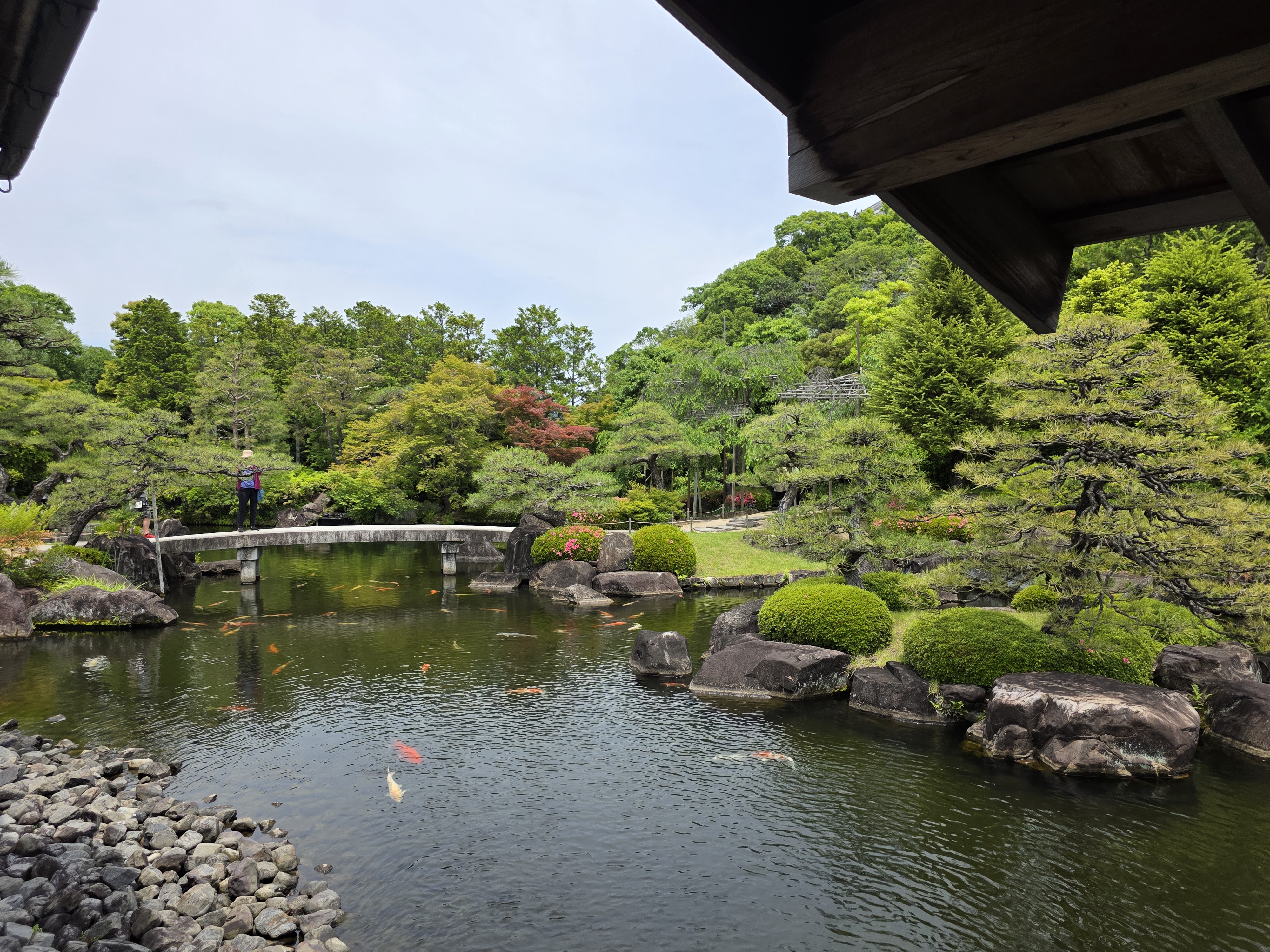
However, right next to the castle is Koko-en – a lovely garden made up of nine smaller gardens, each designed in a different traditional Japanese style. One focuses on pine trees only, another features multi-level paths, waterfalls, and stones, while another has a flat landscape – and all are filled with beautiful flowers and trees. Interestingly, the garden was created only recently, in the late 20th century, but it’s designed to reflect the aesthetics of the Edo period.

It was hot and stuffy all day, even though the forecast had promised rain – instead, we got bright sun. By the time we finished at the gardens, it was already lunchtime. We decided to have lunch in Himeji and ate in a tiny local eatery that served Kobe beef – a premium, marbled Wagyu variety that’s about twice as expensive as regular Wagyu, but still reasonably priced here.

There wasn’t anything else we wanted to do in Himeji, so we headed to Osaka – in the opposite direction, towards Kyoto – about an hour’s ride.

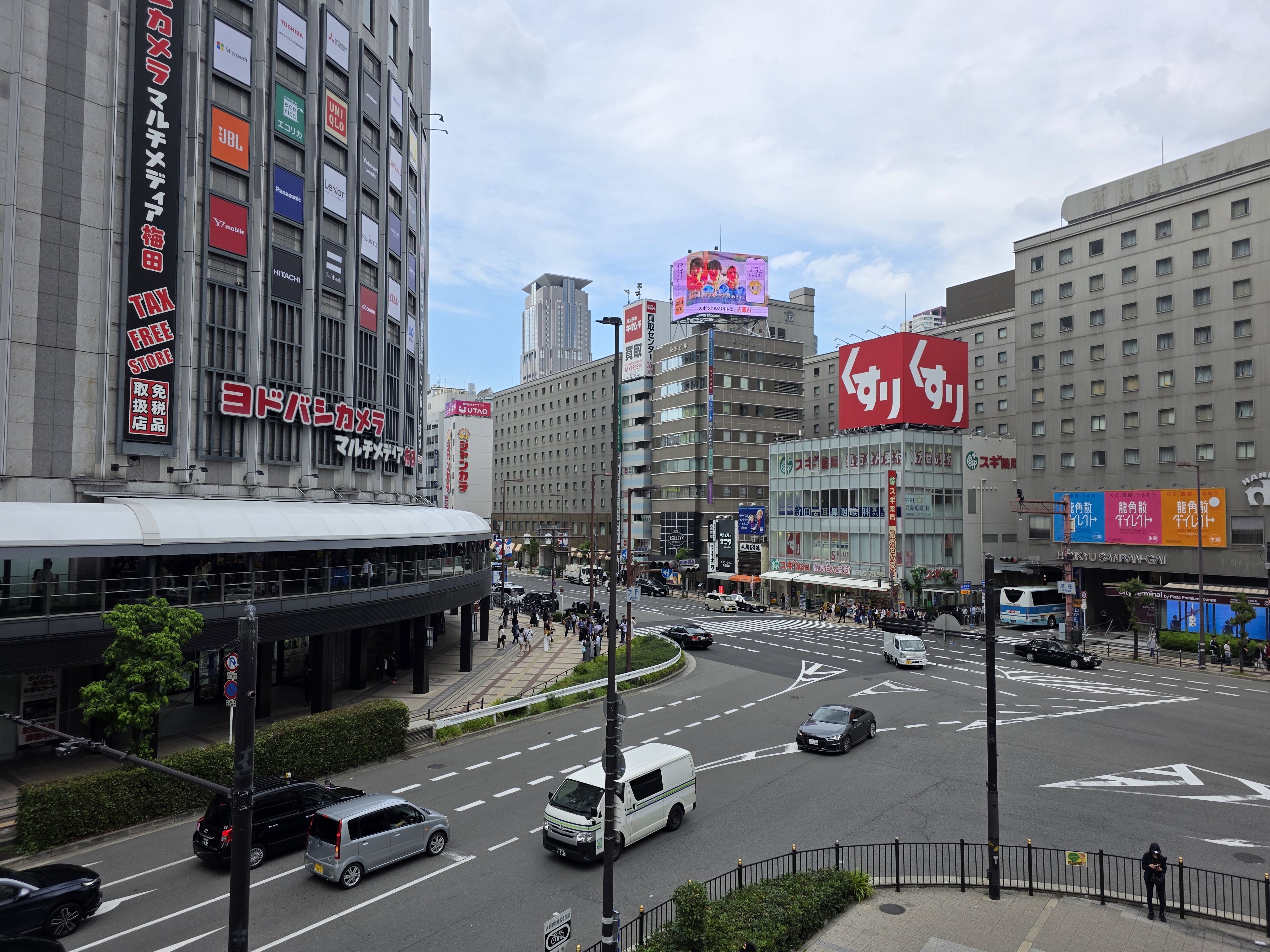
The contrast was immediate – Osaka has a completely different energy. It is a much more modern city than anything else we’d seen so far (even Tokyo). If your idea of a modern Asian city includes futuristic infrastructure and glass skyscrapers, Osaka fits the bill perfectly – it felt like such a contrast to Kyoto, which is only half an hour away. Even the people looked different – more relaxed, dressed more brightly and stylishly. And there are even dedicated bike lanes – in the other places we saw, cyclists just ride on the sidewalks, while you narrowly manage to avoid them.

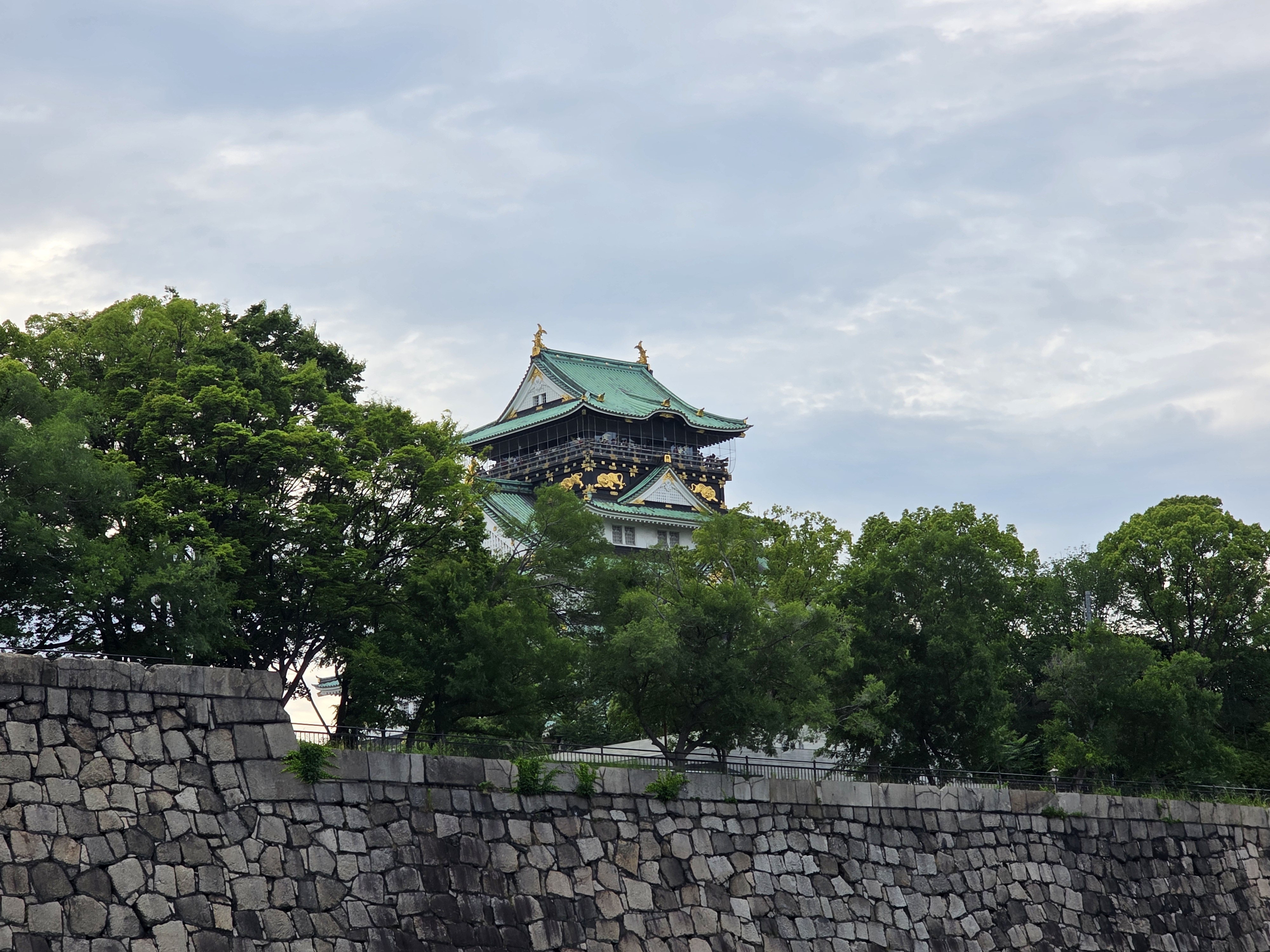
Osaka also has a castle, so we went to take a look – just from the outside, of course. It turned out to be located on a hill, mostly hidden behind trees, and we didn’t feel like climbing up – we simply didn’t have the energy.

The park around the castle reminded us a bit of Hiroshima Castle’s grounds, but Osaka’s was better maintained and much more lively – full of people, like the city itself.

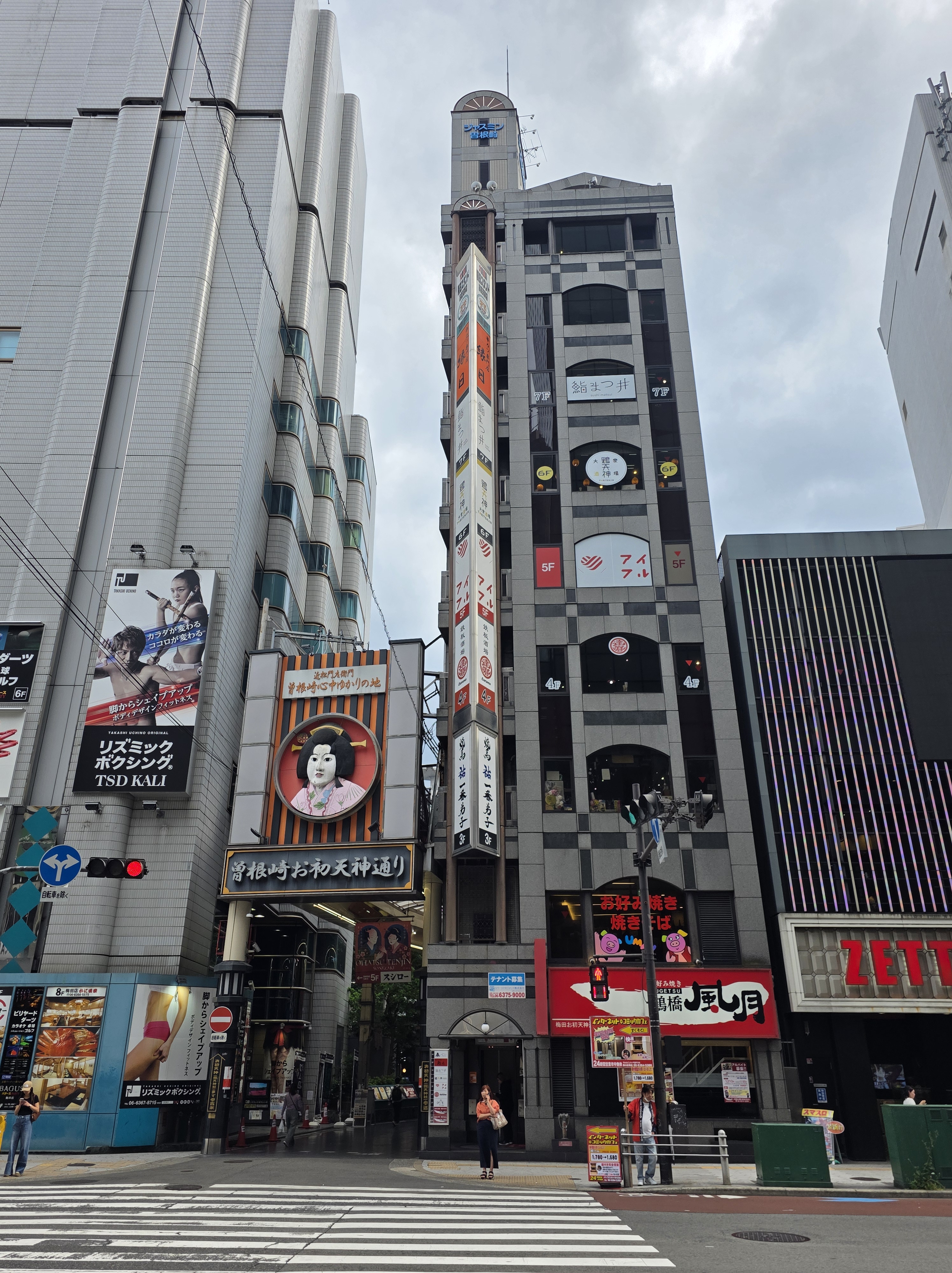
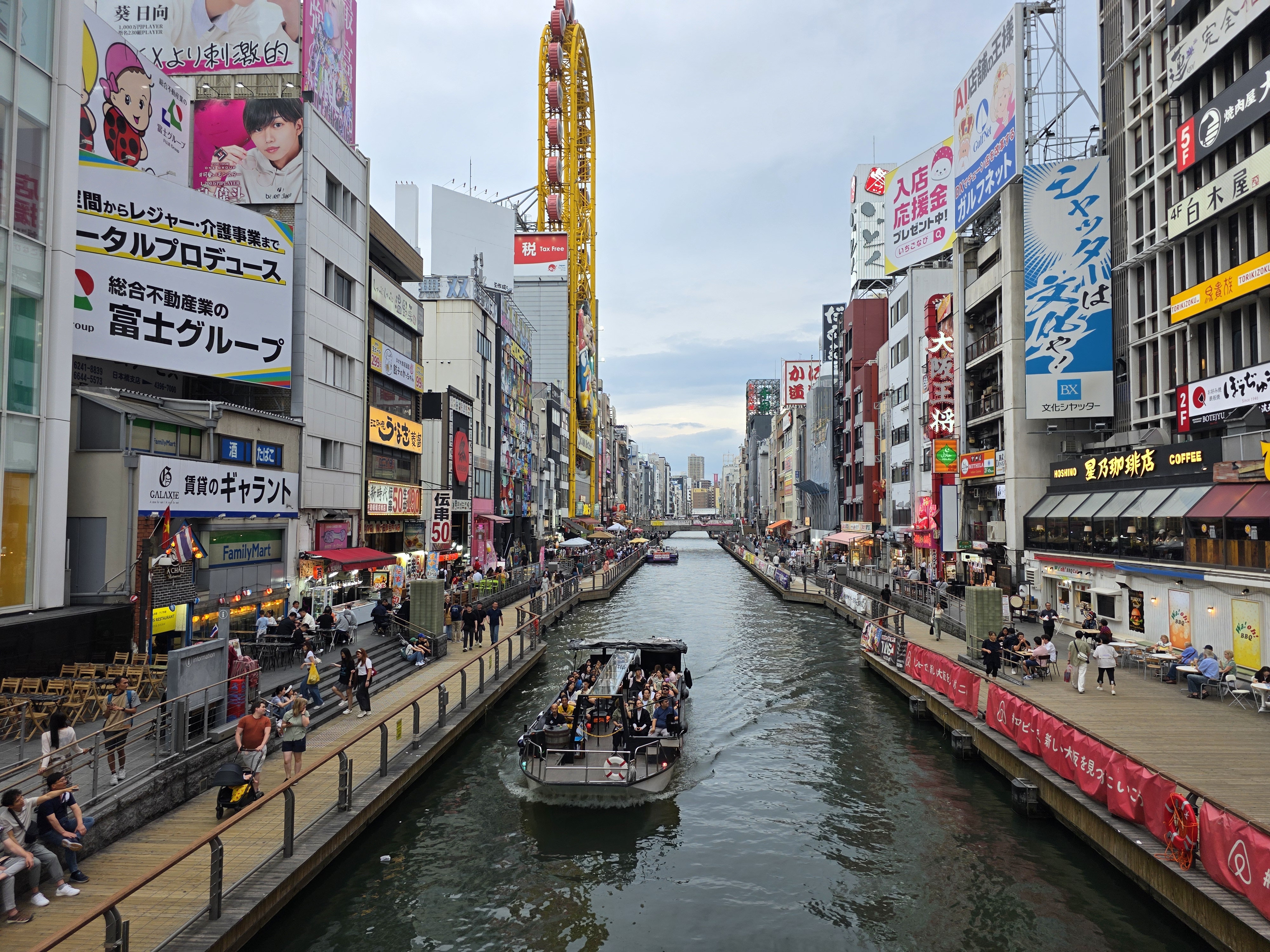
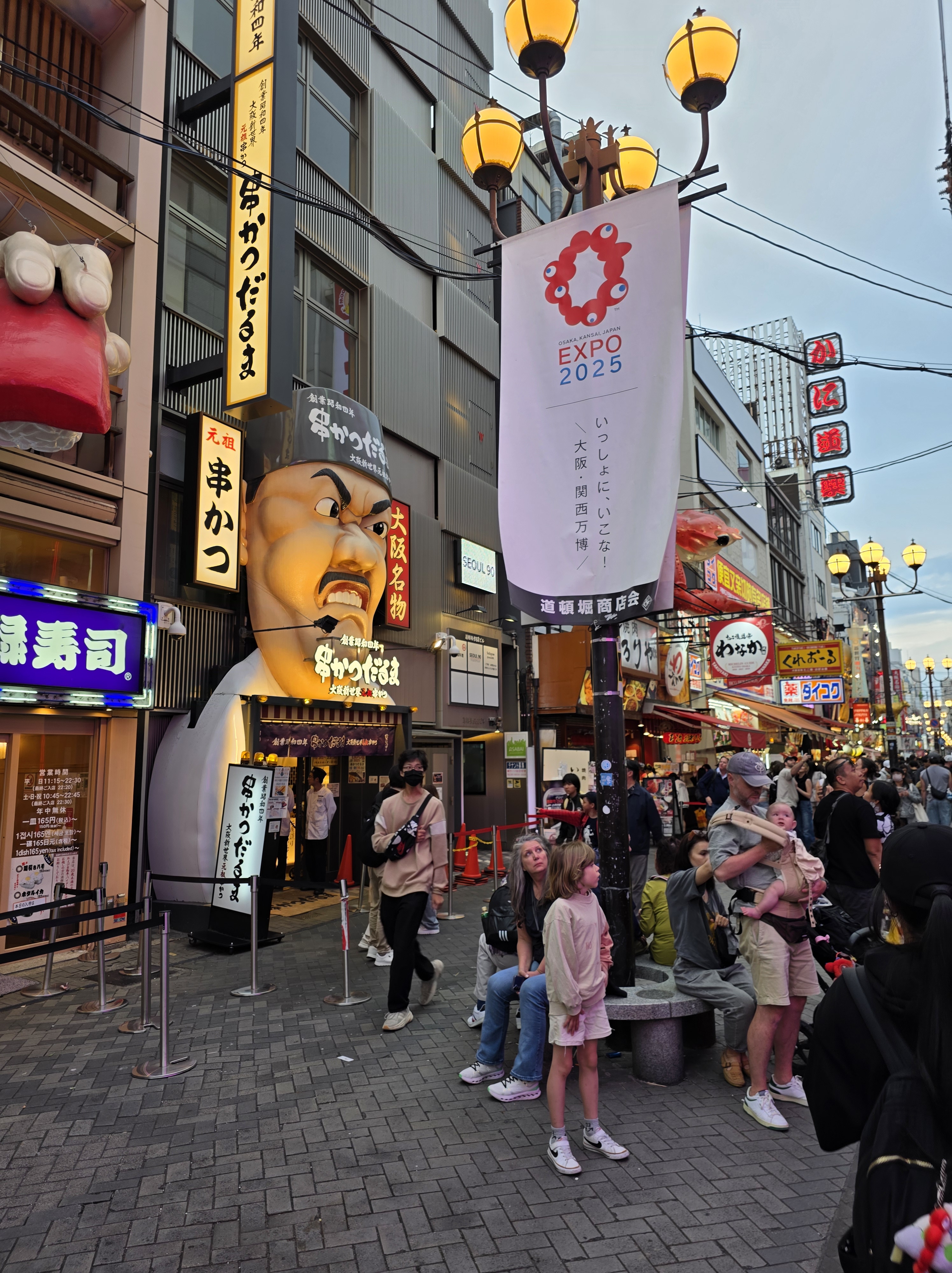
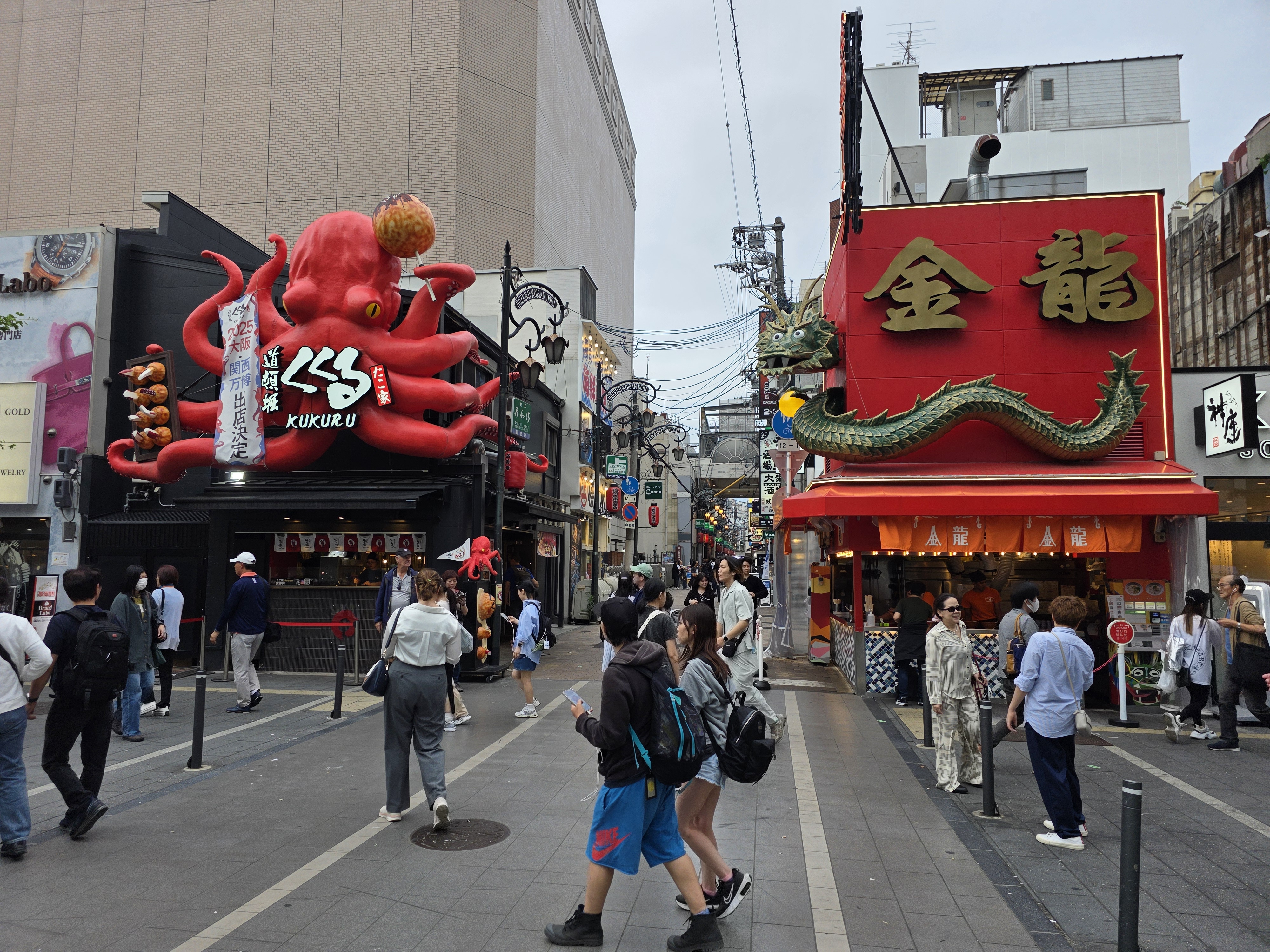
Next, we headed to what’s probably the noisiest and most chaotic part of the city: the Dotonbori area. Along the canal and the adjacent pedestrian street, there is an endless choice of cafés, restaurants, shops, and game centres – all with huge, elaborate signs, that are more like 3D sculptures, covering the entire facade. At night, everything lights up in dazzling neon.

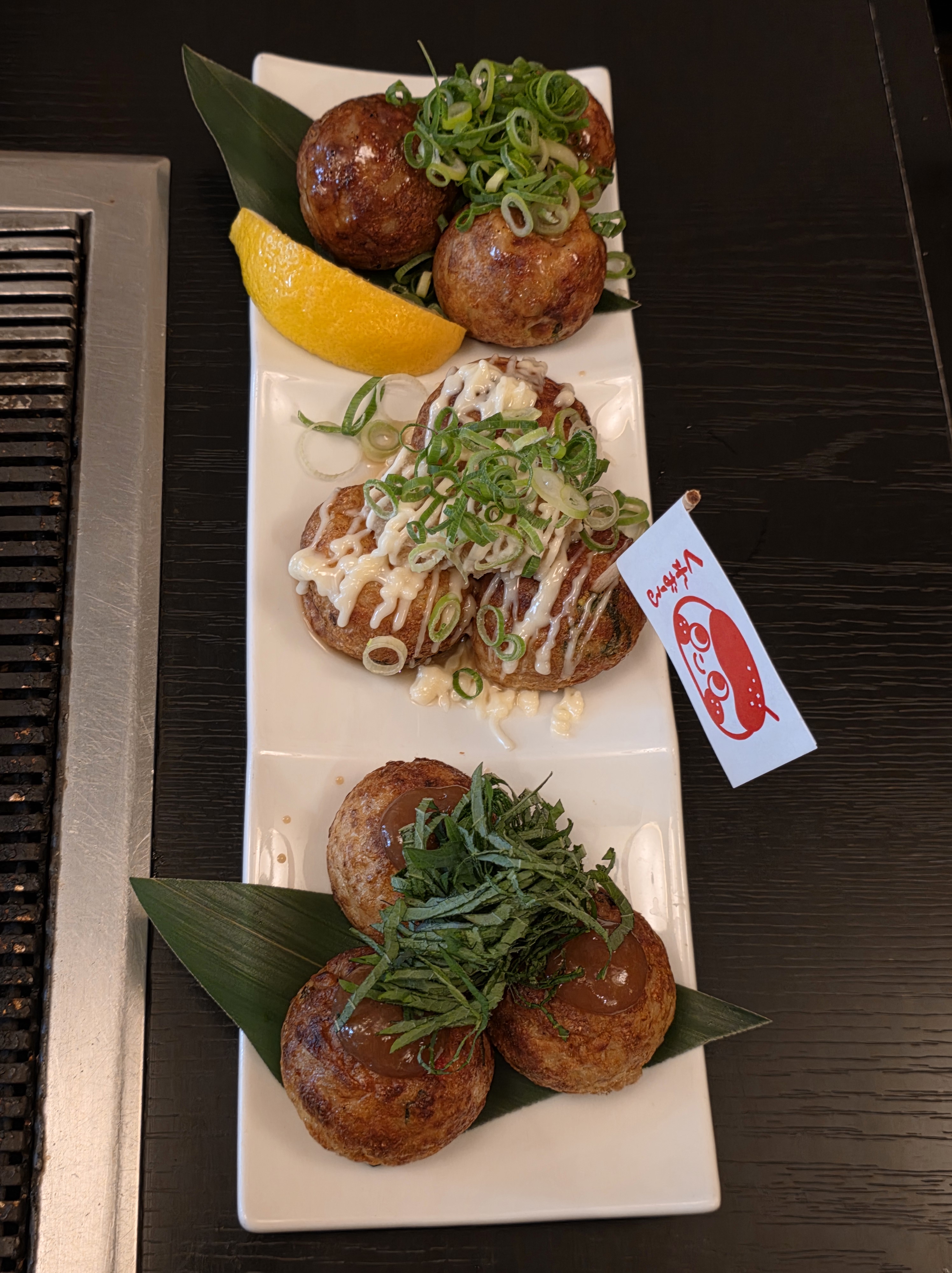
Food stalls and restaurants offer all the local specialties – which, of course, we tried for dinner: okonomiyaki (something between a savory pancake and fritter made of a hodgepodge of different ingredients – seafood, cabbage, eggs), takoyaki (fried octopus balls in liquid batter), and noodles. I really liked it, though Rena didn’t.

In general, if you’re looking for that loud, wild, fashionable version of Japan you often see in the media – you’ll find it here, in Osaka. The city is vibrant, chaotic, and it’s very entertaining to look at all this, but we’re still happy to be staying in Kyoto, where we were happy to return in the evening.

Posted in Asia, English, Hiroshima, Japan, Miyajima

Japan – Day 6

РУССКОЯЗЫЧНАЯ ВЕРСИЯ ПО ЭТОЙ ССЫЛКЕ. CLICK HERE FOR RUSSIAN VERSION.

28 May 2025

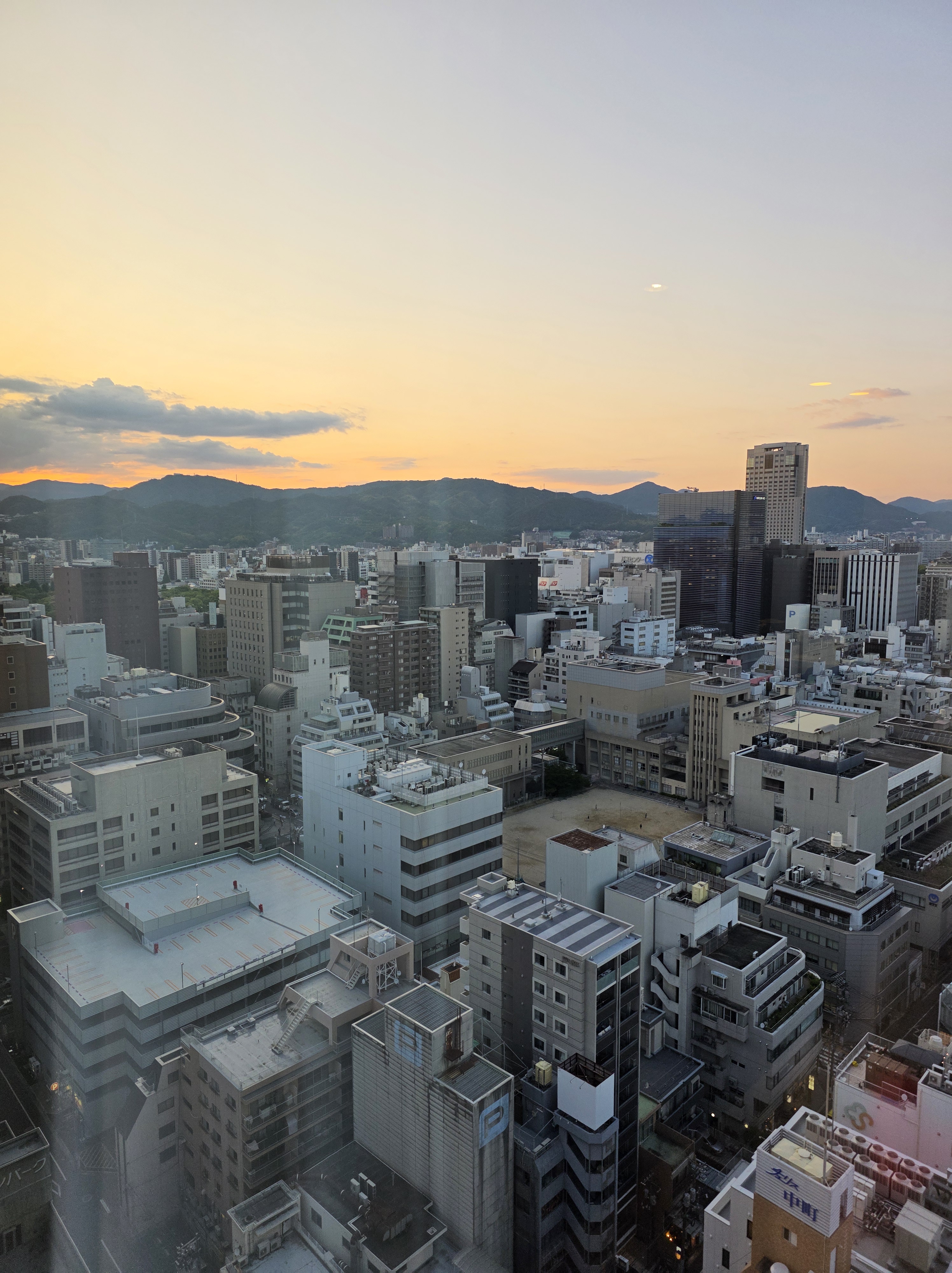
Today we went to Miyajima Island right in the morning. Prior to that, we had breakfast at our hotel – we tried the buffet on the 25th floor, which had a really cool view of the city. The breakfast offered both Western and Japanese options, including local Hiroshima specialties like fish cakes and fish sausage.

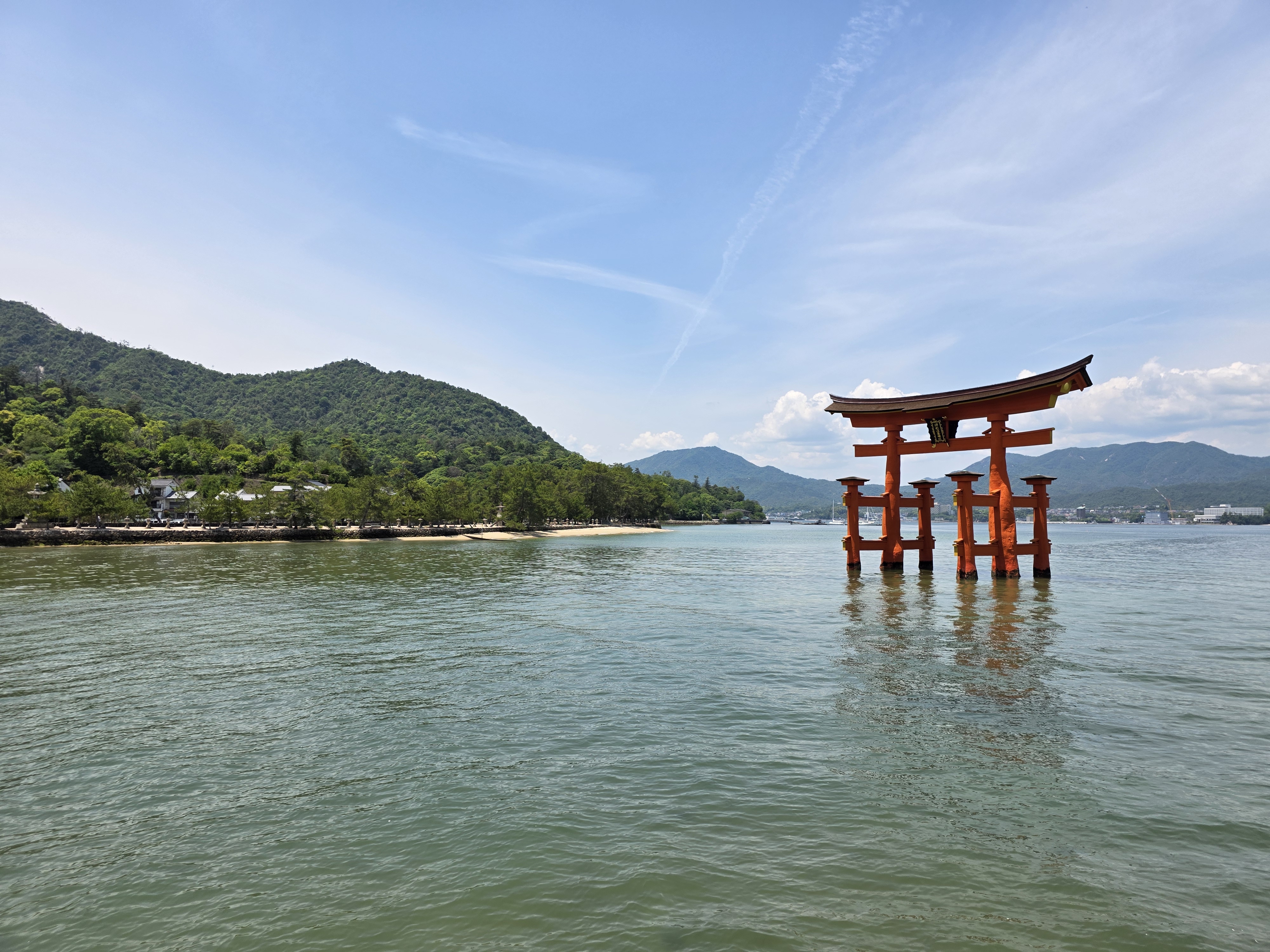
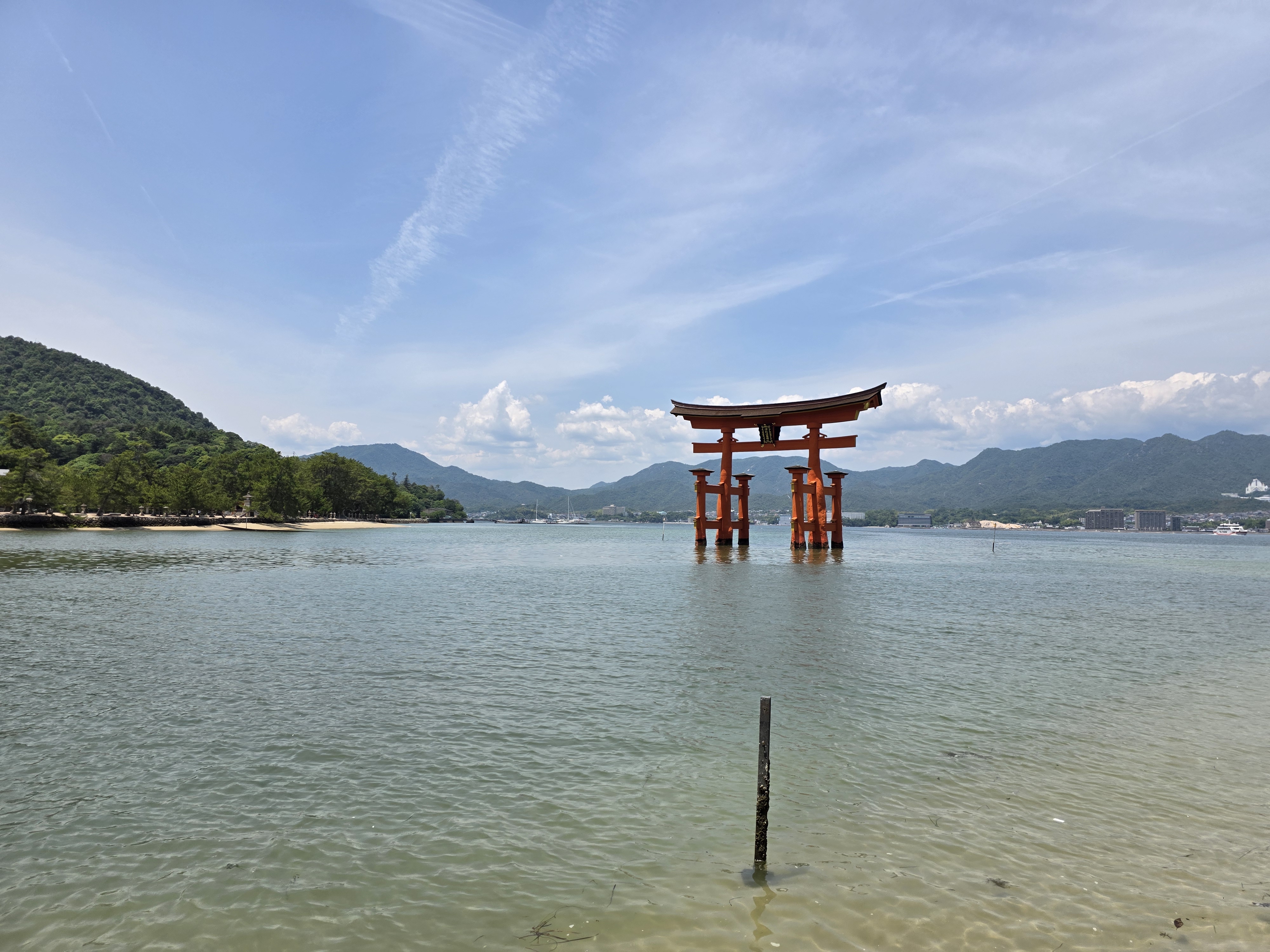
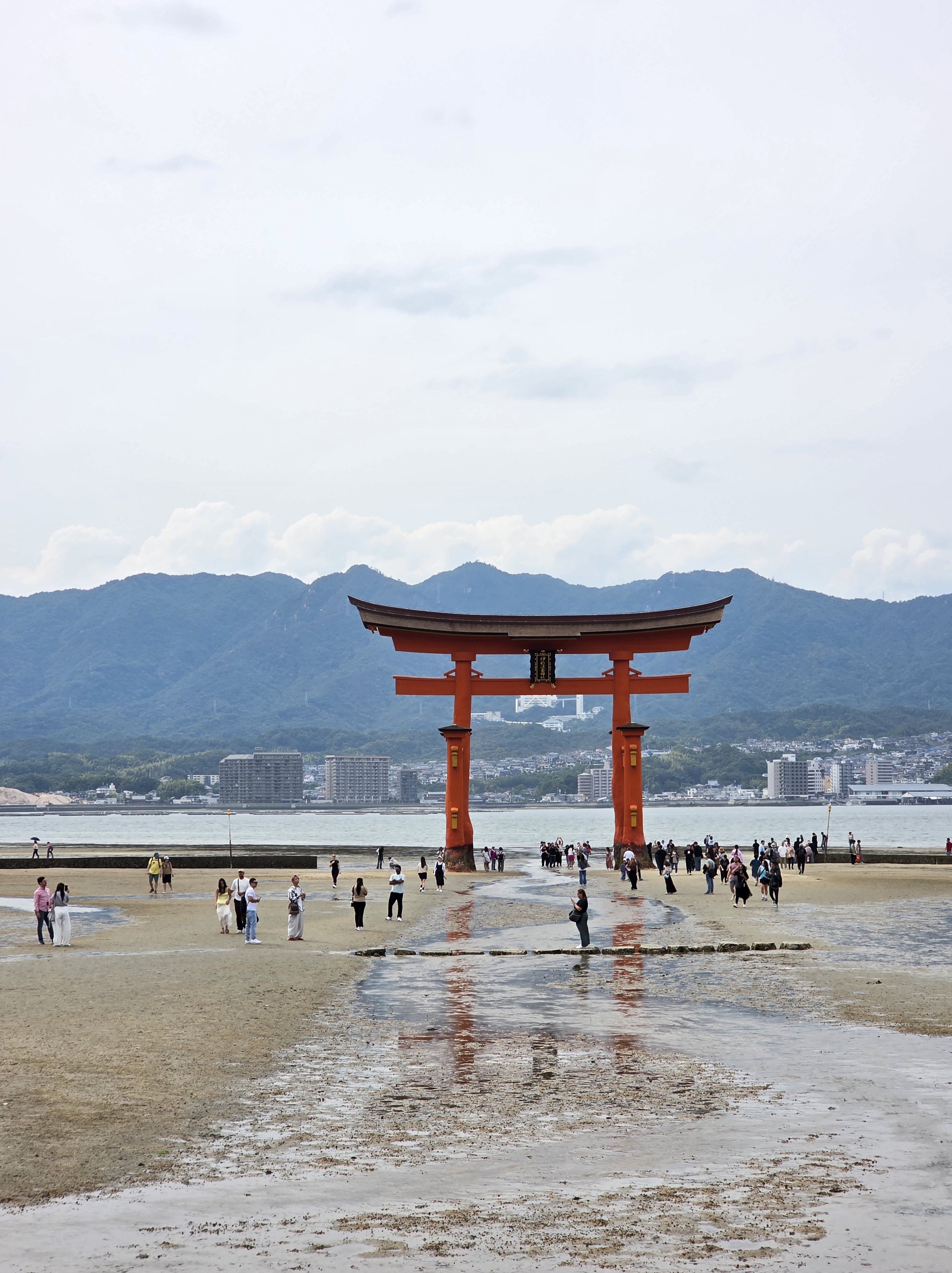
We walked to Shin-Hakushima Station, passing by the castle we visited yesterday – which, in daylight, looked a little less impressive than it did lit up at night. The train took about 20 minutes to get us to the ferry terminal, accompanied by a noisy Iranian tour group. From the terminal, ferries from two different companies run frequently to Miyajima, and the crossing only takes 10 minutes. From the ferry, we got a great view of the famous “floating” torii gates.

There were tons of tourists on the island – but despite its small size, it didn’t feel crowded. Somehow, everyone seemed to spread out. Most tourists were local Japanese, but there were also quite a few foreigners – the Germans again made a noticeable appearance.

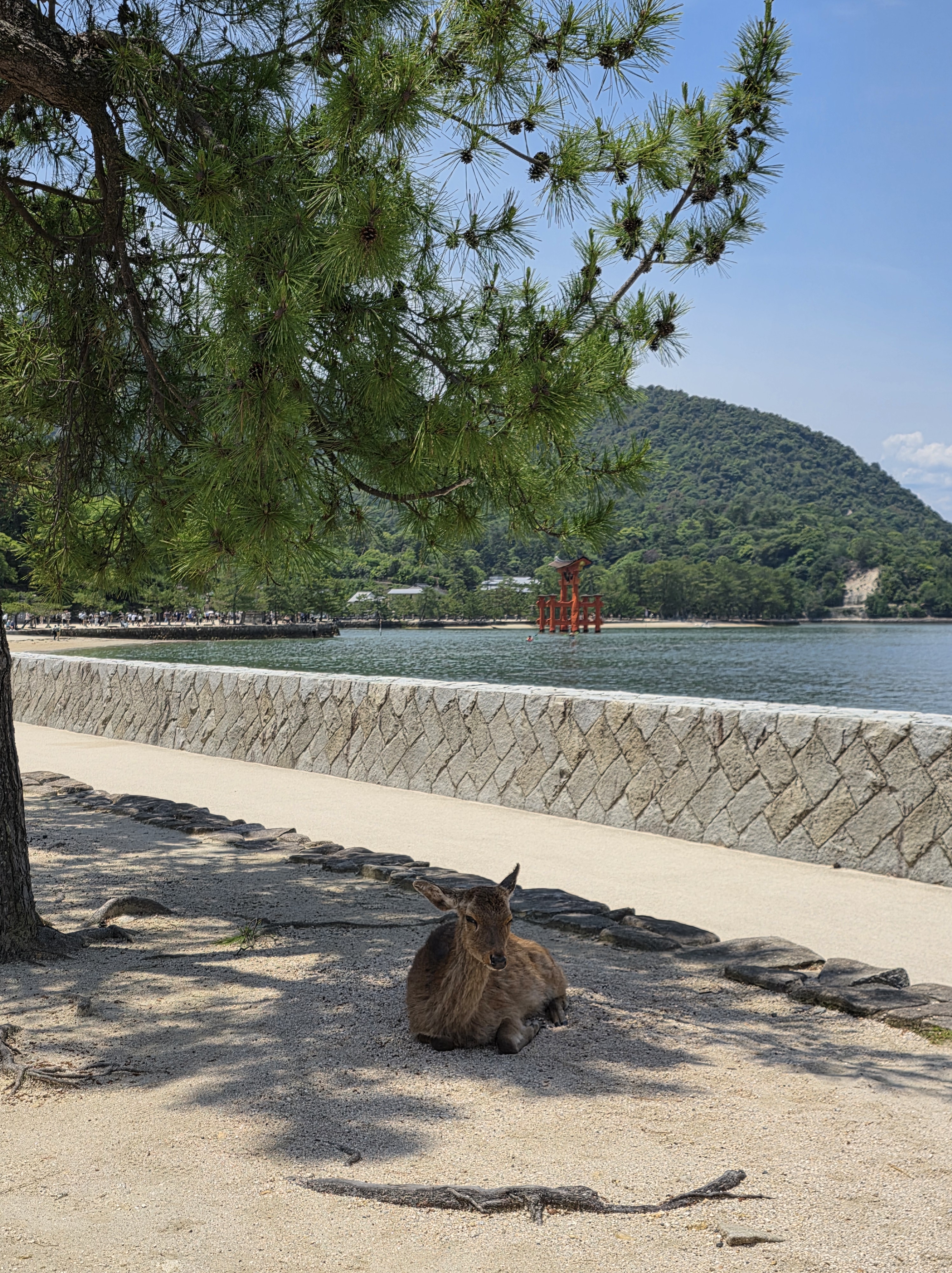
Stray deer roam freely on the island – so there’s no need to go to Nara to see them. That said, the ones here seem hungrier and more persistent. We didn’t even think of eating anything outside, but we saw others who did and clearly regretted it, trying in vain to fend off the pushy deer.

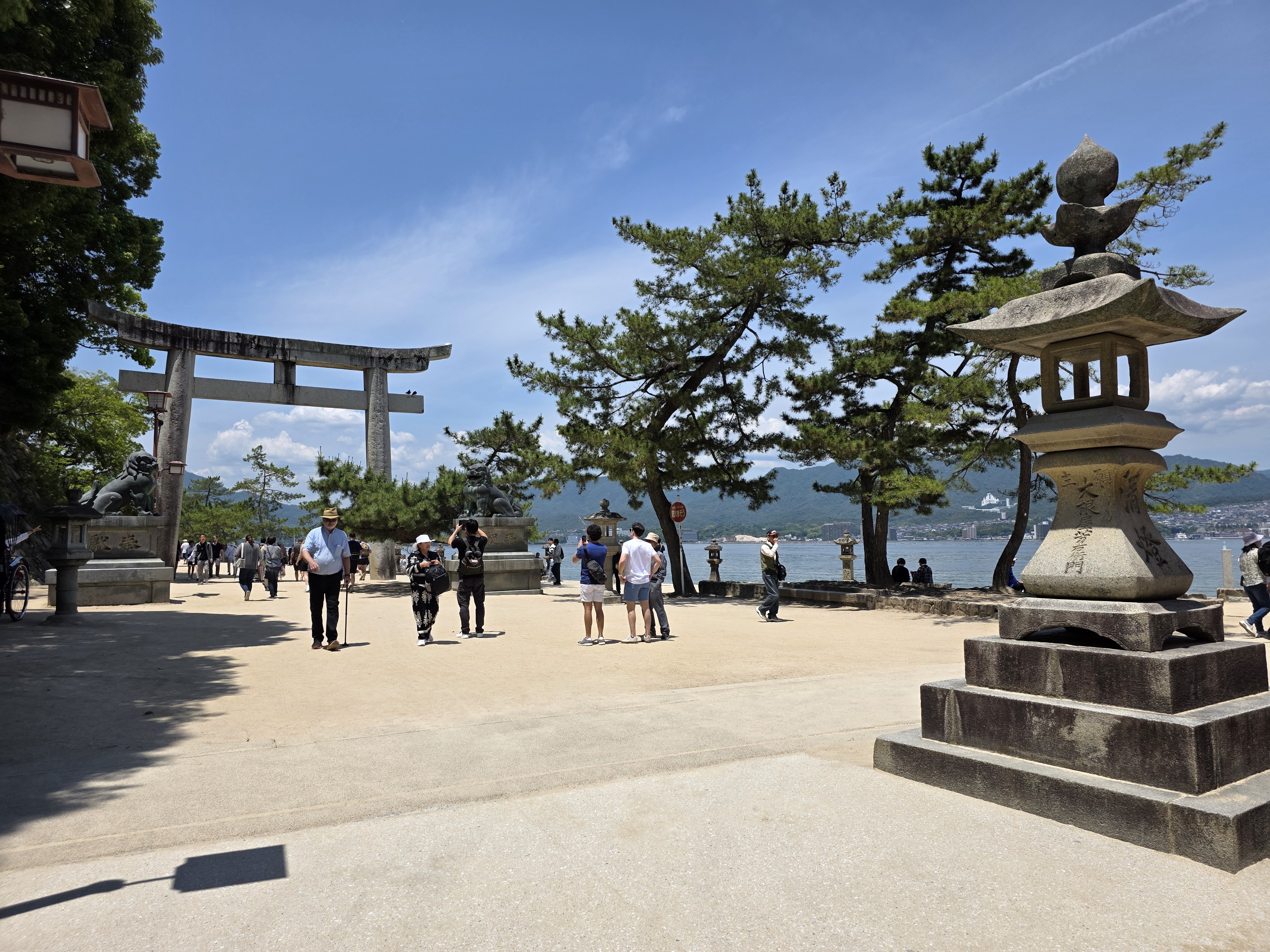
Once on the island, we wandered through the charming streets of Miyajima toward the Itsukushima Shrine – the one the “floating” torii gate belongs to. Interestingly, the gate doesn’t “float” all the time – only at high tide. So when we arrived in the morning, it was surrounded by water, but by around 3 p.m., it was already on dry land, with people walking right up to it and through it.

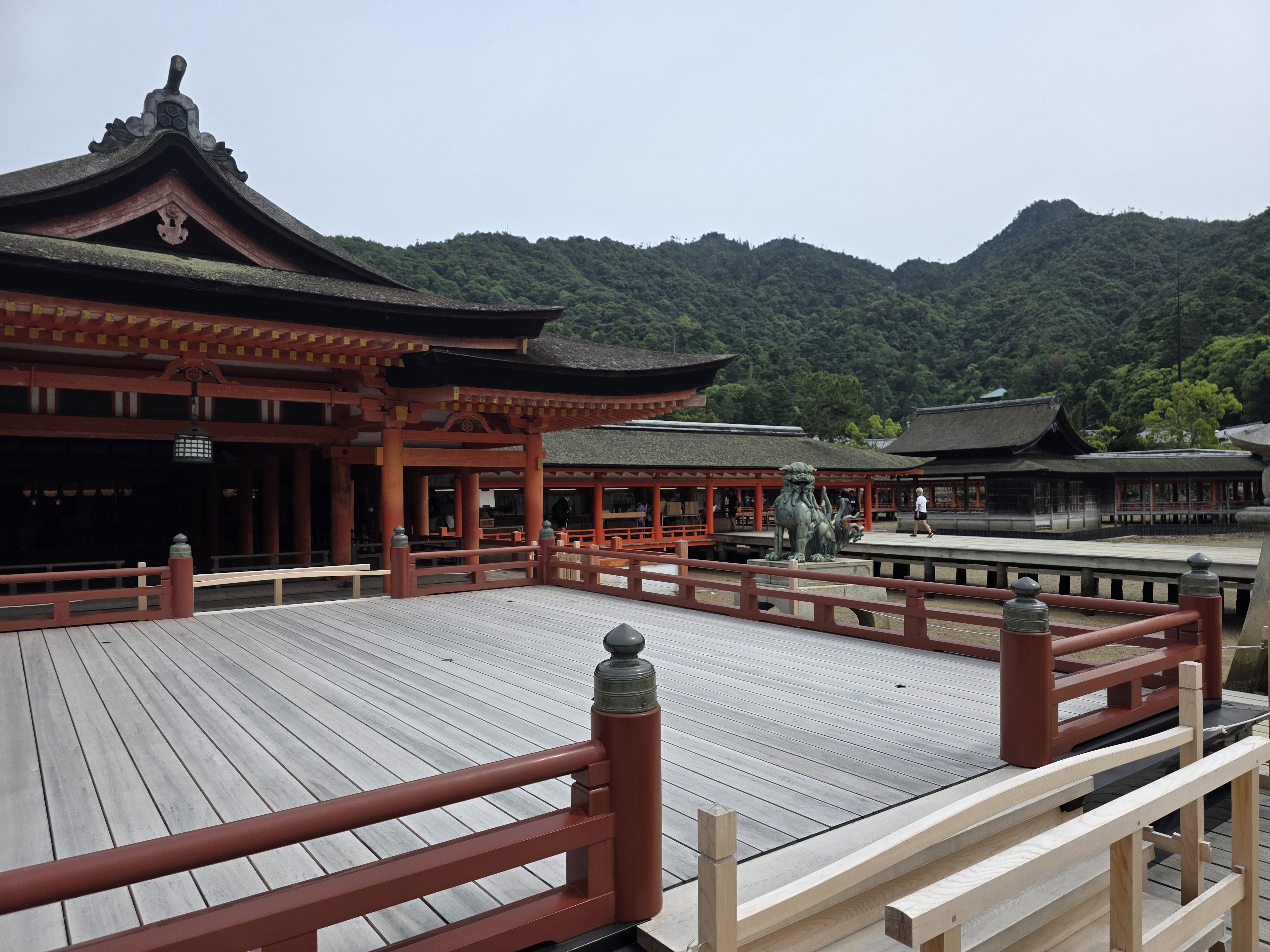
The shrine is Shinto, and the entrance fee is 300 yen (about £1.50), but at the moment, much of it is closed for restoration. Unfortunately, the nearby five-tiered pagoda from the 15th century was also under restoration – we didn’t even recognise it at first, and thought it was a new building going up in the middle of this historical island! So when we climbed up to the Hokoku Temple, we weren’t able to see it.

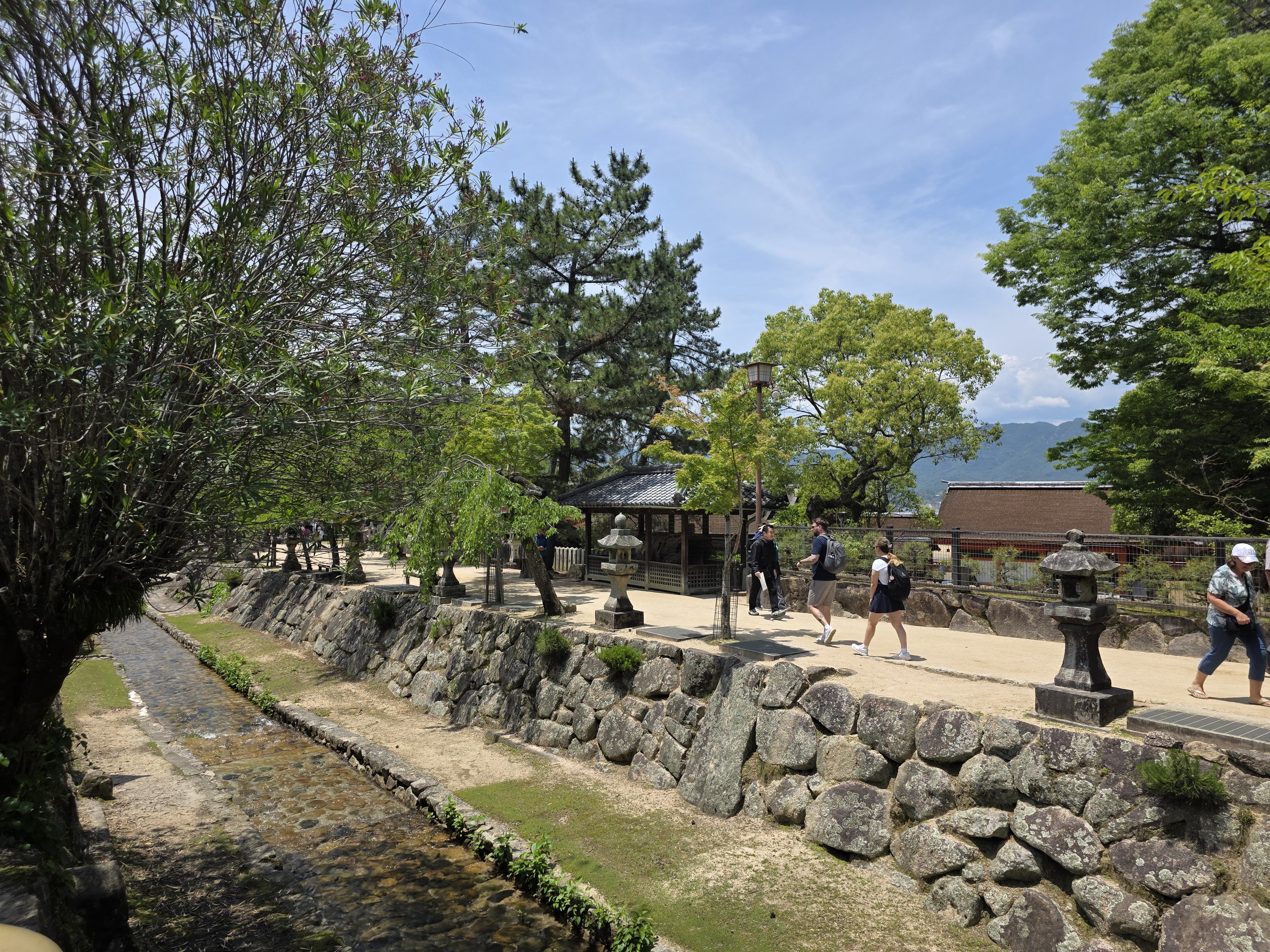
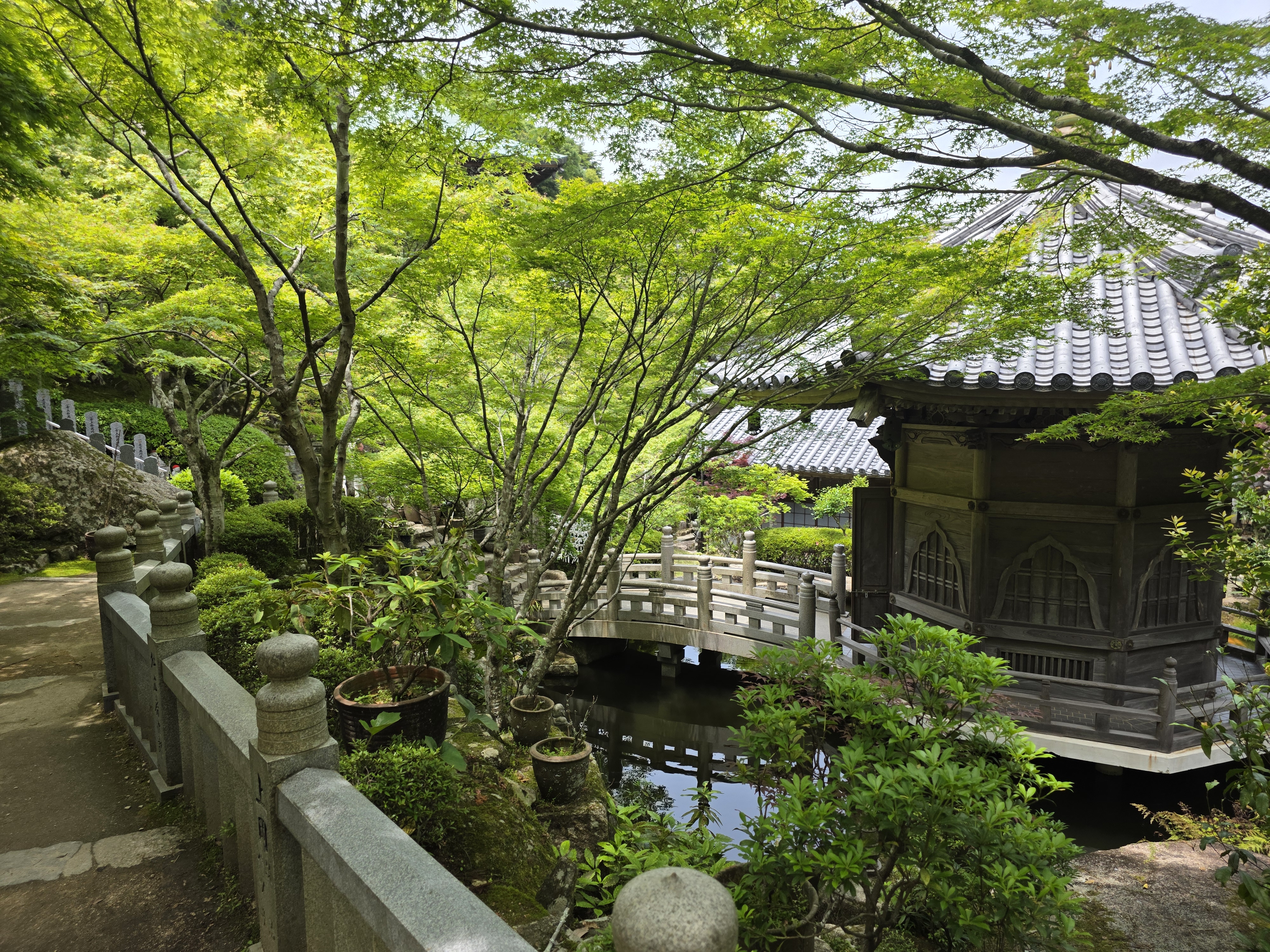
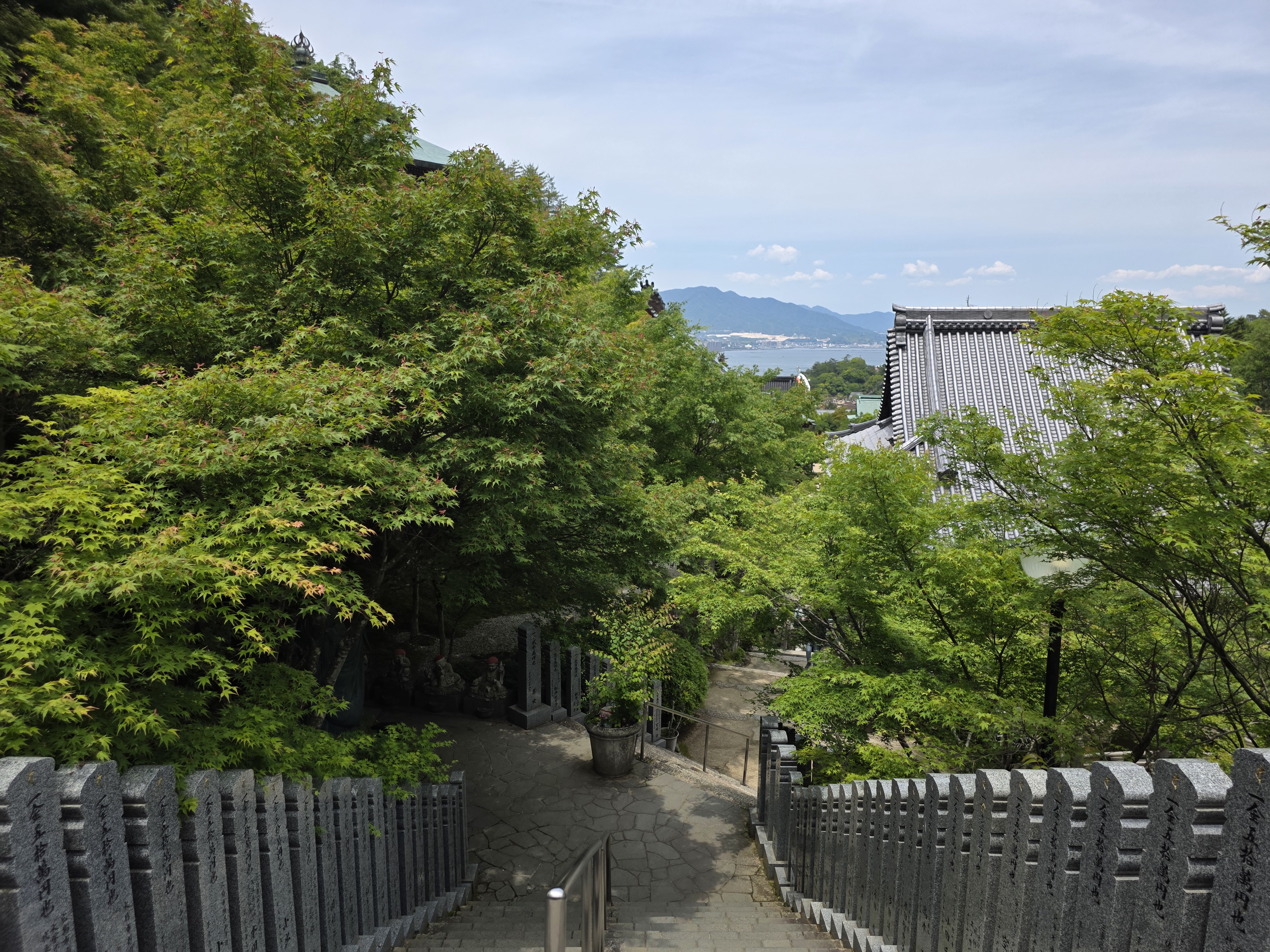
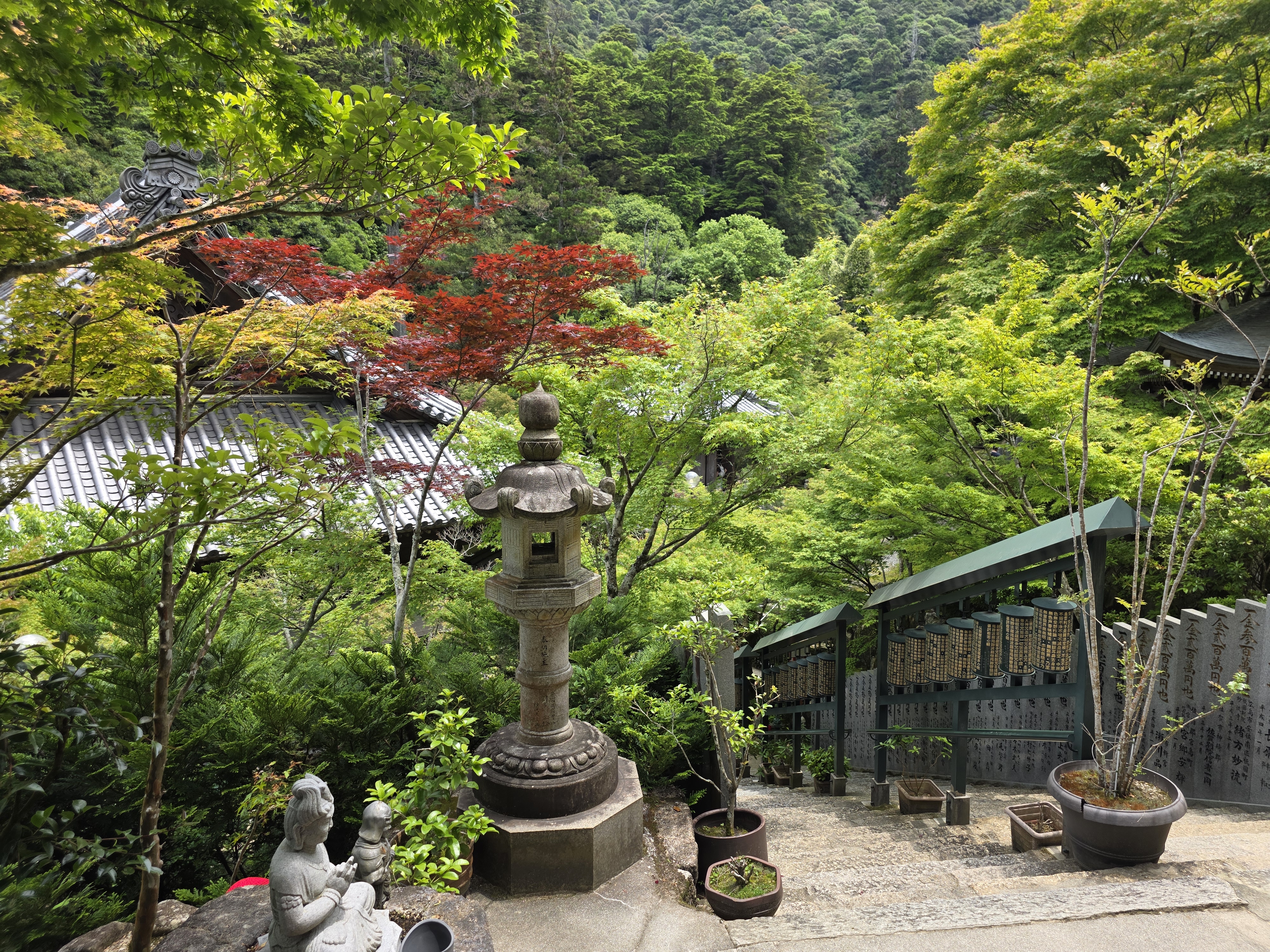
We then continued up to Daisho-in Temple – unlike the shrine and like Hokoku, this one is Buddhist. From here, you can hike to the top of Mount Misen, but we decided not to do that and just enjoyed the temple itself.

The path to the temple was calm and peaceful. Of course, tourists come here too (the same noisy Iranian group was there), but not in overwhelming numbers. Many worshippers were also present, performing rituals. For example, you can strike a large bell and make a wish – though you have to pay. Sure, you can do it for free, but I would imagine that the local higher powers probably don’t grant free wishes.

They say (and back it up with photos!) that the views from the temple in autumn are absolutely spectacular – but even in May, for some reason, many trees were already red, so it was beautiful anyway. We really liked the temple.

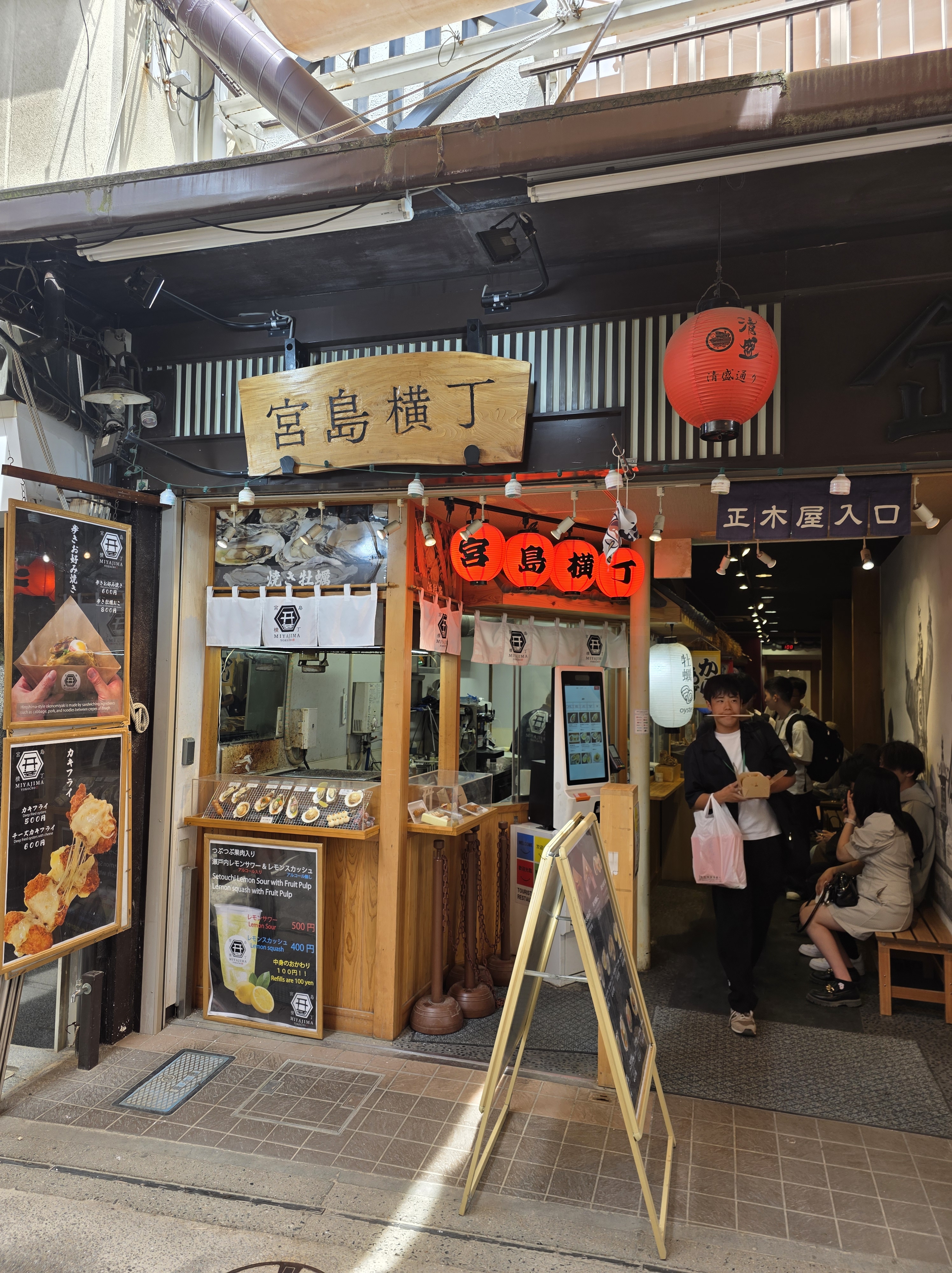
By then it was lunchtime, so we headed back down toward the pier and went into one of the local restaurants to try regional cuisine. We were seated in a “Japanese room” – many places here offer that option – which means sitting on tatami mats at a low table, shoes off. The regional specialties are grilled eel and oysters, which we had in a set meal with buckwheat noodles (soba). It was interesting to try, but I wouldn’t call it my favourite flavour of Japan.

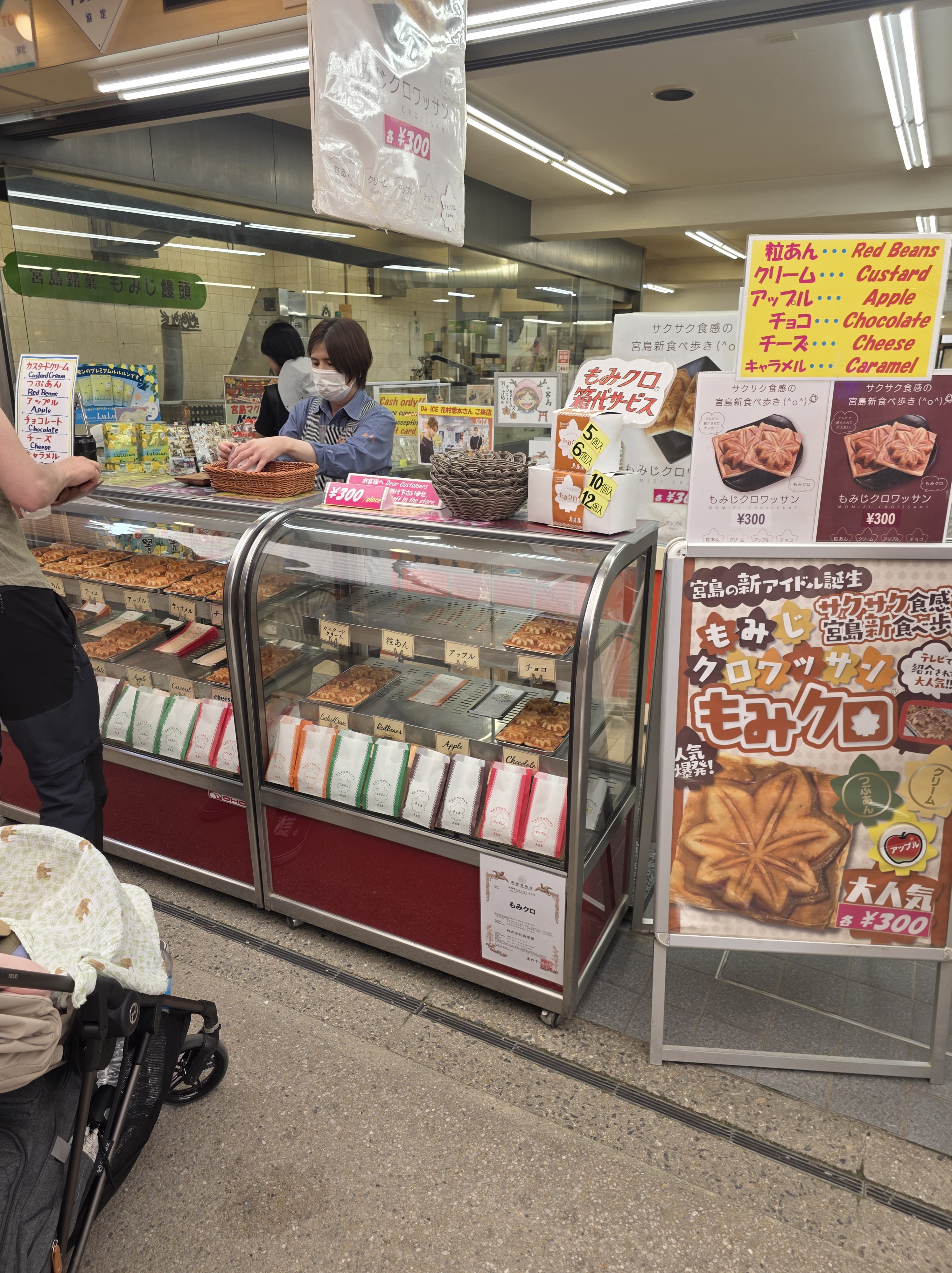
Another local delicacy is momiji manju – maple-leaf-shaped cakes with sweet fillings. The traditional version has sweet bean paste, which I didn’t like, but the chocolate and custard-filled ones were very tasty and delicate.

After lunch, we strolled through covered streets filled with cafés, food stalls, and souvenir shops – including some Ghibli-themed ones that were much better than the museum shop we saw yesterday.

Then we stopped for coffee at a place we’d spotted earlier that looked like someone’s private garden. And as far as I could tell, that’s exactly what it was – a house and garden converted into a café, run by two elderly women. The garden was beautifully maintained and very traditionally Japanese, and it was such a pleasant spot to relax. At first there were some noisy customers chatting loudly, but they left soon after.

From there, we headed back to the ferry. For some reason, at that time there were schoolchildren in uniforms everywhere – whole classes, probably on school trips. Some were arriving, some were leaving, some were gathered for class photos.

Back in Hiroshima, we decided to walk through the Peace Memorial Park and visit the Atomic Dome – the skeletal remains of one of the Hiroshima Prefectural buildings that survived the atomic bombing. Interestingly, the memorial plaque doesn’t mention anywhere that the bombing was carried out by the Americans – and the overall tone of the memorial isn’t accusatory at all, but more like a quiet reflection on the horrors of war and the importance of peace.

At the hotel, we arrived just in time for happy hour and had some rather mediocre wine that made us a bit dizzy – but then we went to dinner and had delicious katsu to make up for it.

Posted in Asia, English, Hiroshima, Japan, Tokyo

Japan – Day 5

РУССКОЯЗЫЧНАЯ ВЕРСИЯ ПО ЭТОЙ ССЫЛКЕ. CLICK HERE FOR RUSSIAN VERSION.

27 May 2025

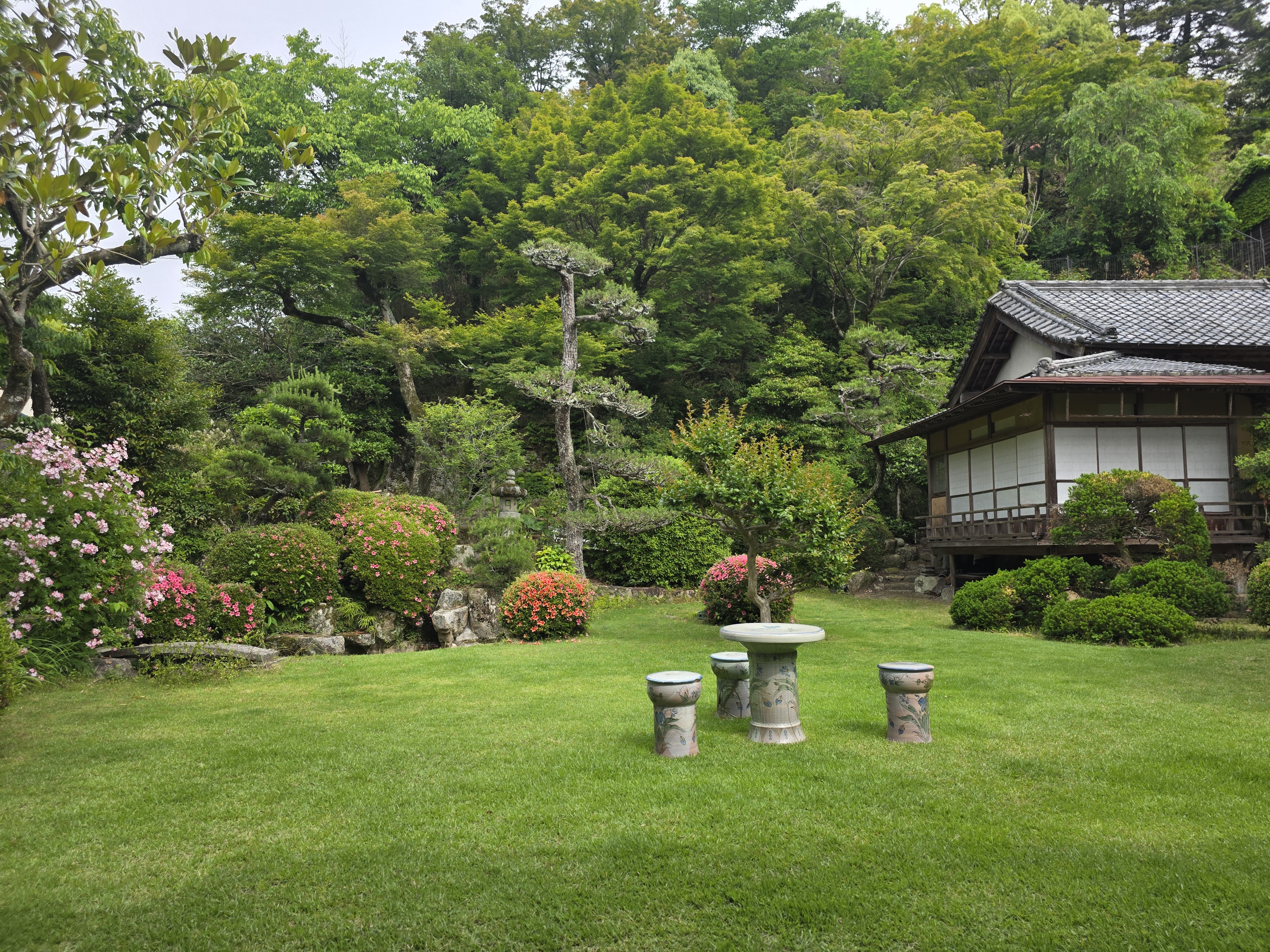
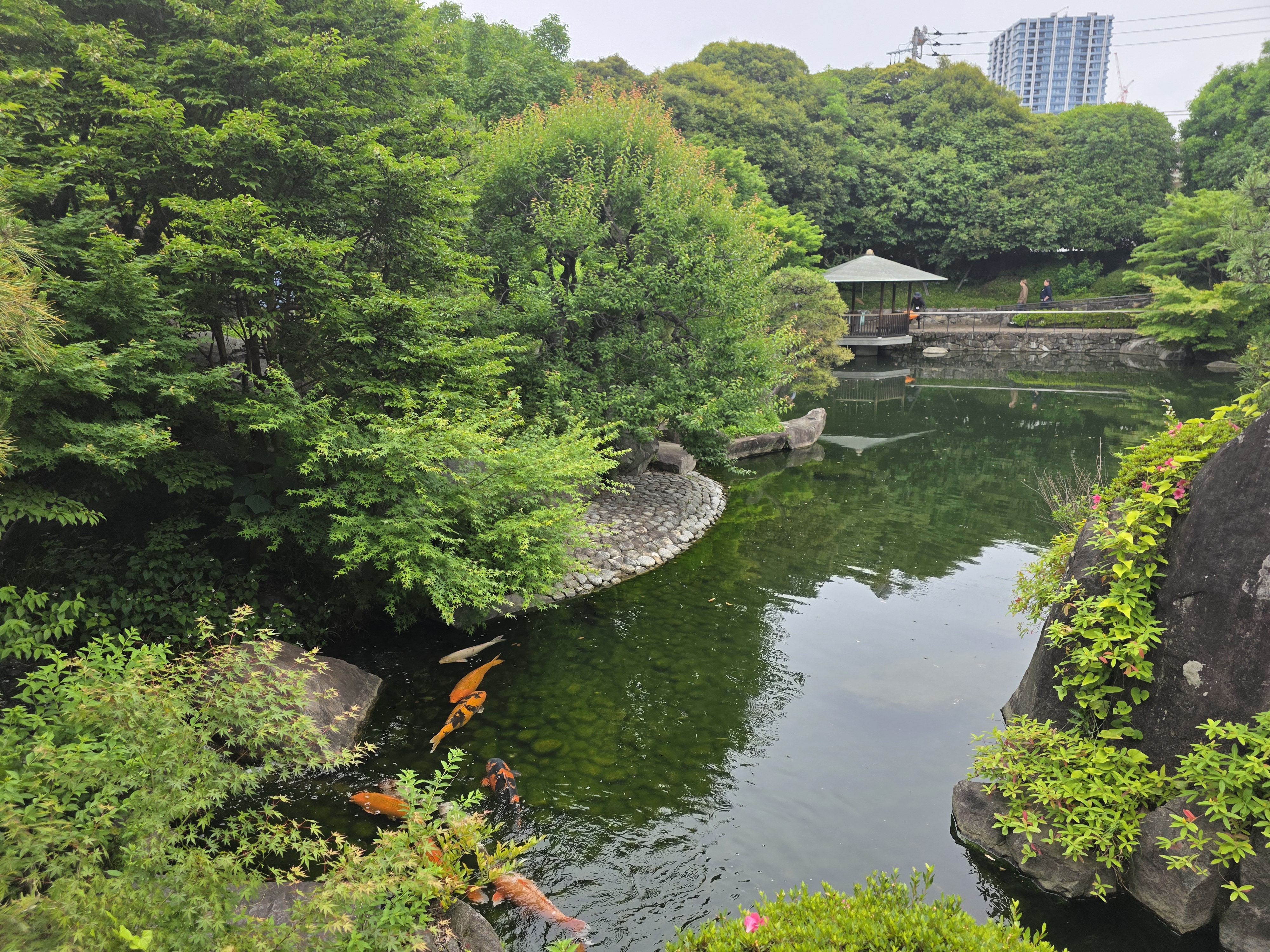
Today was our last day in Tokyo (though we’ll be coming back later). We had breakfast again at the same café in the park as the day before yesterday. We had to go to Hiroshima, but only after lunch, so in the morning we took a walk to Mejiro Japanese Garden, not far from our hotel. It’s a small, quiet, and very typically Japanese garden – clearly not a famous one, as there were very few people around.

At the entrance, there’s a traditional room that looks like a tea house, which can be rented for photo shoots or private events. The garden itself has a central pond surrounded by greenery, and a small gazebo. On the surface of the pond we saw lots of water striders, and in the pond itself, big fat koi carp swimming lazily around.

After returning to the hotel, we headed off to Tokyo Station. The station is truly massive – many subway and train lines converge there, and it’s also where the high-speed Shinkansen trains depart, which we were taking to Hiroshima. We had lunch right at the station in a Chinese restaurant – the hot and sour soup was especially good.

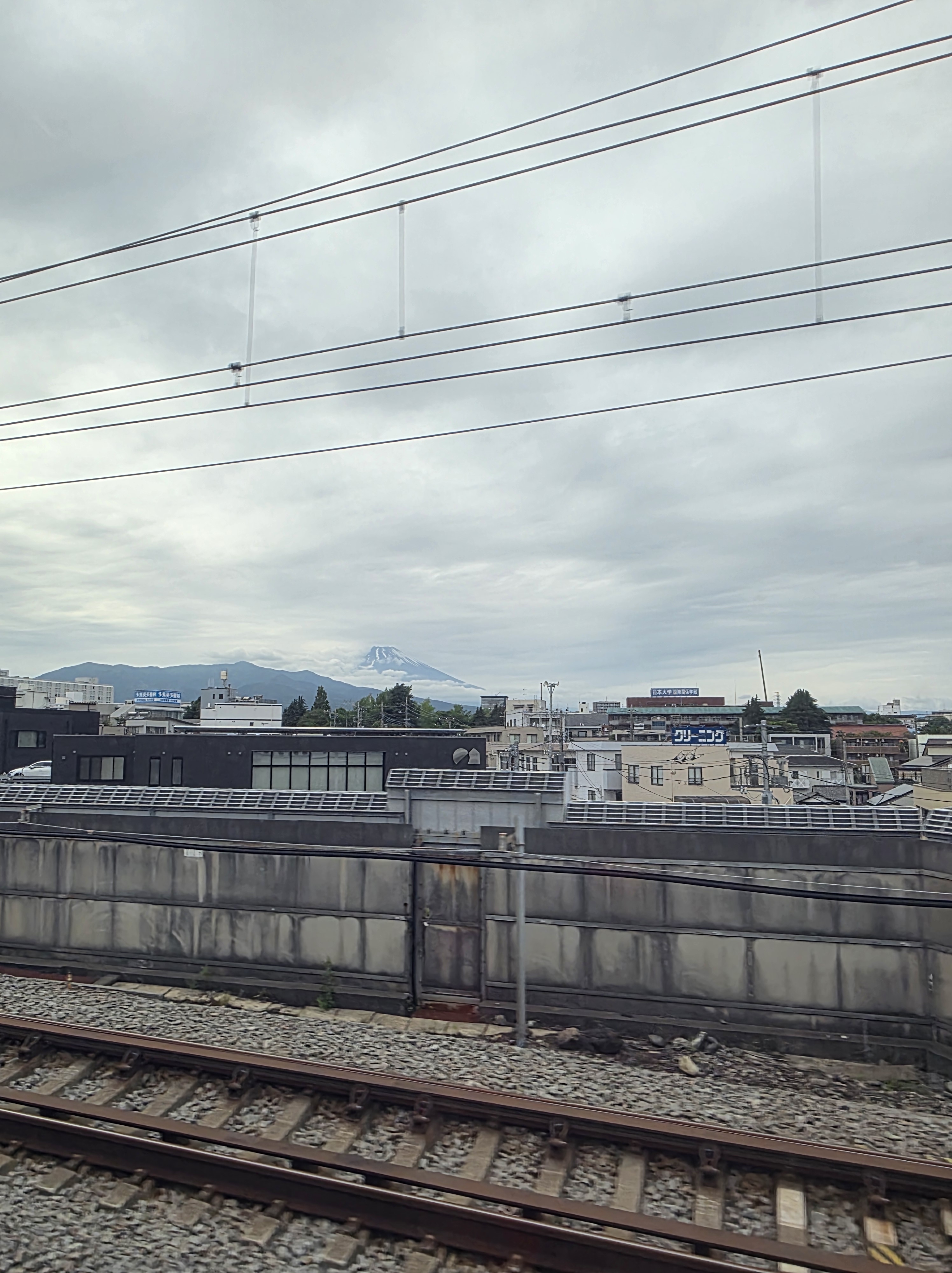
Coming back to the Shinkansen – also known as “bullet trains.” They’re fast, but not quite as jaw-dropping as the ones in China. Almost ten years ago, I took a Chinese bullet train from Hangzhou to Shanghai, and it was flying so fast you couldn’t even make out the scenery – everything outside just blurred into a gray wall. That was a proper “bullet.” Here, the train is definitely fast, but you can still see everything outside – the outline of Mount Fuji as we approached Kyoto, endless rice fields, and villages with houses that still have traditional curved Japanese roofs.

The journey to Hiroshima took about four hours, but it passed quickly and effortlessly. We’re not planning to do much in Hiroshima itself – the real goal of coming here is to visit Miyajima Island.

Once we arrived, we checked in to the hotel. First impressions of the city – at first glance, Hiroshima didn’t feel that different from Tokyo. But no, the vibe is quite different. For one, there are far fewer people, which makes foreigners stand out more – especially Germans, of whom there seem to be quite a few. Second – though maybe this was just our route – there were some confusing pedestrian passages and street crossings where it wasn’t obvious how or where to cross. Thirdly, I’ve already mentioned Japan’s older infrastructure – and here it feels even more dated. The buses look like ancient Ikaruses, and the taxis seem straight out of a movie from the ’80s or ’90s.

Just off the wide avenues, as in Tokyo, are hidden narrow streets. Same as in Tokyo, often there are no sidewalks, and where they do exist, cyclists ride along them, also in the same way.

We had dinner at a fish restaurant – though calling it a “restaurant” might be a bit generous. It was more like a small eatery with room for 10–15 people, and, once again, everything was in Japanese. They gave us a card with pictures of various fish, and we just pointed to the ones we wanted. Those were grilled with salt and served with rice, miso soup, and a few small side dishes.

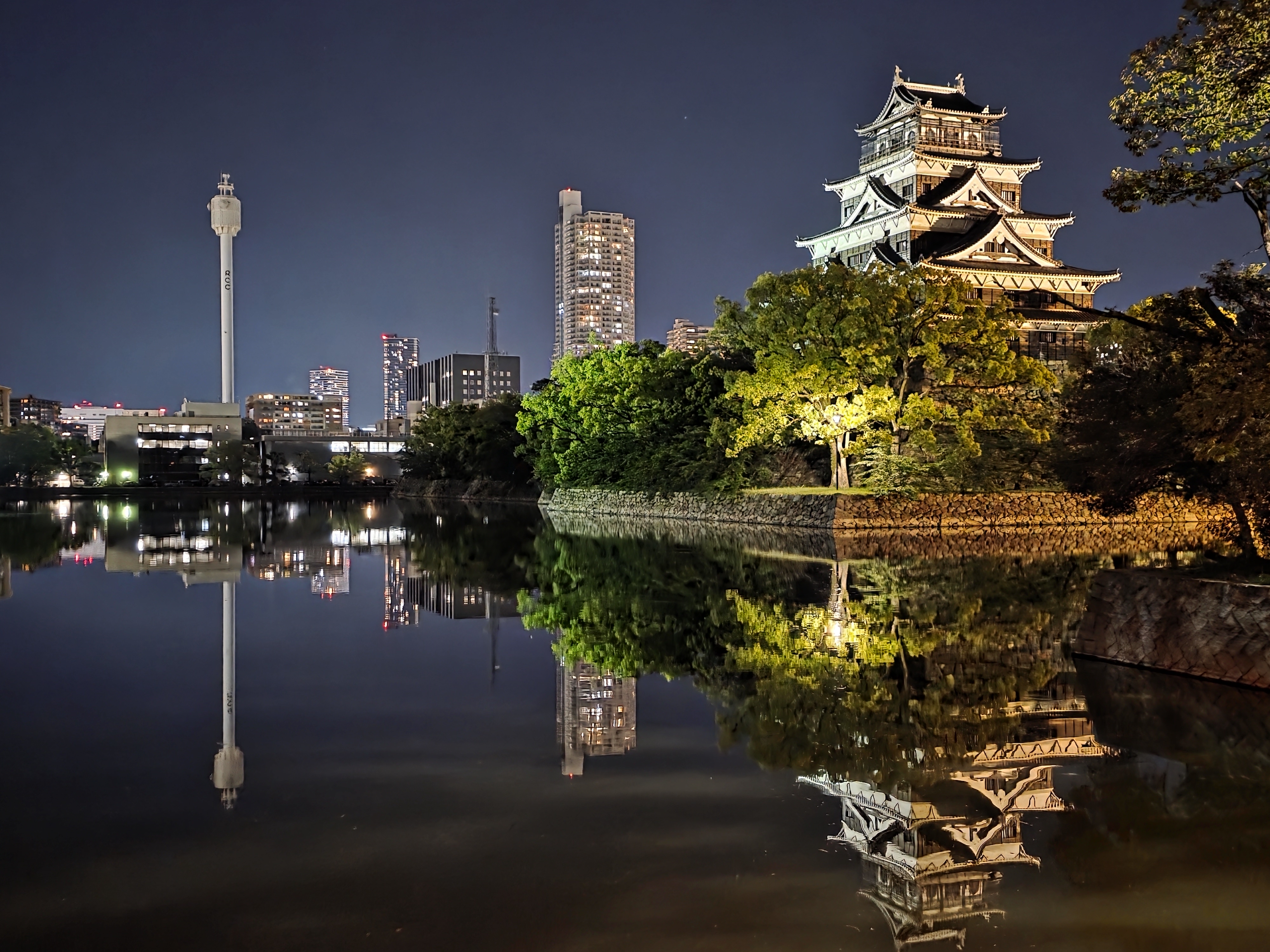
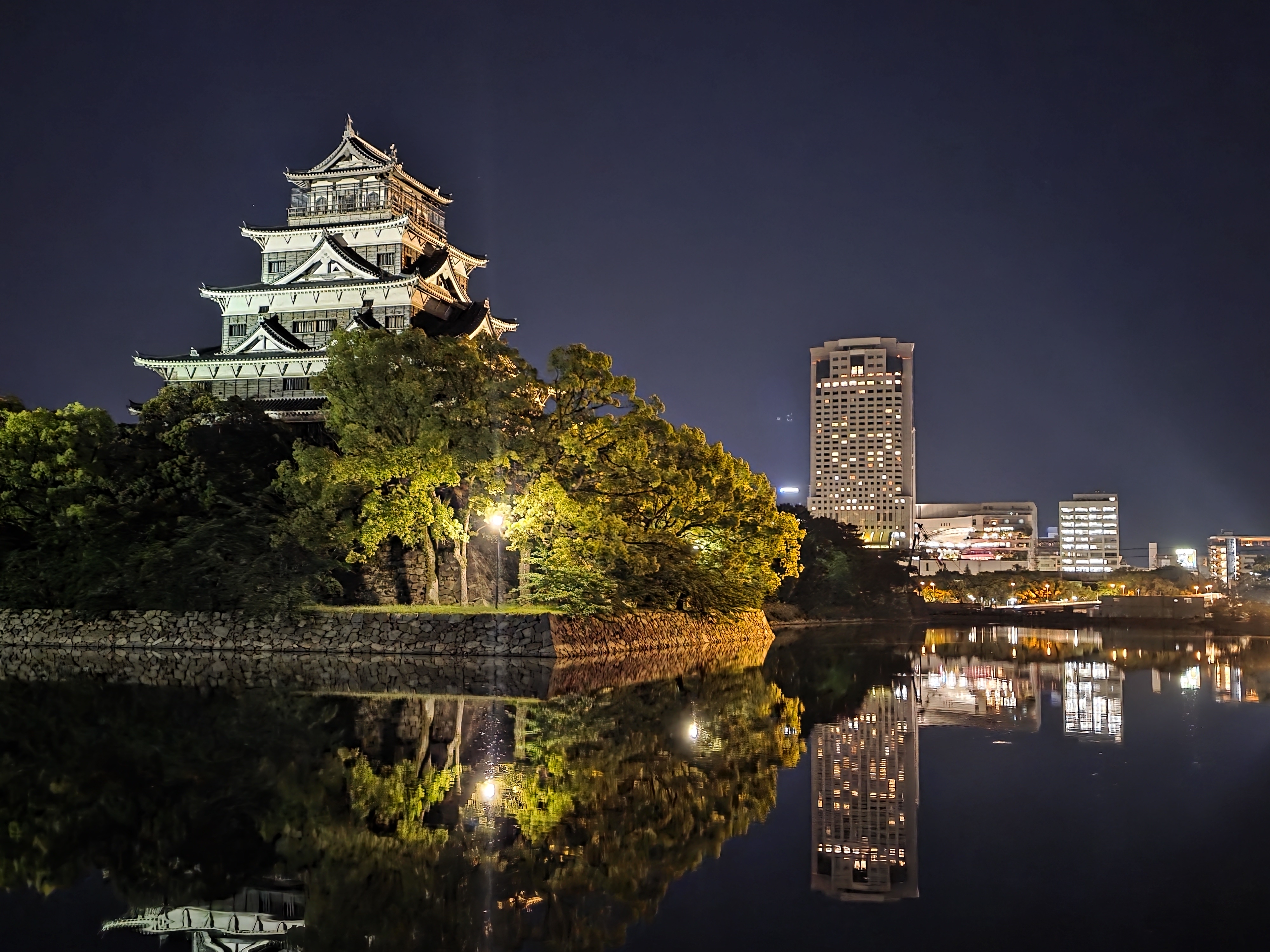
After that, we made our way through some dark streets to Hiroshima Castle to see it lit up at night. It was definitely worth the walk – we got some beautiful photos with the castle reflected in the water. By the way, the original castle was almost completely destroyed by the atomic bombing – what we see today is a reconstruction.

Posted in Asia, English, Japan, Tokyo

Japan – Day 4

РУССКОЯЗЫЧНАЯ ВЕРСИЯ ПО ЭТОЙ ССЫЛКЕ. CLICK HERE FOR RUSSIAN VERSION.

26 May 2025

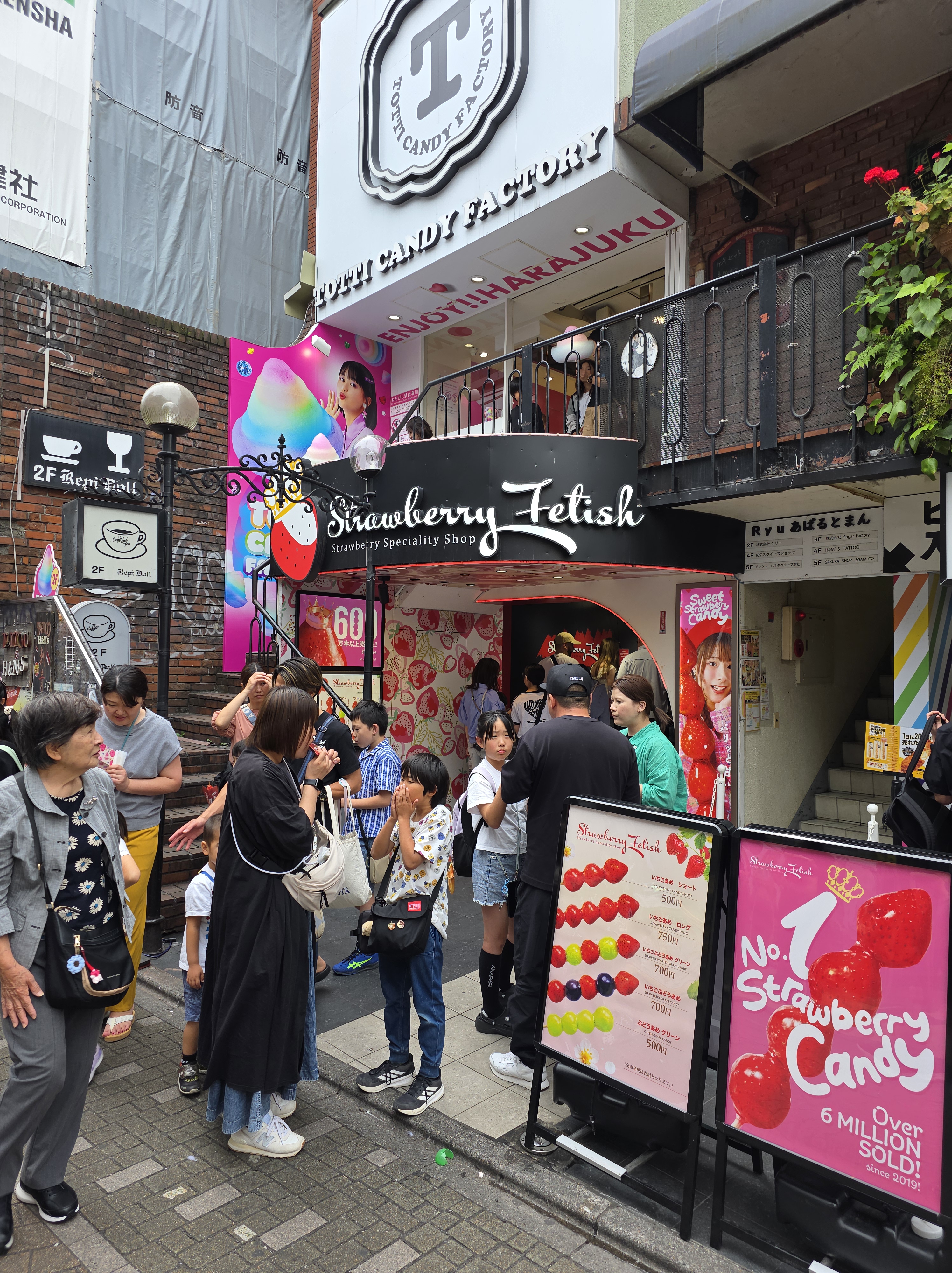
In the morning, we went to have breakfast at a French bakery not far from the hotel. Since we had the Ghibli Museum on the agenda for today, we decided not to rush and instead went for a walk through Harajuku – a trendy, youthful district full of interesting and extravagant shops with alternative fashion.

Tokyo really is a huge city – the distances are vast, and each district has its own distinct vibe, completely different from the others.

Another observation – the Japanese really do love queuing. Even though, as I mentioned before, there are countless eateries, some are clearly more popular than others, and there are always queues outside them. We often see queues at shops too – and sometimes, it’s not even clear what people are queuing up for.

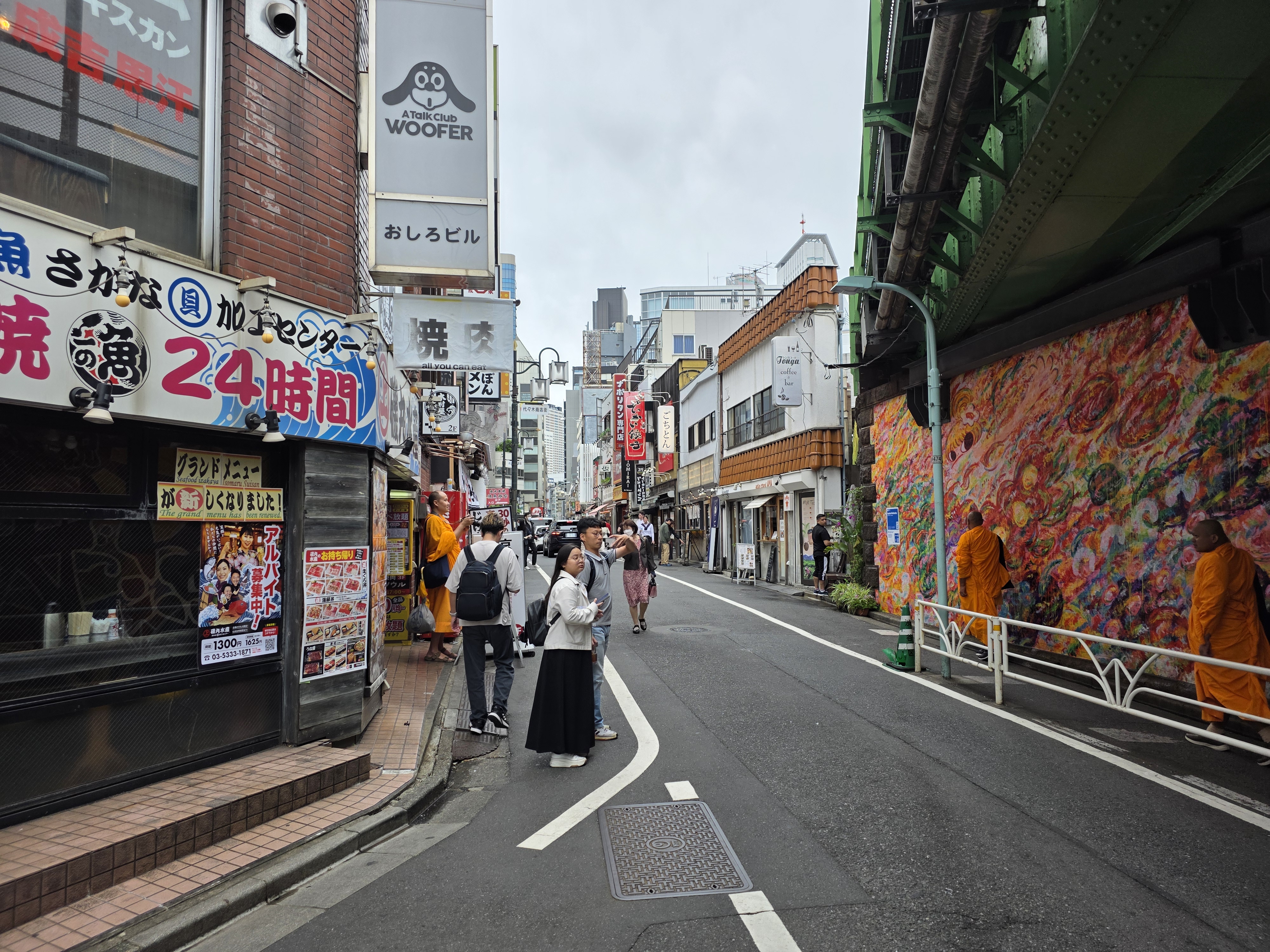
We walked across the entire district to the subway station, and from there we headed to the Kichijoji area, where the Ghibli Museum is located. Kichijoji also has a totally different feel, and it also has narrow streets with izakayas, but we didn’t find anything interesting here: since it was around midday, most of them were shut behind roller shutters (I’m guessing, it’s more lively in the evening).

So, in search of lunch, we somehow ended up in the Japanese equivalent of what we’d call a “day-day kafesi” (literally – “café for uncles”), indeed quite packed with local “uncles”, and everything was in Japanese. Luckily, the ordering was done via an interactive tablet – you just tap on pictures and help yourself out with Google Lens. They served ramen, noodles, yakitori with rice, and some very tasty gyoza. It was a delicious and incredibly cheap meal – 1800 yen for two (that’s 9 pounds, mind you!).

After lunch, we still had time before the museum and headed to the nearby Inokashira Park – a lovely park with a large lake in the middle.

As for the museum itself – as you can probably guess, it’s dedicated to the Ghibli anime studio. Tickets need to be bought in advance – for foreign tourists, they’re released once a month for the following month and sell out within just a couple of hours. I’m not a Ghibli fan (to be honest, I’ve never even seen a single film), but I joined Rena – and didn’t regret it one bit.

You’re not allowed to take pictures inside the museum, which makes sense – otherwise, people would be crowding every exhibit forever. The exhibits – both temporary and permanent – were really interesting. The idea is to use Studio Ghibli’s well-known anime films as an example to show the entire animation process – from early sketches and drawings to the final product.

There are piles of scrapbooks and art books filled with images of everything imaginable – tools, landscapes, cityscapes, people in motion, animals, plants – all used to create the most realistic animations possible. You really get a sense of how colossal the amount of work is.

It was also fascinating to see how animation frames are brought to life – with techniques like layering images or using fast-spinning three-dimensional figures in different poses (the rotation itself is too fast to see, so it looks like the figures are actually moving, though they’re just different models ending up in the same position). Overall, it was all really, really interesting.

They also showed a short animation – “The Day I Bought a Star” – about a boy who buys something like a precious gem from a mole and a frog, then plants it and grows a planet. Unfortunately, the film was in Japanese with no subtitles, so we didn’t quite understand what was going on. Actually, the museum doesn’t bother much with translations in other parts either – apparently, they feel they have enough visitors already, and if you don’t understand Japanese, that’s your own problem.

The museum shop was a bit of a disappointment – we expected more, given how great the museum was, but it really didn’t impress us.

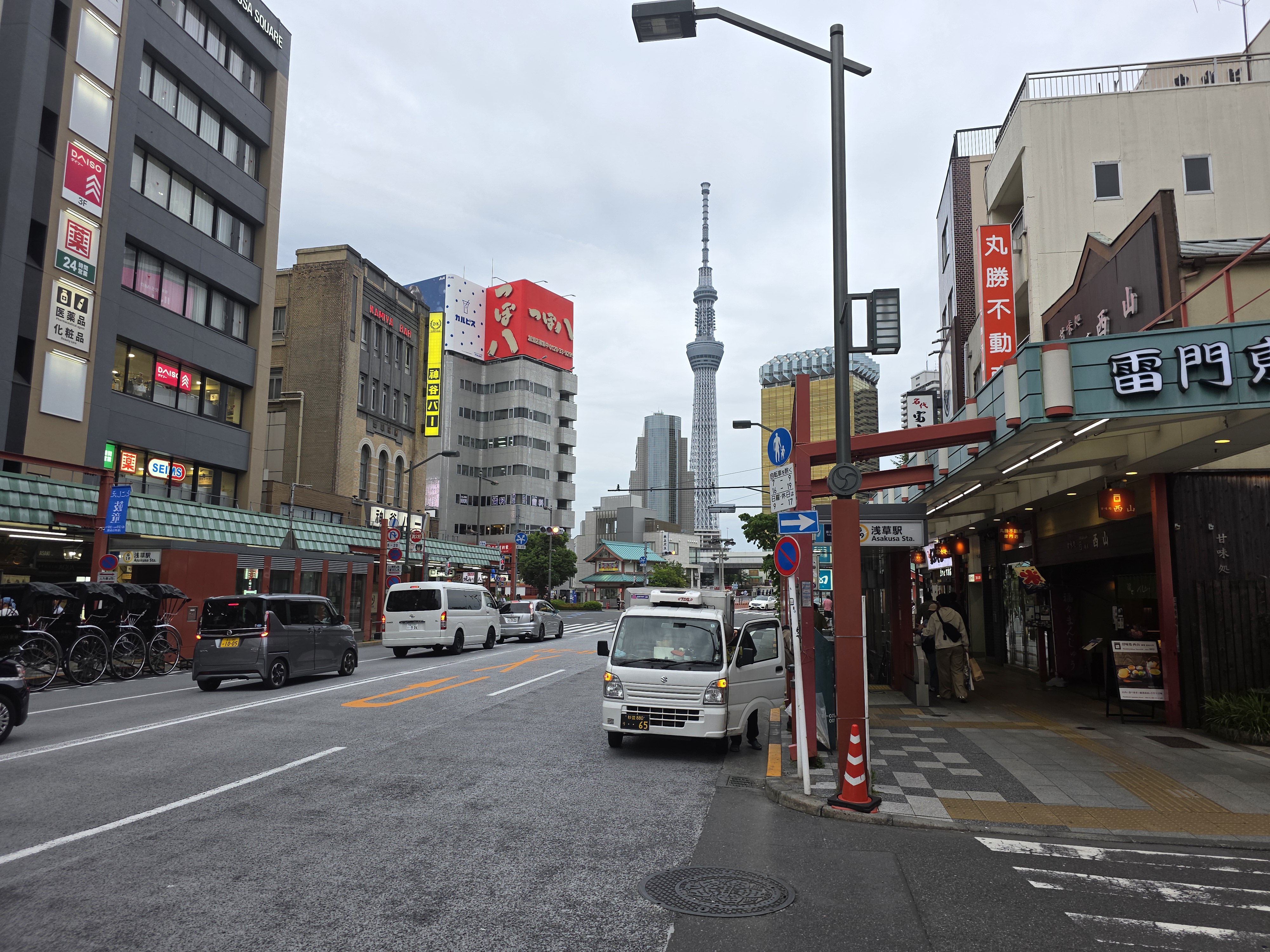
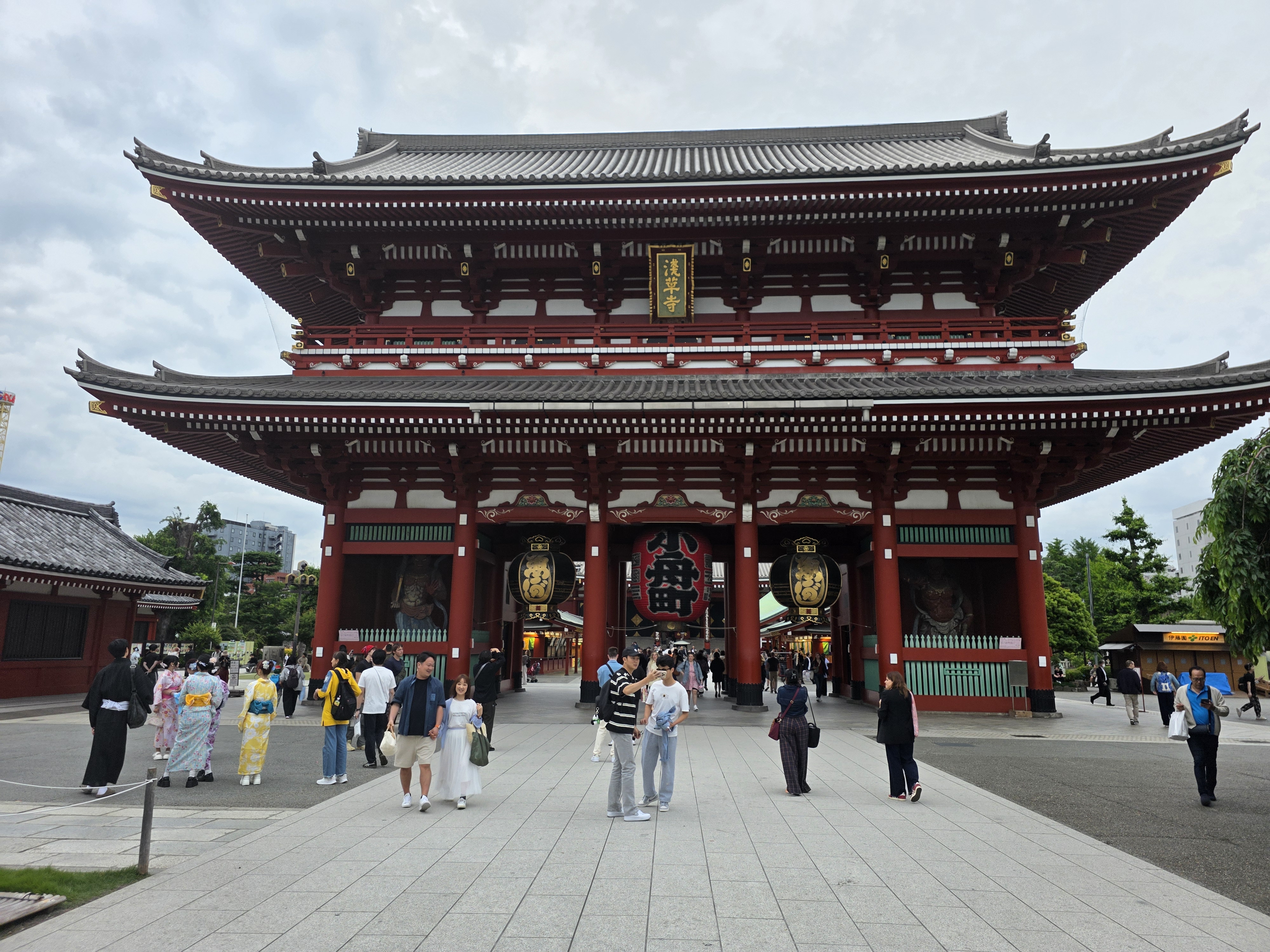
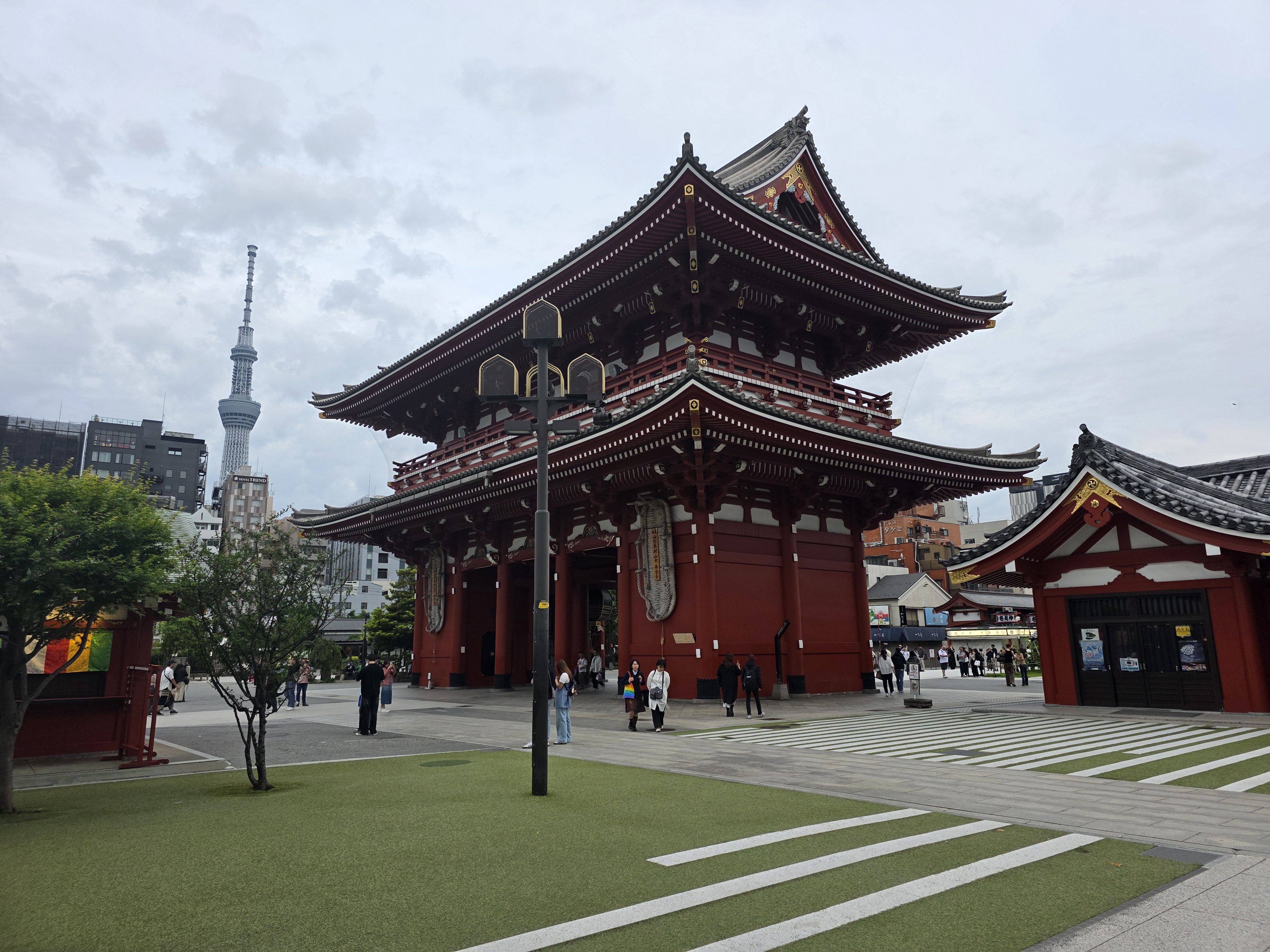
After the museum, we headed to the other side of Tokyo – to the Asakusa district – to visit Sensoji Temple. It’s Buddhist and is the oldest Buddhist temple in Tokyo. The approach to the temple is via Nakamise-dori, a traditional-style shopping street that mostly sells souvenirs. Since it was almost evening already, very few of the shops were still open – which was actually a good thing, because there were no crowds. The temple itself was beautiful.

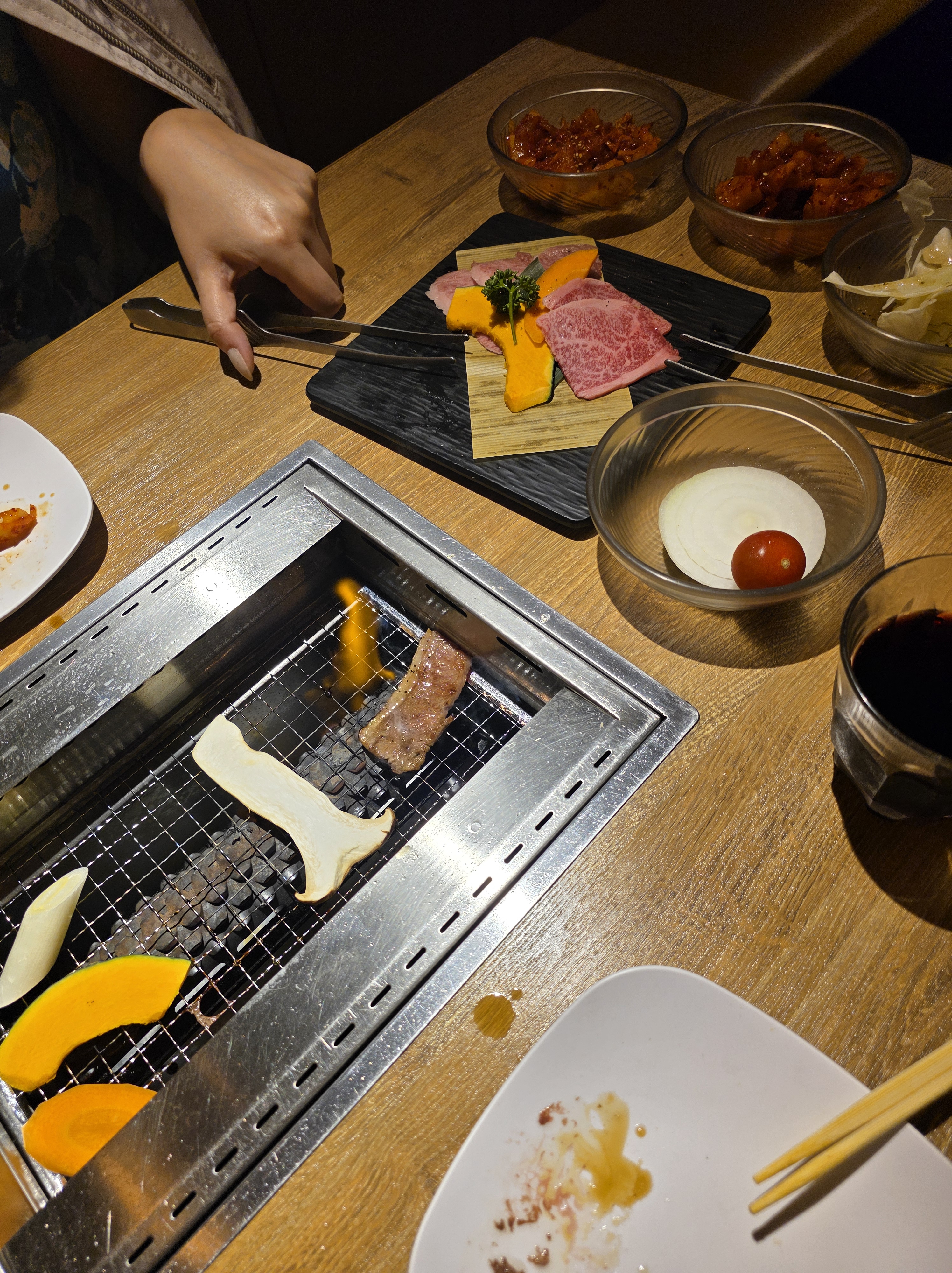
We had dinner in the same area, at a yakiniku-style restaurant – where you grill meat and other food yourself at the table. The place offered all-you-can-eat for 100 minutes. Naturally, we went for the marbled Wagyu beef – they had a variety of cuts. Unfortunately, we only managed two rounds of meat per person – a shame, because the beef was absolutely delicious!

Posted in Asia, English, Japan, Tokyo

Japan – Day 2

РУССКОЯЗЫЧНАЯ ВЕРСИЯ ПО ЭТОЙ ССЫЛКЕ. CLICK HERE FOR RUSSIAN VERSION.

24 May 2025

Observations after our second day in Tokyo – first of all, Japan is, above all, for the Japanese. For example, you won’t see souvenir shops with magnets and other touristy junk popping up everywhere – you can find them, of course, but you pretty much have to deliberately look for them.

Secondly, cash still plays a major role here – which is surprising for such a developed, high-tech country. Cards are accepted in many places, but definitely not everywhere. For example, the balance on the transport IC card (which, by the way, is incredibly convenient – you can use it for transport all over Japan, and also to pay in convenience stores like FamilyMart and 7-Eleven, at vending machines, and even to lock up your suitcase in hotel storage rooms or in Shinkansen luggage lockers) can only be topped up with cash. You can load it from a card only when you first buy it at the airport.

That said, the country doesn’t even feel especially high-tech. Websites and online payment systems are often clunky, and the city infrastructure doesn’t give off a futuristic vibe that’s miles ahead of, say, old Europe – like was the case in e.g. Singapore. For instance, there aren’t always escalators at the entrances and exits of the subway, which would be unthinkable in Singapore. It feels like Japan’s rapid development sort of paused at some point – maybe in the ’90s. The architecture doesn’t resemble the likes of Singapore or Hong Kong either. There are lots of plain, boxy concrete apartment buildings. But it also doesn’t feel densely built-up like Hong Kong, despite what we’d heard about Japanese homes being so compact they fit a bed, a toilet, and a kitchen into literally a single square meter – often with retractable furniture. At least from the outside, it doesn’t look like space is that tight.

People, of course, are very polite. If the British are known for loving to queue, then the Japanese seem like they were born for it.

We also noticed that various jobs that seem “inefficient” by our standards – like waving a flag to direct traffic that’s already controlled by traffic lights – are often done by elderly men. Even in retirement age, people don’t sit at home on the couch; they still prefer to work, even if it’s not clear what exactly they’re contributing.

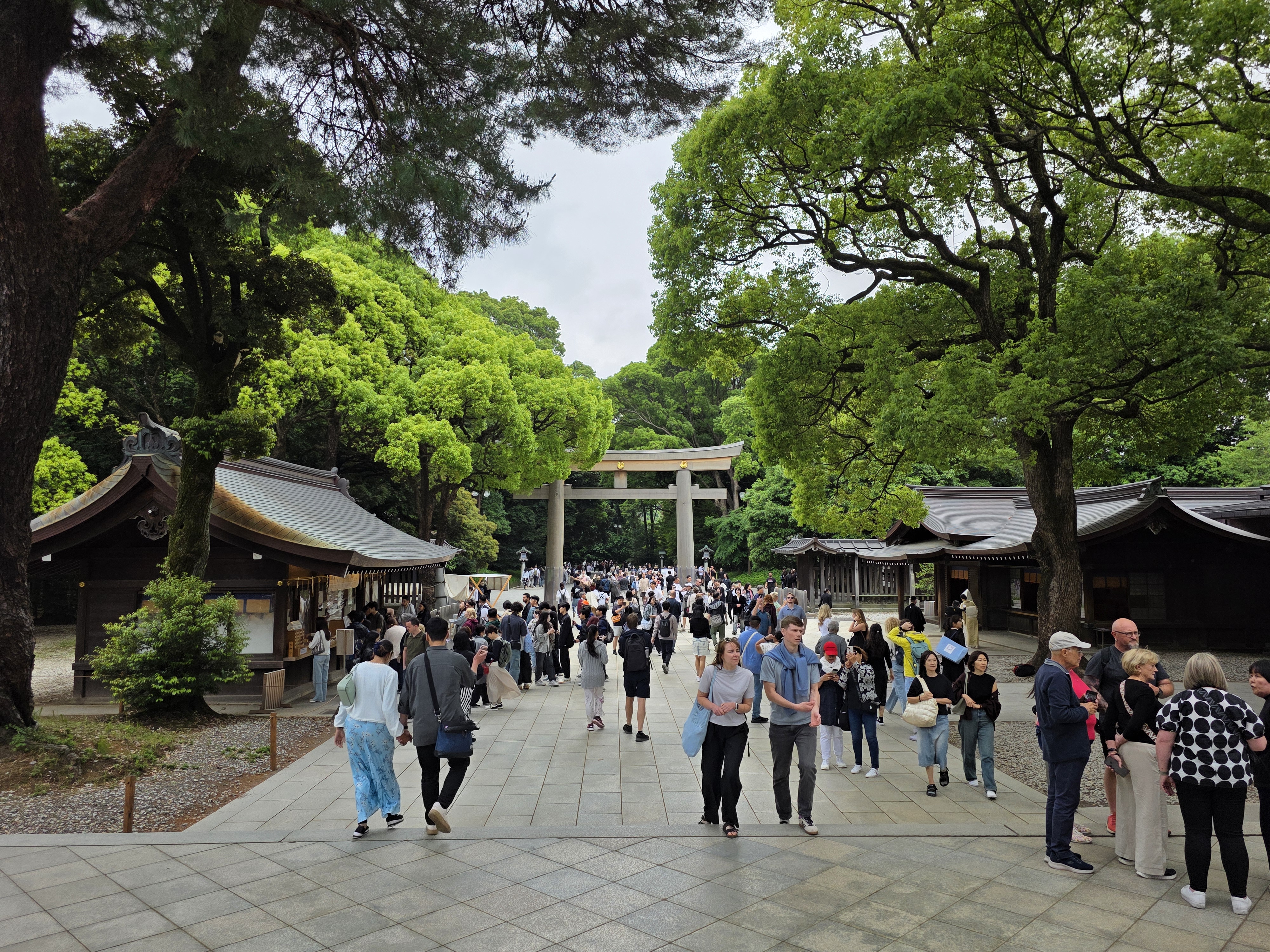
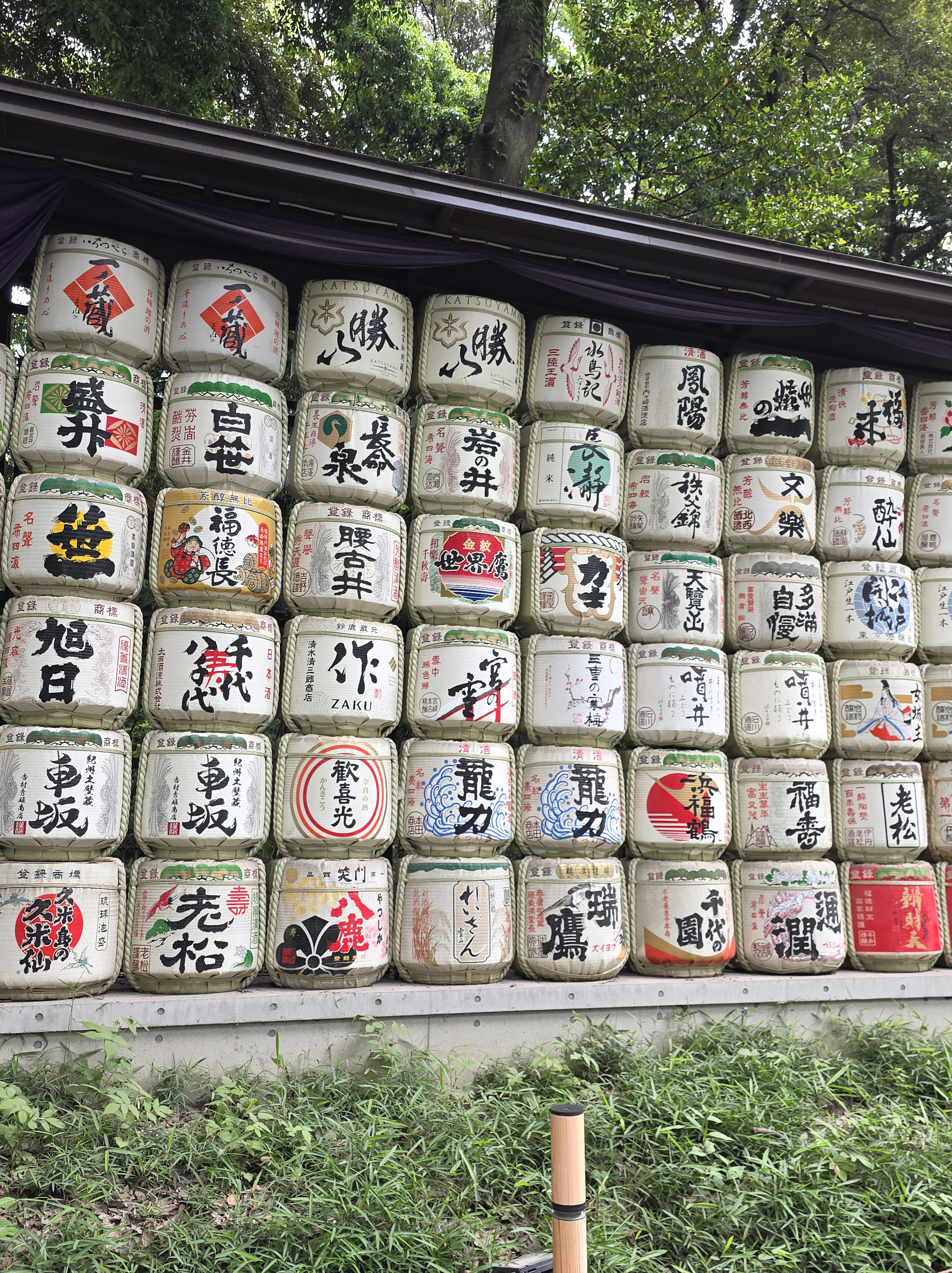
Now, about today itself. In the morning, we had breakfast at a café near the hotel and then headed to Meiji Shrine. It’s a large area with gardens and the shrine complex itself – the biggest Shinto shrine in Tokyo from the early 20th century. It was interesting, though there wasn’t that much to linger over. We were lucky to see a traditional Japanese wedding procession, and all the tourists immediately whipped out their cameras to record it.

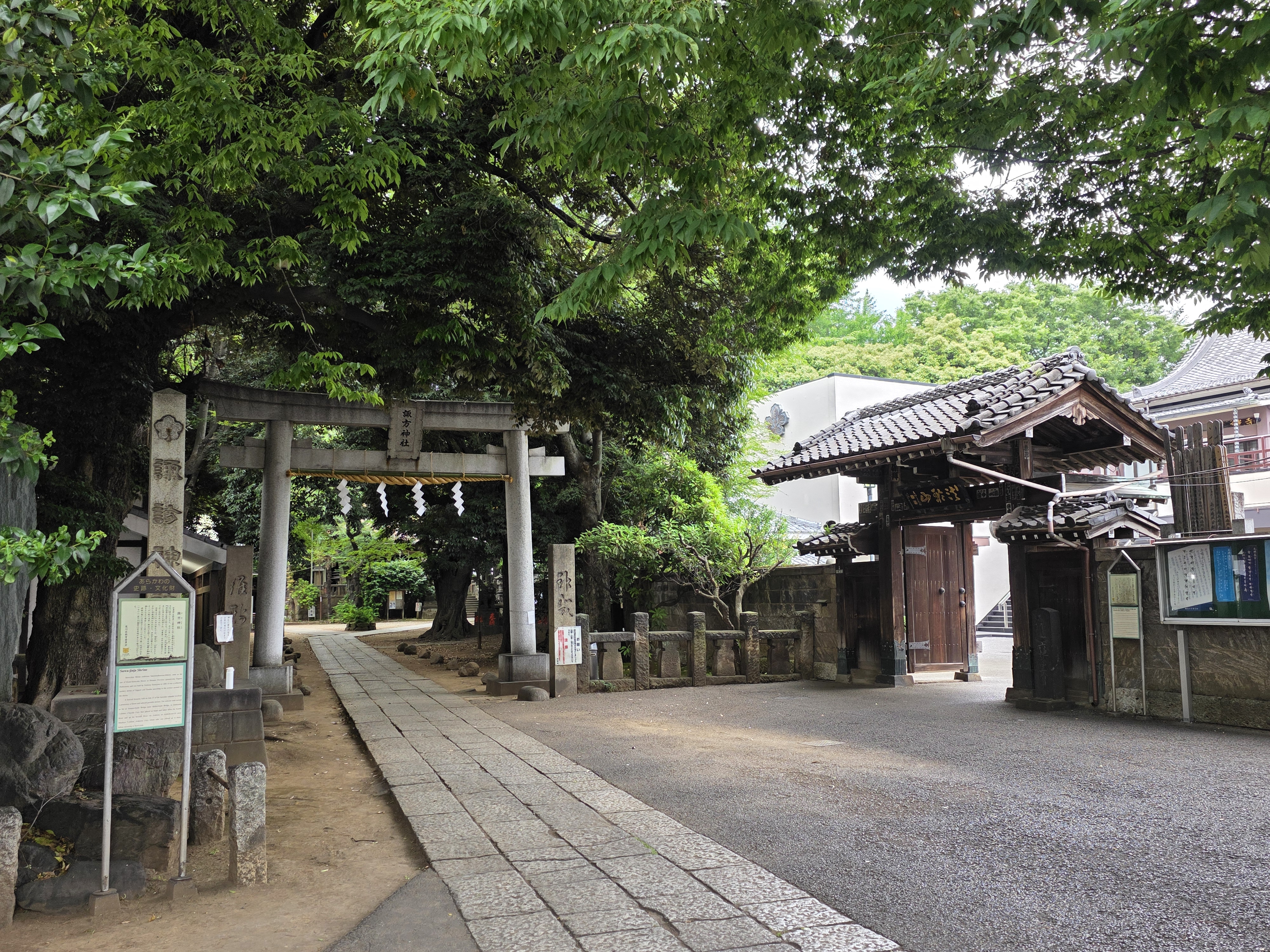
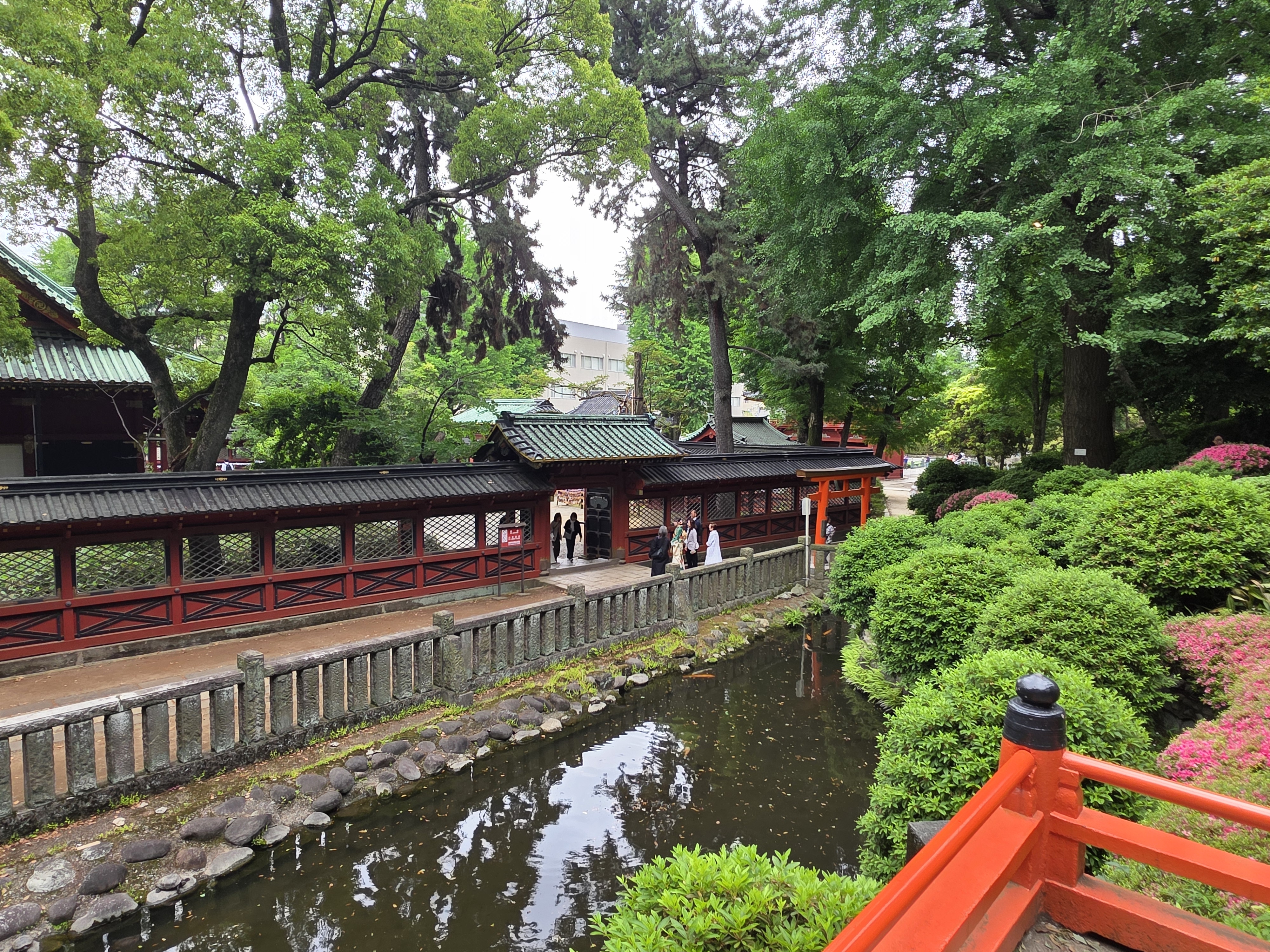
From there, we went to the Nezu area, where we strolled through narrow streets and visited another shrine – called Nezu Shrine. It was much quieter there, clearly not a major tourist spot, but we actually found it more charming and interesting.

Before visiting the shrine, we had sushi nearby. I ordered an assorted nigiri set – I could recognise salmon, tuna, and grilled eel, and there were a few other types of fish I couldn’t identify. It was incredibly tasty – sushi like this just doesn’t exist outside Japan. And yes, it’s true what people say: sushi here is nothing like what we get back home. Here it’s mostly nigiri, sashimi, and occasionally very simple maki rolls. Just the basics: rice, fish, nori. No mayo, avocado, cream cheese – or God forbid, Caesar rolls.

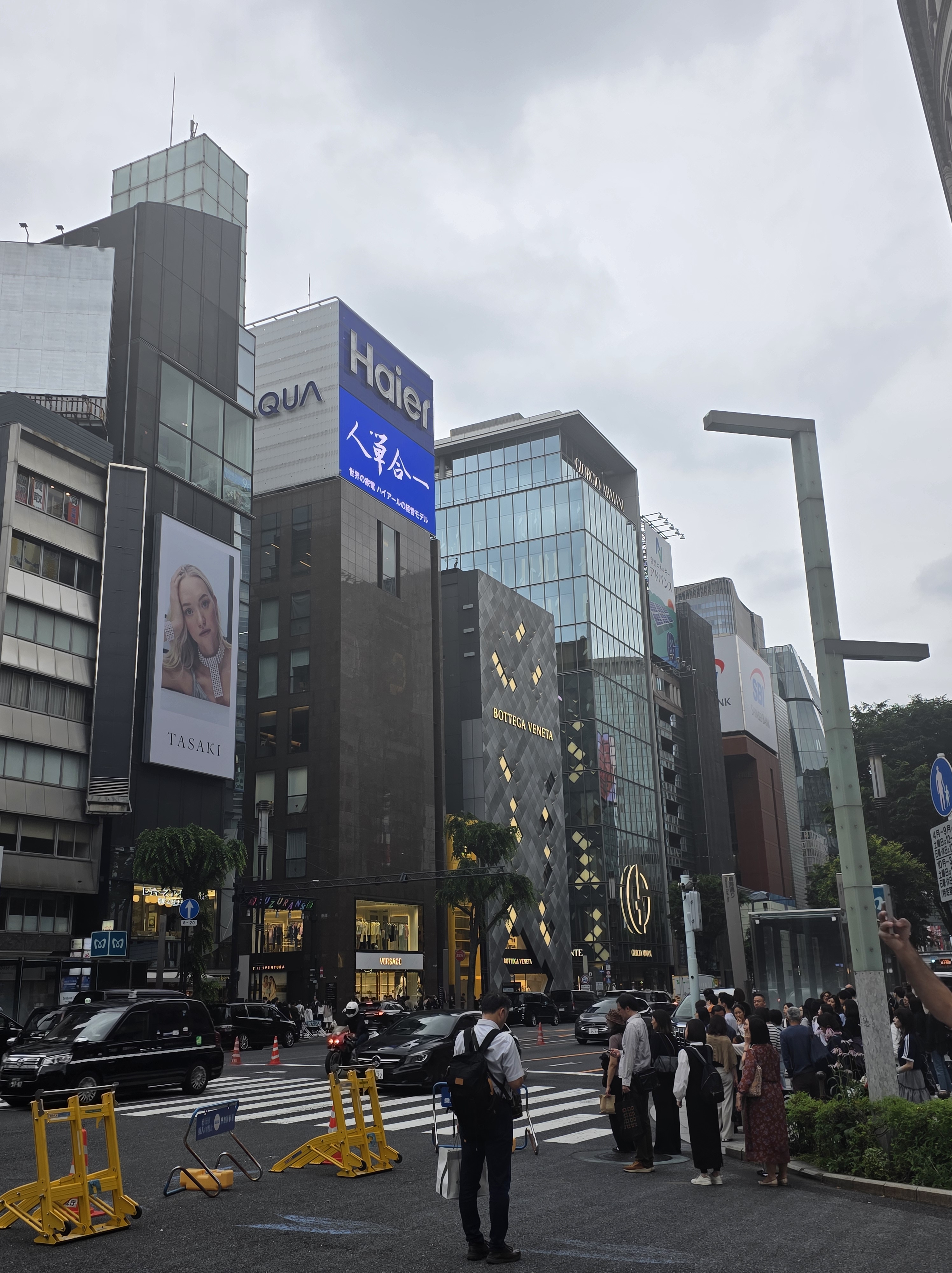
Next, we headed to the Ginza district and walked around. Each Tokyo neighbourhood feels different from the the other – Ginza feels more upscale and also more European in a way. In places, it almost feels like walking around the Galeries Lafayette area in Paris.

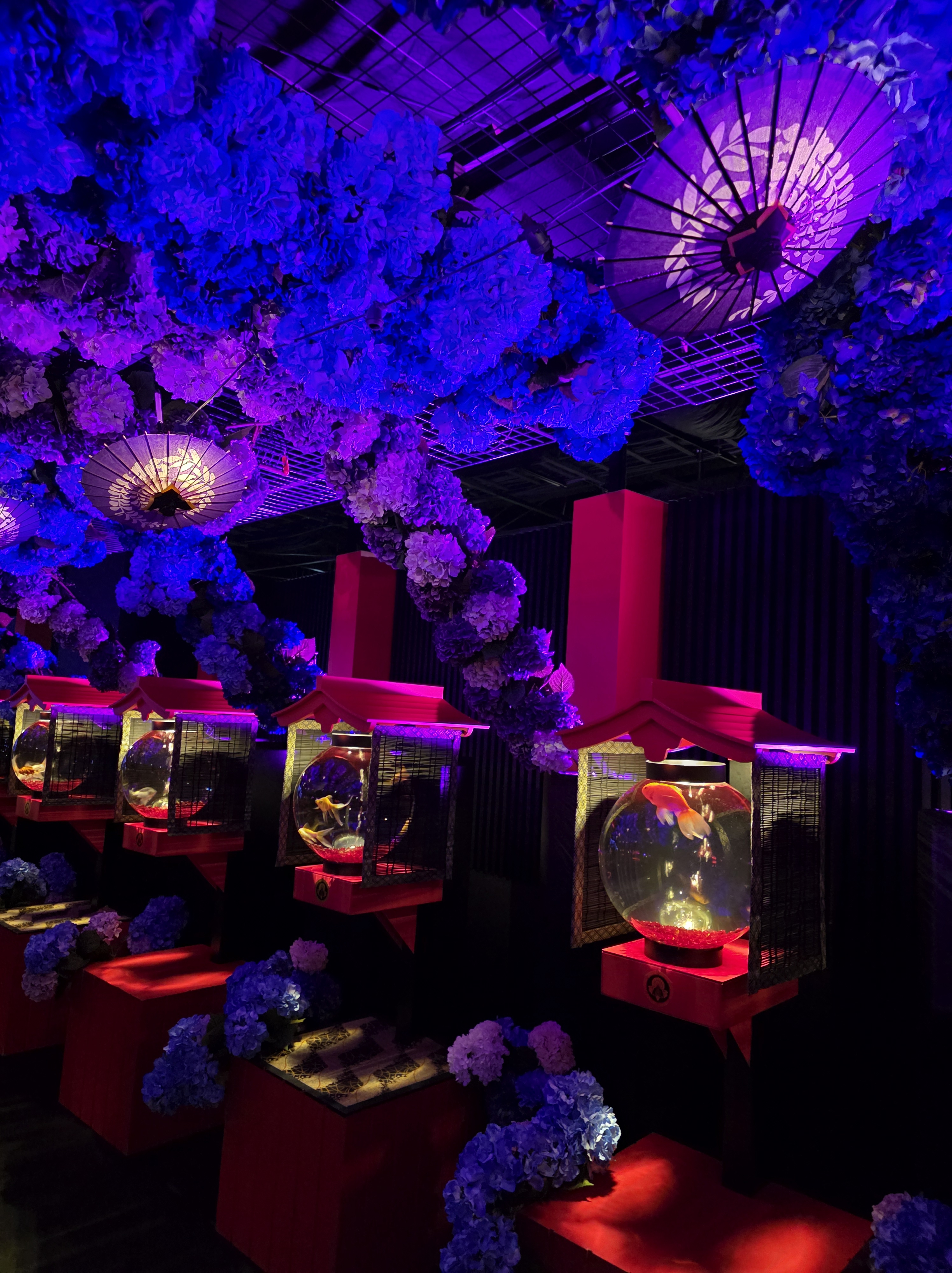
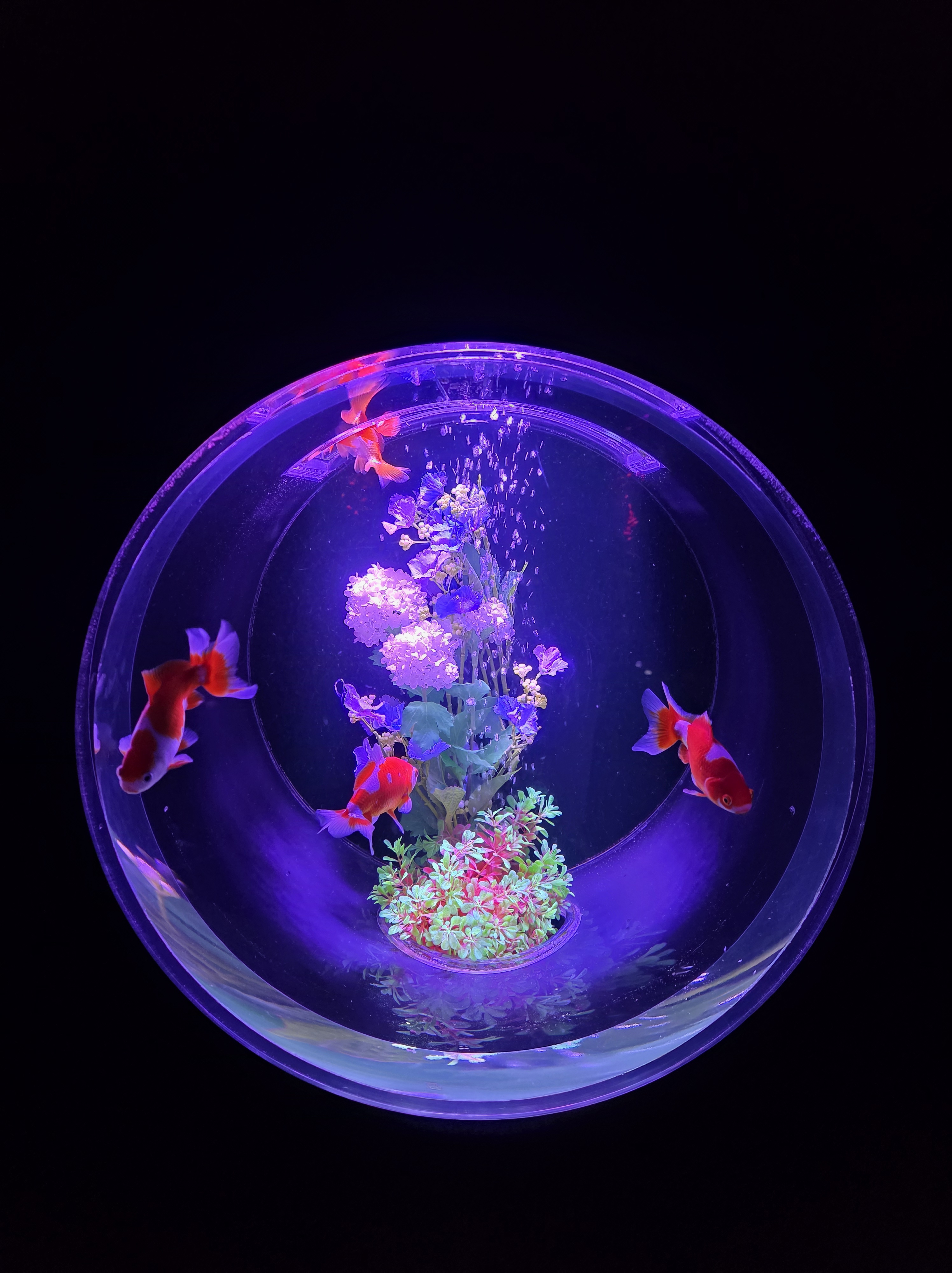
In Ginza, we visited the Art Aquarium Museum, which has lots of different aquarium installations with live fish lit up in creative ways. Yes, it was cool and interesting, but there was also something a bit unsettling about it – some sense of neglect or even cruelty. Some tanks were tiny glass bowls, others looked like solitary confinement cells with two or three fish crammed inside, clearly with no room to move. It’s unclear whether they’re kept there permanently, and if not, how the whole system works – how they’re fed, where they’re moved, etc. The fish themselves were fascinating – some with bulging eyes, others round-bellied and odd-looking. But after a while, the installations started to feel a bit repetitive.

We had dinner in a diner in the same building – set meals with meat, fish, and various small side dishes. I had one with wagyu beef.

We wanted to hang around Ginza a bit longer, but it started raining so we headed back to the hotel.

Posted in Asia, English, Japan, Tokyo

Japan – Day 1

РУССКОЯЗЫЧНАЯ ВЕРСИЯ ПО ЭТОЙ ССЫЛКЕ. CLICK HERE FOR RUSSIAN VERSION.

23 May 2025

Whoop whoop, my childhood dream is finally coming true and I’m going to Japan! This is something I’ve wanted to do for years, but it never quite worked out – whether it was the Fukushima disaster (yes, when I say “years,” I mean years!) or trying to combine the trip with a wedding in Barcelona – only to realise this wasn’t going to work.

I took a direct 13-hour flight from London to Tokyo. I’d really hoped to sleep on the plane, but since the flight was during London daytime – and, as luck would have it, I was sitting right behind a baby who screamed almost non-stop for what felt like the entire 13 hours – I couldn’t fall asleep at all. Of course, I don’t know why the parents were flying to Japan – maybe they had a good reason – but if not, it did feel a bit selfish. Not just toward the other passengers, but toward the baby too, who was clearly not having a comfortable flight.

Naturally, I arrived feeling pretty irritated. But that mood quickly lifted as I easily went through airport procedures, figured out how to get to the hotel, finally sat down on the train, and realised – damn, I was in Japan!

But even before that, I’d already had my first culture shock as I entered a Japanese toilet. Heated seats, built-in washing functions, and even a button that plays forest sounds and birdsong to mask any “indecent” noises.

The second shock came while I was on my way, as I changed from the train to the subway. I happened to hit rush hour – around 9 am – and that’s when I realised: anyone who has never ridden the Tokyo subway, hasn’t truly seen a packed train. The London Underground looks tame in comparison. Luckily, I had a seat, but the crowd was so dense I ended up half-lying on someone, my suitcases pressing into me and simultaneously squashing some poor guy’s crotch. I was genuinely worried I wouldn’t be able to get off at my stop with all my luggage, but thankfully Ikebukuro is a major station, and a wave of people getting off pretty much swept me and my suitcases out with them.

I arrived at the hotel a couple of hours before Rena, who was flying from Baku via Tashkent, and while waiting for her, I decided to take a walk around the area and look around. My eyes just darted around – everything looked so interesting! The signs, the shops (including those selling loads of Japanese and Korean cosmetics!), and all sorts of eateries – at least 358 of them per square meter, by my estimate.

While waiting, I had a couple of coffees and a matcha latte – I needed to refuel with caffeine after an entire sleepless day. English doesn’t seem to be widely spoken here, as far as I can see. In the coffee shop they spoke to me in Japanese, and naturally I didn’t understand a word, but still managed to order and pay using gestures and pointing at pictures.

The weather wasn’t too hot or sunny, but it’s still fairly stuffy. Despite the lack of direct sun, many people carry umbrellas to avoid getting burned. And lots of people wear masks – which, as we know, has been common in Japan long before Covid.

I also noticed that food and lots of other things are actually quite cheap here. It’s only the accommodation and some transport – mainly the high-speed Shinkansen trains – that are expensive. The rest of the transport system is quite reasonable (I’m comparing everything to London prices, of course).

We also saw groups of schoolgirls in uniforms here and there throughout the day, but oddly enough, no schoolboys (at least until 6 pm – it makes you wonder if they either study in different shifts, or if the girls skip classes en masse during the day, while the boys sit in class).

Once Rena arrived and while waiting for the hotel check-in time, we walked around the neighbourhood some more, had a rich and greasy bowl of ramen in a casual eatery, stopped by a cemetery (and immediately left – it wasn’t exactly Père Lachaise, but just a regular Japanese cemetery) and had more coffee at a conceptual little coffee shop.

In the evening, we headed to Shibuya to see the famous scramble crossing – the busiest in Japan, with up to 3,000 people crossing at the same time.

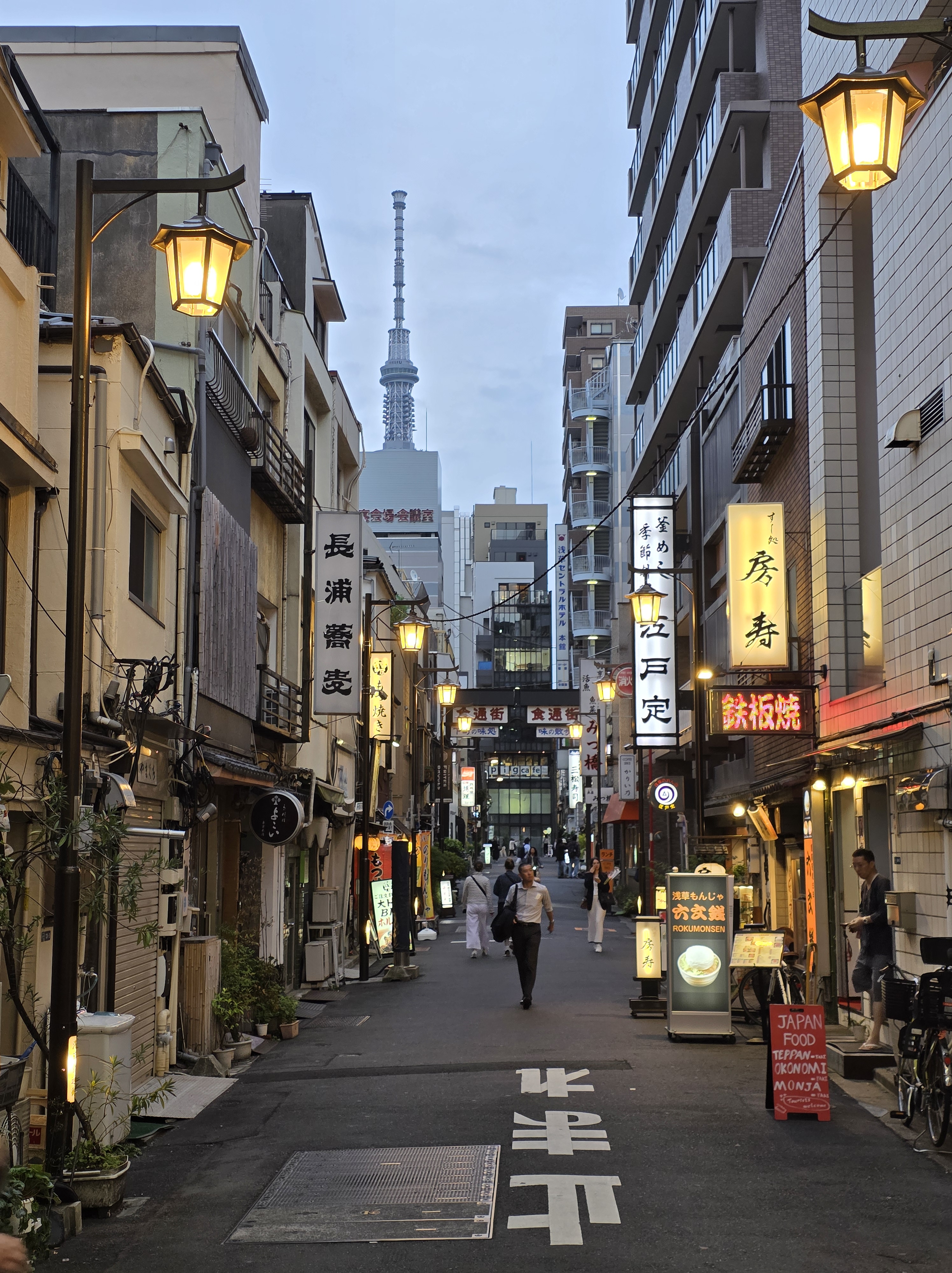
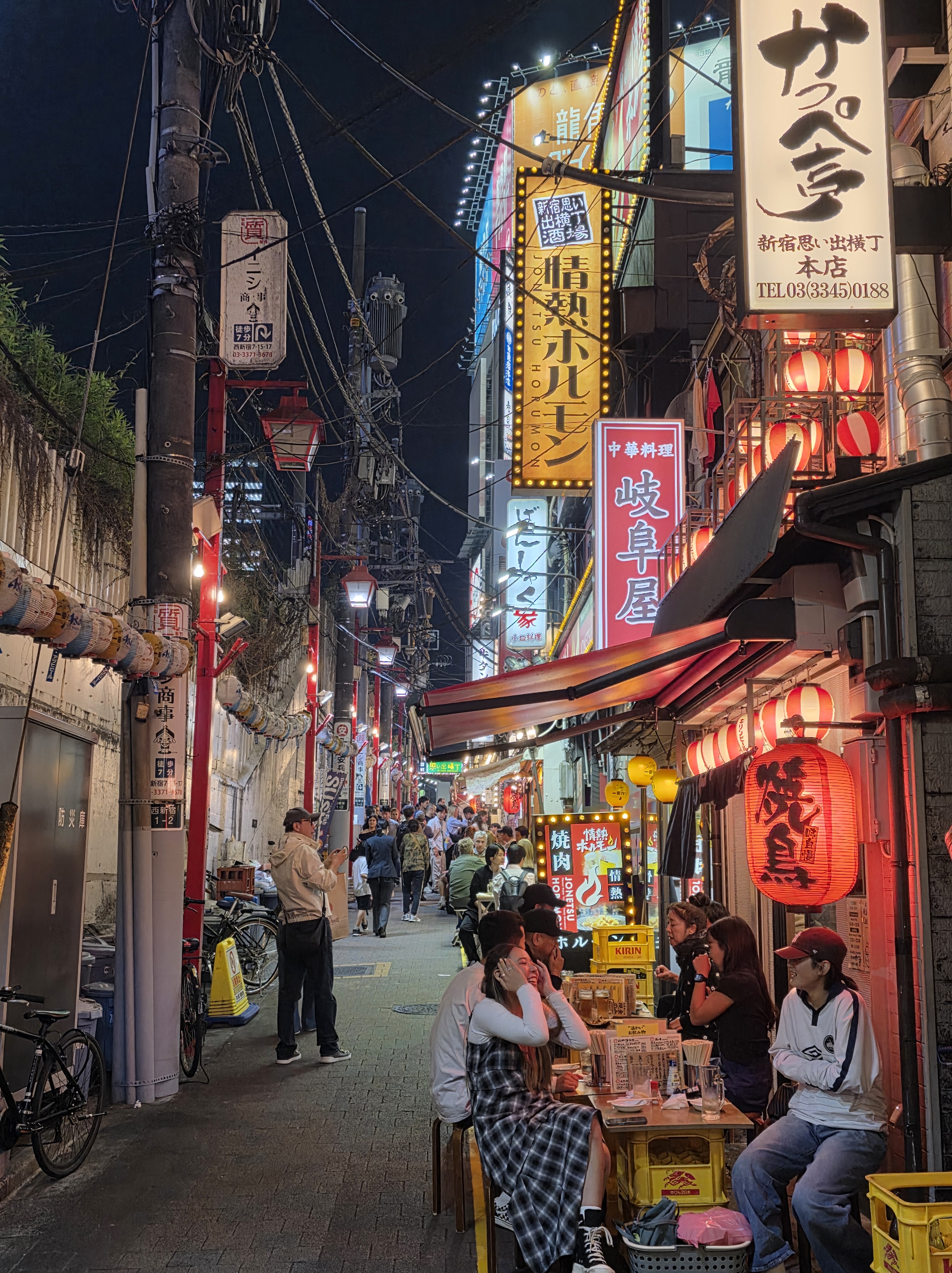
From Shibuya we went over to Shinjuku, and explored some of its narrow alleyways lined with izakayas – these are something like traditional Japanese pubs. Some of them are so tiny that they fit literally five visitors at a time.

We also went to an izakaya for dinner – but not to one of these small ones, instead we found a larger one, on the 5th floor of a mall, where we happily consumed sashimi and other dishes. Meals here are usually served as a set – with miso soup, boiled rice and pickled vegetables. And honestly, those who say that Japanese cuisine in other countries will be ruined for you once you try it in Japan itself – are right.

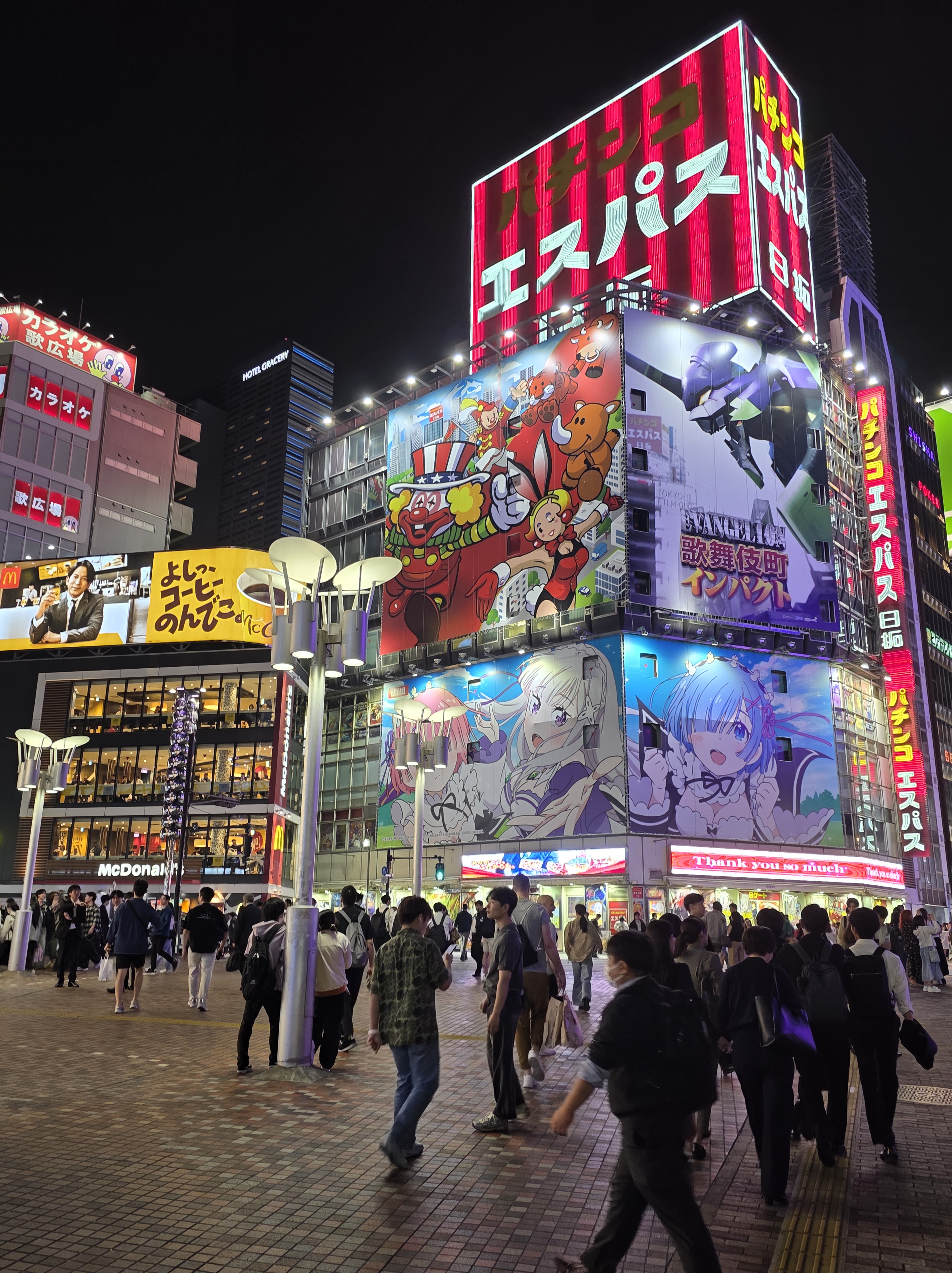
After dinner, we strolled through Shinjuku a bit more, enjoying the neon-lit night views.

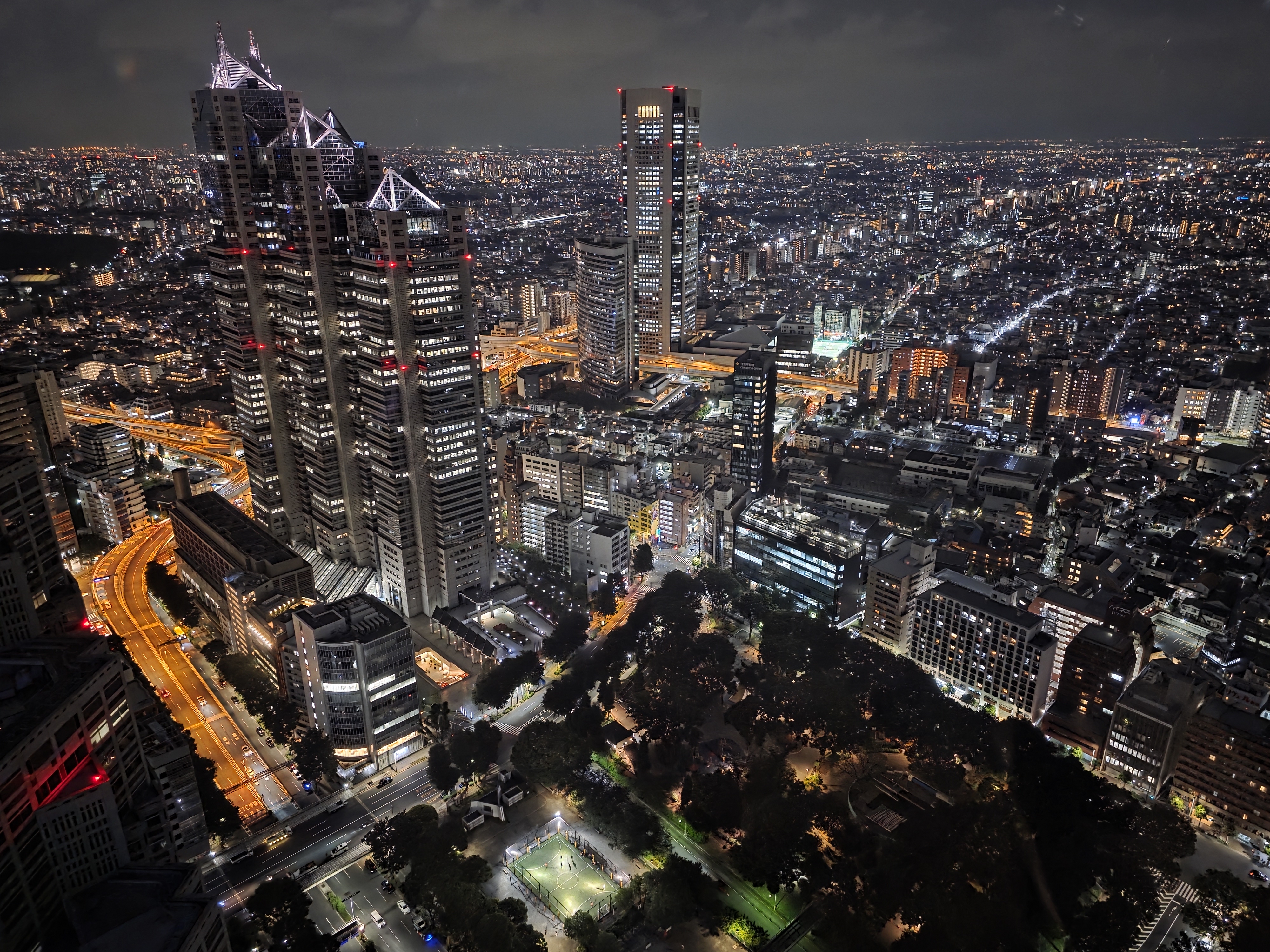
Our last stop of the day was the Tokyo Metropolitan Government Building, which has an observation deck on the 45th floor with great city views. We didn’t see Mount Fuji from there, although on clear days it’s apparently visible.

From there, we took the subway back to the hotel. Another observation – the stations here are huge. Even a small one with just a single line can have quite a few exits, a public toilet, and a number of shops and food stalls. And I’m not even mentioning the major hubs with several lines – they’re full-on labyrinths, and getting out can take a good 5–10 minutes. Luckily, there are plenty of signs, and everything is duplicated English (and often Chinese and Korean too), so it’s easy to find your way.

And that’s how we wrapped up the day – after 30+ hours with no sleep, running purely on excitement (with a little help from caffeine).

Posted in English, Europe, Istanbul, Turkey

Istanbul – Days 4&5

РУССКОЯЗЫЧНАЯ ВЕРСИЯ ПО ЭТОЙ ССЫЛКЕ. CLICK HERE FOR RUSSIAN VERSION.

07 February 2019

Today is the penultimate day of our short stay in Istanbul. Of course, there is a lot that we didn’t get to see – mainly because of the weather, rather than lack of time. For example, had the weather been good we could have headed to the Prince’s Islands or the Rumeli Fortress. Instead, we had to dedicate the day to shopping, which is actually also interesting and also a source of impressions. Besides, it turned out to be a great bargain: first, the lira is rather cheap at the moment and second, we were lucky to be here during big winter sales.

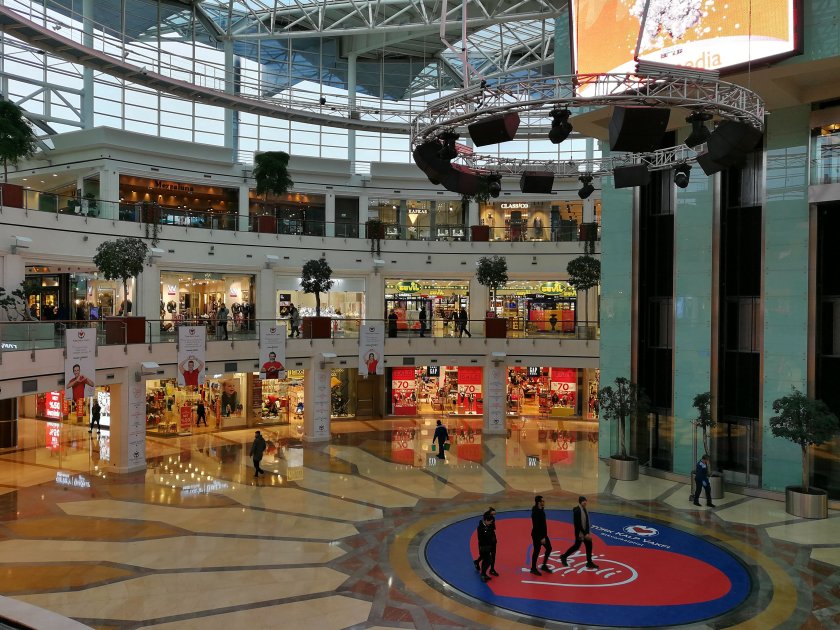
A drive to the Istinye Park shopping mall, located quite far north, near the Technical University, is also an introduction to previously unexplored parts of Istanbul. I guess, this is the perfect time to share my general impressions of the city, taking, of course, into account the fact that the trees are all bare now and will certainly add a lot more colour to the landscapes in the spring. So, the city is not homogeneous, some parts of it look a bit shabby, although I would say that overall, buildings in one area tend to follow the same style – it is unlikely to see a tall new building among old five-storey houses, like it is often the case back home.

The shopping centre is a huge building, topped with a dome, which, of course, gives it a distinct Middle-Eastern look.

sdr

Shopping-wise, we were interested specifically in Turkish brands. Generally, shopping in Istanbul is very pleasant, primarily because of the high quality of service. The shop assistant immediately greets you but does not pounce on you or tread on your heels, as, again, they annoyingly like to do back home. And when you address them, they show a maximum of friendliness, patience and willingness to help you make a purchase that you are really going to like.

The same, by the way, applies to waiters in restaurant: the service is very quick and they are really friendly (which doesn’t look fake and forced).

Funnily, the only time when we saw neither of these qualities was the day before yesterday, when we had lunch at our hotel’s bistro. We waited for our most basic sandwiches for so long that we could vividly imagine the waiter running into the kitchen in a panic and shouting: “They ordered sandwiches! Be quick, run to buy chicken and meat!”

But overall, we really liked the local people. Not once did we even observe any quarrel, rudeness or swearing. People are polite and friendly to each other. The degree of friendliness towards us increased even more when they learned that we were from Azerbaijan. And their attitude towards animals, which I have already mentioned, simply wins one’s heart and mind!

On this day, dedicated to shopping, we got a chance to visit not only a large modern mall, but also the little shops of the Old City. The impressions are completely different, of course. Shops are strictly specialized – bags only or hats only – but on the whole, there is some feeling of chaos. Yet, this chaos has a certain charm to it.

We finished the day with dinner at the same restaurant near our hotel, which we liked so much yesterday.

08 February 2019

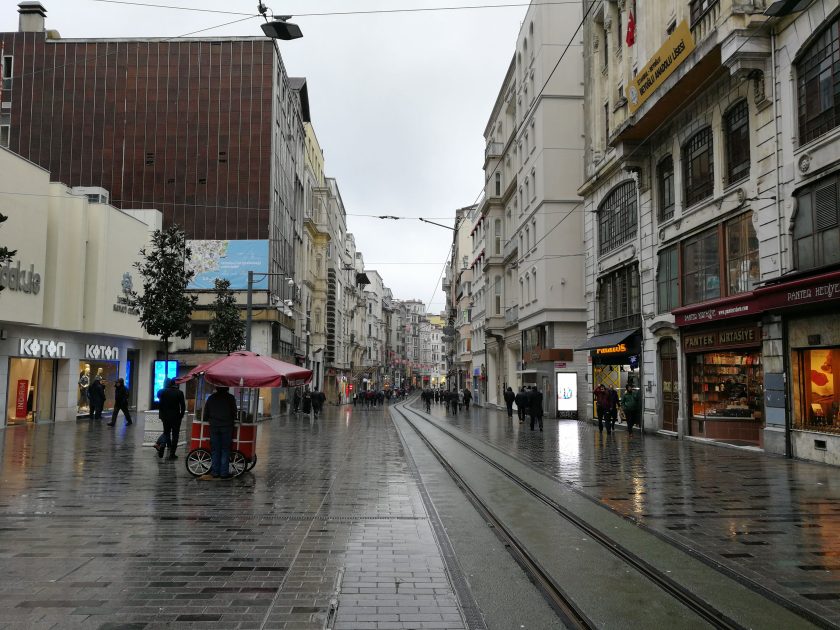
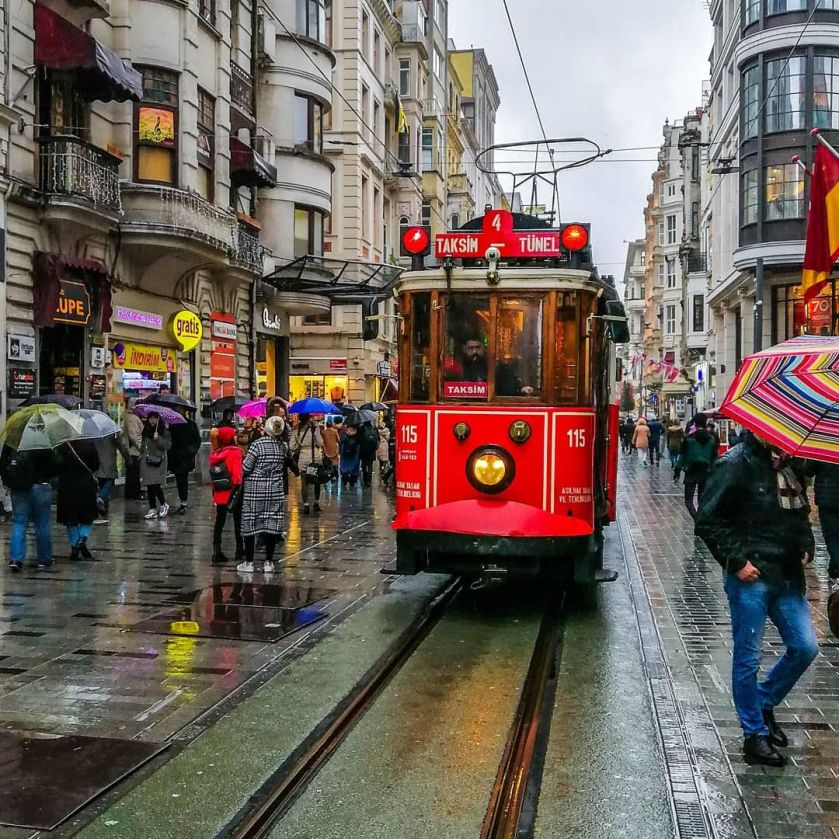
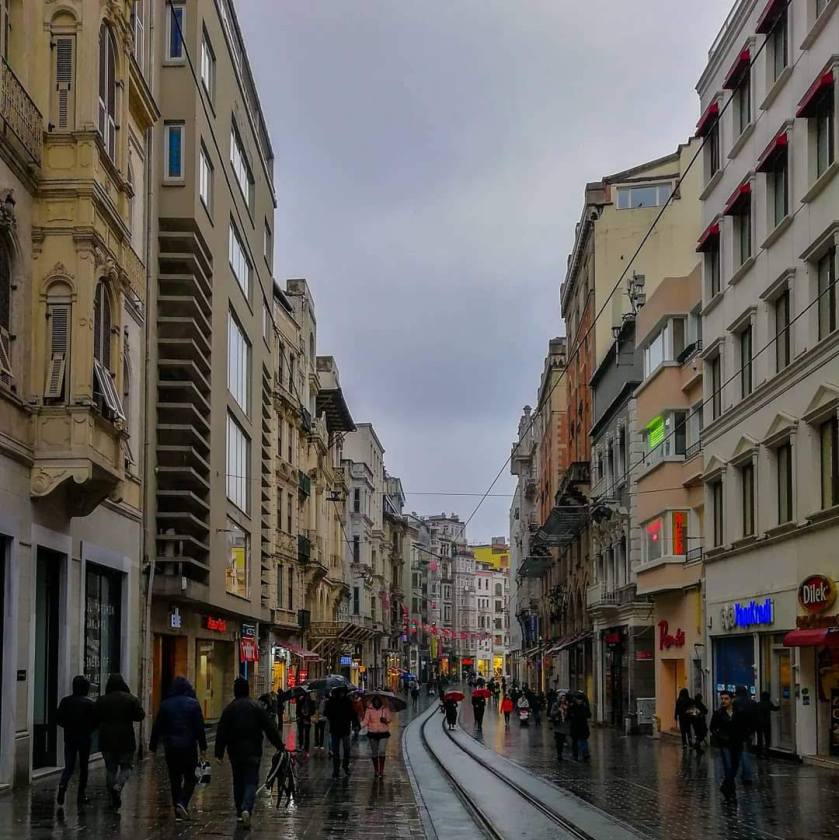
Today, on the day of our departure, we enjoyed a very pleasant walk along the rainy Istiklal Caddesi after breakfast.

sdr

cof

IMG_20190208_123906_079

IMG_20190208_123906_076

We decided to have lunch at the airport, and we headed there rather early – as it turned out, it was a good idea. The queues at the Istanbul airport begin not at the check-in counter, but from the entrance, where a full security check is taking place. Actually, the measure is quite understandable, remembering the terrorist attack at this airport three years ago.

Interestingly, everywhere around the airport we could spot bald men, with bruises on their seemingly burned heads. We’d come across such men previously as well, in the city. We wondered what that could be – some kind of sect? Later it turned out that everything was much more trivial and that Istanbul is a Mecca of hair transplantation, with lots of clinics and prices more affordable than in other countries.

Posted in Asia, Chiang Mai, English, Phuket, Thailand

Thailand – Day 7

РУССКОЯЗЫЧНАЯ ВЕРСИЯ ПО ЭТОЙ ССЫЛКЕ. CLICK HERE FOR RUSSIAN VERSION.

24 March 2018

This post is also supposed to turn out short, as well as devoid of any particular enthusiasm. But anyway, the morning started pretty well. We got up, had a slow breakfast at the poolside (by the way, the breakfast in Chiang Mai is leading so far, compared to breakfasts in other cities: there’s more variety, the food is tastier and the place looks more pleasant overall), and went for a walk to the Old Town on our own.

IMG_20180323_163025_290

Basically, just as during our evening walk with the guide, we didn’t discover anything particularly remarkable in the Old Town. Well, there is a medieval city wall, but I’ve seen better walls. Otherwise, there are lots and lots of temples at literally every step – I think, Chiang Mai has around 300 of them, in fact, that is what it’s famous for.

IMG_3662

IMG_3665

IMG_3666

IMG_3687

IMG_3683

On the way we noticed an interesting procession. First we saw school-aged boys in identical white clothes. They were followed by girls, in the same type of clothes, only with skirts. Then we saw young monks of the same age in monastic robes of the same white colour. There were also occasional adults, dressed normally, but all carrying beautifully folded orange cloth in their hands – it looked as if they were carrying robes for monks as a gift. Some schoolchildren were carrying some flags or portraits of the king and members of the royal family. Unfortunately, we weren’t able to figure out what kind of event that was and where they were all heading.

IMG_3670

IMG_3672

IMG_3673

IMG_3676

We didn’t get to do a long walk, as it became very hot, so we returned to the hotel, packed and came downstairs to the lobby to wait for our driver for our airport transfer. Kudos to the driver, he arrived exactly on time – it’s not for nothing that we liked him (moreover, in the driver-guide tandem, he was definitely our favourite).

The flight to Phuket itself was on time and went fine. But at the airport there was a surprise waiting for us – or rather, there wasn’t anyone waiting for us at all. Based on our experience working with this travel agency, this came completely unexpected, as neither in Vietnam, nor in Thailand so far had we faced such issues. We tried calling the agency, but no one responded – it was Saturday, after all. To our great luck, though, we had a business card from Vanna, our Bangkok guide. We called her, she followed up, and it turned out that there was someone waiting for us after all, but he didn’t have our names written on the paper, or maybe forgot about us completely. By the way, he wasn’t a personal guide, but merely a representative of the transfer company, and, having made us wait for some more time, finally organised a car with a driver for us. In total, we had to wait for at least 45 minutes. Honestly, it wasn’t the most pleasant experience, because while our Vietnam trip had left us with the impression that we were much better off taking a tour than if we’d organised the trip ourselves, in a situation like this we definitely felt that it would have been way easier for us to just get a taxi and not spend ages waiting.
As for tomorrow’s cooking class, no one left us any instructions either. Once again, many thanks to Vanna, who came to our rescue and found out everything: who would pick us up and when.
As a result, we arrived at the hotel already in the dark, and didn’t get to see much. The beach is right across our hotel, and there seem to be many different restaurants around. We wend to one of them straight away to have seafood and really enjoyed sitting on the terrace overlooking the sea (in the dark). The prices in Phuket are significantly higher than elsewhere and apparently, the restaurant itself wasn’t cheap as well. By the way, alcohol is relatively expensive throughout Thailand. A glass of wine or a cocktail here will cost the same as a main dish, if not more.